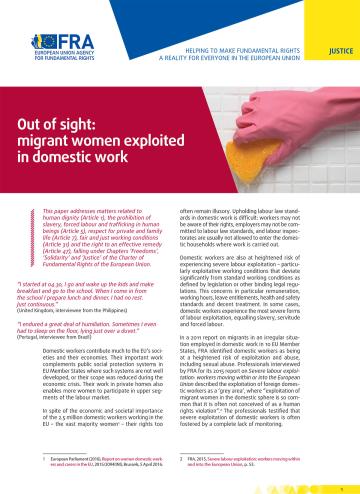
The stories of the domestic workers FRA interviewed for this paper reveal appalling working conditions and fundamental rights abuses in private homes across the EU. These stories indicate that, seven years on from FRA’s first report on domestic workers in 2011, little has changed in terms of the risks and experiences of severe labour exploitation domestic workers in the EU face.
The Consolidated Annual Activity Report (CAAR) 2017
provides an overview of the activities and achievements
of the European Union Agency for Fundamental
Rights (FRA) in that year. It follows the guidelines of
the European Union (EU) Agencies Network.
Le rapport d’activité annuel consolidé 2017 fournit une
vue d’ensemble des activités et des réalisations de
l’Agence des droits fondamentaux de l’Union européenne
(FRA) au cours de cette année. Il respecte les
lignes directrices du réseau des agences de l’Union
européenne (UE).
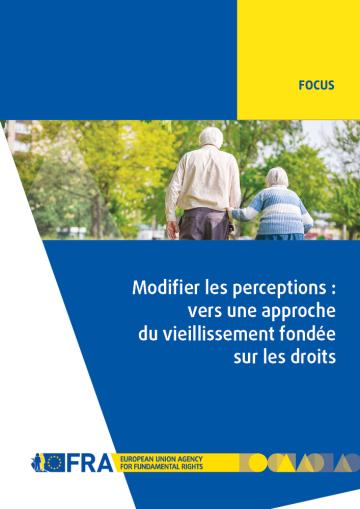
European societies are not getting any younger! It is a simple truth we must face both about ourselves and Europe as a whole. In two generations, by 2080, those aged 65 or above will account for almost 30% of the European Union’s population.
L’année 2017 a été marquée à la fois par des avancées et des régressions en matière de protection des droits fondamentaux. Le rapport sur les droits fondamentaux 2018 de la FRA examine les principales évolutions intervenues dans l’Union entre janvier et décembre 2017 et présente les avis de la FRA à cet égard.
The year 2017 brought both progress and setbacks in terms of rights protection. The European Pillar of Social Rights marked an important move towards a more ‘social Europe’. But, as experiences with the EU Charter of Fundamental Rights underscore, agreement on a text is merely a first step. Even in its eighth year as the EU's binding bill of rights, the Charter's potential was not fully exploited, highlighting the need to more actively promote its use.
Das Jahr 2017 brachte in Bezug auf den Schutz der Grundrechte sowohl Fortschritte als auch
Rückschritte. Der Grundrechte-Bericht 2018 der FRA bietet eine Zusammenfassung und Analyse
der wichtigsten einschlägigen Entwicklungen in der EU zwischen Januar und Dezember
2017 und präsentiert die diesbezüglichen Stellungnahmen der FRA.
The year 2017 brought both progress and setbacks in terms of fundamental rights protection. FRA’s Fundamental Rights Report 2018 reviews major developments in the field, identifying both achievements and remaining areas of concern.
Les sociétés européennes ne rajeunissent pas. Ceci est un fait auquel l’Europe entière doit faire face, sachant que d’ici 2080, soit deux générations, la proportion de personnes âgéesde 65 ans ou plus représentera près de 30 % de la population de l’Union européenne.
We live in a world of big data, where technological developments in the area of machine learning and artificial intelligence have changed the way we live. Decisions and processes concerning everyday life are increasingly automated, based on data. This affects fundamental rights in various ways. This focus paper specifically deals with discrimination, a fundamental rights area particularly affected by technological developments.
EU Member States, and the EU itself have ratified
the CRPD, committing themselves to achieving independent
living for persons with disabilities. Doing so
requires a meaningful and sustainable shift from institutional
to community-based living arrangements. This
publication summarises the findings from the three
FRA reports focusing on different aspects of deinstitutionalisation.
In view of the increasing numbers of refugees, asylum seekers and migrants entering the EU, the EU Agency for Fundamental Rights has been collecting relevant data since September 2015. This report focuses on the fundamental rights situation of people arriving in Member States particularly affected by large migration movements. This report addresses fundamental rights concerns between 1 March-30 April 2018.
The rapid development of information technology has exacerbated the need for robust personal data protection, the right to which is safeguarded by both European Union (EU) and Council of Europe (CoE) instruments. Safeguarding this important right entails new and significant challenges as technological advances expand the frontiers of areas such as surveillance, communication interception and data storage. This handbook is designed to familiarise legal practitioners not specialised in data protection with this emerging area of the law.
Civil society organisations in the European Union play a crucial role in promoting fundamental
rights, but it has become harder for them do so – due to both legal and practical restrictions.
This summary outlines the main
findings and FRA’s opinions on the different
types and patterns of challenges faced by civil society
organisations across the EU,
Au sein de l’Union européenne, les OSC jouent un rôle crucial dans la promotion des droits
fondamentaux, mais il leur est désormais plus difficile d’assumer ce rôle en raison de restrictions
d’ordre à la fois juridique et pratique.
Le rapport de la l’Agence des droits fondamentaux de l’Union européenne (FRA) se penche
par conséquent sur les différents types de difficultés rencontrées par les OSC actives dans
le domaine des droits de l’homme au sein de l’Union européenne.
Angesichts der wachsenden Bedrohungen durch Terrorismus, Cyber-Angriffe und ausgefeilte grenzüberschreitende kriminelle Netze ist die Arbeit der Nachrichtendienste dringlicher, vielschichtiger und internationaler geworden. Diese Arbeit kann einen starken Eingriff in die Grundrechte darstellen, und hierbei insbesondere in die Achtung der Privatsphäre und den Datenschutz. Obgleich der stetige technologische Fortschritt die Bedrohung eines solchen Eingriffs potentiell verschlimmert, kann das Missbrauchspotential durch wirksame Aufsicht und Rechtsbehelfe eingedämmt werden.
With terrorism, cyber-attacks and sophisticated cross-border criminal networks posing growing threats, the work of intelligence services has become more urgent, complex and international. Such work can strongly interfere with fundamental rights, especially privacy and data protection. While continuous technological advances potentially exacerbate the threat of such interference, effective oversight and remedies can curb the potential for abuse.
La persistance de la menace terroriste à un niveau élevé, la constitution de
réseaux criminels transnationaux sur le territoire de l’Union européenne, mais
également les conséquences des ingérences d’origine étatique de nature diverse
et le durcissement des modes opératoires hostiles dans l’espace cyber représentent
des enjeux de sécurité nationale d’importance majeure pour les États
membres ; la prévention de ces menaces peut reposer sur la mise en oeuvre,
par des services de renseignement, de mesures de surveillance attentatoires
aux libertés. Parallèlement, le développement continu des progrès techniques
accroit les capacités d’ingérences dans la vie privée des personnes.