This report looks into the fundamental rights situation of asylum applicants and beneficiaries of international protection in the EU throughout 2018. It pulls together the main issues identified in FRA’s regular updates on fundamental rights related to asylum, migration and borders in selected EU Member States, which the agency has been publishing since September 2015.
In November 2016, FRA formulated 21 individual opinions to address the fundamental rights shortcomings identified in the implementation of the hotspot approach in Greece and Italy. Despite genuine efforts to improve the situation since November 2016, many of the suggestions contained in the 21 opinions FRA formulated at the time remain valid.
The EU Agency for Fundamental Rights has been regularly collecting data on migration since
September 2015. This report focuses on the fundamental rights situation of people arriving in
Member States and EU candidate countries particularly affected by large migration movements.
This Opinion by the European Union Agency for Fundamental Rights (FRA) aims to inform
the European Parliament’s position on the legislative proposal on the European Border and
Coast Guard (EBCG) presented by the European Commission on 12 September 2018.
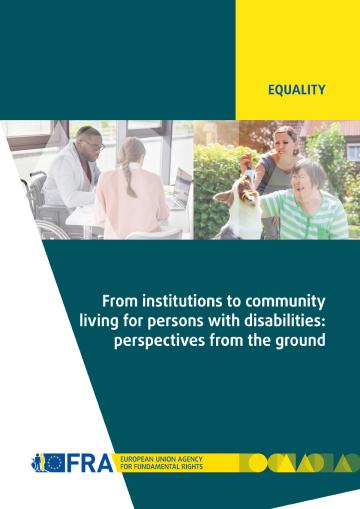
The Convention on the Rights of Persons with Disabilities commits both the EU and all of its Member States to realising the right of persons with disabilities to live independently in the community – which includes achieving deinstitutionalisation for those residing in institutional settings. But much remains to be done to make this a reality in practice. This report presents the main insights gained during fieldwork on the drivers of and barriers to deinstitutionalisation. Focusing on the local level, it gives voice to a diverse set of actors – most importantly, to people with disabilities themselves.
The EU Agency for Fundamental Rights has been collecting relevant data since September 2015, in light of the increasing numbers of refugees, asylum seekers and migrants entering the EU. This report focuses on the fundamental rights situation of people arriving in Member States particularly affected by large migration movements. The countries covered are: Austria, Bulgaria, Croatia, Denmark, Finland, France, Germany, Greece, Hungary, Italy, the Netherlands, Poland, Spain and Sweden.
This report presents the main insights gained during the EU Fundamental Rights Agency’s project on local engagement for Roma inclusion, which explores how to best involve Roma in integration efforts at the local level. Bringing together local authorities and residents, especially Roma, it investigated what aspects work, which ones do not, and why this is the case.
This set of variables maps the various patterns concerning age requirements for children to acquire rights across the EU. This data is correct up to 20 November 2017. No updates to reflect new or amended legislation have been made since this date.
Almost 25 million children under 18 are at risk of poverty or social exclusion in the EU. Poverty deprives children of educational
opportunities, childcare, access to health care, adequate food and housing, family support and even protection from violence.
This report outlines data and survey findings that highlight the magnitude of child poverty in the EU, but also presents tools
available to counter this phenomenon and keep track of progress made.
With this Opinion, FRA aims to contribute to the European Parliament's own-initiative report on the “Implementation of the Charter of Fundamental Rights of the European Union in the EU institutional framework”, being prepared in the Parliament’s Committee for Constitutional Affairs (AFCO). The request aims at understanding the interaction between the Charter’s implementation at national and EU level, and whether there are “instruments, mechanisms and practices” available at EU level to assist Member States to better implement the Charter.
The EU Agency for Fundamental Rights has been collecting relevant data since September 2015, in light of the increasing numbers of refugees, asylum seekers and migrants entering the EU. This report focuses on the fundamental rights situation of people arriving in Member States particularly affected by large migration movements. The countries covered are: Austria, Bulgaria, Croatia, Denmark, Finland, France, Germany, Greece, Hungary, Italy, the Netherlands, Poland, Spain and Sweden.
The EU Agency for Fundamental Rights has been collecting relevant data since September 2015, in light of the increasing numbers of refugees, asylum seekers and migrants entering the EU. This report focuses on the fundamental rights situation of people arriving in Member States particularly affected by large migration movements. The countries covered are: Austria, Bulgaria, Croatia, Denmark, Finland, France, Germany, Greece, Hungary, Italy, the Netherlands, Poland, Spain and Sweden.
Across the European Union, Member States are faced with the challenge of integrating Europe’s most deprived
and disenfranchised minority groups. As a follow up to the EU-MIDIS II findings on Roma, this report presents
FRA’s findings relating to the issues of education and employment. Encouraging Roma participation in education
and employment equips communities with higher incomes, better life opportunities and greater social inclusion.
European societies are not getting any younger! It is a simple truth we must face both about ourselves and Europe as a whole. In two generations, by 2080, those aged 65 or above will account for almost 30% of the European Union’s population.
The year 2017 brought both progress and setbacks in terms of rights protection. The European Pillar of Social Rights marked an important move towards a more ‘social Europe’. But, as experiences with the EU Charter of Fundamental Rights underscore, agreement on a text is merely a first step. Even in its eighth year as the EU's binding bill of rights, the Charter's potential was not fully exploited, highlighting the need to more actively promote its use.
In view of the increasing numbers of refugees, asylum seekers and migrants entering the EU, the EU Agency for Fundamental Rights has been collecting relevant data since September 2015. This report focuses on the fundamental rights situation of people arriving in Member States particularly affected by large migration movements. This report addresses fundamental rights concerns between 1 March-30 April 2018.
Straujā informācijas tehnoloģiju attīstība ir saasinājusi nepieciešamību pēc stabila personas datu aizsardzības
regulējuma, tiesībām, kuras aizsargā gan Eiropas Savienības (ES), gan Eiropas Padomes (EP) instrumenti.
Šo svarīgo tiesību aizsardzība rada jaunas un būtiskas problēmas, jo tehnoloģiju attīstība paplašina tādu
jomu robežas kā novērošana, sakaru pārtveršana un datu glabāšana. Šī rokasgrāmata ir paredzēta, lai
iepazīstinātu ar šo jauno tiesību jomu praktizējošus juristus, kuri nespecializējas datu aizsardzībā.
A rápida evolução das tecnologias da informação exacerbou a necessidade de uma proteção sólida dos dados pessoais, cujo direito é garantido por instrumentos da União Europeia (UE) e do Conselho da Europa (CdE). A salvaguarda deste importante direito implica importantes novos desafios porque os avanços tecnológicos expandem as fronteiras de áreas como a vigilância, a interceção das comunicações e o armazenamento dos dados. O presente manual destina-se a familiarizar os profissionais do Direito que não são especializados em proteção de dados com esta área emergente do Direito.
The methods used to determine the age of
an applicant may include “invasive” medical tests which interfere with the rights of the child, including their right to dignity,
integrity and privacy. It is often a challenge to find the right balance between protecting children from harm and promoting
their participation in these procedures. This report provides important insights and identifies the implications of collecting
children’s biometric data and conducting age assessments.