Data

Datenschutz

Highlights

  • Report / Paper / Summary
    11
    Juni
    2024
    Data protection rules protect privacy and prevent personal information from misuse. When the general data protection regulation (GDPR) came into force in 2018, it strengthened the role of data protection authorities. These supervisory bodies are the key enforcers of the fundamental right of protection of personal data. This report analyses the challenges they face in the GDPR implementation. The findings complement the European Commission's forthcoming evaluation of the GDPR.
  • Report / Paper / Summary
    24
    Mai
    2023
    This report provides a partial update on the findings of the 2017 European Union Agency for Fundamental Rights (FRA) report Surveillance by intelligence services: Fundamental rights safeguards and remedies in the EU. It was prepared at the request of the European Parliament, which asked FRA to update its 2017 findings to support the work of its committee of inquiry to investigate the use of Pegasus and equivalent surveillance spyware (PEGA).
  • Report / Paper / Summary
    18
    Juni
    2020
    This document presents data from the FRA Fundamental Rights Survey. It includes data on opinions and experiences of people in the European Union (EU) linked to data protection and technology.
  • Report / Paper / Summary
    12
    Juni
    2019
    The General Data Protection Regulation (GDPR) has applied across the European Union (EU) since 25 May 2018. One year on, this paper looks at how the new regulation has affected the daily work of civil society organisations (CSOs).
    Produkte
    29
    Mai
    2026
    Online fraud represents a major criminal threat, affecting a growing number of people across the EU. This report presents findings from an EU-wide Eurobarometer survey of 26 453 respondents, focusing on responses to survey questions developed by FRA. It explores the prevalence of online fraud, who is most at risk, and which schemes people are most likely to fall victim to. It also looks at the reporting rate to the police and contact with other services, and at the impact on victims.

    11
    Mai
    2026
    The ability to communicate freely and privately online is protected under Article 7 of the EU Charter; it is a crucial enabler of other fundamental rights, particularly as the world becomes increasingly digital. This paper presents results from an EU-wide survey about people’s views on encryption of their private online communication. It looks, for example, at concern regarding access by outside actors to information shared when using private messaging applications. The results indicate that people highly value encryption and at the same time have concerns about online communications being accessed without their knowledge or permission. It provides a timely evidence base to shape policy discussions on internal security and digital privacy.
    27
    März
    2026
    This publication presents findings from an EU-wide survey on public attitudes to children’s use of social media. It presents people’s key concerns and their views on the minimum age limits for accessing social media platforms. The survey draws on the views of both teenagers and adults – those most directly affected. The findings offer a useful evidence base for policy discussions on social media age restrictions in the EU.
    2
    April
    2025
    This factsheet examines mass surveillance and its impact on human rights within the context of EU law and the European Convention on Human Rights. EU law and the Convention sometimes overlap. The publication clarifies where there are similar principles in different legislation and provides examples of relevant case law.
    11
    Juni
    2024
    Data protection rules protect privacy and prevent personal information from misuse. When the general data protection regulation (GDPR) came into force in 2018, it strengthened the role of data protection authorities. These supervisory bodies are the key enforcers of the fundamental right of protection of personal data. This report analyses the challenges they face in the GDPR implementation. The findings complement the European Commission's forthcoming evaluation of the GDPR.
    24
    Mai
    2023
    This report provides a partial update on the findings of the 2017 European Union Agency for Fundamental Rights (FRA) report Surveillance by intelligence services: Fundamental rights safeguards and remedies in the EU. It was prepared at the request of the European Parliament, which asked FRA to update its 2017 findings to support the work of its committee of inquiry to investigate the use of Pegasus and equivalent surveillance spyware (PEGA).
    18
    Juni
    2020
    This document presents data from the FRA Fundamental Rights Survey. It includes data on opinions and experiences of people in the European Union (EU) linked to data protection and technology.
    In this vlog Michael O'Flaherty outlines fundamental rights considerations when developing technological responses to public health, as he introduces the focus of FRA's next COVID-19 bulletin.
    16
    Januar
    2020
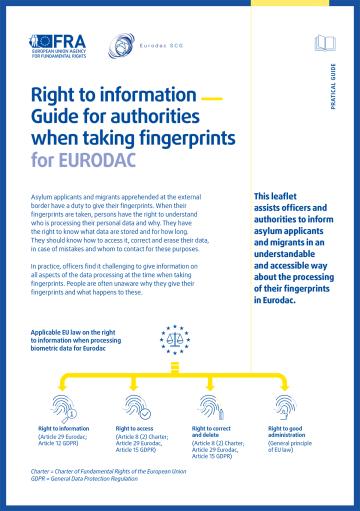
    Dieses Merkblatt unterstützt Beamte und Behörden bei der verständlichen und anschaulichen Information von Asylbewerbern und Migranten über die Verarbeitung ihrer Fingerabdrücke in Eurodac.
    12
    Juni
    2019
    The General Data Protection Regulation (GDPR) has applied across the European Union (EU) since 25 May 2018. One year on, this paper looks at how the new regulation has affected the daily work of civil society organisations (CSOs).
    5
    Dezember
    2018
    In diesem Handbuch wird erläutert, was Profiling ist, welcher Rechtsrahmen ihm zugrunde liegt und weshalb Profiling von rechtlicher Seite nicht nur die Grundrechte wahren muss, sondern auch von entscheidender Bedeutung für eine wirksame Polizeiarbeit und ein wirksames Grenzmanagement ist. Das Handbuch enthält außerdem praktische Anweisungen zur Vermeidung von unrechtmäßigem Profiling bei Einsätzen von Polizei und Grenzmanagement.
    25
    Mai
    2018
    Die rasante Entwicklung der Informationstechnologie hat den Bedarf nach einem stabilen
    Schutz personenbezogener Daten verschärft, das Recht darauf wird sowohl durch Instrumente
    der Europäischen Union (EU) als auch des Europarates geschützt. Der Schutz dieses wichtigen
    Rechts steht vor neuen und großen Herausforderungen, da technologische Fortschritte die
    Möglichkeiten beispielsweise bei der Überwachung, beim Abfangen von Kommunikation und
    bei der Datenspeicherung erweitern. Dieses Handbuch bietet für Angehörige der Rechtsberufe,
    die sich im Bereich des Datenschutzes nicht so gut auskennen, eine Einführung in diesen
    aufstrebenden Rechtsbereich.
    9
    Mai
    2018
    Angesichts der wachsenden Bedrohungen durch Terrorismus, Cyber-Angriffe und ausgefeilte grenzüberschreitende kriminelle Netze ist die Arbeit der Nachrichtendienste dringlicher, vielschichtiger und internationaler geworden. Diese Arbeit kann einen starken Eingriff in die Grundrechte darstellen, und hierbei insbesondere in die Achtung der Privatsphäre und den Datenschutz. Obgleich der stetige technologische Fortschritt die Bedrohung eines solchen Eingriffs potentiell verschlimmert, kann das Missbrauchspotential durch wirksame Aufsicht und Rechtsbehelfe eingedämmt werden.
    This video blog by FRA Director Michael O'Flaherty is released periodically and will address burning fundamental rights themes.
    This is the recording of the online press briefing about mass surveillance as presented by the EU Agency for Fundamental Rights (FRA) on 16 October 2017.
    23
    Oktober
    2017
    This report is FRA’s second publication addressing a European Parliament request for in-depth research on the impact of surveillance on fundamental rights. It updates FRA’s 2015 legal analysis on the topic, and supplements that analysis with field-based insights gained from extensive interviews with diverse experts in intelligence and related fields, including its oversight.
    13
    Juli
    2017
    In 2006 the EU issued its Data Retention Directive. According to the Directive, EU Member States had to store electronic telecommunications data for at least six months and at most 24 months for investigating, detecting and prosecuting serious crime. In 2016, with an EU legal framework on data retention still lacking, the CJEU further clarified what safeguards are required for data retention to be lawful.This paper looks at amendments to national data retention laws in 2016 after the Digital Rights Ireland judgment.
    18
    November
    2015
    This report, drafted in response to the European Parliament’s call for thorough research on fundamental rights protection in the context of surveillance, maps and analyses the legal frameworks on surveillance in place in EU Member States.
    26
    Januar
    2015
    FRA was requested by the European Commission (EC) in January 2014 to provide practical guidance on the processing of Passenger Name Record (PNR) data for law enforcement purposes, in light of efforts by Member States to establish national PNR systems. As a result, in informal consultation with EC services and the European Data Protection Supervisor (EDPS) and building on opinions FRA, the EDPS and the Article 29 Working Party on PNR, FRA presented twelve fundamental rights considerations to EU Member States experts at technical level.
    27
    Januar
    2014
    Diese Zusammenfassung stellt die wichtigsten Schlussfolgerungen des FRA‑Projekts zu Rechtsbehelfen in Fällen von Datenschutzverletzungen vor.