eu-charter

Charta der Grundrechte der Europäischen Union

Artikel 29 - Recht auf Zugang zu einem Arbeitsvermittlungsdienst

Artikel 29 - Recht auf Zugang zu einem Arbeitsvermittlungsdienst

Jeder Mensch hat das Recht auf Zugang zu einem unentgeltlichen Arbeitsvermittlungsdienst.

Erläuterungen

  • Text:

    Dieser Artikel stützt sich auf Artikel 1 Absatz 3 der Europäischen Sozialcharta sowie auf Nummer 13 der Gemeinschaftscharta der sozialen Grundrechte der Arbeitnehmer.

    Quelle:
    Amtsblatt der Europäischen Union C 303/17 - 14.12.2007
    Preamble - Explanations relating to the Charter of Fundamental Rights:
    Die Erläuterungen wurden ursprünglich unter der Verantwortung des Präsidiums des Konvents, der die Charta der Grundrechte der Europäischen Union ausgearbeitet hat, formuliert. Sie wurden unter der Verantwortung des Präsidiums des Europäischen Konvents aufgrund der von diesem Konvent vorgenommenen Anpassungen des Wortlauts der Charta (insbesondere der Artikel 51 und 52) und der Fortentwicklung des Unionsrechts aktualisiert. Diese Erläuterungen haben als solche keinen rechtlichen Status, stellen jedoch eine nützliche Interpretationshilfe dar, die dazu dient, die Bestimmungen der Charta zu verdeutlichen.

Rechtsprechung

0 results found

Nationales Verfassungsrecht

14 results found

  • Act No. 5/2004 Coll. on employment services and on amendment of certain acts published in Chapter 4/2004
    Land:
    Slovakia

    § 1 - Scope of the ActThis Act regulates the legal relationships in the provision of employment services.

  • Code du Travail
    Land:
    Luxembourg

    (dans sa teneur modifiée au 11 novembre 2009) Section 2 - Main-d’oeuvre et placement

  • Constitution of Finland
    Land:
    Finland

    Section 18 The right to work and the freedom to engage in commercial activity (...) The public authorities shall promote employment and work towards guaranteeing for everyone the right to work. Provisions on the right to receive training that promotes employability are laid down by an Act. (...)

  • Constitution of Malta
    Land:
    Malta

    Article 12(1) The State shall protect work.(2) It shall provide for the professional or vocational training and advancement of workers.Article 17 (3) Disabled persons and persons incapable of work are entitled to education and vocational training.

  • Constitution of the Republic of Croatia
    Land:
    Croatia
  • Constitution of the Republic of Estonia
    Land:
    Estonia

    Article 29. (…) The national government organises vocational training and assists persons who seek employment in finding work. (…)

  • Constitution of the Republic of Poland
    Land:
    Poland

    Article 65(...) 5. Public authorities shall pursue policies aiming at full, productive employment by implementing programmes to combat unemployment, including the organization of and support for occupational advice and training, as well as public works and economic intervention. 

  • Constitution of the Republic of Poland
    Land:
    Poland

    Article 65(...) 5. Public authorities shall pursue policies aiming at full, productive employment by implementing programmes to combat unemployment, including the organization of and support for occupational advice and training, as well as public works and economic intervention. 

  • Eesti Vabariigi Põhiseadus
    Land:
    Estonia

    § 29. (...) Riik korraldab kutseõpet ja abistab tööotsijaid töö leidmisel. (...)

  • Konstytucja Rzeczypospolitej Polskiej
    Land:
    Poland

    Art. 65(..) 5. Władze publiczne prowadzą politykę zmierzającą do pełnego, produktywnego zatrudnienia poprzez realizowanie programów zwalczania bezrobocia, w tym organizowanie i wspieranie poradnictwa i szkolenia zawodowego oraz robót publicznych i prac interwencyjnych.

  • Labour Code
    Land:
    Bulgaria
  • Luxemburg / Verfassung des Großherzogtums Luxemburg
    Land:
    Luxemburg

    Art. 38 Der Staat garantiert das Recht auf Arbeit und sorgt dafür, dass die Ausübung dieses Rechts sichergestellt ist.

  • Portugal / Constitution of the Portuguese Republic
    Land:
    Portugal

    Article 58 (Right to work) (1) Everyone has the right to work. (2) In order to ensure the right to work, the state shall be charged with promoting: (c) Cultural and technical training and vocational development for workers.

    Article 59 (Workers’ rights) (1) Regardless of age, sex, race, citizenship, place of origin, religion and political and ideological convictions, every worker has the right: (e) To material assistance when he involuntarily finds himself in a situation of unemployment.
    ...
    Article 70 (Youth) (1) In order to ensure the effective enjoyment of their economic, social and cultural rights, young people shall receive special protection, particularly: (a) In education, vocational training and culture.

  • Suomen perustuslaki
    Land:
    Finland

    18 § Oikeus työhön ja elinkeinovapaus (...) Julkisen vallan on edistettävä työllisyyttä ja pyrittävä turvaamaan jokaiselle oikeus työhön. Oikeudesta työllistävään koulutukseen säädetään lailla. (...)

EU-Recht

3 results found

  • Community Charter of the Fundamental Social Rights of Workers (not in force)

    13. The right to resort to collective action in the event of a conflict of interests shall include the right to strike, subject to the obligations arising under national regulations arid collective agreements.
    In order to facilitate the settlement of industrial disputes the establishment and utilization at the appropriate levels of conciliation, mediation and arbitration procedures sliould be encouraged in accordance with national practice.

  • Council Decision 2010/707/EU of 21 October 2010 on guidelines for the employment policies of the Member States

    The Decision affirmed that ‘Employment services play an important role in activation and matching and they should therefore be strengthened with personalised services and active and preventive labour market measures at an early stage. Such services and measures should be open to all, including young people, those threatened by unemployment, and those furthest away from the labour market.’ (Guideline 7)  

  • Regulation (EU) 2016/589 of the European Parliament and of the Council of 13 April 2016 on a European network of employment services (EURES), workers' access to mobility services and the further integration of labour markets, and amending Regulations (...

    Article 3 - Definitions
    ‘For the purpose of this Regulation, the following definitions apply:
    (1) ‘public employment services’ or ‘PES’ means the organisations of the Member States, as part of relevant ministries, public bodies or corporations falling under public law, that are responsible for implementing active labour market policies and providing quality employment services in the public interest;
    (2) ‘employment services’ means a legal entity lawfully operating in a Member State which provides services for workers seeking employment and for employers wishing to recruit workers;
    (3) ‘job vacancy’ means an offer of employment which would allow the successful applicant to enter into an employment relationship that would qualify that applicant as a worker for the purposes of Article 45 TFEU;
    (4) ‘clearance’ means the exchange of information and processing of job vacancies, job applications and CVs;
    (5) ‘common IT platform’ means the IT infrastructure and related platforms set up at Union level for the purpose of transparency and clearance in accordance with this Regulation;
    (6) ‘frontier worker’ means a worker pursuing an activity as an employed person in a Member State and who resides in another Member State to which that worker returns as a rule daily or at least once a week;
    (7) ‘EURES cross-border partnership’ means a grouping of EURES Members or Partners and, where relevant, other stakeholders outside of the EURES network, with the intention of long-term cooperation in regional structures, set up in cross-border regions between: the employment services on regional, local and, where appropriate, national level; the social partners; and, where relevant, other stakeholders of at least two Member States or a Member State and another country participating in the Union instruments aiming to support the EURES network.‘
    Article 4 - Accessibility
    ‘1. Services under this Regulation shall be available to all workers and employers across the Union and shall respect the principle of equal treatment.
    2. Accessibility for persons with disabilities to the information provided on the EURES portal and to support services available at national level shall be ensured. The Commission and the EURES Members and Partners shall determine the means to ensure this with regard to their respective obligations.‘

Internationales Recht

0 results found

Produkte

  • Handbook / Guide / Manual
    23
    Oktober
    2018
    Italian and Romanian version now available
    03 April 2020
    As a very modern human rights catalogue containing many rights not found in established bills of rights, the Charter indeed looks good on paper. Those familiar with the
    main principles of EU law can usually quickly recite that the Charter is always binding
    on the EU, and binding on Member States only when they are “implementing EU law”.
    But what does this often-quoted language from Article 51 of the Charter actually mean?
  • Report / Paper / Summary
    25
    Oktober
    2022
    02 November 2022
    This report presents findings from FRA’s 2021 survey on Roma in Croatia, Czechia, Greece, Hungary, Italy, Portugal, Romania and Spain, as well as in North Macedonia and Serbia. The survey includes interviews with more than 8,400 Roma, collecting information on more than 20,000 individuals living in their households. By focusing on Roma, the survey provides unique data and information that are not available from European general population surveys, which do not disaggregate on grounds of ethnic origin. The findings present a bleak but familiar picture of exclusion, deprivation, discrimination and racism.
  • Report / Paper / Summary
    24
    Februar
    2026
    The start of Russia’s war of aggression against Ukraine on 24 February 2022 shocked the global community and gave rise to a
    series of urgent fundamental rights challenges across Europe. While much attention has focused on the scale of devastation and its wider impact on all Ukrainians, the war has also inflicted profound personal harm. This report sheds light on the violence, sexual harassment and exploitation experienced by women displaced from Ukraine. Drawing on a survey and in-depth interviews with women from Ukraine, the report documents the prevalence, forms and patterns of gender-based violence and sets out practical measures to improve safety, access to justice and support.
  • Report / Paper / Summary
    4
    Dezember
    2025
    Artificial Intelligence comes with both benefits and risks. Safe AI use that accounts for fundamental rights is thus crucial. While the 2024 EU AI Act was a milestone in this regard, its broad definitions regarding AI systems and high-risk AI could introduce loopholes for fundamental rights compliance. This report offers an empirical basis for much-needed practical guidance on the Act’s implementation. Based on interviews with AI developers, sellers, and users, FRA addresses challenges of its use in critical domains, like asylum, education, and employment. Our findings help guide next steps in realising the AI Act’s potential to ensure responsible innovation.
  • Report / Paper / Summary
    2
    Oktober
    2025
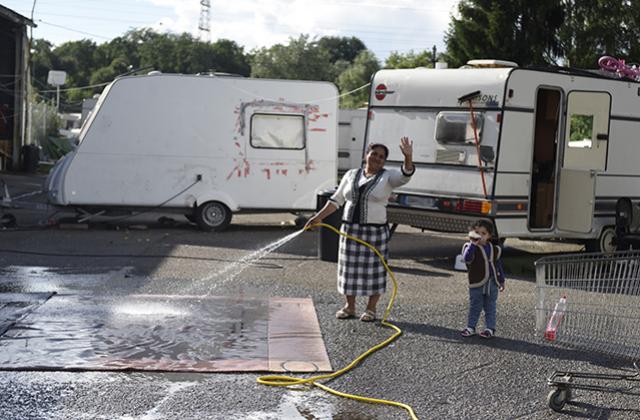
    This report examines the fundamental rights and living conditions of Roma and Travellers across 10 EU Member States and
    3 accession countries. The survey evaluates progress towards the EU Roma strategic framework’s 2030 objectives, covering areas such as discrimination, poverty, education, employment, health, and housing.
  • Report / Paper / Summary
    23
    September
    2020
    This report presents findings from FRA’s 2019 survey on Roma and Travellers in Belgium, France, Ireland, the Netherlands, Sweden and the United Kingdom. The survey included interviews with almost 4,700 Roma and Travellers, collecting information on more than 8,200 individuals living in their households.
  • Country sheets
    22
    März
    2019
    Die Mitgliedstaaten sind ausdrücklich verpflichtet, die Anwendung der Charta zu fördern. Mit diesen Länderblättern werden diese Bemühungen unterstützt. Sie enthalten Beispiele für die Anwendung der Charta und weisen auf den durch die Charta geschaffenen Mehrwert hin.