Children are full-fledged holders of rights. They are beneficiaries of all human and fundamental rights and subjects of special regulations, given their specific characteristics. This handbook aims to illustrate how European law and case law accommodate the specific interests and needs of children. It also considers the importance of parents and guardians or other legal representatives and makes reference, where appropriate, to situations in which rights and responsibilities are most prominently vested in children’s carers. It is a point of reference on both European Union (EU) and Council of Europe (CoE) law related to these subjects, explaining how each issue is regulated under EU law, including the Charter of Fundamental Rights of the European Union, as well as under the European Convention on Human Rights, the European Social Charter and other CoE instruments.
Les enfants sont des titulaires de droits à part entière. Ils sont bénéficiaires de tous les droits fondamentaux et de tous les droits de l’homme, et sont sujets de réglementations particulières compte tenu de leurs caractéristiques spécifiques. Le présent manuel a pour but de montrer comment le droit et la jurisprudence européens s’adaptent aux intérêts et besoins particuliers des enfants. Il illustre également l’importance des parents et des tuteurs ou d’autres représentants légaux et fait référence, le cas échéant, aux principaux droits et responsabilités conférés aux personnes ayant la charge des enfants. Ce manuel entend sensibiliser le lecteur et approfondir ses connaissances des normes juridiques qui protègent et promeuvent les droits de l’enfant en Europe. Il constitue un ouvrage de référence sur le droit de l’Union européenne et du Conseil de l’Europe dans ces domaines. Il explique comment chaque question est réglementée en vertu du droit de l’UE, y compris de la charte des droits fondamentaux de l’Union européenne, ainsi qu’en vertu de la convention européenne des droits de l’homme, de la charte sociale européenne et d’autres instruments du Conseil de l’Europe.
Barn har alldeles egna rättigheter. De är berättigade till alla mänskliga och grundläggande rättigheter och omfattas av ett särskilt regelverk med tanke på deras särskilda egenskaper. Syftet med denna handbok är att visa hur europeisk lagstiftning och rättspraxis tar till vara barns särskilda intressen och behov. Den beskriver också föräldrars, vårdnadshavares eller andra juridiska företrädares betydelse och anger i tillämpliga fall var rättigheter och ansvar i första hand innehas av barnens vårdnadshavare. Den är en första referenspunkt för både unionsrätten och Europarådets regelverk avseende dessa ämnesområden och förklarar hur varje fråga regleras enligt unionsrätten och enligt EU-stadgan om de grundläggande rättigheterna, Europakonventionen, den europeiska sociala stadgan och Europarådets övriga instrument.
The EU Agency for Fundamental Rights has been regularly collecting data on asylum and migration since September 2015. This report focuses on the fundamental rights situation of people arriving in Member States and EU candidate countries particularly affected by migration. It addresses fundamental rights concerns between 1 October and 31 December 2021.
In the internet age, information travels faster and further than ever before. But so does disinformation, feeding off rumours, prejudices and stereotypes. How can we tackle it? Watch FRA’s practical guide on how to go about tackling disinformation using +INPUT – be positive, identify, narrate, pioneer, unite and track.
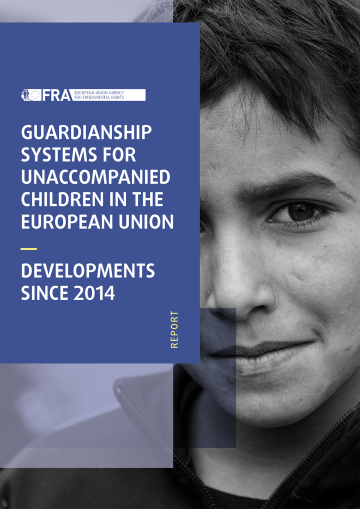
In 2015 and 2016, the numbers of unaccompanied children arriving in Europe increased dramatically, straining national guardianship systems. This report looks at how EU Member States, as well as North Macedonia and Serbia, have adapted their guardianship systems for unaccompanied children since that time.
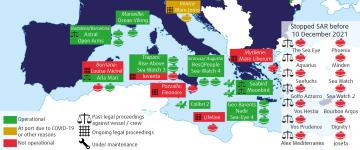
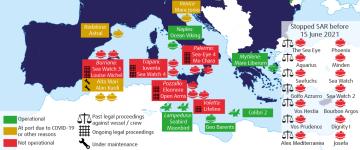
The EU Agency for Fundamental Rights (FRA) regularly collects data on NGO vessels involved in search and rescue in the Mediterranean. This includes any legal proceedings against them, as well as any difficulties disembarking migrants in safe ports. The International Organization for Migration estimates that from January to 10 December 2021 about 1,654 people have died or gone missing while crossing the Mediterranean Sea to reach Europe to escape war or persecution or to pursue a better life. This is an average of more than four people per day. Deadly incidents have also occurred recently in the Channel (La Manche).
This report examines the EU’s main criminal law instrument in the field of counter-terrorism, Directive (EU) 2017/541. Specifically, it considers how the directive engages issues of fundamental rights, affecting individuals, groups and society as a whole.
This report outlines to what extent legal aid is available to those held in pre-removal detention in the 27 EU Member States, and in North Macedonia and Serbia, during procedures related to their return. These involve decisions on return, on detention pending removal, the removal itself and on bans on entry. The report also examines when people are entitled to free legal aid and how this aid is funded, as well as who provides representation and various factors that limit the scope of legal aid.
This report proposes a framework for becoming, and functioning as, a ‘human rights city’ in the EU. It includes ‘foundations’, ‘structures’ and ‘tools’ for mayors, local administrations and grassroots organisations to reinforce fundamental rights locally. It is based on existing good practice and expert input by representatives of human rights cities in the EU, academic experts, international organisations and city networks.
Since September 2020, three National Human Rights Institutions (NHRIs) had a change in their accreditation status, two new institutions were created and nine have had a change in tasks covered by their mandates. Following up on the September 2020 report “Strong and effective national human rights institutions – challenges, promising practices and opportunities”, this update provides an overview of developments in the accreditation status and mandates of NHRIS in the past 12 months. The update covers the 27 EU Member States as well as three additional states within FRA’s mandate (Albania, North Macedonia and Serbia).
Civil society organisations play a vital role in promoting fundamental rights, but they face diverse challenges across the European Union. This report presents FRA’s findings on a range of such challenges. The findings are based on research, and on two online consultations with civil society organisations, carried out in 2020.
Les organisations de la société civile jouent un rôle essentiel dans la promotion des droits fondamentaux, mais sont confrontées à diverses problématiques dans l’Union européenne. Ce rapport présente les conclusions de la FRA concernant quelques-unes de ces problématiques, conclusions qui se fondent sur des recherches ainsi que sur deux consultations en ligne auprès d’organisations de la société civile, menées en 2020.
This note sets out human rights standards stemming from both the European Convention on Human Rights and European Union (EU) law that apply to effective remedies for human rights violations at borders, together with those on complaints mechanisms and investigations into complaints of rights violations at borders.
The Employers Sanctions Directive was primarily enacted to dissuade employers from recruiting migrants in an irregular situation, but it also contains provisions to protect workers. It facilitates access to justice for exploited workers and sets out workers’ rights to claim back payment of outstanding wages. The directive also contains provisions to enhance the effectiveness of labour inspections. This report describes how the 25 Member States bound by the directive have been implementing its protective provisions, focusing on the impact these provisions have on migrant workers in an irregular situation who are victims of exploitation and other labour
law violations.
The International Organization for Migration estimates that about 813 people died or went missing crossing the Mediterranean Sea to reach Europe to escape war, persecution or to pursue a better life in 2021, up to 15 June. This is an average of almost five people per day. The EU Agency for Fundamental Rights (FRA) collects data on NGO ships involved in search and rescue in the Mediterranean, legal proceedings against them, as well as difficulties in disembarking migrants in safe ports.
FRA’s Fundamental Rights Report 2021 reviews major developments in the field in 2020, identifying both achievements and areas of concern. It also presents FRA’s opinions on these developments, including a synopsis of the evidence supporting these opinions. This year’s focus chapter explores the impact of the COVID-19 pandemic on fundamental rights. The remaining chapters cover: the EU Charter of Fundamental Rights; equality and non-discrimination; racism, xenophobia and related intolerance; Roma equality and inclusion; asylum, borders and migration; information society, privacy and data protection; rights of the child; access to justice; and the implementation of the Convention on the Rights of Persons with Disabilities.
There are many reasons for the police to stop someone. But prejudice should not be one of them. Find out what FRA is doing to end discriminatory police stops.
This paper presents statistical survey data for the EU on how often people are stopped by the police, in what kind of situations they are stopped, the action taken by the police during stops, and views on whether or not the police acted respectfully.