eu-charter

Carta de los Derechos Fundamentales de la Unión Europea

Artículo 21 - No discriminación

Artículo 21 - No discriminación

1. Se prohíbe toda discriminación, y en particular la ejercida por razón de sexo, raza, color, orígenes étnicos o sociales, características genéticas, lengua, religión o convicciones, opiniones políticas o de cualquier otro tipo, pertenencia a una minoría nacional, patrimonio, nacimiento, discapacidad, edad u orientación sexual.
2. Se prohíbe toda discriminación por razón de nacionalidad en el ámbito de aplicación de los Tratados y sin perjuicio de sus disposiciones particulares.

Explicaciones

  • Text:

    El apartado 1 se inspira en el artículo 13 del Tratado CE, sustituido ahora por el artículo 19 del Tratado de Funcionamiento de la Unión Europea, en el artículo 14 del CEDH y en el artículo 11 del Convenio relativo a los derechos humanos y la biomedicina, referente al patrimonio genético. En la medida en que coincide con el artículo 14 del CEDH, se aplica de acuerdo con éste.
    No existe contradicción ni incompatibilidad entre el apartado 1 y el artículo 19 del Tratado de Funcionamiento de la Unión Europea, que tiene objetivos y alcance diferentes: el artículo 19 confiere competencias a la Unión para adoptar actos legislativos, incluida la armonización de las disposiciones legales y reglamentarias de los Estados miembros, con el fin de combatir determinadas formas de discriminación que se especifican de forma exhaustiva en el citado artículo. Dicha legislación podría cubrir la acción de las autoridades de los Estados miembros (así como las relaciones entre los particulares) en cualquier ámbito dentro de los límites de las competencias de la Unión. Las disposiciones del apartado 1 del artículo 21 no confieren, sin embargo, competencias para adoptar leyes con el fin de combatir formas de discriminación en ámbitos de acción de los Estados miembros o en la esfera privada, ni constituyen una prohibición generalizada de la discriminación en dichos ámbitos. Se refieren solamente a las discriminaciones por parte de las instituciones y órganos de la Unión en el ejercicio de las competencias que les confieren los Tratados, y por parte de los Estados miembros cuando apliquen el Derecho de la Unión solamente. Por consiguiente, el apartado 1 no modifica el alcance de las competencias conferidas por el artículo 19 ni la interpretación de dicho artículo.
    El apartado 2 corresponde al párrafo primero del artículo 18 del Tratado de Funcionamiento de la Unión Europea y debe aplicarse de acuerdo con este último.

    Source:
    Diario Oficial de la Unión Europea C 303/17 - 14.12.2007
    Preamble - Explanations relating to the Charter of Fundamental Rights:
    Las presentes explicaciones fueron elaboradas inicialmente bajo la responsabilidad del Praesidium de la Convención que redactó la Carta de los Derechos Fundamentales de la Unión Europea. Han sido actualizadas bajo la responsabilidad del Praesidium de la Convención Europea, a la vista de las adaptaciones de la redacción del texto de la Carta realizadas por la Convención (en particular, los artículos 51 y 52) y de la evolución del Derecho de la Unión. Si bien no tienen por sí mismas valor jurídico, constituyen un valioso instrumento de interpretación con objeto de aclarar las disposiciones de la Carta.

Jurisprudencia

Derecho constitucional nacional

57 results found

  • Portugal / Constitution of the Portuguese Republic
    País:
    Portugal

    Article 13 (Principle of equality) (1) All citizens possess the same social dignity and are equal before the law. (2) No one may be privileged, favoured, prejudiced, deprived of any right or exempted from any duty for reasons of ancestry, sex, race, language, territory of origin, religion, political or ideological beliefs, education, economic situation, social circumstances or sexual orientation.

  • Preamble to the Constitution of 27 October 1946
    País:
    France

    1 In the morrow of the victory achieved by the free peoples over the regimes that had sought to enslave and degrade humanity, the people of France proclaim anew that each human being, without distinction of race, religion or creed, possesses sacred and inalienable rights. They solemnly reaffirm the rights and freedoms of man and the citizen enshrined in the Declaration of Rights of 1789 and the fundamental principles acknowledged in the laws of the Republic. 3 The law guarantees women equal rights to those of men in all spheres. 5 Each person has the duty to work and the right to employment. No person may suffer prejudice in his work or employment by virtue of his origins, opinions or beliefs. 12 The Nation proclaims the solidarity and equality of all French people in bearing the burden resulting from national calamities.

  • Préambule de la Constitution du 27 octobre 1946
    País:
    France

    1. Au lendemain de la victoire remportée par les peuples libres sur les régimes qui ont tenté d'asservir et de dégrader la personne humaine, le peuple français proclame à nouveau que tout être humain, sans distinction de race, de religion ni de croyance, possède des droits inaliénables et sacrés. Il réaffirme solennellement les droits et libertés de l'homme et du citoyen consacrés par la Déclaration des droits de 1789 et les principes fondamentaux reconnus par les lois de la République. 3. La loi garantit à la femme, dans tous les domaines, des droits égaux à ceux de l'homme. 5. Chacun a le devoir de travailler et le droit d'obtenir un emploi. Nul ne peut être lésé, dans son travail ou son emploi, en raison de ses origines, de ses opinions ou de ses croyances. 12. La Nation proclame la solidarité et l'égalité de tous les Français devant les charges qui résultent des calamités nationales.

  • Romania / Constitution of Romania
    País:
    Romania

      Article 4 (...) (2) Romania is the common and indivisible homeland of all its citizens, without any discrimination on account of race, nationality, ethnic origin, language, religion, sex, opinion, political adherence, property or social origin.

  • Slovakia / Constitution of the Slovak Republic
    País:
    Slovakia

    Article 12 (...) (2) Basic rights and freedoms on the territory of the Slovak Republic are guaranteed to everyone regardless of sex, race, color of skin, language, faith and religion, political, or other thoughts, national or social origin, belonging to a national minority or an ethnic group, property, gender, or any other status. No one may be harmed, preferred, or discriminated against on these grounds. (...)

  • Slovenia / Constitution of the Republic of Slovenia
    País:
    Slovenia

    Article 14 In Slovenia everyone shall be guaranteed equal human rights and fundamental freedoms irrespective of national origin, race, sex, language, religion, political or other conviction, material standing, birth, education, social status, disability or any other personal circumstance. All are equal before the law.

  • España / Constitutión Española
    País:
    España

    Artículo 14 Los españoles son iguales ante la ley, sin que pueda prevalecer discriminación alguna por razón de nacimiento, raza, sexo, religión, opinión o cualquier otra condición o circunstancia personal o social.

  • Suomen perustuslaki
    País:
    Finland

    6 § Yhdenvertaisuus Ihmiset ovat yhdenvertaisia lain edessä. Ketään ei saa ilman hyväksyttävää perustetta asettaa eri asemaan sukupuolen, iän, alkuperän, kielen, uskonnon, vakaumuksen, mielipiteen, terveydentilan, vammaisuuden tai muun henkilöön liittyvän syyn perusteella. Lapsia on kohdeltava tasa-arvoisesti yksilöinä, ja heidän tulee saada vaikuttaa itseään koskeviin asioihin kehitystään vastaavasti. Sukupuolten tasa-arvoa edistetään yhteiskunnallisessa toiminnassa sekä työelämässä, erityisesti palkkauksesta ja muista palvelussuhteen ehdoista määrättäessä, sen mukaan kuin lailla tarkemmin säädetään.

  • The Belgian Constitution
    País:
    Belgium

    Article 11.Enjoyment of the rights and freedoms recognised for Belgians must be provided without discrimination. To this end, laws and federate laws* guarantee among others the rights and freedoms of ideological and philosophical minorities. Article 131.The law determines the measures designed to prevent all forms of discrimination for ideological or philosophical reasons.

  • The Constitution of the Republic of Cyprus
    País:
    Cyprus

    Article 28
    1. All persons are equal before the law, the administration and justice and are entitled to equal protection thereof and treatment thereby.
    2. Every person shall enjoy all the rights and liberties provided for in this Constitution without any direct or indirect discrimination against any person on the ground of his community, race, religion, language, sex, political
    or other convictions, national or social descent, birth, colour, wealth, social class, or on any ground whatsoever, unless there is express provision to the contrary in this Constitution.
    3. No citizen shall be entitled to use or enjoy any privilege of any title of nobility or of social distinction within the territorial limits of the Republic.
    4. No title or nobility or other social distinction shall be conferred by or recognised in the Republic. Article 6
    Subject to the express provisions of this Constitution no law or decision of the House of Representatives or of any of the Communal Chambers, and no act or decision of any organ, authority or person in the Republic exercising executive power or administrative functions, shall discriminate against any of the two Communities or any person as a person or by virtue of being a member of a Community.

  • The Constitutional Act of Denmark
    País:
    Denmark

    Section 70. No person shall by reason of his creed or descent be deprived of access to the full enjoyment of civic and political rights, nor shall he escape compliance with any common civic duty for such reasons.
    Section 71. Subsection 1. Personal liberty shall be inviolable. No Danish subject shall, in any manner whatsoever, be deprived of his liberty because of his political or religious convictions or because of his descent.
    Section 83. All legislative privileges attaching to nobility, title, and rank shall be abolished.

  • The Fundamental Law of Hungary
    País:
    Hungary

    Article XV (Freedom and Responsibility) [...] (2) Hungary shall guarantee fundamental rights to everyone without discrimination and in particular without discrimination on grounds of race, colour, sex, disability, language, religion, political or other opinion, national or social origin, property, birth or any other status. [...]
    (4) By means of separate measures, Hungary shall help to achieve equality of
    opportunity and social inclusion.

  • Tο Σύνταγμα της Κυπριακής Δημοκρατίας
    País:
    Cyprus

    ΑΡΘΡΟΝ 28
    1. Πάντες είναι ίσοι ενώπιον του νόμου, της διοικήσεως και της δικαιοσύνης και δικαιούνται να τύχωσι ίσης προστασίας και μεταχειρίσεως.
    2. Έκαστος απολαύει πάντων των δικαιωμάτων και των ελευθεριών των προβλεπομένων υπό του Συντάγματος άνευ ουδεμιάς δυσμενούς διακρίσεως αμέσου ή εμμέσου εις βάρος οιουδήποτε ατόμου ένεκα της κοινότητος, της φυλής, του χρώματος, της θρησκείας, της γλώσσης, του φύλου, των πολιτικών ή άλλων πεποιθήσεων, της εθνικής ή κοινωνικής καταγωγής, της γεννήσεως, του πλούτου, της κοινωνικής τάξεως αυτού ή ένεκα οιουδήποτε άλλου λόγου, εκτός εάν διά ρητής διατάξεως του Συντάγματος ορίζηται το αντίθετον.
    3. Ουδείς πολίτης δικαιούται να χρησιμοποιή τίτλον ευγενείας ή κοινωνικής διακρίσεως ή να απολαύη οιουδήποτε προνομίου εκ ταύτης εντός των εδαφικών ορίων της Δημοκρατίας.
    4. Ουδείς τίτλος ευγενείας ή άλλης κοινωνικής διακρίσεως απονέμεται ή αναγνωρίζεται εν τη Δημοκρατία. ΑΡΘΡΟΝ 6
    Τηρουμένων των ρητών διατάξεων του Συντάγματος ουδείς νόμος ή ουδεμία απόφασις της Βουλής ή οιασδήποτε των Κοινοτικών Συνελεύσεων ως και ουδεμία πράξις ή απόφασις οιουδήποτε οργάνου, αρχής ή προσώπου εν τη Δημοκρατία ασκούντος εκτελεστικήν εξουσίαν ή διοικητικόν λειτούργημα θέλει υποβάλλει εις δυσμενή διάκρισιν οιανδήποτε εκ των δύο κοινοτήτων ή οιονδήποτε πρόσωπον ως τοιούτον ή υπό την ιδιότητα αυτού ως μέλους κοινότητος.

  • Ustav Republike Hrvatske
    País:
    Croatia

    Članak 14.
    (1) Svatko u Republici Hrvatskoj ima prava i slobode, neovisno o njegovoj rasi, boji kože, spolu, jeziku, vjeri, političkom ili drugom uvjerenju, nacionalnom ili socijalnom podrijetlu, imovini, rođenju, naobrazbi, društvenom položaju ili drugim osobinama.

    Članak 39.
    Zabranjeno je i kažnjivo svako pozivanje ili poticanje na rat ili uporabu nasilja, na nacionalnu, rasnu ili vjersku mržnju ili bilo koji oblik nesnošljivosti.

  • Võrdse kohtlemise seadus
    País:
    Estonia

    § 1. Seaduse eesmärk ja reguleerimisala
    (1) Seaduse eesmärk on tagada isikute kaitse diskrimineerimise eest rahvuse (etnilise kuuluvuse), rassi, nahavärvuse, usutunnistuse või veendumuste, vanuse, puude või seksuaalse sättumuse alusel.
    (2) Käesoleva paragrahvi lõikes 1 nimetatud eesmärgi saavutamiseks sätestab seadus:
    1) võrdse kohtlemise põhimõtted;
    2) ülesanded võrdse kohtlemise põhimõtte rakendamisel ja edendamisel;
    3) diskrimineerimisvaidluste lahendamise.

  • Το Σύνταγμα της Ελλάδας
    País:
    Greece

    Άρθρο 4 (5) Oι Έλληνες πoλίτες συνεισφέρoυν χωρίς διακρίσεις στα δημόσια βάρη, ανάλoγα με τις δυνάμεις τoυς. […] Άρθρο 5 (2) Όλoι όσoι βρίσκoνται στην Eλληνική Eπικράτεια απoλαμβάνoυν την απόλυτη πρoστασία της ζωής, της τιμής και της ελευθερίας τoυς, χωρίς διάκριση εθνικότητας, φυλής, γλώσσας και θρησκευτικών ή πoλιτικών πεπoιθήσεων. Eξαιρέσεις επιτρέπoνται στις περιπτώσεις πoυ πρoβλέπει τo διεθνές δίκαιo. [...]

  • КОНСТИТУЦИЯ на Република България
    País:
    Bulgaria

    Чл. 6. (1) Всички хора се раждат свободни и равни по достойнство и права. (2) Всички граждани са равни пред закона. Не се допускат никакви ограничения на правата или привилегии, основани на раса, народност, етническа принадлежност, пол, произход, религия, образование, убеждения, политическа принадлежност, лично и обществено положение или имуществено състояние.

Derecho de la UE

33 results found

  • Regulation (EU) 2021/817 of the European Parliament and of the Council of 20 May 2021 establishing Erasmus+: the Union Programme for education and training, youth and sport and repealing Regulation (EU) No 1288/2013

    (64) This Regulation respects the fundamental rights and observes the principles recognised in particular by the Charter of Fundamental Rights of the European Union (the ‘Charter’). In particular, this Regulation seeks to ensure full respect for the right to equality between women and men and the right to non-discrimination based on sex, racial or ethnic origin, religion or belief, disability, age or sexual orientation, and to promote the application of Articles 21 and 23 of the Charter. In line with Article 13 of the Charter, it should also be ensured that academic freedom is respected by the countries receiving funds under the Programme.

    [...]

    Article 2

    Definitions

    (25) ‘people with fewer opportunities’ means people who, for economic, social, cultural, geographical or health reasons, due to their migrant background, or for reasons such as disability or educational difficulties or for any other reason, including a reason that could give rise to discrimination under Article 21 of the Charter of Fundamental Rights of the European Union, face obstacles that prevent them from having effective access to opportunities under the Programme;

  • Directive (EU) 2023/2225 of the European Parliament and of the Council of 18 October 2023 on credit agreements for consumers and repealing Directive 2008/48/EC

    (11) Article 169(1) and Article 169(2), point (a), TFEU provide that the Union is to contribute to the attainment of a high level of consumer protection through measures adopted pursuant to Article 114 TFEU. Article 38 of the Charter of Fundamental Rights of the European Union (‘the Charter’) provides that Union policies are to ensure a high level of consumer protection.

    [...]

    (31) Consumers who are legally resident in the Union should not be discriminated against on the ground of their nationality or place of residence, or on any ground as referred to in Article 21 of the Charter when requesting, concluding or holding a credit agreement within the Union. This is without prejudice to the possibility of offering different conditions of access to a credit where those different conditions are duly justified by objective criteria. Moreover, this should not be understood as creating an obligation for creditors or credit intermediaries to provide services in areas in which they do not conduct business.

    [...]

    Article 6

    Non-discrimination

    Member States shall ensure that the conditions to be fulfilled for being granted a credit do not discriminate against consumers legally resident in the Union on ground of their nationality or place of residence or on any ground as referred to in Article 21 of the Charter of Fundamental Rights of the European Union, when those consumers request, conclude or hold a credit agreement within the Union.

  • Regulation (EU) 2021/784 of the European Parliament and of the Council of 29 April 2021 on addressing the dissemination of terrorist content online

    Preamble 


    (20) It should be possible for the competent authority of the Member State where the hosting service provider has its main establishment or where its legal representative resides or is established to scrutinise the removal order issued by competent authorities of another Member State to determine whether it seriously or manifestly infringes this Regulation or the fundamental rights enshrined in the Charter. Both the content provider and the hosting service provider should have the right to request such scrutiny by the competent authority in the Member State where the hosting service provider has its main establishment or where its legal representative resides or is established. Where such a request is made, that competent authority should adopt a decision on whether the removal order comprises such an infringement. Where that decision finds such an infringement, the removal order should cease to have legal effects. The scrutiny should be carried out swiftly so as to ensure that erroneously removed or disabled content is reinstated as soon as possible.


    (23) When putting in place specific measures, hosting service providers should ensure that users’ right to freedom of expression and information as well as the freedom and pluralism of the media as protected under the Charter are preserved. In addition to any requirement laid down in the law, including legislation on the protection of personal data, hosting service providers should act with due diligence and implement safeguards, where appropriate, including human oversight and verifications, to avoid any unintended or erroneous decision leading to the removal of or disabling of access to content that is not terrorist content.

    Article 1: Subject matter and scope

    1. This Regulation lays down uniform rules to address the misuse of hosting services for the dissemination to the public of terrorist content online, in particular on:

    (a) reasonable and proportionate duties of care to be applied by hosting service providers in order to address the dissemination to the public of terrorist content through their services and ensure, where necessary, the expeditious removal of or disabling of access to such content;

    (b) the measures to be put in place by Member States, in accordance with Union law and subject to suitable safeguards to protect fundamental rights, in particular the freedom of expression and information in an open and democratic society, in order to:

    (i) identify and ensure the expeditious removal of terrorist content by hosting service providers; and

    (ii) facilitate cooperation among the competent authorities of Member States, hosting service providers and, where appropriate, Europol.

    2. This Regulation applies to hosting service providers offering services in the Union, irrespective of their place of main establishment, insofar as they disseminate information to the public.

    3. Material disseminated to the public for educational, journalistic, artistic or research purposes or for the purposes of preventing or countering terrorism, including material which represents an expression of polemic or controversial views in the course of public debate, shall not be considered to be terrorist content. An assessment shall determine the true purpose of that dissemination and whether material is disseminated to the public for those purposes.

    4. This Regulation shall not have the effect of modifying the obligation to respect the rights, freedoms and principles referred to in Article 6 TEU and shall apply without prejudice to fundamental principles relating to freedom of expression and information, including freedom and pluralism of the media.

    5. This Regulation shall be without prejudice to Directives 2000/31/EC and 2010/13/EU. For audiovisual media services as defined in point (a) of Article 1(1) of Directive 2010/13/EU, Directive 2010/13/EU shall prevail.

    Article 4: Procedure for cross-borders removal orders 

    3.   The competent authority of the Member State where the hosting service provider has its main establishment or where its legal representative resides or is established may, on its own initiative, within 72 hours of receiving the copy of the removal order in accordance with paragraph 1, scrutinise the removal order to determine whether it seriously or manifestly infringes this Regulation or the fundamental rights and freedoms guaranteed by the Charter.

    Where it finds an infringement, it shall, within the same period, adopt a reasoned decision to that effect. 

  • Directive 2004/38/EC of the European Parliament and of the Council of 29 April 2004 on the right of citizens of the Union and their family members to move and reside freely within the territory of the Member States

    Preamble 


    (31) This Directive respects the fundamental rights and freedoms and observes the principles recognised in particular by the Charter of Fundamental Rights of the European Union. In accordance with the prohibition of discrimination contained in the Charter, Member States should implement this Directive without discrimination between the beneficiaries of this Directive on grounds such as sex, race, colour, ethnic or social origin, genetic characteristics, language, religion or beliefs, political or other opinion, membership of an ethnic minority, property, birth, disability, age or sexual orientation,


    Article 1: Subject

    This Directive lays down:

    (a) the conditions governing the exercise of the right of free movement and residence within the territory of the Member States by Union citizens and their family members;

    (b) the right of permanent residence in the territory of the Member States for Union citizens and their family members;

    (c) the limits placed on the rights set out in (a) and (b) on grounds of public policy, public security or public health.

  • Council Regulation (EU) 2016/1103 of 24 June 2016 implementing enhanced cooperation in the area of jurisdiction, applicable law and the recognition and enforcement of decisions in matters of matrimonial property regimes

    [...]

    (73) This Regulation respects fundamental rights and observes the principles recognised in the Charter, in particular Articles 7, 9, 17, 21 and 47 concerning, respectively, respect for private and family life, the right to marry and to found a family according to national laws, property rights, the principle of non-discrimination and the right to an effective remedy and to a fair trial. This Regulation should be applied by the courts and other competent authorities of the Member States in compliance with those rights and principles.

    [...]

  • Directive (EU) 2022/2381 of the European Parliament and of the Council of 23 November 2022 on improving the gender balance among directors of listed companies and related measures

    Article 1

    Purpose

    This Directive aims to achieve a more balanced representation of women and men among the directors of listed companies by establishing effective measures that aim to accelerate progress towards gender balance, while allowing listed companies sufficient time to make the necessary arrangements for that purpose.

  • Regulation (EU) 2021/692 of the European Parliament and of the Council of 28 April 2021 establishing the Citizens, Equality, Rights and Values Programme and repealing Regulation (EU) No 1381/2013

    Article 4

    Equality, rights and gender equality strand

    Within the general objective set out in Article 2(1) and within the specific objective set out in point (b) of Article 2(2), the Programme shall focus on:

    (1) promoting equality and preventing and combating inequalities and discrimination based on sex, racial or ethnic origin, religion or belief, disability, age or sexual orientation, and respecting the principle of non-discrimination on the grounds provided for in Article 21 of the Charter;

    [...]

  • Regulation (EU) 2022/2065 of the European Parliament and of the Council of 19 October 2022 on a Single Market For Digital Services and amending Directive 2000/31/EC (Digital Services Act)

    Article 34: Risk assessment

    1. Providers of very large online platforms and of very large online search engines shall diligently identify, analyse and assess any systemic risks in the Union stemming from the design or functioning of their service and its related systems, including algorithmic systems, or from the use made of their services.

    They shall carry out the risk assessments by the date of application referred to in Article 33(6), second subparagraph, and at least once every year thereafter, and in any event prior to deploying functionalities that are likely to have a critical impact on the risks identified pursuant to this Article. This risk assessment shall be specific to their services and proportionate to the systemic risks, taking into consideration their severity and probability, and shall include the following systemic risks:

    [...]

    (b) any actual or foreseeable negative effects for the exercise of fundamental rights, in particular the fundamental rights to human dignity enshrined in Article 1 of the Charter, to respect for private and family life enshrined in Article 7 of the Charter, to the protection of personal data enshrined in Article 8 of the Charter, to freedom of expression and information, including the freedom and pluralism of the media, enshrined in Article 11 of the Charter, to non-discrimination enshrined in Article 21 of the Charter, to respect for the rights of the child enshrined in Article 24 of the Charter and to a high-level of consumer protection enshrined in Article 38 of the Charter;

  • Council Directive 2000/78/EC of 27 November 2000 establishing a general framework for equal treatment in employment and occupation

    Preamble  

    (2) The principle of equal treatment between women and men is well established by an important body of Community law, in particular in Council Directive 76/207/EEC of 9 February 1976 on the implementation of the principle of equal treatment for men and women as regards access to employment, vocational training and promotion, and working conditions(5).

    (3) In implementing the principle of equal treatment, the Community should, in accordance with Article 3(2) of the EC Treaty, aim to eliminate inequalities, and to promote equality between men and women, especially since women are often the victims of multiple discrimination.

    (4) The right of all persons to equality before the law and protection against discrimination constitutes a universal right recognised by the Universal Declaration of Human Rights, the United Nations Convention on the Elimination of All Forms of Discrimination against Women, United Nations Covenants on Civil and Political Rights and on Economic, Social and Cultural Rights and by the European Convention for the Protection of Human Rights and Fundamental Freedoms, to which all Member States are signatories. Convention No 111 of the International Labour Organisation (ILO) prohibits discrimination in the field of employment and occupation.

    (6) The Community Charter of the Fundamental Social Rights of Workers recognises the importance of combating every form of discrimination, including the need to take appropriate action for the social and economic integration of elderly and disabled people.

    (8) The Employment Guidelines for 2000 agreed by the European Council at Helsinki on 10 and 11 December 1999 stress the need to foster a labour market favourable to social integration by formulating a coherent set of policies aimed at combating discrimination against groups such as persons with disability. They also emphasise the need to pay particular attention to supporting older workers, in order to increase their participation in the labour force.

    (10) On 29 June 2000 the Council adopted Directive 2000/43/EC(6) implementing the principle of equal treatment between persons irrespective of racial or ethnic origin. That Directive already provides protection against such discrimination in the field of employment and occupation.

    (11) Discrimination based on religion or belief, disability, age or sexual orientation may undermine the achievement of the objectives of the EC Treaty, in particular the attainment of a high level of employment and social protection, raising the standard of living and the quality of life, economic and social cohesion and solidarity, and the free movement of persons.

    (12) To this end, any direct or indirect discrimination based on religion or belief, disability, age or sexual orientation as regards the areas covered by this Directive should be prohibited throughout the Community. This prohibition of discrimination should also apply to nationals of third countries but does not cover differences of treatment based on nationality and is without prejudice to provisions governing the entry and residence of third-country nationals and their access to employment and occupation.

    Article 1: Purpose

    The purpose of this Directive is to lay down a general framework for combating discrimination on the grounds of religion or belief, disability, age or sexual orientation as regards employment and occupation, with a view to putting into effect in the Member States the principle of equal treatment.

    Article 2: Concept of discrimination

    1. For the purposes of this Directive, the "principle of equal treatment" shall mean that there shall be no direct or indirect discrimination whatsoever on any of the grounds referred to in Article 1.

    2. For the purposes of paragraph 1:

    (a) direct discrimination shall be taken to occur where one person is treated less favourably than another is, has been or would be treated in a comparable situation, on any of the grounds referred to in Article 1;

    (b) indirect discrimination shall be taken to occur where an apparently neutral provision, criterion or practice would put persons having a particular religion or belief, a particular disability, a particular age, or a particular sexual orientation at a particular disadvantage compared with other persons unless:

    (i) that provision, criterion or practice is objectively justified by a legitimate aim and the means of achieving that aim are appropriate and necessary, or

    (ii) as regards persons with a particular disability, the employer or any person or organisation to whom this Directive applies, is obliged, under national legislation, to take appropriate measures in line with the principles contained in Article 5 in order to eliminate disadvantages entailed by such provision, criterion or practice.

    3. Harassment shall be deemed to be a form of discrimination within the meaning of paragraph 1, when unwanted conduct related to any of the grounds referred to in Article 1 takes place with the purpose or effect of violating the dignity of a person and of creating an intimidating, hostile, degrading, humiliating or offensive environment. In this context, the concept of harassment may be defined in accordance with the national laws and practice of the Member States.

    Article 5: Reasonable accommodation for disabled persons

    In order to guarantee compliance with the principle of equal treatment in relation to persons with disabilities, reasonable accommodation shall be provided. This means that employers shall take appropriate measures, where needed in a particular case, to enable a person with a disability to have access to, participate in, or advance in employment, or to undergo training, unless such measures would impose a disproportionate burden on the employer. This burden shall not be disproportionate when it is sufficiently remedied by measures existing within the framework of the disability policy of the Member State concerned.

    Article 9: Defence of rights

    1. Member States shall ensure that judicial and/or administrative procedures, including where they deem it appropriate conciliation procedures, for the enforcement of obligations under this Directive are available to all persons who consider themselves wronged by failure to apply the principle of equal treatment to them, even after the relationship in which the discrimination is alleged to have occurred has ended.

    2. Member States shall ensure that associations, organisations or other legal entities which have, in accordance with the criteria laid down by their national law, a legitimate interest in ensuring that the provisions of this Directive are complied with, may engage, either on behalf or in support of the complainant, with his or her approval, in any judicial and/or administrative procedure provided for the enforcement of obligations under this Directive.

    3. Paragraphs 1 and 2 are without prejudice to national rules relating to time limits for bringing actions as regards the principle of equality of treatment.

  • Regulation (EU) 2021/693 of the European Parliament and of the Council of 28 April 2021 establishing the Justice Programme and repealing Regulation (EU) No 1382/2013

    Article 1

    Subject matter

    This Regulation establishes the Justice Programme (the ‘Programme’) for the duration of the multiannual financial framework 2021-2027, as laid down in Regulation (EU, Euratom) 2020/2093.

    It lays down the objectives of the Programme, the budget for the period 2021–2027, the forms of Union funding and the rules for providing such funding.

Derecho internacional

4 results found

  • Committee on the Elimination of Racial Discrimination, General recommendation No. 35 Combating racist hate speech

    ‘24. Article 5 of the Convention enshrines the obligation of States parties to prohibit and eliminate racial discrimination and to guarantee the right of everyone, without distinction as to race, colour, or national or ethnic origin, to equality before the law, notably in the enjoyment of civil, political, economic, social and cultural rights, including the rights to freedom of thought, conscience and religion, freedom of opinion and expression, and freedom of peaceful assembly and association.‘
    ‘25. The Committee considers that the expression of ideas and opinions made in the context of academic debates, political engagement or similar activity, and without incitement to hatred, contempt, violence or discrimination, should be regarded as legitimate exercises of the right to freedom of expression, even when such ideas are controversial.‘
    ‘26. In addition to its inclusion in article 5, freedom of opinion and expression is recognized as a fundamental right in a broad range of international instruments, including the Universal Declaration of Human Rights, which affirm that everyone has the right to hold opinions and to seek, receive and impart information and ideas of all kinds through any media and regardless of frontiers. The right to freedom of expression is not unlimited but carries with it special duties and responsibilities. It may therefore be subject to certain restrictions, but only if they are provided by law and are necessary for protection of the rights or reputations of others and for the protection of national security or of public order, or of public health or morals. Freedom of expression should not aim at the destruction of the rights and freedoms of others, including the right to equality and non-discrimination.‘

  • Human Rights Council Resolution 26/15 (2014) - Accelerating efforts to eliminate all forms of violence against women: violence against women as a barrier to women’s political and economic empowerment

    ‘6. Emphasizes that the prohibition of discrimination against women on grounds of sex, pregnancy, maternity, parenthood or care work should be enforced for all women in all areas of work, including in the informal sector;
    7. Requests States to take measures to overcome the barriers to women’s economic opportunities resulting from maternity and the disproportionate burden of unpaid care work in order to permit choice by women and men as to how they allocate work and family duties and in order to enable the complementarity of work and family between women and men;
    8. Urges States to take measures to reduce informal work for women, with a focus on female participation in economic life and by increasing women’s economic opportunities, particularly in formal employment, in order to promote gender equality; [...]‘

  • Human Rights Council Resolution 26/5 (2014) - Elimination of discrimination against women
  • Human Rights Council Resolution 35/18 (2017) - Elimination of discrimination against women and girls

Productos

  • Opinion / Position Paper
    6
    December
    2021
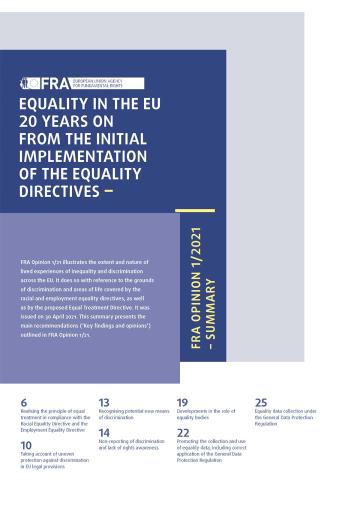
    El dictamen 1/21 de la FRA ilustra el alcance y la naturaleza de las experiencias vividas de desigualdad y discriminación en toda la UE. Lo hace en relación con los motivos de discriminación y los ámbitos de la vida cubiertos por las directivas sobre igualdad racial y relativa a la igualdad de trato en el empleo, así como por la propuesta de Directiva sobre la igualdad de trato. Se emitió el 30 de abril de 2021. En este resumen se presentan las principales recomendaciones («Principales conclusiones y dictámenes») esbozadas en el dictamen 1/21 de la FRA.
  • Report / Paper / Summary
    18
    November
    2021
    This report examines the EU’s main criminal law instrument in the field of counter-terrorism, Directive (EU) 2017/541. Specifically, it considers how the directive engages issues of fundamental rights, affecting individuals, groups and society as a whole.
  • Report / Paper / Summary
    9
    November
    2021
    Antisemitic incidents and hate crimes violate fundamental rights, especially the right to human dignity, the right to equality of treatment, and the freedom of thought, conscience and religion. This report provides an overview of available data on antisemitism as recorded by official and unofficial sources in the EU Member States as well as Albania, North Macedonia and Serbia. The data provided by the countries are supplemented with information from international organisations.
  • Report / Paper / Summary
    22
    September
    2021
    Civil society organisations play a vital role in promoting fundamental rights, but they face diverse challenges across the European Union. This report presents FRA’s findings on a range of such challenges. The findings are based on research, and on two online consultations with civil society organisations, carried out in 2020.
  • Periodic updates / Series
    16
    June
    2021
    This Coronavirus Bulletin focuses on equitable access to vaccines. It outlines the situation in the 27 EU Member States from 1 March to 30 April 2021. The bulletin looks at two main areas: planning and prioritisation in deploying Covid-19 vaccinations and their rollout in the countries. It covers information and communication campaigns, as well as (pre)registration channels for and the administration of vaccinations.
  • Fundamental Rights Report
    10
    June
    2021
    FRA’s Fundamental Rights Report 2021 reviews major developments in the field in 2020, identifying both achievements and areas of concern. It also presents FRA’s opinions on these developments, including a synopsis of the evidence supporting these opinions. This year’s focus chapter explores the impact of the COVID-19 pandemic on fundamental rights. The remaining chapters cover: the EU Charter of Fundamental Rights; equality and non-discrimination; racism, xenophobia and related intolerance; Roma equality and inclusion; asylum, borders and migration; information society, privacy and data protection; rights of the child; access to justice; and the implementation of the Convention on the Rights of Persons with Disabilities.
  • Fundamental Rights Report
    10
    June
    2021
    This focus looks at COVID-19’s impact on fundamental rights. It underscores that a human rights-based approach to tackling the pandemic requires balanced measures that are based on law, necessary, temporary and proportional. It also requires addressing the pandemic’s socio-economic impact, protecting the vulnerable and fighting racism.
  • Fundamental Rights Report
    10
    June
    2021
    En el año 2020 se produjeron tanto avances como
    retrocesos en materia de protección de los derechos
    fundamentales. El Informe sobre los derechos
    fundamentales 2021 de la Agencia de los Derechos
    Fundamentales de la Unión Europea (FRA) analiza
    los principales acontecimientos en este ámbito,
    destacando tanto los progresos realizados como las
    dificultades que todavía persisten.
  • Report / Paper / Summary
    25
    May
    2021
    This paper presents statistical survey data for the EU on how often people are stopped by the police, in what kind of situations they are stopped, the action taken by the police during stops, and views on whether or not the police acted respectfully.
  • Opinion / Position Paper
    30
    April
    2021
    This opinion illustrates the extent and nature of lived experiences of inequality and discrimination across the EU. It does so with reference to the grounds of discrimination and areas of life covered by the racial and employment equality directives, as well as in relation to the grounds and areas covered by the proposed Equal Treatment Directive.