Justice

Õigusküsimused, ohvrite õigused ja õigusalane koostöö

<p>Your access to justice is a fundamental right. It is central to making your other rights a reality.</p>
<p>It protects rights of the individual. It puts right civil wrongs. It holds power to account. We shine a light on obstacles to access to justice. And we give evidence-based advice on overcoming them.</p>

Highlights
    Tooted

    Publications and Data

    Displaying results 91 - 100 of 136
    Report / Paper / Summary
    2
    June
    2015
    Worker exploitation is not an isolated or marginal phenomenon. But despite its pervasiveness in everyday life, severe labour exploitation and its adverse effects on third-country nationals and EU citizens - as workers, but also as consumers - have to date not received much attention from researchers.
    Report / Paper / Summary
    5
    May
    2015
    Making justice systems more child‑friendly improves
    the protection of children, enhances their meaningful
    participation and at the same time improves
    the operation of justice. The findings in this summary
    can provide Member States with useful tools
    to identify barriers, gaps or weaknesses in their
    judicial proceedings, especially in the process of
    transposing and implementing relevant EU directives. Also available in BG - CS - DA - DE - EL - ES - ET - FI - FR - HR - HU - IT - LV - LT - MT - PL - PT - RO - SK - SK - SV
    Report / Paper / Summary
    5
    May
    2015
    Each year thousands of children take part in criminal and civil judicial proceedings, affected by parental divorce
    or as victims or witnesses to crime. Such proceedings can be stressful for anyone. The European Union Agency
    for Fundamental Rights (FRA) investigated whether children’s rights are respected in these proceedings.
    Report / Paper / Summary
    6
    February
    2015
    This summary outlines the research findings of the EU Agency for Fundamental Rights (FRA) on support services for victims of crime across the EU from a fundamental rights perspective. It gives an overview of how current victim support service provision across the 28 EU Member States compares in practice with the objectives and goals for victim support set out by the Victims’ Directive. The focus is on the directive’s Articles 8 and 9 on support services, although other closely related provisions are also considered.
    Handbook / Guide / Manual
    26
    January
    2015
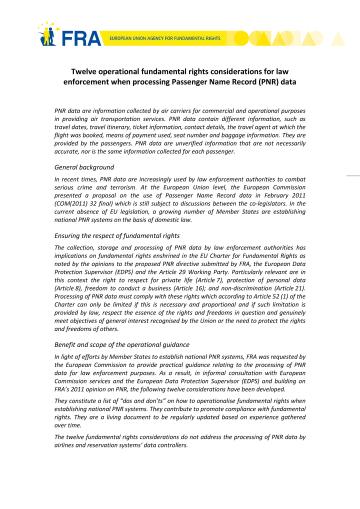
    FRA was requested by the European Commission (EC) in January 2014 to provide practical guidance on the processing of Passenger Name Record (PNR) data for law enforcement purposes, in light of efforts by Member States to establish national PNR systems. As a result, in informal consultation with EC services and the European Data Protection Supervisor (EDPS) and building on opinions FRA, the EDPS and the Article 29 Working Party on PNR, FRA presented twelve fundamental rights considerations to EU Member States experts at technical level.
    Report / Paper / Summary
    12
    January
    2015
    The rights of victims of crime to access justice and to be protected against repeat victimisation may remain illusory in practice if the victim fails to receive professional advice and support. This research by the European Union Agency
    for Fundamental Rights (FRA) examines support service provision for such victims across the 28 EU Member States, in line with the 2012 EU Victims’ Directive. It focuses not on abstract fundamental rights standards but on the final
    practical results.
    Leaflet / Flyer
    29
    September
    2014
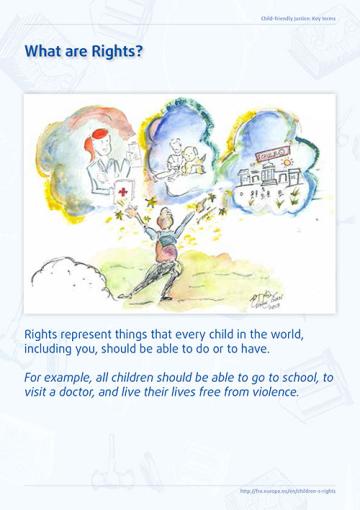
    This document provides clear explanations for children of the key terms used in the child-friendly justice project. It explains what rights are and how these rights should be protected during legal proceedings.
    Fundamental Rights Report
    9
    July
    2014
    The EU and its Member States took a variety of important steps in 2013 to protect and promote fundamental rights by
    assuming
    new international commitments, revamping legislation and pursuing innovative policies on the ground. Yet, fundamental
    rights violations seized the spotlight with distressing frequency: would‑be migrants drowning off the EU’s coast,
    unprecedented mass surveillance, racist and extremist‑motivated murders, child poverty and Roma deprivation.