Asylum

Piirid ja infosüsteemid

    Tooted

    Publications and Data

    Displaying results 1 - 10 of 47
    Periodic updates / Series
    28
    July
    2026
    The EU Agency for Fundamental Rights regularly collects data on the operations of NGO vessels involved in search and rescue in the Mediterranean. This includes any legal proceedings against them, as well as any difficulties in disembarking migrants in safe ports. This paper provides an overview of criminal investigations and other legal proceedings initiated by European Union Member States against civil society organisations deploying search and rescue vessels and aircraft in the Mediterranean and/or against crew members. The latest update covers the period from 2018 up until 30 June 2026.
    Handbook / Guide / Manual
    8
    October
    2025
    The Entry/Exit System (EES), launching in 2025, will register non-EU nationals crossing the EU’s external borders. This FRA guidance supports managers overseeing the operation of the new system. It helps them to ensure compliance with EU fundamental rights. It outlines operational considerations: clear communication, dignified biometric data collection and data protection. It also addresses staff training needs. Based on fieldwork at 10 border crossing points in 6 Member States, the guidance will ensure rights are respected under the new system. A separate guidance publication for border guards accompanies this publication.

    Handbook / Guide / Manual
    8
    October
    2025
    The Entry/Exit System (EES), launching in 2025, will register non-EU nationals crossing the EU’s external borders. This FRA guidance helps border guards apply the new rules in line with EU fundamental rights. It offers practical tips on informing people, collecting biometric data and supporting people with specific needs. Based on fieldwork at 10 border crossing points in 6 Member States, the guidance will ensure rights are respected under the new system. A separate guidance publication for managers accompanies this publication.
    Periodic updates / Series
    30
    July
    2025
    This publication looks at how EU countries investigate abuse and ill-treatment at their borders. While more incidents are now raised with judicial authorities, convictions remain rare. Covering incidents up to the end of 2024 - including serious cases and shipwrecks - it also highlights the role of Frontex and pending cases before the European Court of Human Rights. It builds on FRA’s 2024 Guidance on investigating alleged ill-treatment at borders which outlines ways to make investigations more effective.
    Periodic updates / Series
    20
    June
    2025
    The EU Agency for Fundamental Rights regularly collects data on the operations of NGO vessels involved in search and rescue in the Mediterranean. This includes any legal proceedings against them, as well as any difficulties in disembarking migrants in safe ports. This paper provides an overview of criminal investigations and other legal proceedings initiated by European Union (EU) Member States against civil society organisations deploying search and rescue vessels and aircraft in the Mediterranean and/or against individual crew members. The latest update covers the period from 2018 up until 1 June 2025.
    Handbook / Guide / Manual
    19
    September
    2024
    This publication guides EU countries on setting up independent monitoring mechanisms to ensure fundamental rights are respected during screening and asylum border procedures. These processes at borders are for people arriving from non-EU countries. Monitoring mechanisms are meant to prevent rights violations, protect victims, and support investigations into any allegations of wrongdoing by public authorities. The guidance highlights the importance of transparency and accountability, which builds trust in public authorities. New EU regulations coming into effect in 2026 will require such monitoring systems to be in place. This updates the guidance published in 2022.
    Report / Paper / Summary
    30
    July
    2024
    Fundamental rights violations on the EU’s land and sea borders often go unreported. Investigations into these violations need to be more effective. This report gathers examples of alleged rights violations of migrants and refugees between 2020 and 2023. It sets out 10 steps to promote prompt and effective national investigations into incidents of ill-treatment at borders.
    Periodic updates / Series
    1
    July
    2024
    The EU Agency for Fundamental Rights regularly collects data on the operations of NGO vessels involved in search and rescue in the Mediterranean. This includes any legal proceedings against them, as well as any difficulties in disembarking migrants in safe ports. This paper provides an overview of criminal investigations and other legal proceedings initiated by European Union (EU) Member States against civil society organisations deploying search and rescue vessels and aircraft in the Mediterranean and/or against individual crew members. The latest update covers the period from 2018 up until the end of May 2024.
    Report / Paper / Summary
    18
    December
    2023
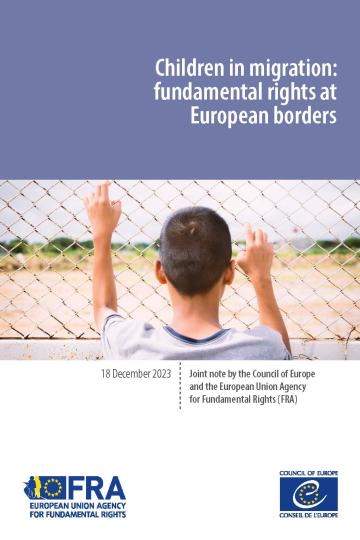
    Council of Europe (CoE) and European Union (EU) Member States have an undeniable sovereign right to control the entry of non-nationals into their territory. While carrying out border control, states have a duty to protect fundamental rights of all people under their jurisdiction, regardless of their nationality, status, or age. Children as a category
    of vulnerable persons with special needs require heightened protection.
    Report / Paper / Summary
    31
    October
    2023
    Fundamental rights are an important consideration in European border management. Virtually all activities can have an impact on rights – from risk analysis to training, border checks and border surveillance. Safeguards in laws regulating European border management aim to protect rights. This report is a contribution to the first review of the European Border and Coast Guard Regulation (EU) 2019/1896 that offers an opportunity to reflect on how best to improve the fundamental rights situation at the external borders of the EU.