eu-charter

Charta základných práv Európskej únie

Článok 18 - Právo na azyl

Článok 18 - Právo na azyl

Právo na azyl sa zaručuje dodržiavaním pravidiel Ženevského dohovoru z 28. júla 1951 a Protokolu z 31. januára 1967 týkajúcich sa postavenia utečencov a v súlade so Zmluvou o Európskej únii a so Zmluvou o fungovaní Európskej únie (ďalej len "zmluvy").

Vysvetlivky

  • Text:

    Znenie tohto článku je založené na článku 63 Zmluvy o ES, ktorý je v súčasnosti nahradený článkom 78 Zmluvy o fungovaní Európskej únie, ktorý Únii ukladá povinnosť dodržiavať Ženevský dohovor o postavení utečencov. Bolo dohodnuté, že sa má odkazovať na ustanovenia protokolov, ktoré sa vzťahujú na Spojené kráľovstvo a Írsko, a ktoré sú pripojené k zmluvám a na Dánsko, aby sa určil rozsah, v akom tieto členské štáty vykonávajú právo Únie v tejto oblasti a rozsah, v akom sa na ne vzťahuje tento článok. Tento článok je v súlade s Protokolom o azyle, ktorý je pripojený k zmluvám.

    Source:
    Úradný vestník Európskej únie C 303/17 - 14.12.2007
    Preamble - Explanations relating to the Charter of Fundamental Rights:
    Ďalej uvedené vysvetlivky boli pôvodne pripravené pod vedením predsedníctva konventu, ktorý vypracoval návrh Charty základných práv Európskej únie. Boli aktualizované pod vedením predsedníctva Európskeho konventu so zreteľom na úpravy, ktoré urobil tento konvent k textu charty (najmä k článkom 51 a 52), a vývoj práva Únie. Hoci tieto vysvetlivky nie sú ako také právne záväzné, predstavujú cenný nástroj výkladu, ktorý je určený na objasnenie ustanovení charty.

Prípadové právo

Vnútroštátne ústavné právo

27 results found

  • Slovensko / Ústava Slovenskej republiky
    Štát:
    Slovensko

    Čl. 53 Slovenská republika poskytuje azyl cudzincom prenasledovaným za uplatňovanie politických práv a slobôd. Azyl možno odoprieť tomu, kto konal v rozpore so základnými ľudskými právami a slobodami. Podrobnosti ustanoví zákon.

  • Slovenia / Constitution of the Republic of Slovenia
    Štát:
    Slovenia

    Article 48 Within the limits of the law, the right of asylum shall be recognised for foreign nationals and stateless persons who are subject to persecution for their commitment to human rights and fundamental freedoms.

  • Spain / Constitution of the Kingdom of Spain
    Štát:
    Spain

    Section 13 (1) Aliens in Spain shall enjoy the public freedoms guaranteed by the present Part, under the terms to be laid down by treaties and the law. (2) Only Spaniards shall have the rights recognized in section 23, except in cases which may be established by treaty or by law concerning the right to vote and the right to be elected in municipal elections, and subject to the principle of reciprocity. (This text includes the first constitutional reform adopted on 27/08/1992; it just added the words "and the right to be elected" to the paragraph). (3) Extradition shall be granted only in compliance with a treaty or with the law, on reciprocal basis. No extradition can be granted for political crimes; but acts of terrorism shall not be regarded as such. (4) The law shall lay down the terms under which citizens from other countries and stateless persons may enjoy the right to asylum in Spain.

  • Suomen perustuslaki
    Štát:
    Finland

    9 § Liikkumisvapaus Suomen kansalaisella ja maassa laillisesti oleskelevalla ulkomaalaisella on vapaus liikkua maassa ja valita asuinpaikkansa. Jokaisella on oikeus lähteä maasta. Tähän oikeuteen voidaan lailla säätää välttämättömiä rajoituksia oikeudenkäynnin tai rangaistuksen täytäntöönpanon varmistamiseksi taikka maanpuolustusvelvollisuuden täyttämisen turvaamiseksi. Suomen kansalaista ei saa estää saapumasta maahan, karkottaa maasta eikä vastoin tahtoaan luovuttaa tai siirtää toiseen maahan. Lailla voidaan kuitenkin säätää, että Suomen kansalainen voidaan rikoksen johdosta tai oikeudenkäyntiä varten taikka lapsen huoltoa tai hoitoa koskevan päätöksen täytäntöönpanemiseksi luovuttaa tai siirtää maahan, jossa hänen ihmisoikeutensa ja oikeusturvansa on taattu. Ulkomaalaisen oikeudesta tulla Suomeen ja oleskella maassa säädetään lailla. Ulkomaalaista ei saa karkottaa, luovuttaa tai palauttaa, jos häntä tämän vuoksi uhkaa kuolemanrangaistus, kidutus tai muu ihmisarvoa loukkaava kohtelu. 

  • The Fundamental Law of Hungary
    Štát:
    Hungary

    Article XIV (Freedom and Responsibility) [...] (3) Hungary shall, upon request, grant the right to asylum to non-Hungarian citizens being persecuted or
    having a well-founded fear of persecution in their native country or in the country of their
    habitual residence for reasons of race, nationality, membership of a particular social group, religious, political belief, if they do not receive protection from their country of origin or from any other country.

  • Ustav Republike Hrvatske
    Štát:
    Croatia

    Članak 33.
    Strani državljanin i osobe bez državljanstva mogu dobiti utočište u Republici Hrvatskoj, osim ako su progonjeni za nepolitičke zločine i djelatnosti oprečne temeljnim načelima međunarodnog prava.
    Stranac koji se zakonito nalazi na teritoriju Republike Hrvatske ne može biti protjeran ni izručen drugoj državi, osim kad se mora izvršiti odluka donesena u skladu s međunarodnim ugovorom i zakonom.

  • КОНСТИТУЦИЯ на Република България
    Štát:
    Bulgaria

    Чл. 26. [...] (2) Чужденците, които пребивават в Република България, имат всички права и задължения по тази Конституция с изключение на правата и задълженията, за които Конституцията и законите изискват българско гражданство. Чл. 27. (1) Чужденците, които пребивават в страната на законно основание, не могат да бъдат изгонвани от нея или предавани на друга държава против тяхната воля, освен при условията и по реда, определени със закон. (2) Република България дава убежище на чужденци, преследвани заради техните убеждения или дейност в защита на международно признати права и свободи. (3) Условията и редът за даване на убежище се уреждат със закон.

Právo EÚ

14 results found

  • Treaty on the Functioning of the European Union

    Article 78 (ex Articles 63, points 1 and 2, and 64(2) TEC)

    1. The Union shall develop a common policy on asylum, subsidiary protection and temporary protection with a view to offering appropriate status to any third-country national requiring international protection and ensuring compliance with the principle of non-refoulement. This policy must be in accordance with the Geneva Convention of 28 July 1951 and the Protocol of 31 January 1967 relating to the status of refugees, and other relevant treaties.

    2. For the purposes of paragraph 1, the European Parliament and the Council, acting in accordance with the ordinary legislative procedure, shall adopt measures for a common European asylum system comprising:

    (a) a uniform status of asylum for nationals of third countries, valid throughout the Union;

    (b) a uniform status of subsidiary protection for nationals of third countries who, without obtaining European asylum, are in need of international protection;

    (c) a common system of temporary protection for displaced persons in the event of a massive inflow;

    (d) common procedures for the granting and withdrawing of uniform asylum or subsidiary protection status;

    (e) criteria and mechanisms for determining which Member State is responsible for considering an application for asylum or subsidiary protection;

    (f) standards concerning the conditions for the reception of applicants for asylum or subsidiary protection;

    (g) partnership and cooperation with third countries for the purpose of managing inflows of people applying for asylum or subsidiary or temporary protection.

    3. In the event of one or more Member States being confronted by an emergency situation characterised by a sudden inflow of nationals of third countries, the Council, on a proposal from the Commission, may adopt provisional measures for the benefit of the Member State(s) concerned. It shall act after consulting the European Parliament.

  • Regulation (EU) 2019/1896 of the European Parliament and of the Council of 13 November 2019 on the European Border and Coast Guard and repealing Regulations (EU) No 1052/2013 and (EU) 2016/1624

    Article 1

    Subject matter

    This Regulation establishes a European Border and Coast Guard to ensure European integrated border management at the external borders with a view to managing those borders efficiently in full compliance with fundamental rights and to increasing the efficiency of the Union return policy. This Regulation addresses migratory challenges and potential future challenges and threats at the external borders. It ensures a high level of internal security within the Union in full respect of fundamental rights, while safeguarding the free movement of persons within the Union. It contributes to the detection, prevention and combating of cross-border crime at the external borders.

  • Regulation (EU) 2019/1896 of the European Parliament and of the Council of 13 November 2019 on the European Border and Coast Guard and repealing Regulations (EU) No 1052/2013 and (EU) 2016/1624

    Preamble

    (103) This Regulation respects the fundamental rights and observes the principles recognised by Articles 2 and 6 TEU and by the Charter of Fundamental Rights of the European Union (‘the Charter’), in particular respect for human dignity, the right to life, the prohibition of torture and inhuman or degrading treatment or punishment, the prohibition of trafficking in human beings, the right to liberty and security, the right to the protection of personal data, the right of access to documents, the right to asylum and to protection against removal and expulsion, non-refoulement, non-discrimination and the rights of the child.

    Article 1: Subject matter

    This Regulation establishes a European Border and Coast Guard to ensure European integrated border management at the external borders with a view to managing those borders efficiently in full compliance with fundamental rights and to increasing the efficiency of the Union return policy.

    This Regulation addresses migratory challenges and potential future challenges and threats at the external borders. It ensures a high level of internal security within the Union in full respect of fundamental rights, while safeguarding the free movement of persons within the Union. It contributes to the detection, prevention and combating of cross-border crime at the external borders.

    Article 43: Instructions to the teams

    4.   Members of the teams shall, in the performance of their tasks and in the exercise of their powers, fully respect fundamental rights, including access to asylum procedures and human dignity, and shall pay particular attention to vulnerable persons. Any measures taken in the performance of their tasks and in the exercise of their powers shall be proportionate to the objectives pursued by such measures. While performing their tasks and exercising their powers, they shall not discriminate against persons on the basis of any grounds such as sex, race, colour, ethnic or social origin, genetic features, language, religion or belief, political or any other opinion, membership of a national minority, property, birth, disability, age or sexual orientation in line with Article 21 of the Charter.

  • Directive 2013/33/EU of the European Parliament and of the Council of 26 June 2013 laying down standards for the reception of applicants for international protection

Medzinárodné právo

5 results found

Informačné materiály

  • Report / Paper / Summary
    5
    December
    2016
    EU Member States are increasingly involved in border management activities on the high seas, within – or i cooperation with – third countries, and at the EU’s borders. Such activities entail risks of violating the principle of non-refoulement, the cornerstone of the international legal regime for the protection of refugees, which prohibits returning individuals to a risk of persecution. This report aims to encourage fundamental-rights compliant approaches to border management, including by highlighting potential grey areas.
  • Report / Paper / Summary
    22
    November
    2016
    Asylum seekers and migrants face various forms of violence and harassment across the European Union (EU). As this month’s report on the migration situation underscores, such acts are both perpetrated and condoned by state authorities, private individuals, as well as vigilante groups. They increasingly also target activists and politicians perceived as ‘pro-refugee’.
  • Report / Paper / Summary
    25
    October
    2016
    In view of the increasing numbers of refugees, asylum seekers and migrants entering the EU, the European Commission asked FRA to collect data about the fundamental rights situation of people arriving in those Member States that have been particularly affected by large migration movements. This month's focus section reviews persistent key issues since initial reporting began one year ago.
  • Fundamental Rights Report
    29
    May
    2016
    This Focus takes a closer look at asylum and migration issues in the European Union (EU) in 2015. It looks at the effectiveness of measures taken or proposed by the EU and its Member States to manage this situation, with particular reference to their fundamental rights compliance.
  • Report / Paper / Summary
    11
    December
    2015
    While awareness of the rights of lesbian, gay, bisexual, transgender and intersex (LGBTI) persons is on the rise across the European Union, hurdles to their full enjoyment of their fundamental rights remain. This report updates FRA’s 2010 report on homophobia, transphobia and discrimination on grounds of sexual orientation and gender identity.
  • Handbook / Guide / Manual
    22
    October
    2015
    Processing biometric data for immigration, asylum and border management purposes has become common. This focus paper looks at measures authorities can take to enforce the obligation of newly arrived asylum seekers and migrants in an irregular situation to provide fingerprints for inclusion in Eurodac.
  • Report / Paper / Summary
    16
    October
    2015
    This report explores the key features of guardianship systems put in place to cater for the needs of all children in need of protection, including child victims and those at risk of becoming victims of trafficking in human beings or of other forms of exploitation. The research covers four specific areas, namely the type of guardianship systems in place, the profile of appointed guardians, the appointment procedures, and the tasks of the guardians.
  • Report / Paper / Summary
    19
    June
    2015
    The situation at land border crossing points into the EU has received less attention than
    Europe’s southern sea borders, where migrants’ lives are at risk. Although FRA research
    shows that land border checks of third-country nationals are generally conducted routinely
    and take place without incident, a number of challenges affect travellers’ fundamental
    rights.
  • Report / Paper / Summary
    6
    March
    2015
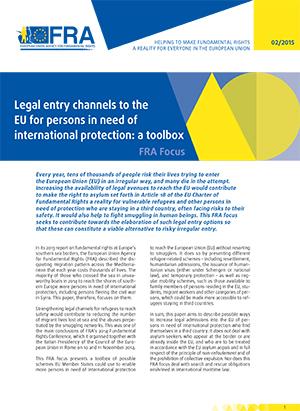
    Every year, tens of thousands of people risk their lives trying to enter the European Union (EU) in an irregular way, and many die in the attempt. Increasing the availability of legal avenues to reach the EU would contribute to make the right to asylum set forth in Article 18 of the EU Charter of Fundamental Rights a reality for vulnerable refugees and other persons in need of protection who are staying in a third country, often facing risks to their safety. It would also help to fight smuggling in human beings. This FRA focus seeks to contribute towards the elaboration of such legal entry options so that these can constitute a viable alternative to risky irregular entry.

  • Report / Paper / Summary
    27
    November
    2014
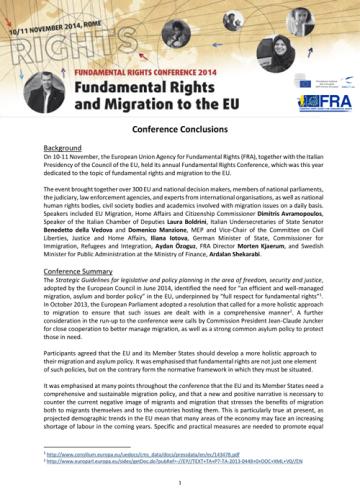
    The Conclusions contain suggestions and concerns voiced by participants at the conference, from plenary speakers and panellists through to members of the thematic working groups.