Displaying 1 - 20 of 136
  • Fundamental Rights Report
    11
    June
    2026
    The Fundamental Rights Report: Challenges and Achievements in 2025 is FRA’s flagship annual publication. It provides an overview of the state of fundamental rights in the EU and highlights selected critical developments from 2025. This year, it focuses on four areas: rights protection in a rapidly changing digital environment; the housing crisis and rising homelessness rates; employment challenges for people from non-EU countries; and the implementation of the EU Charter of Fundamental Rights. The publication is a valuable resource for those seeking to stay informed about the EU’s shifting landscape of fundamental rights.
  • Report / Paper / Summary
    27
    November
    2025
    This report looks at the breadth and depth of violence and neglect faced by people with disabilities living in institutions. It highlights the shortcomings by EU Member States in preventing violence and protecting those who are at a higher risk of experiencing it, in line with the UN Convention on the Rights of Persons with Disabilities. Based on research across all EU Member States and FRA observer candidate countries, the report calls for better protection, stronger prevention of violence, and clear accountability. It urges the EU and its Member States to implement their obligations around equality and fundamental rights.
  • In brief / Factsheet
    1
    September
    2025
    This factsheet focuses on the European arrest warrant and EU Member States obligations to respect fundamental rights. EU law and the European Convention on Human Rights sometimes overlap. The publication clarifies where there are similar principles in different legislation and provides examples of case law. In collaboration, the EU Agency for Fundamental Rights and the European Court of Human Rights produced this short publication. It is designed to aid lawyers and policymakers in understanding and applying the jurisprudence in this area. The August 2025 version now contains recent case-law developments.
  • Report / Paper / Summary
    17
    September
    2025
    This report highlights the discrimination, harassment, violence, and non-consensual medical interventions faced by intersex people across 30 European countries, based on responses from nearly 2,000 participants in FRA's 2023 EU LGBTIQ Survey III. It reveals that many intersex individuals also identify as trans, non-binary, gender-diverse and have varied sexual orientations, which further compounds their experiences of discrimination. The report aims to support the development of laws and policies that promote the inclusion and dignity of intersex people.

  • Opinion / Position Paper
    23
    July
    2025
    This position paper examines how the EU can counter the instrumentalisation of migrants while also upholding fundamental rights. Instrumentalisation refers to countries outside the EU using migration to exert political pressure. This position paper defines the phenomenon, provides examples, and outlines legal obligations under EU law. It provides legal analysis and warns that some responses risk undermining fundamental rights at the EU’s external borders, including the right to asylum. To counter instrumentalisation and uphold fundamental rights, the position paper proposes practical measures for Member States to take, such as sanctions, border controls, and cooperation with private operators.
  • In brief / Factsheet
    27
    May
    2025
    This factsheet focuses on the European arrest warrant and EU Member States obligations to respect fundamental rights. EU law and the European Convention on Human Rights sometimes overlap. The publication clarifies where there are similar principles in different legislation and provides examples of case law. In collaboration, the EU Agency for Fundamental Rights and the European Court of Human Rights produced this short publication. It is designed to aid lawyers and policymakers in understanding and applying the jurisprudence in this area. The 2025 version now contains recent case-law developments.
  • Opinion / Position Paper
    6
    February
    2025
    This FRA Position Paper outlines the Agency’s position on the creation of 'return hubs' in non-EU countries for migrants who have been ordered to leave the EU. Considering the serious fundamental rights risks connected with running return hubs, this legal analysis presents the conditions that would have to be met for return hubs to respect fundamental rights and comply with EU law. These include setting up agreements with the host countries and creating independent human rights monitoring mechanisms. The position paper does not examine centres in third countries that process asylum applications.
  • Handbook / Guide / Manual
    19
    September
    2024
    Tyto praktické pokyny pomáhají členským státům EU zřídit nebo určit vnitrostátní nezávislé mechanismy ke sledování dodržování základních práv při prověřování státních příslušníků třetích zemí a při posuzování žádostí o azyl v řízeních na hranicích.
  • Handbook / Guide / Manual
    19
    September
    2024
    Η παρούσα πρακτική καθοδήγηση έχει ως στόχο να βοηθήσει τα κράτη μέλη της ΕΕ να δημιουργήσουν ή να ορίσουν εθνικούς ανεξάρτητους μηχανισμούς για την παρακολούθηση της τήρησης των θεμελιωδών δικαιωμάτων κατά τον έλεγχο διαλογής των υπηκόων τρίτων χωρών και κατά την εξέταση των αιτήσεων ασύλου στο πλαίσιο των διαδικασιών στα σύνορα.
  • Handbook / Guide / Manual
    19
    September
    2024
    This publication guides EU countries on setting up independent monitoring mechanisms to ensure fundamental rights are respected during screening and asylum border procedures. These processes at borders are for people arriving from non-EU countries. Monitoring mechanisms are meant to prevent rights violations, protect victims, and support investigations into any allegations of wrongdoing by public authorities. The guidance highlights the importance of transparency and accountability, which builds trust in public authorities. New EU regulations coming into effect in 2026 will require such monitoring systems to be in place. This updates the guidance published in 2022.
  • Handbook / Guide / Manual
    19
    September
    2024
    Esta guía práctica ayuda a los Estados miembros de la Unión Europea (UE) a establecer o designar mecanismos nacionales independientes para supervisar los derechos fundamentales durante el triaje de los nacionales de terceros países y al examinar en las fronteras las solicitudes de asilo.
  • Handbook / Guide / Manual
    19
    September
    2024
    Nämä käytännön ohjeet auttavat EU:n jäsenvaltioita perustamaan tai nimeämään kansallisia riippumattomia mekanismeja, joilla seurataan perusoikeuksien noudattamista kolmansien maiden kansalaisten seulonnassa ja turvapaikkahakemusten tutkimisessa rajamenettelyissä.
  • Handbook / Guide / Manual
    19
    September
    2024
    Ove praktične smjernice pomažu državama članicama EU-a u uspostavi ili određivanju nacionalnih neovisnih mehanizama za praćenje poštovanja temeljnih prava tijekom dubinske provjere državljana trećih zemalja i prilikom razmatranja zahtjeva za azil u postupcima na granici.
  • Handbook / Guide / Manual
    19
    September
    2024
    Ez a gyakorlati iránymutatás segítséget nyújt az EUtagállamoknak abban, hogy független nemzeti mechanizmusokat hozzanak létre vagy jelöljenek ki az alapvető jogok tiszteletben tartásának ellenőrzésére a harmadik országok állampolgárainak előszűrése és a menedékjog iránti kérelmek határ menti eljárások keretében történő vizsgálata során.
  • Handbook / Guide / Manual
    19
    September
    2024
    I presenti orientamenti pratici aiutano gli Stati membri dell'UE a istituire o designare meccanismi nazionali indipendenti per monitorare il rispetto dei diritti fondamentali durante gli accertamenti dei cittadini di paesi terzi e l'esame delle domande di asilo nelle procedure di frontiera.
  • Handbook / Guide / Manual
    19
    September
    2024
    Niniejsze praktyczne wytyczne pomagają państwom członkowskim UE w tworzeniu lub wyznaczaniu krajowych niezależnych mechanizmów monitorowania przestrzegania praw podstawowych podczas kontroli przesiewowej obywateli państw trzecich oraz podczas rozpatrywania wniosków o udzielenie azylu w postępowaniach na granicach.
  • In brief / Factsheet
    18
    June
    2024
    This factsheet focuses on the European arrest warrant and EU Member States obligations to respect fundamental rights. EU law and the European Convention on Human Rights sometimes overlap. The publication clarifies where there are similar principles in different legislation and provides examples of case law. In collaboration, the EU Agency for Fundamental Rights and the European Court of Human Rights produced this short publication. It is designed to aid lawyers and policymakers in understanding and applying the jurisprudence in this area.
  • In brief / Factsheet
    18
    June
    2024
    La présente fiche thématique a été préparée par le Greffe de la Cour européenne des droits de l’homme (« Cour EDH ») et l’Agence des droits fondamentaux de l’Union européenne dans le cadre d’une collaboration visant à présenter la jurisprudence dans des domaines choisis dans lesquels le droit de l’Union européenne et de la Convention européenne des droits de l’homme (« CEDH » ou « Convention EDH ») interagissent.
  • Fundamental Rights Report
    5
    June
    2024
    FRA’s Fundamental Rights Report 2024 analyses the year’s developments in fundamental rights. It focuses on the most pressing fundamental rights concerns facing Europe in 2023: the cost-of-living crisis, rights concerns at the EU’s external borders and migration, and threats to democracy. Re-structured, this year’s new approach is a shorter and sharper analysis. It also presents FRA’s opinions on these developments, including a summary of the evidence supporting these opinions.
  • Report / Paper / Summary
    14
    May
    2024
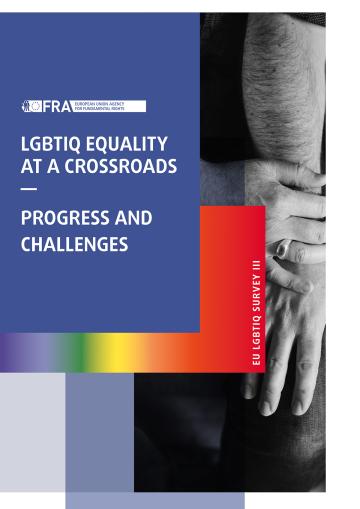
    FRA’s third LGBTIQ survey shows that people still experience hate-motivated violence and discrimination. Trans and intersex people face even greater victimisation. Yet, signs of progress show that the EU’s and Member States’ efforts can positively affect people’s lives. More LGBTIQ people are open about their sexual orientation, gender identity, gender expression and sex characteristics.
Displaying 1 - 20 of 136