eu-charter

Listina základních práv EU

Preambule

Národy Evropy, vytvářejíce mezi sebou stále těsnější unii, se rozhodly sdílet mírovou budoucnost založenou na společných hodnotách.

Unie, vědoma si svého duchovního a morálního dědictví, se zakládá na nedělitelných a všeobecných hodnotách lidské důstojnosti, svobody, rovnosti a solidarity; spočívá na zásadách demokracie a právního státu. Do středu své činnosti staví jednotlivce tím, že zavádí občanství Unie a vytváří prostor svobody, bezpečnosti a práva.
Unie přispívá k zachování a rozvíjení těchto společných hodnot při současném respektování rozmanitosti kultur a tradic národů Evropy, národní identity členských států a uspořádání jejich veřejné moci na státní, regionální a místní úrovni; usiluje o podporu vyváženého a udržitelného rozvoje a zajišťuje volný pohyb osob, služeb, zboží a kapitálu, jakož i svobodu usazování.
K tomuto účelu je nezbytné posílit ochranu základních práv s ohledem na společenský vývoj, sociální pokrok a vědeckotechnologický rozvoj zřetelnějším vyjádřením těchto práv v podobě listiny.
Při respektování pravomocí a úkolů Unie i zásady subsidiarity potvrzuje tato listina práva, která vyplývají především z ústavních tradic a mezinárodních závazků společných členským státům, z Evropské úmluvy o ochraně lidských práv a základních svobod, ze sociálních chart přijatých Unií a Radou Evropy a z judikatury Soudního dvora Evropské unie a Evropského soudu pro lidská práva. Tuto listinu budou v této souvislosti soudy Unie a členských států vykládat s náležitým zřetelem na vysvětlení vyhotovená pod vedením prezídia Konventu, jež vypracovalo tuto listinu, a doplněná pod vedením prezídia Evropského konventu.
Uplatňování těchto práv s sebou nese odpovědnost a povinnosti, jak ve vztahu k druhým, tak ve vztahu k lidskému společenství a budoucím generacím.
V důsledku toho uznává Unie práva, svobody a zásady, které jsou vyhlášeny níže.

Vysvětlivky

  • Text:
    Source:
    Preamble - Explanations relating to the Charter of Fundamental Rights:

Soudcovské právo

0 results found

Vnitrostátního ústavního práva

0 results found

Právo EU

0 results found

Mezinárodní právo

0 results found

Produkty

  • Handbook / Guide / Manual
    10
    October
    2025
    Labour inspectors are essential for enforcing workers’ rights and for detecting and addressing labour exploitation. Together, the European Labour Authority (ELA) and the European Union Agency for Fundamental Rights (FRA) have developed a guide for workplace inspectors on how to detect labour exploitation. This guide is a practical tool for labour inspectors. It focuses on non-national workers in the EU who work in a country other than their own. Such workers are particularly vulnerable to labour exploitation. The guide is also accompanied by a leaflet that summarises the detailed information provided in this guide.
  • Handbook / Guide / Manual
    8
    October
    2025
    The Entry/Exit System (EES), launching in 2025, will register non-EU nationals crossing the EU’s external borders. This FRA guidance supports managers overseeing the operation of the new system. It helps them to ensure compliance with EU fundamental rights. It outlines operational considerations: clear communication, dignified biometric data collection and data protection. It also addresses staff training needs. Based on fieldwork at 10 border crossing points in 6 Member States, the guidance will ensure rights are respected under the new system. A separate guidance publication for border guards accompanies this publication.
  • Handbook / Guide / Manual
    8
    October
    2025
    The Entry/Exit System (EES), launching in 2025, will register non-EU nationals crossing the EU’s external borders. This FRA guidance helps border guards apply the new rules in line with EU fundamental rights. It offers practical tips on informing people, collecting biometric data and supporting people with specific needs. Based on fieldwork at 10 border crossing points in 6 Member States, the guidance will ensure rights are respected under the new system. A separate guidance publication for managers accompanies this publication.
  • Report / Paper / Summary
    2
    October
    2025
    This report examines the fundamental rights and living conditions of Roma and Travellers across 10 EU Member States and
    3 accession countries. The survey evaluates progress towards the EU Roma strategic framework’s 2030 objectives, covering areas such as discrimination, poverty, education, employment, health, and housing.
  • Report / Paper / Summary
    17
    September
    2025
    This report highlights the discrimination, harassment, violence, and non-consensual medical interventions faced by intersex people across 30 European countries, based on responses from nearly 2,000 participants in FRA's 2023 EU LGBTIQ Survey III. It reveals that many intersex individuals also identify as trans, non-binary, gender-diverse and have varied sexual orientations, which further compounds their experiences of discrimination. The report aims to support the development of laws and policies that promote the inclusion and dignity of intersex people.
  • In brief / Factsheet
    1
    September
    2025
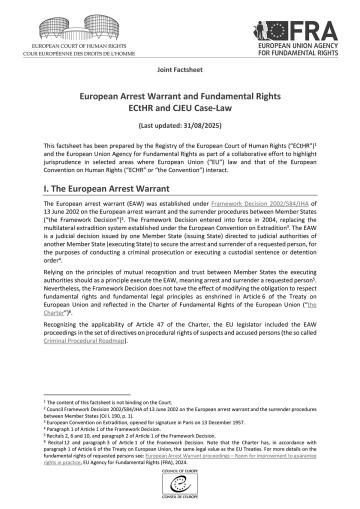
    This factsheet focuses on the European arrest warrant and EU Member States obligations to respect fundamental rights. EU law and the European Convention on Human Rights sometimes overlap. The publication clarifies where there are similar principles in different legislation and provides examples of case law. In collaboration, the EU Agency for Fundamental Rights and the European Court of Human Rights produced this short publication. It is designed to aid lawyers and policymakers in understanding and applying the jurisprudence in this area. The August 2025 version now contains recent case-law developments.
  • Periodic updates / Series
    30
    July
    2025
    This publication looks at how EU countries investigate abuse and ill-treatment at their borders. While more incidents are now raised with judicial authorities, convictions remain rare. Covering incidents up to the end of 2024 - including serious cases and shipwrecks - it also highlights the role of Frontex and pending cases before the European Court of Human Rights. It builds on FRA’s 2024 Guidance on investigating alleged ill-treatment at borders which outlines ways to make investigations more effective.
  • Opinion / Position Paper
    23
    July
    2025
    This position paper examines how the EU can counter the instrumentalisation of migrants while also upholding fundamental rights. Instrumentalisation refers to countries outside the EU using migration to exert political pressure. This position paper defines the phenomenon, provides examples, and outlines legal obligations under EU law. It provides legal analysis and warns that some responses risk undermining fundamental rights at the EU’s external borders, including the right to asylum. To counter instrumentalisation and uphold fundamental rights, the position paper proposes practical measures for Member States to take, such as sanctions, border controls, and cooperation with private operators.
  • Periodic updates / Series
    20
    June
    2025
    The EU Agency for Fundamental Rights regularly collects data on the operations of NGO vessels involved in search and rescue in the Mediterranean. This includes any legal proceedings against them, as well as any difficulties in disembarking migrants in safe ports. This paper provides an overview of criminal investigations and other legal proceedings initiated by European Union (EU) Member States against civil society organisations deploying search and rescue vessels and aircraft in the Mediterranean and/or against individual crew members. The latest update covers the period from 2018 up until 1 June 2025.