eu-charter

Listina základních práv EU

Článek 21 - Zákaz diskriminace

Článek 21 - Zákaz diskriminace

  1. Zakazuje se jakákoli diskriminace založená zejména na pohlaví, rase, barvě pleti, etnickém nebo sociálním původu, genetických rysech, jazyku, náboženském vyznání nebo přesvědčení, politických názorech či jakýchkoli jiných názorech, příslušnosti k národnostní menšině, majetku, narození, zdravotním postižení, věku nebo sexuální orientaci.
  2. V oblasti působnosti Smluv, a aniž jsou dotčena jejich zvláštní ustanovení, se zakazuje jakákoli diskriminace na základě státní příslušnosti.

Vysvětlivky

  • Text:

    Odstavec 1 čerpá z článku 13 Smlouvy o ES, nyní nahrazeného článkem 19 Smlouvy o fungování Evropské unie a článku 14 EÚLP a článku 11 Úmluvy o lidských právech a biomedicíně, pokud jde o genetické dědictví. Použije se v souladu s článkem 14 EÚLP v míře, v jaké mu odpovídá.

    Odstavec 1 a článek 19 Smlouvy o fungování Evropské unie, který má jiný smysl a rozsah, si neodporují a jsou navzájem slučitelné: článek 19 svěřuje Unii pravomoc přijímat právní akty, včetně harmonizace právních předpisů členských států, a bojovat proti některým formám diskriminace v něm vyčerpávajícím způsobem vyjmenovaným. Takové právní předpisy mohou zahrnovat činnost orgánů členského státu (a také vztahy mezi soukromými osobami) ve všech oblastech v rámci pravomocí Unie. Odstavec 1 článku 21 naproti tomu nevytváří žádné pravomoci přijímat antidiskriminační právní předpisy v oblastech pravomocí členského státu nebo v soukromé sféře ani nestanoví obecný zákaz diskriminace v těchto širokých oblastech. Místo toho upravuje pouze diskriminaci ze strany orgánů a institucí samotné Unie při výkonu pravomocí, které jí svěřují Smlouvy, a ze strany členských států, pouze provádějí-li právo Unie. Odstavec 1 proto nemění rozsah pravomocí udělených článkem 19 ani jeho výklad.

    Odstavec 2 odpovídá čl. 18 prvnímu pododstavci Smlouvy o fungování Evropské unie a musí být uplatňován v souladu s ním.

    Source:
    Úřední věstník Evropské unie C 303/17 - 14.12.2007
    Preamble - Explanations relating to the Charter of Fundamental Rights:
    Tato vysvětlení byla původně vyhotovena pod vedením prezídia Konventu, který vypracoval Listinu základních práv Evropské unie. Byla aktualizována pod vedením prezídia Evropského konventu s ohledem na změny návrhu znění Listiny provedené Konventem (zejména článků 51 a 52) a na vývoj práva Unie. Ačkoliv sama nemají právní závaznost, jsou cenným výkladovým nástrojem pro vyjasnění ustanovení Listiny.

Soudcovské právo

Vnitrostátního ústavního práva

57 results found

  • Constitution of the Republic of Lithuania
    Země:
    Lithuania

    Article 29. All persons shall be equal before the law, the court, and other State institutions and officials. The rights of the human being may not be restricted, nor may he be granted any privileges on the ground of gender, race, nationality, language, origin, social status, belief, convictions, or views.

  • Constitution of the Republic of Poland
    Země:
    Poland

    Article 32 1. All persons shall be equal before the law. All persons shall have the right to equal treatment by public authorities. 2. No one shall be discriminated against in political, social or economic life for any reason whatsoever.

  • Costituzione della Repubblica Italiana
    Země:
    Italy

    Art. 3. Tutti i cittadini hanno pari dignità sociale e sono eguali davanti alla legge, senza distinzione di sesso, di razza, di lingua, di religione, di opinioni politiche, di condizioni personali e sociali. È compito della Repubblica rimuovere gli ostacoli di ordine economico e sociale, che, limitando di fatto la libertà e la uguaglianza dei cittadini, impediscono il pieno sviluppo della persona umana e l'effettiva partecipazione di tutti i lavoratori all'organizzazione politica, economica e sociale del Paese. Art. 10. (...) La condizione giuridica dello straniero è regolata dalla legge in conformità delle norme e dei trattati internazionali (...)

  • Česko / Listina základních práv a svobod
    Země:
    Česko

    Článek 3 (1) Základní práva a svobody se zaručují všem bez rozdílu pohlaví, rasy, barvy pleti, jazyka, víry a náboženství, politického či jiného smýšlení, národního nebo sociálního původu, příslušnosti k národnostní nebo etnické menšině, majetku, rodu nebo jiného postavení. (...)

  • Danmarks Riges Grundlov
    Země:
    Denmark

    § 70. Ingen kan på grund af sin trosbekendelse eller afstamning berøves adgang til den fulde nydelse af borgerlige og politiske rettigheder eller unddrage sig opfyldelsen af nogen almindelig borgerpligt.
    § 71. Stk. 1. Den personlige frihed er ukrænkelig. Ingen dansk borger kan på grund af sin politiske eller religiøse overbevisning eller sin afstamning underkastes nogen form for frihedsberøvelse.
    § 83. Enhver i lovgivningen til adel, titel og rang knyttet forret er afskaffet.

  • De Belgische Grondwet
    Země:
    Belgium

    Artikel 11Het genot van de rechten en vrijheden aan de Belgen toegekend moet zonder discriminatie verzekerd worden. Te dien einde waarborgen de wet en het decreet inzonderheid de rechten en vrijheden van de ideologische en filosofische minderheden.Artikel 131De wet stelt de regelen vast ter voorkoming van elke discriminatie om ideologische en filosofische redenen.

  • Eesti Vabariigi Põhiseadus
    Země:
    Estonia

    § 12. Kõik on seaduse ees võrdsed. Kedagi ei tohi diskrimineerida rahvuse, rassi, nahavärvuse, soo, keele, päritolu, usutunnistuse, poliitiliste või muude veendumuste, samuti varalise ja sotsiaalse seisundi või muude asjaolude tõttu. Rahvusliku, rassilise, usulise või poliitilise vihkamise, vägivalla ja diskrimineerimise õhutamine on seadusega keelatud ja karistatav. Samuti on seadusega keelatud ja karistatav õhutada vihkamist, vägivalda ja diskrimineerimist ühiskonnakihtide vahel.

  • Equal Treatment Act
    Země:
    Estonia

    § 1. Purpose and scope of Act
    (1) The purpose of this Act is to ensure the protection of persons against discrimination on grounds of nationality (ethnic origin), race, colour, religion or other beliefs, age, disability or sexual orientation.
    (2) In order to achieve the purpose specified in subsection (1) of this section, this Act provides for:
    1) the principles of equal treatment;
    2) duties upon implementation and promotion of the principle of equal treatment;
    3) resolution of discrimination disputes.

  • Federal Constitutional Act on Elimination of racial discrimination
    Země:
    Austria

    Article 1 §1 (1) Any form of racial discrimination – also to the extent not already in contradiction with Article 7 of the Federal Constitutional Act as amended 1929 and Article 14 of the Convention for the Protection of Human Rights and Fundamental Liberties, Federal Law Gazette No. 210/1958 – is forbidden. Legislation and execution shall refrain from any discrimination for the sole reason of race, colour of skin, descent or national or ethnic origin. (2) Para 1 shall not prevent granting special rights to Austrian citizens or imposing
    special obligations on them, unless contradicted by Article 14 of the Convention for the Protection of Human Rights and Fundamental Liberties.

  • General Equal Treatment Act
    Země:
    Germany


  • Grundgesetz für die Bundesrepublik Deutschland
    Země:
    Germany

    Artikel 3 (...) (3) Niemand darf wegen seines Geschlechtes, seiner Abstammung, seiner Rasse, seiner Sprache, seiner Heimat und Herkunft, seines Glaubens, seiner religiösen oder politischen Anschauungen benachteiligt oder bevorzugt werden. Niemand darf wegen seiner Behinderung benachteiligt werden. Artikel 33 (1) Jeder Deutsche hat in jedem Lande die gleichen staatsbürgerlichen Rechte und Pflichten. (2) Jeder Deutsche hat nach seiner Eignung, Befähigung und fachlichen Leistung gleichen Zugang zu jedem öffentlichen Amte. (3) Der Genuß bürgerlicher und staatsbürgerlicher Rechte, die Zulassung zu öffentlichen Ämtern sowie die im öffentlichen Dienste erworbenen Rechte sind unabhängig von dem religiösen Bekenntnis. Niemandem darf aus seiner Zugehörigkeit oder Nichtzugehörigkeit zu einem Bekenntnisse oder einer Weltanschauung ein Nachteil erwachsen.

  • Konstytucja Rzeczypospolitej Polskiej
    Země:
    Poland

    Art. 32. 1. Wszyscy są wobec prawa równi. Wszyscy mają prawo do równego traktowania przez władze publiczne.2. Nikt nie może być dyskryminowany w życiu politycznym, społecznym lub gospodarczym z jakiejkolwiek przyczyny.

  • Konvention zum Schutze der Menschenrechte und Grundfreiheiten
    Země:
    Austria

    Artikel 14 Der Genuß der in der vorliegenden Konvention festgelegten Rechte und Freiheiten ist ohne Benachteiligung zu gewährleisten, die insbesondere im Geschlecht, in der Rasse, Hautfarbe, Sprache, Religion, in den politischen oder sonstigen Anschauungen, in nationaler oder sozialer Herkunft, in der Zugehörigkeit zu einer nationalen Minderheit, im Vermögen, in der Geburt oder im sonstigen Status begründet ist.

  • La Constitution Belge
    Země:
    Belgium

    Article 11La jouissance des droits et libertés reconnus aux Belges doit être assurée sans discrimination. A cette fin, la loi et le décret garantissent notamment les droits et libertés des minorités idéologiques et philosophiques.Article 131La loi arrête les mesures en vue de prévenir toute discrimination pour des raisons idéologiques et philosophiques.

  • Latvijas Republikas Satversme
    Země:
    Latvia

    91. Visi cilvēki Latvijā ir vienlīdzīgi likuma un tiesas priekšā. Cilvēka tiesības tiek īstenotas bez jebkādas diskriminācijas.

  • Lietuvos Respublikos Konstitucija
    Země:
    Lithuania

    29 straipsnis Įstatymui, teismui ir kitoms valstybės institucijoms ar pareigūnams visi asmenys lygūs. Žmogaus teisių negalima varžyti ir teikti jam privilegijų dėl jo lyties, rasės, tautybės, kalbos, kilmės, socialinės padėties, tikėjimo, įsitikinimų ar pažiūrų pagrindu.

  • Luxembourg / Constitution of the Grand Ducal of Luxembourg
    Země:
    Luxembourg

    Art. 15.  ... (2) Nul ne peut être discriminé en raison de sa situation ou de circonstances personnelles. 

    ...

  • Magyarország Alaptörvénye
    Země:
    Hungary

    XV. cikk (SZABADSÁG ÉS FELELŐSSÉG) [...] (2) Magyarország az alapvető jogokat mindenkinek bármely megkülönböztetés, nevezetesen faj, szín, nem, fogyatékosság, nyelv, vallás, politikai vagy más vélemény , nemzeti vagy társadalmi származás, vagyoni, születési vagy egyéb helyzet szerinti kűlönbségtétel nélkül biztosítja. [...] (4)Magyarország az esélyegyenlőség és a társadalmi felzárkózás megvalósulását külön intézkedésekkel segíti.

  • Netherlands / Constitution of the Kingdom of the Netherlands
    Země:
    Netherlands

    Article 1 All persons in the Netherlands shall be treated equally in equal circumstances. Discrimination on the grounds of religion, belief, political opinion, race or sex, disability, sexual orientation or on any other grounds whatsoever shall not be permitted.

  • Non-Discrimination Act (21/2004)
    Země:
    Finland

Právo EU

33 results found

  • Regulation (EU) 2021/692 of the European Parliament and of the Council of 28 April 2021 establishing the Citizens, Equality, Rights and Values Programme and repealing Regulation (EU) No 1381/2013 of the European Parliament

    Article 1

    Subject matter

    This Regulation establishes the Citizens, Equality, Rights and Values Programme (the ‘Programme’) for the duration of the multiannual financial framework 2021-2027, as laid down in Regulation (EU, Euratom) 2020/2093.

    It lays down the objectives of the Programme, the budget for the period 2021–2027, the forms of Union funding and the rules for providing such funding.

  • Regulation (EU) 2019/1896 of the European Parliament and of the Council of 13 November 2019 on the European Border and Coast Guard and repealing Regulations (EU) No 1052/2013 and (EU) 2016/1624

    Preamble

    (103) This Regulation respects the fundamental rights and observes the principles recognised by Articles 2 and 6 TEU and by the Charter of Fundamental Rights of the European Union (‘the Charter’), in particular respect for human dignity, the right to life, the prohibition of torture and inhuman or degrading treatment or punishment, the prohibition of trafficking in human beings, the right to liberty and security, the right to the protection of personal data, the right of access to documents, the right to asylum and to protection against removal and expulsion, non-refoulement, non-discrimination and the rights of the child.

    Article 1: Subject matter

    This Regulation establishes a European Border and Coast Guard to ensure European integrated border management at the external borders with a view to managing those borders efficiently in full compliance with fundamental rights and to increasing the efficiency of the Union return policy.

    This Regulation addresses migratory challenges and potential future challenges and threats at the external borders. It ensures a high level of internal security within the Union in full respect of fundamental rights, while safeguarding the free movement of persons within the Union. It contributes to the detection, prevention and combating of cross-border crime at the external borders.

    Article 43: Instructions to the teams

    4.   Members of the teams shall, in the performance of their tasks and in the exercise of their powers, fully respect fundamental rights, including access to asylum procedures and human dignity, and shall pay particular attention to vulnerable persons. Any measures taken in the performance of their tasks and in the exercise of their powers shall be proportionate to the objectives pursued by such measures. While performing their tasks and exercising their powers, they shall not discriminate against persons on the basis of any grounds such as sex, race, colour, ethnic or social origin, genetic features, language, religion or belief, political or any other opinion, membership of a national minority, property, birth, disability, age or sexual orientation in line with Article 21 of the Charter.

  • Directive 2012/29/EU of the European Parliament and of the Council of 25 October 2012 establishing minimum standards on the rights, support and protection of victims of crime, and replacing Council Framework Decision 2001/220/JHA

    Preamble:

    (14) In applying this Directive, children's best interests must be a primary consideration, in accordance with the Charter of Fundamental Rights of the European Union and the United Nations Convention on the Rights of the Child adopted on 20 November 1989. Child victims should be considered and treated as the full bearers of rights set out in this Directive and should be entitled to exercise those rights in a manner that takes into account their capacity to form their own views.
    (16) Victims of terrorism have suffered attacks that are intended ultimately to harm society. They may therefore need special attention, support and protection due to the particular nature of the crime that has been committed against them. Victims of terrorism can be under significant public scrutiny and often need social recognition and respectful treatment by society. Member States should therefore take particular account of the needs of victims of terrorism, and should seek to protect their dignity and security.’
    ‘(38) [...] A main task of these services and their staff, which play an important role in supporting the victim to recover from and overcome potential harm or trauma as a result of a criminal offence, should be to inform victims about the rights set out in this Directive so that they can take decisions in a supportive environment that treats them with dignity, respect and sensitivity. The types of support that such specialist support services should offer could include providing shelter and safe accommodation, immediate medical support, referral to medical and forensic examination for evidence in cases of rape or sexual assault, short and long-term psychological counselling, trauma care, legal advice, advocacy and specific services for children as direct or indirect victims.’
    ‘(52) Measures should be available to protect the safety and dignity of victims and their family members from secondary and repeat victimisation, from intimidation and from retaliation, such as interim injunctions or protection or restraining orders.’

    (66) This Directive respects fundamental rights and observes the principles recognised by the Charter of Fundamental Rights of the European Union. In particular, it seeks to promote the right to dignity, life, physical and mental integrity, liberty and security, respect for private and family life, the right to property, the principle of non-discrimination, the principle of equality between women and men, the rights of the child, the elderly and persons with disabilities, and the right to a fair trial.

    Article 18 - Right to protection
    ‘Without prejudice to the rights of the defence, Member States shall ensure that measures are available to protect victims and their family members from secondary and repeat victimisation, from intimidation and from retaliation, including against the risk of emotional or psychological harm, and to protect the dignity of victims during questioning and when testifying. When necessary, such measures shall also include procedures established under national law for the physical protection of victims and their family members.’

Mezinárodní právo

4 results found

  • Committee on the Elimination of Racial Discrimination, General recommendation No. 35 Combating racist hate speech

    ‘24. Article 5 of the Convention enshrines the obligation of States parties to prohibit and eliminate racial discrimination and to guarantee the right of everyone, without distinction as to race, colour, or national or ethnic origin, to equality before the law, notably in the enjoyment of civil, political, economic, social and cultural rights, including the rights to freedom of thought, conscience and religion, freedom of opinion and expression, and freedom of peaceful assembly and association.‘
    ‘25. The Committee considers that the expression of ideas and opinions made in the context of academic debates, political engagement or similar activity, and without incitement to hatred, contempt, violence or discrimination, should be regarded as legitimate exercises of the right to freedom of expression, even when such ideas are controversial.‘
    ‘26. In addition to its inclusion in article 5, freedom of opinion and expression is recognized as a fundamental right in a broad range of international instruments, including the Universal Declaration of Human Rights, which affirm that everyone has the right to hold opinions and to seek, receive and impart information and ideas of all kinds through any media and regardless of frontiers. The right to freedom of expression is not unlimited but carries with it special duties and responsibilities. It may therefore be subject to certain restrictions, but only if they are provided by law and are necessary for protection of the rights or reputations of others and for the protection of national security or of public order, or of public health or morals. Freedom of expression should not aim at the destruction of the rights and freedoms of others, including the right to equality and non-discrimination.‘

  • Human Rights Council Resolution 26/15 (2014) - Accelerating efforts to eliminate all forms of violence against women: violence against women as a barrier to women’s political and economic empowerment

    ‘6. Emphasizes that the prohibition of discrimination against women on grounds of sex, pregnancy, maternity, parenthood or care work should be enforced for all women in all areas of work, including in the informal sector;
    7. Requests States to take measures to overcome the barriers to women’s economic opportunities resulting from maternity and the disproportionate burden of unpaid care work in order to permit choice by women and men as to how they allocate work and family duties and in order to enable the complementarity of work and family between women and men;
    8. Urges States to take measures to reduce informal work for women, with a focus on female participation in economic life and by increasing women’s economic opportunities, particularly in formal employment, in order to promote gender equality; [...]‘

  • Human Rights Council Resolution 26/5 (2014) - Elimination of discrimination against women
  • Human Rights Council Resolution 35/18 (2017) - Elimination of discrimination against women and girls

Produkty

  • In brief / Factsheet
    5
    March
    2014
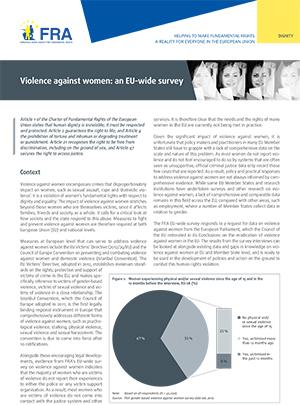
    Tento přehled uvádí některé příklady zjištění průzkumu, které jsou předloženy společně s obecnými úvahami jako možná budoucí opatření v reakci na násilí na ženách.
    FRA
  • Report / Paper / Summary
    5
    March
    2014
    Násilí na ženách představuje porušení nejdůležitějších základních práv žen, jako je právo na důstojnost, přístup ke spravedlnosti a rovnost žen a mužů. Například fyzickému a/nebo sexuálnímu násilí byla po dosažení 15 let věku vystavena každá třetí žena, každá pátá žena byla vystavena nebezpečnému pronásledování a každá druhá se setkala s jednou nebo více formami sexuálního obtěžování.
    FRA
  • Report / Paper / Summary
    5
    March
    2014
    This FRA survey is the first of its kind on violence against women across the 28 Member States of the European Union (EU). It is based on interviews with 42,000 women across the EU, who were asked about their experiences of physical, sexual and psychological violence, including incidents of intimate partner violence (‘domestic violence’).
  • Report / Paper / Summary
    20
    December
    2013
    This thematic situation report examines the effectiveness of responses by public authorities, civil society organisations and others to counter racism, discrimination, intolerance and extremism in Greece and Hungary. The report goes on to make proposals for fighting racist crime, increasing trust in the police, and combating extremism throughout the EU.
  • Report / Paper / Summary
    December
    2013
    The Fundamental Rights Conference 2013 was organised by the European Union Agency for Fundamental Rights (FRA) in cooperation with the Lithuanian Presidency of the Council of the EU. The focus of the conference was on the issue of ‘Combating hate crime in the EU’.
  • In brief / Factsheet
    8
    November
    2013
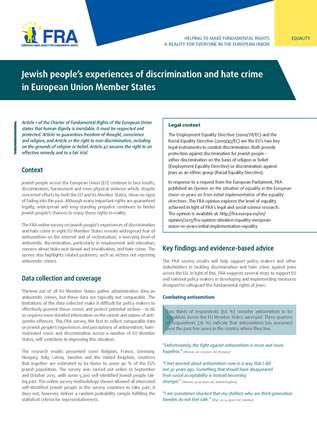
    Jewish people across the European Union (EU) continue to face insults, discrimination, harassment and even physical violence which, despite concerted efforts by both the EU and its Member States, show no signs of fading into the past. Although many important rights are guaranteed legally, widespread and long-standing prejudice continues to hinder Jewish people’s chances to enjoy these rights in reality.
  • Report / Paper / Summary
    8
    November
    2013
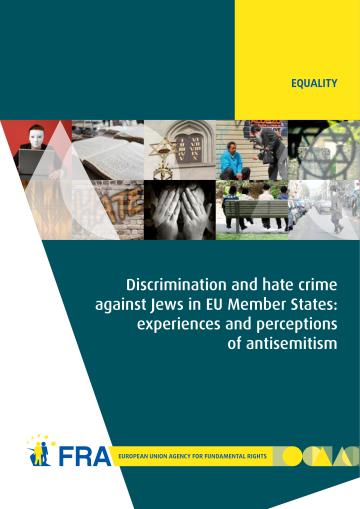
    This FRA survey is the first-ever to collect comparable data on Jewish people’s experiences and perceptions of antisemitism, hate-motivated crime and discrimination across a number of EU Member States, specifically in Belgium, France, Germany, Hungary, Italy, Latvia, Sweden and the United Kingdom. Its findings reveal a worrying level of discrimination, particularly in employment and education, a widespread fear of victimisation and heightening concern about antisemitism online.
  • Report / Paper / Summary
    18
    September
    2013
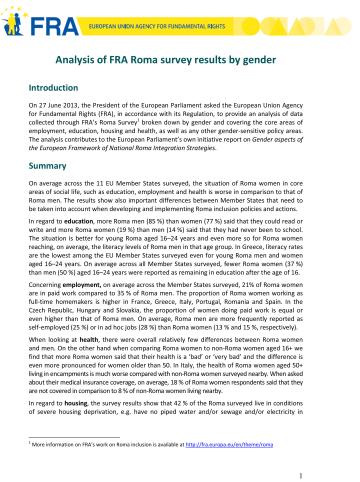
    This paper provides an analysis of data collected through FRA’s Roma Survey broken down by gender and covering the core areas of employment, education, housing and health, as well as any other gender‐sensitive policy areas. The paper is the result of a request made by the President of the European Parliament to the European Union Agency for Fundamental Rights (FRA) on 27 June 2013.
  • Report / Paper / Summary
    26
    July
    2013
    This report analyses the current international and European legal standards and compares EU Member States’ laws in the area of legal capacity. Evidence from fieldwork research supports the legal analysis, providing eloquent testimony to the obstacles many persons with disabilities face in securing equal enjoyment of their fundamental rights.
  • In brief / Factsheet
    17
    May
    2013
    In 2010, the European Commission asked FRA to collect comparable data on discrimination and hate crime experienced by LGBT persons in all EU Member States and Croatia. In response, FRA launched in 2012 its EU LGBT online survey, which received 93,079 responses.