eu-charter

Charta der Grundrechte der Europäischen Union

Artikel 48 - Unschuldsvermutung und Verteidigungsrechte

Artikel 48 - Unschuldsvermutung und Verteidigungsrechte

(1) Jeder Angeklagte gilt bis zum rechtsförmlich erbrachten Beweis seiner Schuld als unschuldig. (2) Jedem Angeklagten wird die Achtung der Verteidigungsrechte gewährleistet.

Erläuterungen

  • Text:

    Artikel 48 entspricht Artikel 6 Absätze 2 und 3 EMRK, der wie folgt lautet:

    `2. Jede Person, die einer Straftat angeklagt ist, gilt bis zum gesetzlichen Beweis ihrer Schuld als unschuldig.

    3. Jede angeklagte Person hat mindestens folgende Rechte:

    a) innerhalb möglichst kurzer Frist in einer ihr verständlichen Sprache in allen Einzelheiten über Art und Grund der gegen sie erhobenen Beschuldigung unterrichtet zu werden;

    b) ausreichende Zeit und Gelegenheit zur Vorbereitung ihrer Verteidigung zu haben;

    c) sich selbst zu verteidigen, sich durch einen Verteidiger ihrer Wahl verteidigen zu lassen oder, falls ihr die Mittel zur Bezahlung fehlen, unentgeltlich den Beistand eines Verteidigers zu erhalten, wenn dies im Interesse der Rechtspflege erforderlich ist;

    d) Fragen an Belastungszeugen zu stellen oder stellen zu lassen und die Ladung und Vernehmung von Entlastungszeugen unter denselben Bedingungen zu erwirken, wie sie für Belastungszeugen gelten;

    e) unentgeltliche Unterstützung durch einen Dolmetscher zu erhalten, wenn sie die Verhandlungssprache des Gerichts nicht versteht oder spricht.`

    Nach Artikel 52 Absatz 3 hat dieses Recht dieselbe Bedeutung und dieselbe Tragweite wie das durch die EMRK garantierte Recht.

    Quelle:
    Amtsblatt der Europäischen Union C 303/17 - 14.12.2007
    Preamble - Explanations relating to the Charter of Fundamental Rights:
    Die Erläuterungen wurden ursprünglich unter der Verantwortung des Präsidiums des Konvents, der die Charta der Grundrechte der Europäischen Union ausgearbeitet hat, formuliert. Sie wurden unter der Verantwortung des Präsidiums des Europäischen Konvents aufgrund der von diesem Konvent vorgenommenen Anpassungen des Wortlauts der Charta (insbesondere der Artikel 51 und 52) und der Fortentwicklung des Unionsrechts aktualisiert. Diese Erläuterungen haben als solche keinen rechtlichen Status, stellen jedoch eine nützliche Interpretationshilfe dar, die dazu dient, die Bestimmungen der Charta zu verdeutlichen.

Rechtsprechung

Nationales Verfassungsrecht

35 results found

  • Latvijas Republikas Satversme
    Land:
    Latvia

    92. Ikviens var aizstāvēt savas tiesības un likumiskās intereses taisnīgā tiesā. Ikviens uzskatāms par nevainīgu, iekams viņa vaina nav atzīta saskaņā ar likumu. Nepamatota tiesību aizskāruma gadījumā ikvienam ir tiesības uz atbilstīgu atlīdzinājumu. Ikvienam ir tiesības uz advokāta palīdzību.

  • Lietuvos Respublikos Konstitucija
    Land:
    Lithuania

    31 straipsnis. Asmuo laikomas nekaltu, kol jo kaltumas neįrodytas įstatymo nustatyta tvarka ir pripažintas įsiteisėjusiu teismo nuosprendžiu. Asmuo, kaltinamas padaręs nusikaltimą, turi teisę, kad jo bylą viešai ir teisingai išnagrinėtų nepriklausomas ir bešališkas teismas. Draudžiama versti duoti parodymus prieš save, savo šeimos narius ar artimus giminaičius. Bausmė gali būti skiriama ar taikoma tik remiantis įstatymu. Niekas negali būti baudžiamas už tą patį nusikaltimą antrą kartą. Asmeniui, kuris įtariamas padaręs nusikaltimą, ir kaltinamajam nuo jų sulaikymo arba pirmosios apklausos momento garantuojama teisė į gynybą, taip pat ir teisė turėti advokatą.

  • Luxemburg / Verfassung des Großherzogtums Luxemburg
    Land:
    Luxemburg

    Art. 17. ... (4) Jede einer Straftat beschuldigte Person gilt bis zum gesetzmäßig erbrachten Beweis ihrer Schuld als unschuldig.

    Jede Person muss unverzüglich über die Gründe für ihre Festnahme oder den Freiheitsentzug, die gegen sie erhobenen Beschuldigungen und die ihr zur Verfügung stehenden rechtlichen Mittel zur Wiedererlangung ihrer Freiheit informiert werden.

  • Magyarország Alaptörvénye
    Land:
    Hungary

    XXVIII. cikk (SZABADSÁG ÉS FELELŐSSÉG) […] (2) Senki nem tekinthető bűnösnek mindaddig, amíg büntetőjogi felelősségét a bíróság jogerős határozata nem állapította meg.
    (3) A büntetőeljárás alá vont személynek az eljárás minden szakaszában joga van a védelemhez. A védő nem vonható felelősségre a védelem ellátása során kifejtett véleménye miatt.

  • Netherlands / Constitution of the Kingdom of the Netherlands
    Land:
    Netherlands

    Article 17(...) 2. No one may be prevented against his will from being heard by the courts to which he is entitled to apply under the law.

    Article 18 1. Everyone may be legally represented in legal and administrative proceedings.

  • Portugal / Constitution of the Portuguese Republic
    Land:
    Portugal

    Article 20 (Access to law and effective judicial protection) (2) Everyone has the right, in accordance with the law, to legal advice and information, as well as to legal aid, and the right to be assisted by a lawyer before any authority. Article 31 (Habeas corpus) (1) Habeas corpus shall be available to counter the misuse of power in the form of illegal arrest, imprisonment or detention. Application for it shall be made to the competent court. (2) Application for a habeas corpus order may be made by the person so arrested, imprisoned or detained, or by any citizen exercising his political rights. (3) Within eight days of an application for habeas corpus the judge shall rule thereon in a hearing that shall be subject to pleading and counter-pleading.
    ...
    Article 32 (Safeguards in criminal procedures) 1. Criminal proceedings shall ensure all necessary safeguards for the defence, including the right to appeal. (2) Every defendant shall be presumed innocent until his sentence has transited in rem judicatam, and shall be brought to trial as quickly as is compatible with the safeguards of the defence. (3) Defendants shall possess the right to choose counsel and to be assisted by him in relation to every procedural act. The law shall specify those cases and phases of proceedings in which the assistance of a lawyer shall be mandatory. (10) Defendants in proceedings concerning administrative offences or in any proceedings in which penalties may be imposed shall possess the right to be heard and to a defence.

  • Romania / Constitution of Romania
    Land:
    Romania

    Article 23(11) Any person shall be presumed innocent till found guilty by a final decision of the court. Article 24(1) The right to defence is guaranteed. (2) All throughout the trial, the parties shall have the right to be assisted by a lawyer of their own choosing or appointed ex officio.

  • Slovakia / Constitution of the Slovak Republic
    Land:
    Slovakia

    Article 50 (1) Only the court decides on guilt and punishment for criminal acts. (2) Everyone against whom a criminal proceeding is conducted is considered innocent until the court establishes his guilt by a legally valid verdict. (3) The accused has the right to be granted the time and opportunity to prepare his defense, and to defend himself either alone or through a defense counsel.(4) The accused has the right to refuse to testify; this right may not be denied in any way. (...)

  • Slovenia / Constitution of the Republic of Slovenia
    Land:
    Slovenia

     Article 27 - Presumption of Innocence Any person charged with a criminal offence shall be presumed innocent until found guilty in a final judgement.

    Article 29 - Legal Guarantees in Criminal Proceedings Anyone charged with a criminal offence must, in addition to absolute equality, be guaranteed the following rights:- the right to have adequate time and facilities to prepare his defence;- the right to be present at his trial and to conduct his own defence or to be defended by a legal representative;- the right to present all evidence to his benefit;- the right not to incriminate himself or his relatives or those close to him, or to admit guilt.

  • Spain / Constitution of the Kingdom of Spain
    Land:
    Spain

    Section 24 2. Likewise, all have the right to the ordinary judge predetermined by law; to defense and assistance by a lawyer; to be informed of the charges brought against them; to a public trial without undue delays and with full guarantees; to the use of evidence appropriate to their defense; not to make self-incriminating statements; not to plead themselves guilty; and to be presumed innocent.

  • The Constitution of the Republic of Cyprus
    Land:
    Cyprus

    Article 12
    4. Every person charged with an offence shall be presumed innocent until proved guilty according to law.
    5. Every person charged with an offence has the following minimum rights: -
    (a) to be informed promptly and in a language which he understands and in detail of the nature and grounds of the charge preferred against him;
    (b) to have adequate time and facilities for the preparation of his defence;
    (c) to defend himself in person or through a lawyer of his own choosing or, if he has no sufficient means to pay for legal assistance, to be given free legal assistance when the interests of justice so require;
    (d) to examine or have examined witnesses against him and to obtain the attendance and examination of witnesses on his behalf under the same conditions as witnesses against him;
    (e) to have the free assistance of an interpreter if he cannot understand or speak the language used in court.

  • The Fundamental Law of Hungary
    Land:
    Hungary

    Article XXVIII (Freedom and Responsibility) […] (2) No one shall be considered guilty until his or her criminal liability has been established by the final decision of a court.
    (3) Persons subject to criminal proceedings shall have the right to defence at all stages of the procedure. Defence counsels shall not be held liable for their opinion expressed while providing legal defence.

  • Tο Σύνταγμα της Κυπριακής Δημοκρατίας
    Land:
    Cyprus

    Αρθρο 12
    4. Ο κατηγορούμενος δι’ αδίκημά τι θεωρείται αθώος, μέχρις ου αποδειχθή ένοχος συμφώνως προς τον νόμον. 5. Πας κατηγορούμενος δι’ αδίκημά τι έχει τα ακόλουθα κατ’ ελάχιστον όρον δικαιώματα:
    (α) να πληροφορηθή εις καταληπτήν υπ’ αυτού γλώσσαν αμέσως και λεπτομερώς την φύσιν και τους λόγους της εις αυτόν αποδιδομένης κατηγορίας,
    (β) να έχη επαρκή χρόνον και διευκόλυνσιν διά την προπαρασκευήν της υπερασπίσεως αυτού,
    (γ) να υπερασπίζη εαυτόν αυτοπροσώπως ή διά συνηγόρου της εκλογής αυτού ή, εφ’ όσον δεν έχη επαρκή προς αμοιβήν του συνηγόρου μέσα, να παρέχηται εις αυτόν δωρεάν νομική αρωγή, όταν τούτο επιβάλλη το συμφέρον της δικαιοσύνης,
    (δ) να εξετάζη ή να προκαλή την εξέτασιν μαρτύρων κατηγορίας και να ζητή την προσέλευσιν και εξέτασιν μαρτύρων υπερασπίσεως υπό τους αυτούς όρους τους ισχύοντας ως προς τους μάρτυρας κατηγορίας,
    (ε) να έχη δωρεάν συμπαράστασιν διερμηνέως, εφ’ όσον δεν δύναται να κατανοήση ή να ομιλή την εν τω δικαστηρίω χρησιμοποιουμένην γλώσσαν.

  • Ustav Republike Hrvatske
    Land:
    Croatia

    Članak 28.
    Svatko je nedužan i nitko ga ne može smatrati krivim za kazneno djelo dok mu se pravomoćnom sudskom presudom ne utvrdi krivnja.

    Članak 29.
    (2) U slučaju sumnje ili optužbe zbog kažnjivog djela osumnjičenik, okrivljenik ili optuženik ima pravo:
    – da u najkraćem roku bude obaviješten potanko i na jeziku koji razumije o naravi i razlozima optužbe koja se diže protiv njega i o dokazima koji ga terete,
    – da ima odgovarajuće vrijeme i mogućnost za pripremu obrane,
    – na branitelja i nesmetano uspostavljanje veze s braniteljem, i s tim pravom mora biti upoznat,
    – da se brani sam ili uz branitelja po vlastitom izboru, a ako nema dovoljno sredstava da plati branitelja, ima pravo na besplatnog branitelja pod uvjetom propisanim zakonom,
    – da mu se sudi u njegovoj nazočnosti, ukoliko je dostupan sudu,
    – da ispituje ili dade ispitati svjedoke optužbe i da zahtijeva da se osigura nazočnost i ispitivanje svjedoka obrane pod istim uvjetima kao i svjedoka optužbe,
    – na besplatnu pomoć tumača ako ne razumije ili ne govori jezik koji se upotrebljava na sudu.

    (3)Osumnjičenik, okrivljenik i optuženik ne smije se siliti da prizna krivnju.

    (4)Dokazi pribavljeni na nezakonit način ne mogu se uporabiti u sudskom postupku.

    Članak 27.
    Odvjetništvo kao samostalna i neovisna služba osigurava svakome pravnu pomoć, u skladu sa zakonom.

  • КОНСТИТУЦИЯ на Република България
    Land:
    Bulgaria

    Чл. 30 [...] (4) Всеки има право на адвокатска защита от момента на задържането му или на привличането му като обвиняем.(5) Всеки има право да се среща насаме с лицето, което го защитава. Тайната на техните съобщения е неприкосновена. Чл. 31 [...] (2) Никой не може да бъде принуждаван да се признае за виновен, нито да бъде осъден само въз основа на неговото самопризнание.(3) Обвиняемият се смята за невинен до установяване на противното с влязла в сила присъда.(4) Не се допускат ограничения на правата на обвиняемия, надхвърлящи необходимото за осъществяване на правосъдието.Чл. 56Всеки гражданин има право на защита, когато са нарушени или застрашени негови права или законни интереси. В държавните учреждения той може да се явява и със защитник.

EU-Recht

12 results found

  • Directive (EU) 2016/343 of the European Parliament and of the Council of 9 March 2016 on the strengthening of certain aspects of the presumption of innocence and of the right to be present at the trial in criminal proceedings

    Preamble:

    (13) This Directive acknowledges the different needs and levels of protection of certain aspects of the presumption of innocence as regards natural and legal persons. As regards natural persons, such protection is reflected in wellestablished
    case-law of the European Court of Human Rights. The Court of Justice has, however, recognised that the rights flowing from the presumption of innocence do not accrue to legal persons in the same way as they do to natural persons.
    (14) At the current stage of development of national law and of case-law at national and Union level, it is premature to legislate at Union level on the presumption of innocence with regard to legal persons. This Directive should not, therefore, apply to legal persons. This should be without prejudice to the application of the presumption of innocence as laid down, in particular, in the ECHR and as interpreted by the European Court of Human Rights and by the Court of Justice, to legal persons.
    (15) The presumption of innocence with regard to legal persons should be ensured by the existing legislative safeguards and case-law, the evolution of which is to determine whether there is a need for Union action.
    (16) The presumption of innocence would be violated if public statements made by public authorities, or judicial decisions other than those on guilt, referred to a suspect or an accused person as being guilty, for as long as that person has not been proved guilty according to law. Such statements and judicial decisions should not reflect an opinion that that person is guilty. This should be without prejudice to acts of the prosecution which aim to prove the guilt of the suspect or accused person, such as the indictment, and without prejudice to judicial decisions as a result of which a suspended sentence takes effect, provided that the rights of the defence are
    respected. This should also be without prejudice to preliminary decisions of a procedural nature, which are taken by judicial or other competent authorities and are based on suspicion or on elements of incriminating evidence, such as decisions on pre-trial detention, provided that such decisions do not refer to the suspect or accused person as being guilty. Before taking a preliminary decision of a procedural nature the competent authority might first have to verify that there are sufficient elements of incriminating evidence against the suspect or accused person to justify the decision concerned, and the decision could contain reference to those elements.
    ...
    (46) In order to monitor and evaluate the effectiveness of this Directive, Member States should send available data with regard to the implementation of the rights laid down in this Directive to the Commission. Such data could include records made by law enforcement and judicial authorities as regards remedies applied in the case of a
    breach of any of the aspects of the presumption of innocence covered by this Directive or of the right to be present at the trial.
    (47) This Directive upholds the fundamental rights and principles recognised by the Charter and by the ECHR, including the prohibition of torture and inhuman or degrading treatment, the right to liberty and security, respect for private and family life, the right to the integrity of the person, the rights of the child, the integration
    of persons with disabilities, the right to an effective remedy and the right to a fair trial, the presumption of innocence and the rights of the defence. Regard should be had, in particular, to Article 6 of the Treaty on European Union (TEU), according to which the Union recognises the rights, freedoms and principles set out in the Charter, and according to which fundamental rights, as guaranteed by the ECHR and as they result from the constitutional traditions common to the Member States, are to constitute general principles of Union law.
    (48) As this Directive establishes minimum rules, Member States should be able to extend the rights laid down in this Directive in order to provide a higher level of protection. The level of protection provided for by Member States should never fall below the standards provided for by the Charter or by the ECHR, as interpreted by the Court of Justice and by the European Court of Human Rights.
    (49) Since the objectives of this Directive, namely setting common minimum rules for certain aspects of the presumption of innocence and for the right to be present at the trial in criminal proceedings, cannot be sufficiently achieved by the Member States but can rather, by reason of its scale and effects, be better achieved at Union level, the Union may adopt measures in accordance with the principle of subsidiarity as set out in Article 5 TEU. In accordance with the principle of proportionality, as set out in that Article, this Directive does not go beyond what is necessary in order to achieve those objectives.
    ...
    Article 1. Subject matter:
    This directive lays down common minimum rules concerning:
    - certain aspects of the presumption of innocence in criminal proceedings;
    - the right to be present at the trial in criminal proceedings.
    ...
    Article 3. Presumption of innocence:
    Member States shall ensure that suspects and accused persons are presumed innocent until proved guilty according to law.

  • Regulation (EU/Euratom) No 883/2013 of the European Parliament and of the Council of 11 September 2013 concerning investigations conducted by the European Anti-Fraud office (OLAF) and repealing Regulation (EC) No 1073/1999 of the European Parliament an...

    Article 9. Procedural guarantees:
    1. In its investigations the Office shall seek evidence for and
    against the person concerned. Investigations shall be conducted
    objectively and impartially and in accordance with the principle
    of the presumption of innocence and with the procedural guarantees
    set out in this Article.

Internationales Recht

0 results found

Produkte

  • Fundamental Rights Report
    8
    Juni
    2022
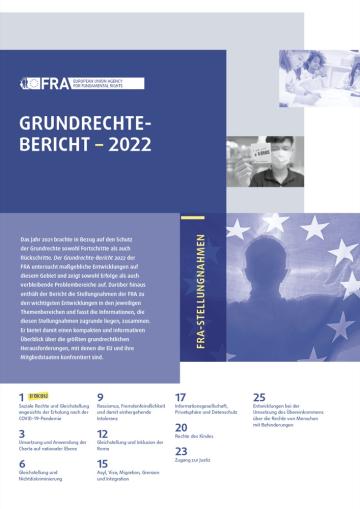
    Das Jahr 2021 brachte in Bezug auf den Schutz der Grundrechte sowohl Fortschritte als auch Rückschritte. Der Grundrechte-Bericht 2022 der FRA untersucht maßgebliche Entwicklungen auf diesem Gebiet und zeigt sowohl Erfolge als auch verbleibende Problembereiche auf. Darüber hinaus enthält der Bericht die Stellungnahmen der FRA zu den wichtigsten Entwicklungen in den jeweiligen Themenbereichen und fasst die Informationen, die diesen Stellungnahmen zugrunde liegen, zusammen. Er bietet damit einen kompakten und informativen Überblick über die größten grundrechtlichen Herausforderungen, mit denen die EU und ihre Mitgliedstaaten konfrontiert sind.
  • Fundamental Rights Report
    11
    Juni
    2020
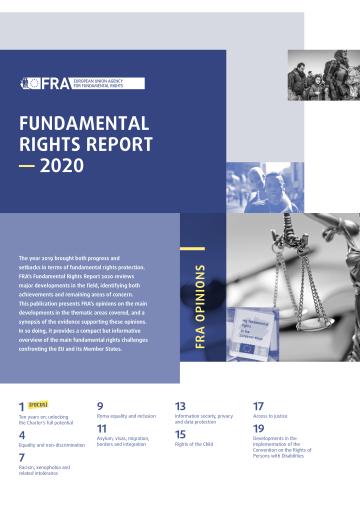
    Das Jahr 2019 brachte beim Schutz der Grundrechte sowohl Fortschritte als auch Rückschritte. In ihrem Grundrechte-Bericht 2020 untersucht die FRA wichtige Entwicklungen auf diesem Gebiet und zeigt sowohl Erfolge auf als auch Bereiche, in denen es immer noch Probleme gibt. Darüber hinaus formuliert die FRA in dieser Veröffentlichung ihre Stellungnahmen zu den wichtigsten Entwicklungen in den abgedeckten Themenbereichen und gibt einen Überblick über die Informationen, die diesen Stellungnahmen zugrunde liegen. So bietet diese Veröffentlichung einen knappen, aber informativen Überblick über die größten Herausforderungen, mit denen die EU und ihre Mitgliedstaaten im Bereich der Grundrechte konfrontiert sind.
  • Fundamental Rights Report
    11
    Juni
    2026
    The Fundamental Rights Report: Challenges and Achievements in 2025 is FRA’s flagship annual publication. It provides an overview of the state of fundamental rights in the EU and highlights selected critical developments from 2025. This year, it focuses on four areas: rights protection in a rapidly changing digital environment; the housing crisis and rising homelessness rates; employment challenges for people from non-EU countries; and the implementation of the EU Charter of Fundamental Rights. The publication is a valuable resource for those seeking to stay informed about the EU’s shifting landscape of fundamental rights.
  • Report / Paper / Summary
    4
    Dezember
    2025
    Artificial Intelligence comes with both benefits and risks. Safe AI use that accounts for fundamental rights is thus crucial. While the 2024 EU AI Act was a milestone in this regard, its broad definitions regarding AI systems and high-risk AI could introduce loopholes for fundamental rights compliance. This report offers an empirical basis for much-needed practical guidance on the Act’s implementation. Based on interviews with AI developers, sellers, and users, FRA addresses challenges of its use in critical domains, like asylum, education, and employment. Our findings help guide next steps in realising the AI Act’s potential to ensure responsible innovation.
  • Report / Paper / Summary
    13
    November
    2025
    FRA analysed 31 digital tools and systems across seven EU Member States, exploring potential positive and negative effects on victims, claimants and defendants. By identifying risks early, investing in skills and training, and embedding protections from the outset, policymakers and practitioners can build effective and inclusive justice systems. This report provides practical suggestions to help ensure that digitalised justice systems are accessible and deliver fair outcomes for all.
  • In brief / Factsheet
    1
    September
    2025
    This factsheet focuses on the European arrest warrant and EU Member States obligations to respect fundamental rights. EU law and the European Convention on Human Rights sometimes overlap. The publication clarifies where there are similar principles in different legislation and provides examples of case law. In collaboration, the EU Agency for Fundamental Rights and the European Court of Human Rights produced this short publication. It is designed to aid lawyers and policymakers in understanding and applying the jurisprudence in this area. The August 2025 version now contains recent case-law developments.
  • Fundamental Rights Report
    10
    Juni
    2025
    The Fundamental Rights Report 2025 is the annual report of the European Union Agency for Fundamental Rights (FRA). It provides an overview of the state of fundamental rights in the EU and highlights selected critical developments and trends in 2024. The report covers issues such as inclusive elections, gender-based violence, and the implementation of the EU Charter of Fundamental Rights. It presents FRA’s opinions on these developments, setting out the actions that the EU and Member States should take. This annual publication is a valuable resource for those seeking to stay informed about the EU’s shifting landscape of fundamental rights.
  • In brief / Factsheet
    27
    Mai
    2025
    This factsheet focuses on the European arrest warrant and EU Member States obligations to respect fundamental rights. EU law and the European Convention on Human Rights sometimes overlap. The publication clarifies where there are similar principles in different legislation and provides examples of case law. In collaboration, the EU Agency for Fundamental Rights and the European Court of Human Rights produced this short publication. It is designed to aid lawyers and policymakers in understanding and applying the jurisprudence in this area. The 2025 version now contains recent case-law developments.
  • In brief / Factsheet
    18
    Juni
    2024
    This factsheet focuses on the European arrest warrant and EU Member States obligations to respect fundamental rights. EU law and the European Convention on Human Rights sometimes overlap. The publication clarifies where there are similar principles in different legislation and provides examples of case law. In collaboration, the EU Agency for Fundamental Rights and the European Court of Human Rights produced this short publication. It is designed to aid lawyers and policymakers in understanding and applying the jurisprudence in this area.
  • Report / Paper / Summary
    26
    März
    2024
    The European Arrest Warrant (EAW) allows Member States to implement judicial decisions issued in another Member State. It applies to decisions such as arrests for the purpose of criminal prosecutions or the execution of custodial sentences. After being in force for over 20 years, FRA’s findings provide evidence for an assessment of the legislation in practice. This report looks at the fundamental rights challenges that people face who are requested through an EAW. It provides a unique insight into their experiences and those of the professionals involved. FRA’s findings indicate that shared challenges exist across EU Member States. They must increase efforts to ensure that people are able to take part in criminal proceedings and receive a fair trial.