The year 2021 brought both progress and setbacks in terms of fundamental rights protection. FRA’s Fundamental Rights Report 2022 reviews major developments in the field, identifying both achievements and remaining areas of concern. This publication presents FRA’s opinions on the main developments in the thematic areas covered, and a synopsis of the evidence supporting these opinions.
L’année 2021 a été marquée à la fois par des avancées et par des reculs en termes de protection des droits fondamentaux. Le Rapport sur les droits fondamentaux 2022 de l’Agence des droits fondamentaux de l’Union européenne (FRA) examine les principales évolutions dans ce domaine, en recensant les progrès accomplis et les sujets de préoccupation persistants. La présente publication expose les avis de la FRA sur les principales évolutions dans les domaines thématiques couverts ainsi qu’un résumé des éléments factuels qui étayent ces avis.
Tógadh céimeanna chun tosaigh agus céimeanna ar gcúl araon i ndáil le cosaint ceart bunúsach sa bhliain 2021. I dTuarascáil um Chearta Bunúsacha 2022 FRA, déantar athbhreithniú ar mhórfhorbairtí sa réimse agus sainaithnítear éachtaí agus ábhair imní nach mór déileáil leo fós. San fhoilseachán seo, cuirtear i láthair tuairimí ó FRA faoi na príomhfhorbairtí sna réimsí téamacha a chumhdaítear agus déantar achoimre ar an bhfianaise a thacaíonn leis na tuairimí sin.
This bulletin looks at the fundamental rights situation of all persons fleeing the Russian war in Ukraine to the four EU Member States neighbouring Ukraine. This is primarily in terms of the application of the EU Temporary Protection Directive. It is based on findings of FRA’s field mission to Hungary, Poland, Romania and Slovakia at the beginning of March 2022. It is also based on weekly country reports prepared by Franet, the contracted research network of FRA between 1 March and 27 April 2022.
Ce guide peut être utile aux villes souhaitant améliorer leurs efforts en matière de respect des droits humains. Il vise à encourager les autorités locales à adopter des normes plus strictes en ce qui concerne les droits humains. Il s’agit d’encourager et de promouvoir l’apprentissage mutuel en matière de droits humains et de droits fondamentaux. L’Agence des droits fondamentaux de l’Union européenne (FRA) ainsi qu’un groupe rassemblant des villes des droits humains et différents praticiens de l’UE, ont travaillé ensemble à l’élaboration de ce guide. Le guide s’appuie sur les pratiques et expériences prometteuses des villes, régions, experts, organisations et réseaux internationaux qui figurent dans le rapport de la FRA intitulé Human rights cities in the EU: A framework for reinforcing rights locally (Villes des droits humains dans l’UE: un cadre pour renforcer les droits au niveau local).
This guide can help cities wishing to improve their efforts to respect human rights. It aims to encourage local authorities to adopt higher human rights standards. The idea is to encourage and foster mutual learning on human and fundamental rights. The European Union Agency for Fundamental Rights (FRA), a group of human rights cities and various practitioners in the EU worked together to produce this guide. The guide draws on the promising practices and experiences of cities, regions, experts, international organisations and networks that can be found in the FRA report Human rights cities in the EU: A framework for reinforcing rights locally.
Children are full-fledged holders of rights. They are beneficiaries of all human and fundamental rights and subjects of special regulations, given their specific characteristics. This handbook aims to illustrate how European law and case law accommodate the specific interests and needs of children. It also considers the importance of parents and guardians or other legal representatives and makes reference, where appropriate, to situations in which rights and responsibilities are most prominently vested in children’s carers. It is a point of reference on both European Union (EU) and Council of Europe (CoE) law related to these subjects, explaining how each issue is regulated under EU law, including the Charter of Fundamental Rights of the European Union, as well as under the European Convention on Human Rights, the European Social Charter and other CoE instruments.
Les enfants sont des titulaires de droits à part entière. Ils sont bénéficiaires de tous les droits fondamentaux et de tous les droits de l’homme, et sont sujets de réglementations particulières compte tenu de leurs caractéristiques spécifiques. Le présent manuel a pour but de montrer comment le droit et la jurisprudence européens s’adaptent aux intérêts et besoins particuliers des enfants. Il illustre également l’importance des parents et des tuteurs ou d’autres représentants légaux et fait référence, le cas échéant, aux principaux droits et responsabilités conférés aux personnes ayant la charge des enfants. Ce manuel entend sensibiliser le lecteur et approfondir ses connaissances des normes juridiques qui protègent et promeuvent les droits de l’enfant en Europe. Il constitue un ouvrage de référence sur le droit de l’Union européenne et du Conseil de l’Europe dans ces domaines. Il explique comment chaque question est réglementée en vertu du droit de l’UE, y compris de la charte des droits fondamentaux de l’Union européenne, ainsi qu’en vertu de la convention européenne des droits de l’homme, de la charte sociale européenne et d’autres instruments du Conseil de l’Europe.
The EU is facing a large-scale humanitarian crisis. Over 10 days at the beginning of March, the EU Agency for Fundamental Rights (FRA) visited all EU countries bordering Ukraine and Moldova – Hungary, Poland, Romania and Slovakia.
The EU Agency for Fundamental Rights has been regularly collecting data on asylum and migration since September 2015. This report focuses on the fundamental rights situation of people arriving in Member States and EU candidate countries particularly affected by migration. It addresses fundamental rights concerns between 1 October and 31 December 2021.
The Fundamental Rights Forum 2021 was the space for dialogue on the human rights challenges facing the EU today. In this video, participants talk about the challenges of fundamental rights in the digital age.
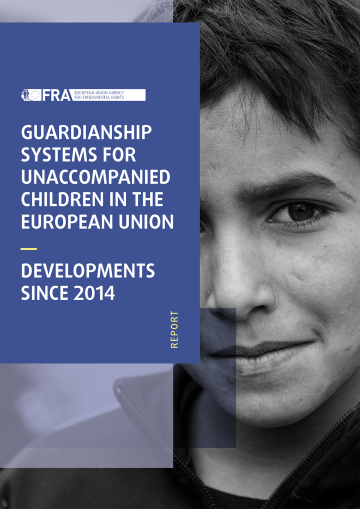
In 2015 and 2016, the numbers of unaccompanied children arriving in Europe increased dramatically, straining national guardianship systems. This report looks at how EU Member States, as well as North Macedonia and Serbia, have adapted their guardianship systems for unaccompanied children since that time.
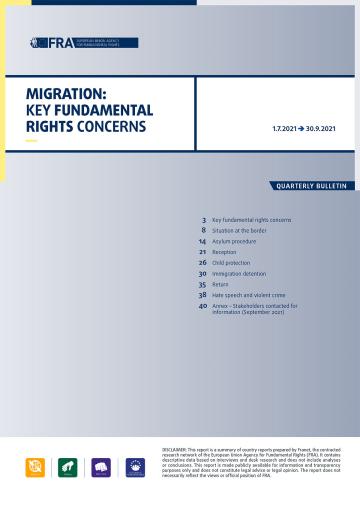
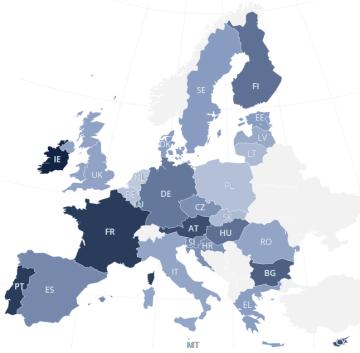
The EU Agency for Fundamental Rights has been regularly collecting data on asylum and migration since September 2015. This report focuses on the fundamental rights situation of people arriving in Member States and EU candidate countries particularly affected by migration. It addresses fundamental rights concerns between 1 July and 30 September 2021.
Since 2014, FRA has been publishing an annual update of the forced return monitoring systems EU Member States have set up under Article 8 (6) of the EU’s Return Directive. This overview describes different indicators for an effective forced return monitoring system. It includes the organisation responsible for monitoring forced return, the number of operations monitored in 2020, the phases of monitored return operations, the number of staff trained and working as monitors, and whether the monitoring body issued public reports about their monitoring.
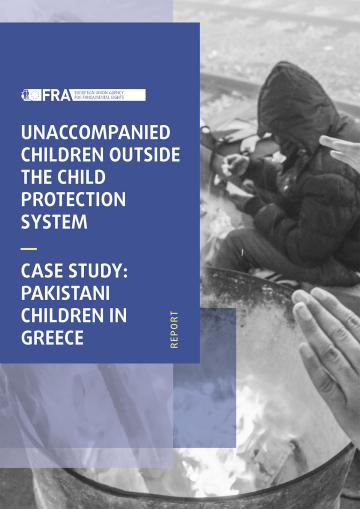
This report sheds light on the realities faced by unaccompanied migrant children who are not in the care of child protection systems in the EU. Presented as a case study, it tells the story of children and young adults from Pakistan who travelled alone to the EU without their parents or other adults.
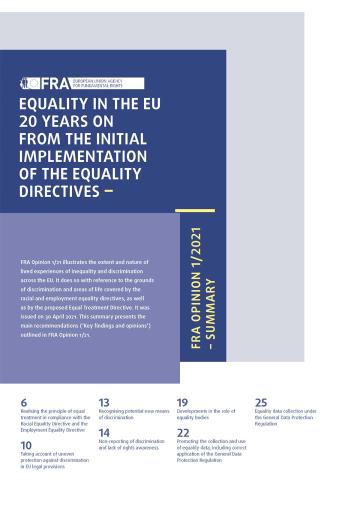
FRA Opinion 1/21 illustrates the extent and nature of lived experiences of inequality and discrimination across the EU. It does so with reference to the grounds of discrimination and areas of life covered by the racial and employment equality directives, as well as by the proposed Equal Treatment Directive. It was issued on 30 April 2021. This summary presents the main recommendations (‘Key findings and opinions’) outlined in FRA Opinion 1/21.
L’avis 1/2021 de la FRA illustre l’étendue et la nature des expériences vécues en matière d’inégalité et de discrimination à travers l’UE. Ce faisant, il se réfère aux motifs de discrimination et aux domaines de la vie couverts par la directive sur l’égalité en matière d’emploi et par la directive sur l’égalité raciale, ainsi que par la proposition de directive sur l’égalité de traitement. Cet avis a été publié le 30 avril 2021. Le présent résumé rassemble les principales recommandations («Points clés et avis») décrites dans l’avis 1/2021 de la FRA.
This report examines the EU’s main criminal law instrument in the field of counter-terrorism, Directive (EU) 2017/541. Specifically, it considers how the directive engages issues of fundamental rights, affecting individuals, groups and society as a whole.
Antisemitic incidents and hate crimes violate fundamental rights, especially the right to human dignity, the right to equality of treatment, and the freedom of thought, conscience and religion. This report provides an overview of available data on antisemitism as recorded by official and unofficial sources in the EU Member States as well as Albania, North Macedonia and Serbia. The data provided by the countries are supplemented with information from international organisations.