In November 2016, FRA formulated 21 individual opinions to address the fundamental rights shortcomings identified in the implementation of the hotspot approach in Greece and Italy. Despite genuine efforts to improve the situation since November 2016, many of the suggestions contained in the 21 opinions FRA formulated at the time remain valid.
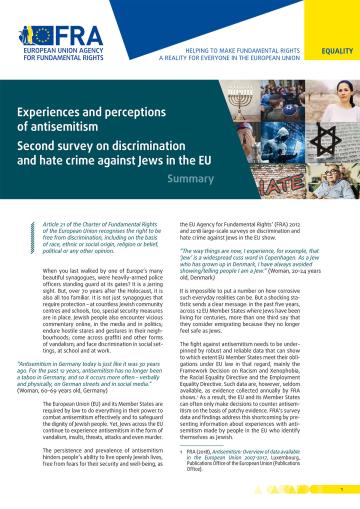
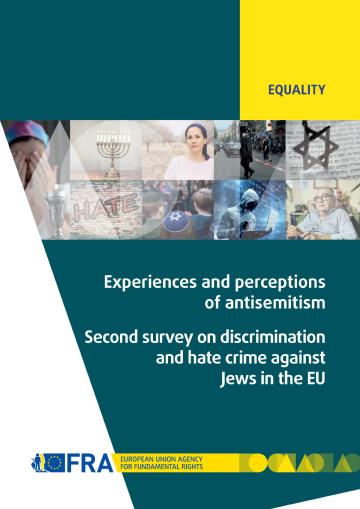
This summary outlines the main findings of FRA’s second survey on Jewish people’s experiences with hate crime, discrimination and antisemitism in the European Union – the biggest survey of Jewish people ever conducted worldwide.
The EU Agency for Fundamental Rights has been regularly collecting data on migration since
September 2015. This report focuses on the fundamental rights situation of people arriving in
Member States and EU candidate countries particularly affected by large migration movements.
This report outlines the main findings of FRA’s second survey on Jewish people’s experiences with hate crime, discrimination and antisemitism in the European Union – the biggest survey of Jewish people ever conducted worldwide. Covering 12 EU Member States, the survey reached almost 16,500 individuals who identify as being Jewish. It follows up on the agency’s first survey, conducted in seven countries in 2012.
This guide explains what profiling is, the legal frameworks that regulate it, and why conducting profiling lawfully is both necessary to comply with fundamental rights and crucial for effective policing and border management. The guide also provides practical guidance on how to avoid unlawful profiling in police and border management operations.
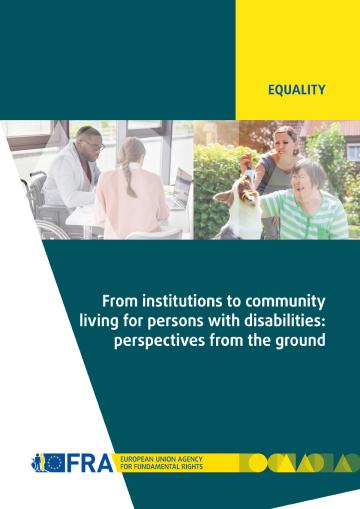
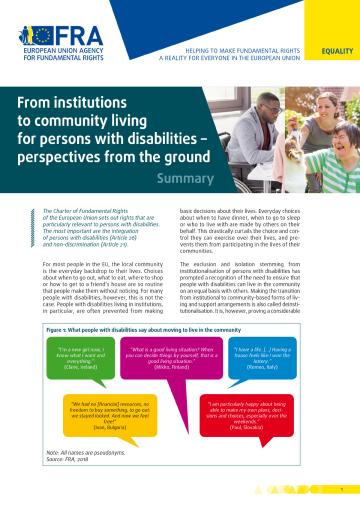
The Convention on the Rights of Persons with Disabilities commits both the EU and all of its Member States to realising the right of persons with disabilities to live independently in the community – which includes achieving deinstitutionalisation for those residing in institutional settings. But much remains to be done to make this a reality in practice. This report presents the main insights gained during fieldwork on the drivers of and barriers to deinstitutionalisation. Focusing on the local level, it gives voice to a diverse set of actors – most importantly, to people with disabilities themselves.
The European Union Agency for Fundamental Rights
(FRA) wanted to contribute to making steps to implement
deinstitutionalisation more effective, by capturing
concrete evidence of what is and what is
not working on the ground. To do this, the agency
conducted extensive fieldwork research in five EU
Member States at different stages of the deinstitutionalisation
process.
This summary report presents the key findings of
that fieldwork and the FRA opinions stemming from
them.
Almost twenty years after adoption of EU laws forbidding discrimination, people of African descent in the EU face widespread and entrenched prejudice and exclusion. This report outlines selected results from FRA's second large-scale EU-wide survey on migrants and minorities (EU-MIDIS II) carried out in 2016. It examines the experiences of almost 6,000 people of African descent in 12 EU Member States.
Almost 25 million children under 18 are at risk of poverty or social exclusion in the EU. Poverty deprives children of educational
opportunities, childcare, access to health care, adequate food and housing, family support and even protection from violence.
This report outlines data and survey findings that highlight the magnitude of child poverty in the EU, but also presents tools
available to counter this phenomenon and keep track of progress made.
Across the European Union, Member States are faced with the challenge of integrating Europe’s most deprived
and disenfranchised minority groups. As a follow up to the EU-MIDIS II findings on Roma, this report presents
FRA’s findings relating to the issues of education and employment. Encouraging Roma participation in education
and employment equips communities with higher incomes, better life opportunities and greater social inclusion.
Across the European Union, people face hatred because of their skin colour, ethnicity, religion, gender or sexuality. In response, the EU and its Member States have introduced laws against hate crime and support services for victims. But these will only fulfil their potential if victims report hate-motivated harassment and violence to the police, and if police officers record such incidents as hate crimes. This report provides rich and detailed information on hate crime recording and data collection systems across the EU, including any systemic cooperation with civil society.
This report looks at what the EU and the 28 countries have agreed to do to move people with disabilities from living in institutions to living in their local community with support.
EU Member States’ legal and practical responses to migrants and refugees implicate several of their fundamental rights, as enshrined in the Charter of Fundamental Rights of the European Union (EU). The EU Agency for Fundamental Rights (FRA) has regularly reported on these issues since September 2015. This report highlights key trends and persistent concerns between October 2016 and December 2017. It focuses on five areas: access to territory, reception conditions, asylum procedures, unaccompanied children and immigration detention.
FRA’s Second European Union Minorities and Discrimination Survey surveys around 26,000 individuals from different ethnic minority and immigrant backgrounds across all 28 EU Member States. This technical report presents a detailed overview of the research methods used by FRA when collecting the survey data.
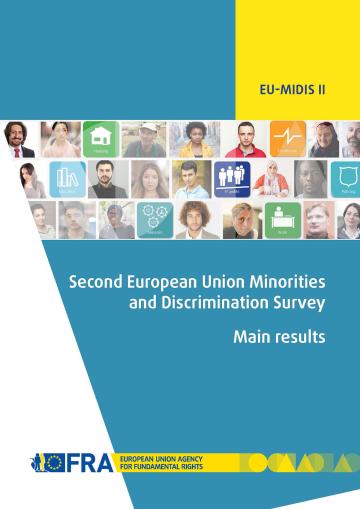
Seventeen years after adoption of EU laws that forbid discrimination, immigrants, descendants of immigrants, and minority ethnic groups continue to face widespread discrimination across the EU and in all areas of life – most often when seeking employment. For many, discrimination is a recurring experience. This is just one of the findings of FRA’s second European Union Minorities and Discrimination Survey (EU-MIDIS II), which collected information from over 25,500 respondents with different ethnic minority and immigrant backgrounds across all 28 EU Member States.
Women and girls in the European Union (EU) experience persistent gender discrimination and gender-based violence, as evidence collected by FRA confirms. This severely limits the ability of women and girls to enjoy their rights and to participate on an equal footing in society. This FRA contribution to the third Annual Colloquium on Fundamental Rights ‘Women's rights in turbulent times’ looks at core human rights commitments. It balances these against selected evidence on gender discrimination, sexist hate speech and gender-based violence against women and girls in the EU.
International treaties, the Charter of Fundamental Rights of the European Union, European Union (EU) secondary law and national legislation provide a number of rights to citizens. The maps and tables presented show the various patterns concerning age requirements for children to acquire rights in the EU. They also identify inconsistencies, protection gaps and restrictions deriving from different age thresholds. The reference period was until April 2016. Any legislative developments since then have been included whenever relevant or if known.
Discussions are under way at the European Union (EU) and national levels about how best to realise the transition from institutional to community-based support. This report contributes to these by bringing together some of the key issues that have emerged from the EU Agency for Fundamental Rights’ (FRA) human rights indicators on Member States’ political and practical commitment to deinstitutionalisation.
Muslims living in the EU face discrimination in a broad range of settings – and particularly when looking for work, on the job, and when trying to access public or private services. The report examines how characteristics – such as an individual's first and last name, skin colour and the wearing of visible religious symbols like a headscarf, for example – may trigger discriminatory treatment and harassment.