eu-charter

Handvest van de grondrechten van de Europese Unie

Artikel 21 - Non-discriminatie

Artikel 21 - Non-discriminatie

1. Iedere discriminatie, met name op grond van geslacht, ras, kleur, etnische of sociale afkomst, genetische kenmerken, taal, godsdienst of overtuiging, politieke of andere denkbeelden, het behoren tot een nationale minderheid, vermogen, geboorte, een handicap, leeftijd of seksuele gerichtheid, is verboden.
2. Binnen de werkingssfeer van de Verdragen en onverminderd de bijzondere bepalingen ervan, is iedere discriminatie op grond van nationaliteit verboden.

Toelichtingen

  • Text:

    Lid 1 is geïnspireerd op artikel 13 VEG, nu vervangen door artikel 19 van het Verdrag betreffende de werking van de Europese Unie, en artikel 14 van het EVRM alsmede op artikel 11 van het Verdrag inzake de rechten van de mens en de biogeneeskunde wat het genetisch erfgoed betreft. Voor zover het samenvalt met artikel 14 van het EVRM wordt het in overeenstemming daarmee toegepast.
    Er is geen sprake van tegenstrijdigheid of onverenigbaarheid tussen lid 1 en artikel 19 van het Verdrag betreffende de werking van de Europese Unie, dat een ander toepassingsgebied en doel heeft: artikel 19 verleent de Unie de bevoegdheid om wetgevingshandelingen vast te stellen, met inbegrip van de harmonisatie van de wet- en regelgeving van de lidstaten, om bepaalde vormen van discriminatie, die in dat artikel exhaustief worden opgesomd, tegen te gaan. Die wetgevingshandelingen kunnen betrekking hebben op maatregelen van de autoriteiten van de lidstaten (alsmede op de betrekkingen tussen particulieren) op ongeacht welk gebied dat onder de bevoegdheid van de Unie valt. Artikel 21, lid 1, creëert daarentegen generlei bevoegdheid om met betrekking tot het optreden van de lidstaten of van particulieren antidiscriminatiewetten vast te stellen; evenmin bevat het een algeheel discriminatieverbod op deze zeer uiteenlopende gebieden. In plaats daarvan heeft dit lid alleen betrekking op discriminerend optreden van de instellingen en organen van de Unie, wanneer zij de hun op grond van de Verdragen verleende bevoegdheden uitoefenen, en van de lidstaten, wanneer zij het recht van de Unie uitvoeren. Lid 1 laat de omvang van de op grond van artikel 19 verleende bevoegdheden, en de uitlegging van dat artikel, derhalve onverlet.
    Lid 2 stemt overeen met artikel 18, eerste alinea, van het Verdrag betreffende de werking van de Europese Unie en moet in overeenstemming daarmee worden toegepast.

    Source:
    Publicatieblad van de Europese Unie C 303/17 - 14.12.2007
    Preamble - Explanations relating to the Charter of Fundamental Rights:
    Deze toelichtingen werden oorspronkelijk opgesteld onder de verantwoordelijkheid van het praesidium van de Conventie die het Handvest van de grondrechten van de Europese Unie heeft opgesteld. Zij zijn bijgewerkt onder de verantwoordelijkheid van het praesidium van de Europese Conventie, in het licht van de wijzigingen die door laatstgenoemde Conventie in het Handvest zijn aangebracht (met name in artikel 51 en 52) en van verdere ontwikkelingen in het recht van de Unie. Hoewel zij op zich geen juridische waarde hebben, vormen zij een waardevol hulpmiddel voor de interpretatie, bedoeld om de bepalingen van het Handvest te verduidelijken.

Jurisprudentie

Nationaal constitutioneel recht

57 results found

  • Constitution of the Republic of Lithuania
    Land:
    Lithuania

    Article 29. All persons shall be equal before the law, the court, and other State institutions and officials. The rights of the human being may not be restricted, nor may he be granted any privileges on the ground of gender, race, nationality, language, origin, social status, belief, convictions, or views.

  • Constitution of the Republic of Poland
    Land:
    Poland

    Article 32 1. All persons shall be equal before the law. All persons shall have the right to equal treatment by public authorities. 2. No one shall be discriminated against in political, social or economic life for any reason whatsoever.

  • Costituzione della Repubblica Italiana
    Land:
    Italy

    Art. 3. Tutti i cittadini hanno pari dignità sociale e sono eguali davanti alla legge, senza distinzione di sesso, di razza, di lingua, di religione, di opinioni politiche, di condizioni personali e sociali. È compito della Repubblica rimuovere gli ostacoli di ordine economico e sociale, che, limitando di fatto la libertà e la uguaglianza dei cittadini, impediscono il pieno sviluppo della persona umana e l'effettiva partecipazione di tutti i lavoratori all'organizzazione politica, economica e sociale del Paese. Art. 10. (...) La condizione giuridica dello straniero è regolata dalla legge in conformità delle norme e dei trattati internazionali (...)

  • Czechia / Charter of Fundamental Rights and Freedoms
    Land:
    Czechia

    Article 3 (1) Everyone is guaranteed the enjoyment of her fundamental rights and basic freedoms without regard to gender, race, colour of skin, language, faith and religion, political or other conviction, national or social origin, membership in a national or ethnic minority, property, birth, or other status.

  • Danmarks Riges Grundlov
    Land:
    Denmark

    § 70. Ingen kan på grund af sin trosbekendelse eller afstamning berøves adgang til den fulde nydelse af borgerlige og politiske rettigheder eller unddrage sig opfyldelsen af nogen almindelig borgerpligt.
    § 71. Stk. 1. Den personlige frihed er ukrænkelig. Ingen dansk borger kan på grund af sin politiske eller religiøse overbevisning eller sin afstamning underkastes nogen form for frihedsberøvelse.
    § 83. Enhver i lovgivningen til adel, titel og rang knyttet forret er afskaffet.

  • De Belgische Grondwet
    Land:
    Belgium

    Artikel 11Het genot van de rechten en vrijheden aan de Belgen toegekend moet zonder discriminatie verzekerd worden. Te dien einde waarborgen de wet en het decreet inzonderheid de rechten en vrijheden van de ideologische en filosofische minderheden.Artikel 131De wet stelt de regelen vast ter voorkoming van elke discriminatie om ideologische en filosofische redenen.

  • Eesti Vabariigi Põhiseadus
    Land:
    Estonia

    § 12. Kõik on seaduse ees võrdsed. Kedagi ei tohi diskrimineerida rahvuse, rassi, nahavärvuse, soo, keele, päritolu, usutunnistuse, poliitiliste või muude veendumuste, samuti varalise ja sotsiaalse seisundi või muude asjaolude tõttu. Rahvusliku, rassilise, usulise või poliitilise vihkamise, vägivalla ja diskrimineerimise õhutamine on seadusega keelatud ja karistatav. Samuti on seadusega keelatud ja karistatav õhutada vihkamist, vägivalda ja diskrimineerimist ühiskonnakihtide vahel.

  • Equal Treatment Act
    Land:
    Estonia

    § 1. Purpose and scope of Act
    (1) The purpose of this Act is to ensure the protection of persons against discrimination on grounds of nationality (ethnic origin), race, colour, religion or other beliefs, age, disability or sexual orientation.
    (2) In order to achieve the purpose specified in subsection (1) of this section, this Act provides for:
    1) the principles of equal treatment;
    2) duties upon implementation and promotion of the principle of equal treatment;
    3) resolution of discrimination disputes.

  • Federal Constitutional Act on Elimination of racial discrimination
    Land:
    Austria

    Article 1 §1 (1) Any form of racial discrimination – also to the extent not already in contradiction with Article 7 of the Federal Constitutional Act as amended 1929 and Article 14 of the Convention for the Protection of Human Rights and Fundamental Liberties, Federal Law Gazette No. 210/1958 – is forbidden. Legislation and execution shall refrain from any discrimination for the sole reason of race, colour of skin, descent or national or ethnic origin. (2) Para 1 shall not prevent granting special rights to Austrian citizens or imposing
    special obligations on them, unless contradicted by Article 14 of the Convention for the Protection of Human Rights and Fundamental Liberties.

  • General Equal Treatment Act
    Land:
    Germany


  • Grundgesetz für die Bundesrepublik Deutschland
    Land:
    Germany

    Artikel 3 (...) (3) Niemand darf wegen seines Geschlechtes, seiner Abstammung, seiner Rasse, seiner Sprache, seiner Heimat und Herkunft, seines Glaubens, seiner religiösen oder politischen Anschauungen benachteiligt oder bevorzugt werden. Niemand darf wegen seiner Behinderung benachteiligt werden. Artikel 33 (1) Jeder Deutsche hat in jedem Lande die gleichen staatsbürgerlichen Rechte und Pflichten. (2) Jeder Deutsche hat nach seiner Eignung, Befähigung und fachlichen Leistung gleichen Zugang zu jedem öffentlichen Amte. (3) Der Genuß bürgerlicher und staatsbürgerlicher Rechte, die Zulassung zu öffentlichen Ämtern sowie die im öffentlichen Dienste erworbenen Rechte sind unabhängig von dem religiösen Bekenntnis. Niemandem darf aus seiner Zugehörigkeit oder Nichtzugehörigkeit zu einem Bekenntnisse oder einer Weltanschauung ein Nachteil erwachsen.

  • Konstytucja Rzeczypospolitej Polskiej
    Land:
    Poland

    Art. 32. 1. Wszyscy są wobec prawa równi. Wszyscy mają prawo do równego traktowania przez władze publiczne.2. Nikt nie może być dyskryminowany w życiu politycznym, społecznym lub gospodarczym z jakiejkolwiek przyczyny.

  • Konvention zum Schutze der Menschenrechte und Grundfreiheiten
    Land:
    Austria

    Artikel 14 Der Genuß der in der vorliegenden Konvention festgelegten Rechte und Freiheiten ist ohne Benachteiligung zu gewährleisten, die insbesondere im Geschlecht, in der Rasse, Hautfarbe, Sprache, Religion, in den politischen oder sonstigen Anschauungen, in nationaler oder sozialer Herkunft, in der Zugehörigkeit zu einer nationalen Minderheit, im Vermögen, in der Geburt oder im sonstigen Status begründet ist.

  • La Constitution Belge
    Land:
    Belgium

    Article 11La jouissance des droits et libertés reconnus aux Belges doit être assurée sans discrimination. A cette fin, la loi et le décret garantissent notamment les droits et libertés des minorités idéologiques et philosophiques.Article 131La loi arrête les mesures en vue de prévenir toute discrimination pour des raisons idéologiques et philosophiques.

  • Latvijas Republikas Satversme
    Land:
    Latvia

    91. Visi cilvēki Latvijā ir vienlīdzīgi likuma un tiesas priekšā. Cilvēka tiesības tiek īstenotas bez jebkādas diskriminācijas.

  • Lietuvos Respublikos Konstitucija
    Land:
    Lithuania

    29 straipsnis Įstatymui, teismui ir kitoms valstybės institucijoms ar pareigūnams visi asmenys lygūs. Žmogaus teisių negalima varžyti ir teikti jam privilegijų dėl jo lyties, rasės, tautybės, kalbos, kilmės, socialinės padėties, tikėjimo, įsitikinimų ar pažiūrų pagrindu.

  • Luxembourg / Constitution of the Grand Ducal of Luxembourg
    Land:
    Luxembourg

    Art. 15.  ... (2) Nul ne peut être discriminé en raison de sa situation ou de circonstances personnelles. 

    ...

  • Magyarország Alaptörvénye
    Land:
    Hungary

    XV. cikk (SZABADSÁG ÉS FELELŐSSÉG) [...] (2) Magyarország az alapvető jogokat mindenkinek bármely megkülönböztetés, nevezetesen faj, szín, nem, fogyatékosság, nyelv, vallás, politikai vagy más vélemény , nemzeti vagy társadalmi származás, vagyoni, születési vagy egyéb helyzet szerinti kűlönbségtétel nélkül biztosítja. [...] (4)Magyarország az esélyegyenlőség és a társadalmi felzárkózás megvalósulását külön intézkedésekkel segíti.

  • Nederland / Grondwet voor het Koninkrijk der Nederlanden
    Land:
    Nederland

    Artikel 1 Allen die zich in Nederland bevinden, worden in gelijke gevallen gelijk behandeld. Discriminatie wegens godsdienst, levensovertuiging, politieke gezindheid, ras, geslacht of op welke grond dan ook, is niet toegestaan.

  • Non-Discrimination Act (21/2004)
    Land:
    Finland

EU-recht

33 results found

  • Regulation (EU) 2021/817 of the European Parliament and of the Council of 20 May 2021 establishing Erasmus+: the Union Programme for education and training, youth and sport and repealing Regulation (EU) No 1288/2013

    (64) This Regulation respects the fundamental rights and observes the principles recognised in particular by the Charter of Fundamental Rights of the European Union (the ‘Charter’). In particular, this Regulation seeks to ensure full respect for the right to equality between women and men and the right to non-discrimination based on sex, racial or ethnic origin, religion or belief, disability, age or sexual orientation, and to promote the application of Articles 21 and 23 of the Charter. In line with Article 13 of the Charter, it should also be ensured that academic freedom is respected by the countries receiving funds under the Programme.

    [...]

    Article 2

    Definitions

    (25) ‘people with fewer opportunities’ means people who, for economic, social, cultural, geographical or health reasons, due to their migrant background, or for reasons such as disability or educational difficulties or for any other reason, including a reason that could give rise to discrimination under Article 21 of the Charter of Fundamental Rights of the European Union, face obstacles that prevent them from having effective access to opportunities under the Programme;

  • Directive (EU) 2023/2225 of the European Parliament and of the Council of 18 October 2023 on credit agreements for consumers and repealing Directive 2008/48/EC

    (11) Article 169(1) and Article 169(2), point (a), TFEU provide that the Union is to contribute to the attainment of a high level of consumer protection through measures adopted pursuant to Article 114 TFEU. Article 38 of the Charter of Fundamental Rights of the European Union (‘the Charter’) provides that Union policies are to ensure a high level of consumer protection.

    [...]

    (31) Consumers who are legally resident in the Union should not be discriminated against on the ground of their nationality or place of residence, or on any ground as referred to in Article 21 of the Charter when requesting, concluding or holding a credit agreement within the Union. This is without prejudice to the possibility of offering different conditions of access to a credit where those different conditions are duly justified by objective criteria. Moreover, this should not be understood as creating an obligation for creditors or credit intermediaries to provide services in areas in which they do not conduct business.

    [...]

    Article 6

    Non-discrimination

    Member States shall ensure that the conditions to be fulfilled for being granted a credit do not discriminate against consumers legally resident in the Union on ground of their nationality or place of residence or on any ground as referred to in Article 21 of the Charter of Fundamental Rights of the European Union, when those consumers request, conclude or hold a credit agreement within the Union.

  • Regulation (EU) 2021/784 of the European Parliament and of the Council of 29 April 2021 on addressing the dissemination of terrorist content online

    Preamble 


    (20) It should be possible for the competent authority of the Member State where the hosting service provider has its main establishment or where its legal representative resides or is established to scrutinise the removal order issued by competent authorities of another Member State to determine whether it seriously or manifestly infringes this Regulation or the fundamental rights enshrined in the Charter. Both the content provider and the hosting service provider should have the right to request such scrutiny by the competent authority in the Member State where the hosting service provider has its main establishment or where its legal representative resides or is established. Where such a request is made, that competent authority should adopt a decision on whether the removal order comprises such an infringement. Where that decision finds such an infringement, the removal order should cease to have legal effects. The scrutiny should be carried out swiftly so as to ensure that erroneously removed or disabled content is reinstated as soon as possible.


    (23) When putting in place specific measures, hosting service providers should ensure that users’ right to freedom of expression and information as well as the freedom and pluralism of the media as protected under the Charter are preserved. In addition to any requirement laid down in the law, including legislation on the protection of personal data, hosting service providers should act with due diligence and implement safeguards, where appropriate, including human oversight and verifications, to avoid any unintended or erroneous decision leading to the removal of or disabling of access to content that is not terrorist content.

    Article 1: Subject matter and scope

    1. This Regulation lays down uniform rules to address the misuse of hosting services for the dissemination to the public of terrorist content online, in particular on:

    (a) reasonable and proportionate duties of care to be applied by hosting service providers in order to address the dissemination to the public of terrorist content through their services and ensure, where necessary, the expeditious removal of or disabling of access to such content;

    (b) the measures to be put in place by Member States, in accordance with Union law and subject to suitable safeguards to protect fundamental rights, in particular the freedom of expression and information in an open and democratic society, in order to:

    (i) identify and ensure the expeditious removal of terrorist content by hosting service providers; and

    (ii) facilitate cooperation among the competent authorities of Member States, hosting service providers and, where appropriate, Europol.

    2. This Regulation applies to hosting service providers offering services in the Union, irrespective of their place of main establishment, insofar as they disseminate information to the public.

    3. Material disseminated to the public for educational, journalistic, artistic or research purposes or for the purposes of preventing or countering terrorism, including material which represents an expression of polemic or controversial views in the course of public debate, shall not be considered to be terrorist content. An assessment shall determine the true purpose of that dissemination and whether material is disseminated to the public for those purposes.

    4. This Regulation shall not have the effect of modifying the obligation to respect the rights, freedoms and principles referred to in Article 6 TEU and shall apply without prejudice to fundamental principles relating to freedom of expression and information, including freedom and pluralism of the media.

    5. This Regulation shall be without prejudice to Directives 2000/31/EC and 2010/13/EU. For audiovisual media services as defined in point (a) of Article 1(1) of Directive 2010/13/EU, Directive 2010/13/EU shall prevail.

    Article 4: Procedure for cross-borders removal orders 

    3.   The competent authority of the Member State where the hosting service provider has its main establishment or where its legal representative resides or is established may, on its own initiative, within 72 hours of receiving the copy of the removal order in accordance with paragraph 1, scrutinise the removal order to determine whether it seriously or manifestly infringes this Regulation or the fundamental rights and freedoms guaranteed by the Charter.

    Where it finds an infringement, it shall, within the same period, adopt a reasoned decision to that effect. 

  • Directive 2004/38/EC of the European Parliament and of the Council of 29 April 2004 on the right of citizens of the Union and their family members to move and reside freely within the territory of the Member States

    Preamble 


    (31) This Directive respects the fundamental rights and freedoms and observes the principles recognised in particular by the Charter of Fundamental Rights of the European Union. In accordance with the prohibition of discrimination contained in the Charter, Member States should implement this Directive without discrimination between the beneficiaries of this Directive on grounds such as sex, race, colour, ethnic or social origin, genetic characteristics, language, religion or beliefs, political or other opinion, membership of an ethnic minority, property, birth, disability, age or sexual orientation,


    Article 1: Subject

    This Directive lays down:

    (a) the conditions governing the exercise of the right of free movement and residence within the territory of the Member States by Union citizens and their family members;

    (b) the right of permanent residence in the territory of the Member States for Union citizens and their family members;

    (c) the limits placed on the rights set out in (a) and (b) on grounds of public policy, public security or public health.

  • Council Regulation (EU) 2016/1103 of 24 June 2016 implementing enhanced cooperation in the area of jurisdiction, applicable law and the recognition and enforcement of decisions in matters of matrimonial property regimes

    [...]

    (73) This Regulation respects fundamental rights and observes the principles recognised in the Charter, in particular Articles 7, 9, 17, 21 and 47 concerning, respectively, respect for private and family life, the right to marry and to found a family according to national laws, property rights, the principle of non-discrimination and the right to an effective remedy and to a fair trial. This Regulation should be applied by the courts and other competent authorities of the Member States in compliance with those rights and principles.

    [...]

  • Directive (EU) 2022/2381 of the European Parliament and of the Council of 23 November 2022 on improving the gender balance among directors of listed companies and related measures

    Article 1

    Purpose

    This Directive aims to achieve a more balanced representation of women and men among the directors of listed companies by establishing effective measures that aim to accelerate progress towards gender balance, while allowing listed companies sufficient time to make the necessary arrangements for that purpose.

  • Regulation (EU) 2021/692 of the European Parliament and of the Council of 28 April 2021 establishing the Citizens, Equality, Rights and Values Programme and repealing Regulation (EU) No 1381/2013

    Article 4

    Equality, rights and gender equality strand

    Within the general objective set out in Article 2(1) and within the specific objective set out in point (b) of Article 2(2), the Programme shall focus on:

    (1) promoting equality and preventing and combating inequalities and discrimination based on sex, racial or ethnic origin, religion or belief, disability, age or sexual orientation, and respecting the principle of non-discrimination on the grounds provided for in Article 21 of the Charter;

    [...]

  • Regulation (EU) 2022/2065 of the European Parliament and of the Council of 19 October 2022 on a Single Market For Digital Services and amending Directive 2000/31/EC (Digital Services Act)

    Article 34: Risk assessment

    1. Providers of very large online platforms and of very large online search engines shall diligently identify, analyse and assess any systemic risks in the Union stemming from the design or functioning of their service and its related systems, including algorithmic systems, or from the use made of their services.

    They shall carry out the risk assessments by the date of application referred to in Article 33(6), second subparagraph, and at least once every year thereafter, and in any event prior to deploying functionalities that are likely to have a critical impact on the risks identified pursuant to this Article. This risk assessment shall be specific to their services and proportionate to the systemic risks, taking into consideration their severity and probability, and shall include the following systemic risks:

    [...]

    (b) any actual or foreseeable negative effects for the exercise of fundamental rights, in particular the fundamental rights to human dignity enshrined in Article 1 of the Charter, to respect for private and family life enshrined in Article 7 of the Charter, to the protection of personal data enshrined in Article 8 of the Charter, to freedom of expression and information, including the freedom and pluralism of the media, enshrined in Article 11 of the Charter, to non-discrimination enshrined in Article 21 of the Charter, to respect for the rights of the child enshrined in Article 24 of the Charter and to a high-level of consumer protection enshrined in Article 38 of the Charter;

  • Council Directive 2000/78/EC of 27 November 2000 establishing a general framework for equal treatment in employment and occupation

    Preamble  

    (2) The principle of equal treatment between women and men is well established by an important body of Community law, in particular in Council Directive 76/207/EEC of 9 February 1976 on the implementation of the principle of equal treatment for men and women as regards access to employment, vocational training and promotion, and working conditions(5).

    (3) In implementing the principle of equal treatment, the Community should, in accordance with Article 3(2) of the EC Treaty, aim to eliminate inequalities, and to promote equality between men and women, especially since women are often the victims of multiple discrimination.

    (4) The right of all persons to equality before the law and protection against discrimination constitutes a universal right recognised by the Universal Declaration of Human Rights, the United Nations Convention on the Elimination of All Forms of Discrimination against Women, United Nations Covenants on Civil and Political Rights and on Economic, Social and Cultural Rights and by the European Convention for the Protection of Human Rights and Fundamental Freedoms, to which all Member States are signatories. Convention No 111 of the International Labour Organisation (ILO) prohibits discrimination in the field of employment and occupation.

    (6) The Community Charter of the Fundamental Social Rights of Workers recognises the importance of combating every form of discrimination, including the need to take appropriate action for the social and economic integration of elderly and disabled people.

    (8) The Employment Guidelines for 2000 agreed by the European Council at Helsinki on 10 and 11 December 1999 stress the need to foster a labour market favourable to social integration by formulating a coherent set of policies aimed at combating discrimination against groups such as persons with disability. They also emphasise the need to pay particular attention to supporting older workers, in order to increase their participation in the labour force.

    (10) On 29 June 2000 the Council adopted Directive 2000/43/EC(6) implementing the principle of equal treatment between persons irrespective of racial or ethnic origin. That Directive already provides protection against such discrimination in the field of employment and occupation.

    (11) Discrimination based on religion or belief, disability, age or sexual orientation may undermine the achievement of the objectives of the EC Treaty, in particular the attainment of a high level of employment and social protection, raising the standard of living and the quality of life, economic and social cohesion and solidarity, and the free movement of persons.

    (12) To this end, any direct or indirect discrimination based on religion or belief, disability, age or sexual orientation as regards the areas covered by this Directive should be prohibited throughout the Community. This prohibition of discrimination should also apply to nationals of third countries but does not cover differences of treatment based on nationality and is without prejudice to provisions governing the entry and residence of third-country nationals and their access to employment and occupation.

    Article 1: Purpose

    The purpose of this Directive is to lay down a general framework for combating discrimination on the grounds of religion or belief, disability, age or sexual orientation as regards employment and occupation, with a view to putting into effect in the Member States the principle of equal treatment.

    Article 2: Concept of discrimination

    1. For the purposes of this Directive, the "principle of equal treatment" shall mean that there shall be no direct or indirect discrimination whatsoever on any of the grounds referred to in Article 1.

    2. For the purposes of paragraph 1:

    (a) direct discrimination shall be taken to occur where one person is treated less favourably than another is, has been or would be treated in a comparable situation, on any of the grounds referred to in Article 1;

    (b) indirect discrimination shall be taken to occur where an apparently neutral provision, criterion or practice would put persons having a particular religion or belief, a particular disability, a particular age, or a particular sexual orientation at a particular disadvantage compared with other persons unless:

    (i) that provision, criterion or practice is objectively justified by a legitimate aim and the means of achieving that aim are appropriate and necessary, or

    (ii) as regards persons with a particular disability, the employer or any person or organisation to whom this Directive applies, is obliged, under national legislation, to take appropriate measures in line with the principles contained in Article 5 in order to eliminate disadvantages entailed by such provision, criterion or practice.

    3. Harassment shall be deemed to be a form of discrimination within the meaning of paragraph 1, when unwanted conduct related to any of the grounds referred to in Article 1 takes place with the purpose or effect of violating the dignity of a person and of creating an intimidating, hostile, degrading, humiliating or offensive environment. In this context, the concept of harassment may be defined in accordance with the national laws and practice of the Member States.

    Article 5: Reasonable accommodation for disabled persons

    In order to guarantee compliance with the principle of equal treatment in relation to persons with disabilities, reasonable accommodation shall be provided. This means that employers shall take appropriate measures, where needed in a particular case, to enable a person with a disability to have access to, participate in, or advance in employment, or to undergo training, unless such measures would impose a disproportionate burden on the employer. This burden shall not be disproportionate when it is sufficiently remedied by measures existing within the framework of the disability policy of the Member State concerned.

    Article 9: Defence of rights

    1. Member States shall ensure that judicial and/or administrative procedures, including where they deem it appropriate conciliation procedures, for the enforcement of obligations under this Directive are available to all persons who consider themselves wronged by failure to apply the principle of equal treatment to them, even after the relationship in which the discrimination is alleged to have occurred has ended.

    2. Member States shall ensure that associations, organisations or other legal entities which have, in accordance with the criteria laid down by their national law, a legitimate interest in ensuring that the provisions of this Directive are complied with, may engage, either on behalf or in support of the complainant, with his or her approval, in any judicial and/or administrative procedure provided for the enforcement of obligations under this Directive.

    3. Paragraphs 1 and 2 are without prejudice to national rules relating to time limits for bringing actions as regards the principle of equality of treatment.

  • Regulation (EU) 2021/693 of the European Parliament and of the Council of 28 April 2021 establishing the Justice Programme and repealing Regulation (EU) No 1382/2013

    Article 1

    Subject matter

    This Regulation establishes the Justice Programme (the ‘Programme’) for the duration of the multiannual financial framework 2021-2027, as laid down in Regulation (EU, Euratom) 2020/2093.

    It lays down the objectives of the Programme, the budget for the period 2021–2027, the forms of Union funding and the rules for providing such funding.

Internationaal recht

4 results found

  • Committee on the Elimination of Racial Discrimination, General recommendation No. 35 Combating racist hate speech

    ‘24. Article 5 of the Convention enshrines the obligation of States parties to prohibit and eliminate racial discrimination and to guarantee the right of everyone, without distinction as to race, colour, or national or ethnic origin, to equality before the law, notably in the enjoyment of civil, political, economic, social and cultural rights, including the rights to freedom of thought, conscience and religion, freedom of opinion and expression, and freedom of peaceful assembly and association.‘
    ‘25. The Committee considers that the expression of ideas and opinions made in the context of academic debates, political engagement or similar activity, and without incitement to hatred, contempt, violence or discrimination, should be regarded as legitimate exercises of the right to freedom of expression, even when such ideas are controversial.‘
    ‘26. In addition to its inclusion in article 5, freedom of opinion and expression is recognized as a fundamental right in a broad range of international instruments, including the Universal Declaration of Human Rights, which affirm that everyone has the right to hold opinions and to seek, receive and impart information and ideas of all kinds through any media and regardless of frontiers. The right to freedom of expression is not unlimited but carries with it special duties and responsibilities. It may therefore be subject to certain restrictions, but only if they are provided by law and are necessary for protection of the rights or reputations of others and for the protection of national security or of public order, or of public health or morals. Freedom of expression should not aim at the destruction of the rights and freedoms of others, including the right to equality and non-discrimination.‘

  • Human Rights Council Resolution 26/15 (2014) - Accelerating efforts to eliminate all forms of violence against women: violence against women as a barrier to women’s political and economic empowerment

    ‘6. Emphasizes that the prohibition of discrimination against women on grounds of sex, pregnancy, maternity, parenthood or care work should be enforced for all women in all areas of work, including in the informal sector;
    7. Requests States to take measures to overcome the barriers to women’s economic opportunities resulting from maternity and the disproportionate burden of unpaid care work in order to permit choice by women and men as to how they allocate work and family duties and in order to enable the complementarity of work and family between women and men;
    8. Urges States to take measures to reduce informal work for women, with a focus on female participation in economic life and by increasing women’s economic opportunities, particularly in formal employment, in order to promote gender equality; [...]‘

  • Human Rights Council Resolution 26/5 (2014) - Elimination of discrimination against women
  • Human Rights Council Resolution 35/18 (2017) - Elimination of discrimination against women and girls

Producten

  • In brief / Factsheet
    5
    March
    2014
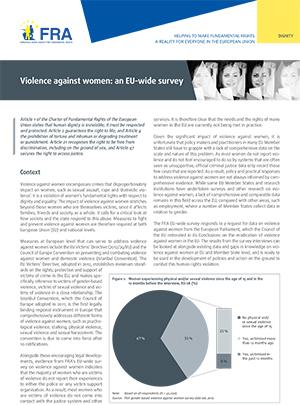
    Dit factsheet presenteert enkele voorbeelden van de enquêtebevindingen, naast algemene overwegingen als mogelijke stappen in de bestrijding van geweld tegen vrouwen.


  • Report / Paper / Summary
    5
    March
    2014
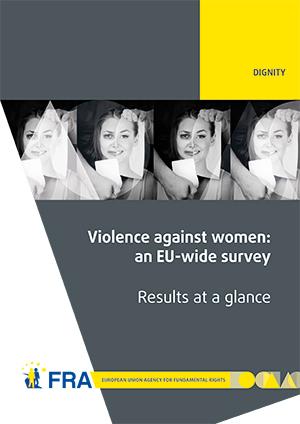
    Geweld tegen vrouwen ondermijnt de elementaire grondrechten van de vrouw, zoals waardigheid, toegang tot de rechter en gendergelijkheid. Zo is bijvoorbeeld een op de drie vrouwen slachtoffer geweest van fysiek en/of seksueel geweld sinds de leeftijd van 15 jaar, is een op de vijf vrouwen slachtoffer geweest van stalking en is een op de twee vrouwen geconfronteerd geweest met een of meerdere vormen van seksuele intimidatie.
    FRA
  • Report / Paper / Summary
    5
    March
    2014
    This FRA survey is the first of its kind on violence against women across the 28 Member States of the European Union (EU). It is based on interviews with 42,000 women across the EU, who were asked about their experiences of physical, sexual and psychological violence, including incidents of intimate partner violence (‘domestic violence’).
  • Report / Paper / Summary
    20
    December
    2013
    This thematic situation report examines the effectiveness of responses by public authorities, civil society organisations and others to counter racism, discrimination, intolerance and extremism in Greece and Hungary. The report goes on to make proposals for fighting racist crime, increasing trust in the police, and combating extremism throughout the EU.
  • Report / Paper / Summary
    December
    2013
    The Fundamental Rights Conference 2013 was organised by the European Union Agency for Fundamental Rights (FRA) in cooperation with the Lithuanian Presidency of the Council of the EU. The focus of the conference was on the issue of ‘Combating hate crime in the EU’.
  • In brief / Factsheet
    8
    November
    2013
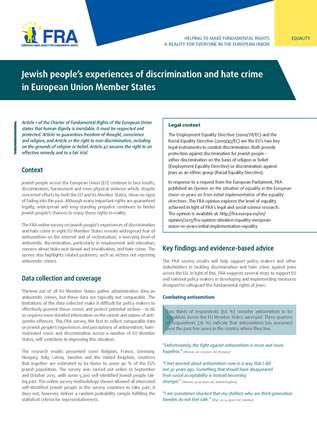
    Jewish people across the European Union (EU) continue to face insults, discrimination, harassment and even physical violence which, despite concerted efforts by both the EU and its Member States, show no signs of fading into the past. Although many important rights are guaranteed legally, widespread and long-standing prejudice continues to hinder Jewish people’s chances to enjoy these rights in reality.
  • Report / Paper / Summary
    8
    November
    2013
    This FRA survey is the first-ever to collect comparable data on Jewish people’s experiences and perceptions of antisemitism, hate-motivated crime and discrimination across a number of EU Member States, specifically in Belgium, France, Germany, Hungary, Italy, Latvia, Sweden and the United Kingdom. Its findings reveal a worrying level of discrimination, particularly in employment and education, a widespread fear of victimisation and heightening concern about antisemitism online.
  • Report / Paper / Summary
    18
    September
    2013
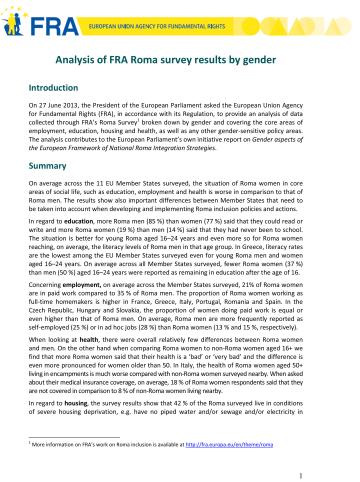
    This paper provides an analysis of data collected through FRA’s Roma Survey broken down by gender and covering the core areas of employment, education, housing and health, as well as any other gender‐sensitive policy areas. The paper is the result of a request made by the President of the European Parliament to the European Union Agency for Fundamental Rights (FRA) on 27 June 2013.
  • Report / Paper / Summary
    26
    July
    2013
    This report analyses the current international and European legal standards and compares EU Member States’ laws in the area of legal capacity. Evidence from fieldwork research supports the legal analysis, providing eloquent testimony to the obstacles many persons with disabilities face in securing equal enjoyment of their fundamental rights.
  • In brief / Factsheet
    17
    May
    2013
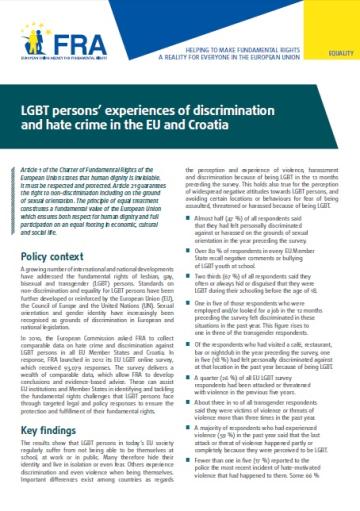
    In 2010, the European Commission asked FRA to collect comparable data on discrimination and hate crime experienced by LGBT persons in all EU Member States and Croatia. In response, FRA launched in 2012 its EU LGBT online survey, which received 93,079 responses.