eu-charter

Handvest van de grondrechten van de Europese Unie

Artikel 21 - Non-discriminatie

Artikel 21 - Non-discriminatie

1. Iedere discriminatie, met name op grond van geslacht, ras, kleur, etnische of sociale afkomst, genetische kenmerken, taal, godsdienst of overtuiging, politieke of andere denkbeelden, het behoren tot een nationale minderheid, vermogen, geboorte, een handicap, leeftijd of seksuele gerichtheid, is verboden.
2. Binnen de werkingssfeer van de Verdragen en onverminderd de bijzondere bepalingen ervan, is iedere discriminatie op grond van nationaliteit verboden.

Toelichtingen

  • Text:

    Lid 1 is geïnspireerd op artikel 13 VEG, nu vervangen door artikel 19 van het Verdrag betreffende de werking van de Europese Unie, en artikel 14 van het EVRM alsmede op artikel 11 van het Verdrag inzake de rechten van de mens en de biogeneeskunde wat het genetisch erfgoed betreft. Voor zover het samenvalt met artikel 14 van het EVRM wordt het in overeenstemming daarmee toegepast.
    Er is geen sprake van tegenstrijdigheid of onverenigbaarheid tussen lid 1 en artikel 19 van het Verdrag betreffende de werking van de Europese Unie, dat een ander toepassingsgebied en doel heeft: artikel 19 verleent de Unie de bevoegdheid om wetgevingshandelingen vast te stellen, met inbegrip van de harmonisatie van de wet- en regelgeving van de lidstaten, om bepaalde vormen van discriminatie, die in dat artikel exhaustief worden opgesomd, tegen te gaan. Die wetgevingshandelingen kunnen betrekking hebben op maatregelen van de autoriteiten van de lidstaten (alsmede op de betrekkingen tussen particulieren) op ongeacht welk gebied dat onder de bevoegdheid van de Unie valt. Artikel 21, lid 1, creëert daarentegen generlei bevoegdheid om met betrekking tot het optreden van de lidstaten of van particulieren antidiscriminatiewetten vast te stellen; evenmin bevat het een algeheel discriminatieverbod op deze zeer uiteenlopende gebieden. In plaats daarvan heeft dit lid alleen betrekking op discriminerend optreden van de instellingen en organen van de Unie, wanneer zij de hun op grond van de Verdragen verleende bevoegdheden uitoefenen, en van de lidstaten, wanneer zij het recht van de Unie uitvoeren. Lid 1 laat de omvang van de op grond van artikel 19 verleende bevoegdheden, en de uitlegging van dat artikel, derhalve onverlet.
    Lid 2 stemt overeen met artikel 18, eerste alinea, van het Verdrag betreffende de werking van de Europese Unie en moet in overeenstemming daarmee worden toegepast.

    Source:
    Publicatieblad van de Europese Unie C 303/17 - 14.12.2007
    Preamble - Explanations relating to the Charter of Fundamental Rights:
    Deze toelichtingen werden oorspronkelijk opgesteld onder de verantwoordelijkheid van het praesidium van de Conventie die het Handvest van de grondrechten van de Europese Unie heeft opgesteld. Zij zijn bijgewerkt onder de verantwoordelijkheid van het praesidium van de Europese Conventie, in het licht van de wijzigingen die door laatstgenoemde Conventie in het Handvest zijn aangebracht (met name in artikel 51 en 52) en van verdere ontwikkelingen in het recht van de Unie. Hoewel zij op zich geen juridische waarde hebben, vormen zij een waardevol hulpmiddel voor de interpretatie, bedoeld om de bepalingen van het Handvest te verduidelijken.

Jurisprudentie

Nationaal constitutioneel recht

57 results found

  • Portugal / Constitution of the Portuguese Republic
    Land:
    Portugal

    Article 13 (Principle of equality) (1) All citizens possess the same social dignity and are equal before the law. (2) No one may be privileged, favoured, prejudiced, deprived of any right or exempted from any duty for reasons of ancestry, sex, race, language, territory of origin, religion, political or ideological beliefs, education, economic situation, social circumstances or sexual orientation.

  • Preamble to the Constitution of 27 October 1946
    Land:
    France

    1 In the morrow of the victory achieved by the free peoples over the regimes that had sought to enslave and degrade humanity, the people of France proclaim anew that each human being, without distinction of race, religion or creed, possesses sacred and inalienable rights. They solemnly reaffirm the rights and freedoms of man and the citizen enshrined in the Declaration of Rights of 1789 and the fundamental principles acknowledged in the laws of the Republic. 3 The law guarantees women equal rights to those of men in all spheres. 5 Each person has the duty to work and the right to employment. No person may suffer prejudice in his work or employment by virtue of his origins, opinions or beliefs. 12 The Nation proclaims the solidarity and equality of all French people in bearing the burden resulting from national calamities.

  • Préambule de la Constitution du 27 octobre 1946
    Land:
    France

    1. Au lendemain de la victoire remportée par les peuples libres sur les régimes qui ont tenté d'asservir et de dégrader la personne humaine, le peuple français proclame à nouveau que tout être humain, sans distinction de race, de religion ni de croyance, possède des droits inaliénables et sacrés. Il réaffirme solennellement les droits et libertés de l'homme et du citoyen consacrés par la Déclaration des droits de 1789 et les principes fondamentaux reconnus par les lois de la République. 3. La loi garantit à la femme, dans tous les domaines, des droits égaux à ceux de l'homme. 5. Chacun a le devoir de travailler et le droit d'obtenir un emploi. Nul ne peut être lésé, dans son travail ou son emploi, en raison de ses origines, de ses opinions ou de ses croyances. 12. La Nation proclame la solidarité et l'égalité de tous les Français devant les charges qui résultent des calamités nationales.

  • Romania / Constitution of Romania
    Land:
    Romania

      Article 4 (...) (2) Romania is the common and indivisible homeland of all its citizens, without any discrimination on account of race, nationality, ethnic origin, language, religion, sex, opinion, political adherence, property or social origin.

  • Slovakia / Constitution of the Slovak Republic
    Land:
    Slovakia

    Article 12 (...) (2) Basic rights and freedoms on the territory of the Slovak Republic are guaranteed to everyone regardless of sex, race, color of skin, language, faith and religion, political, or other thoughts, national or social origin, belonging to a national minority or an ethnic group, property, gender, or any other status. No one may be harmed, preferred, or discriminated against on these grounds. (...)

  • Slovenia / Constitution of the Republic of Slovenia
    Land:
    Slovenia

    Article 14 In Slovenia everyone shall be guaranteed equal human rights and fundamental freedoms irrespective of national origin, race, sex, language, religion, political or other conviction, material standing, birth, education, social status, disability or any other personal circumstance. All are equal before the law.

  • Spain / Constitution of the Kingdom of Spain
    Land:
    Spain

    Section 14 Spaniards are equal before the law and may not in any way be discriminated against on account of birth, race, sex, religion, opinion or any other personal or social condition or circumstance.

  • Suomen perustuslaki
    Land:
    Finland

    6 § Yhdenvertaisuus Ihmiset ovat yhdenvertaisia lain edessä. Ketään ei saa ilman hyväksyttävää perustetta asettaa eri asemaan sukupuolen, iän, alkuperän, kielen, uskonnon, vakaumuksen, mielipiteen, terveydentilan, vammaisuuden tai muun henkilöön liittyvän syyn perusteella. Lapsia on kohdeltava tasa-arvoisesti yksilöinä, ja heidän tulee saada vaikuttaa itseään koskeviin asioihin kehitystään vastaavasti. Sukupuolten tasa-arvoa edistetään yhteiskunnallisessa toiminnassa sekä työelämässä, erityisesti palkkauksesta ja muista palvelussuhteen ehdoista määrättäessä, sen mukaan kuin lailla tarkemmin säädetään.

  • The Belgian Constitution
    Land:
    Belgium

    Article 11.Enjoyment of the rights and freedoms recognised for Belgians must be provided without discrimination. To this end, laws and federate laws* guarantee among others the rights and freedoms of ideological and philosophical minorities. Article 131.The law determines the measures designed to prevent all forms of discrimination for ideological or philosophical reasons.

  • The Constitution of the Republic of Cyprus
    Land:
    Cyprus

    Article 28
    1. All persons are equal before the law, the administration and justice and are entitled to equal protection thereof and treatment thereby.
    2. Every person shall enjoy all the rights and liberties provided for in this Constitution without any direct or indirect discrimination against any person on the ground of his community, race, religion, language, sex, political
    or other convictions, national or social descent, birth, colour, wealth, social class, or on any ground whatsoever, unless there is express provision to the contrary in this Constitution.
    3. No citizen shall be entitled to use or enjoy any privilege of any title of nobility or of social distinction within the territorial limits of the Republic.
    4. No title or nobility or other social distinction shall be conferred by or recognised in the Republic. Article 6
    Subject to the express provisions of this Constitution no law or decision of the House of Representatives or of any of the Communal Chambers, and no act or decision of any organ, authority or person in the Republic exercising executive power or administrative functions, shall discriminate against any of the two Communities or any person as a person or by virtue of being a member of a Community.

  • The Constitutional Act of Denmark
    Land:
    Denmark

    Section 70. No person shall by reason of his creed or descent be deprived of access to the full enjoyment of civic and political rights, nor shall he escape compliance with any common civic duty for such reasons.
    Section 71. Subsection 1. Personal liberty shall be inviolable. No Danish subject shall, in any manner whatsoever, be deprived of his liberty because of his political or religious convictions or because of his descent.
    Section 83. All legislative privileges attaching to nobility, title, and rank shall be abolished.

  • The Fundamental Law of Hungary
    Land:
    Hungary

    Article XV (Freedom and Responsibility) [...] (2) Hungary shall guarantee fundamental rights to everyone without discrimination and in particular without discrimination on grounds of race, colour, sex, disability, language, religion, political or other opinion, national or social origin, property, birth or any other status. [...]
    (4) By means of separate measures, Hungary shall help to achieve equality of
    opportunity and social inclusion.

  • Tο Σύνταγμα της Κυπριακής Δημοκρατίας
    Land:
    Cyprus

    ΑΡΘΡΟΝ 28
    1. Πάντες είναι ίσοι ενώπιον του νόμου, της διοικήσεως και της δικαιοσύνης και δικαιούνται να τύχωσι ίσης προστασίας και μεταχειρίσεως.
    2. Έκαστος απολαύει πάντων των δικαιωμάτων και των ελευθεριών των προβλεπομένων υπό του Συντάγματος άνευ ουδεμιάς δυσμενούς διακρίσεως αμέσου ή εμμέσου εις βάρος οιουδήποτε ατόμου ένεκα της κοινότητος, της φυλής, του χρώματος, της θρησκείας, της γλώσσης, του φύλου, των πολιτικών ή άλλων πεποιθήσεων, της εθνικής ή κοινωνικής καταγωγής, της γεννήσεως, του πλούτου, της κοινωνικής τάξεως αυτού ή ένεκα οιουδήποτε άλλου λόγου, εκτός εάν διά ρητής διατάξεως του Συντάγματος ορίζηται το αντίθετον.
    3. Ουδείς πολίτης δικαιούται να χρησιμοποιή τίτλον ευγενείας ή κοινωνικής διακρίσεως ή να απολαύη οιουδήποτε προνομίου εκ ταύτης εντός των εδαφικών ορίων της Δημοκρατίας.
    4. Ουδείς τίτλος ευγενείας ή άλλης κοινωνικής διακρίσεως απονέμεται ή αναγνωρίζεται εν τη Δημοκρατία. ΑΡΘΡΟΝ 6
    Τηρουμένων των ρητών διατάξεων του Συντάγματος ουδείς νόμος ή ουδεμία απόφασις της Βουλής ή οιασδήποτε των Κοινοτικών Συνελεύσεων ως και ουδεμία πράξις ή απόφασις οιουδήποτε οργάνου, αρχής ή προσώπου εν τη Δημοκρατία ασκούντος εκτελεστικήν εξουσίαν ή διοικητικόν λειτούργημα θέλει υποβάλλει εις δυσμενή διάκρισιν οιανδήποτε εκ των δύο κοινοτήτων ή οιονδήποτε πρόσωπον ως τοιούτον ή υπό την ιδιότητα αυτού ως μέλους κοινότητος.

  • Ustav Republike Hrvatske
    Land:
    Croatia

    Članak 14.
    (1) Svatko u Republici Hrvatskoj ima prava i slobode, neovisno o njegovoj rasi, boji kože, spolu, jeziku, vjeri, političkom ili drugom uvjerenju, nacionalnom ili socijalnom podrijetlu, imovini, rođenju, naobrazbi, društvenom položaju ili drugim osobinama.

    Članak 39.
    Zabranjeno je i kažnjivo svako pozivanje ili poticanje na rat ili uporabu nasilja, na nacionalnu, rasnu ili vjersku mržnju ili bilo koji oblik nesnošljivosti.

  • Võrdse kohtlemise seadus
    Land:
    Estonia

    § 1. Seaduse eesmärk ja reguleerimisala
    (1) Seaduse eesmärk on tagada isikute kaitse diskrimineerimise eest rahvuse (etnilise kuuluvuse), rassi, nahavärvuse, usutunnistuse või veendumuste, vanuse, puude või seksuaalse sättumuse alusel.
    (2) Käesoleva paragrahvi lõikes 1 nimetatud eesmärgi saavutamiseks sätestab seadus:
    1) võrdse kohtlemise põhimõtted;
    2) ülesanded võrdse kohtlemise põhimõtte rakendamisel ja edendamisel;
    3) diskrimineerimisvaidluste lahendamise.

  • Το Σύνταγμα της Ελλάδας
    Land:
    Greece

    Άρθρο 4 (5) Oι Έλληνες πoλίτες συνεισφέρoυν χωρίς διακρίσεις στα δημόσια βάρη, ανάλoγα με τις δυνάμεις τoυς. […] Άρθρο 5 (2) Όλoι όσoι βρίσκoνται στην Eλληνική Eπικράτεια απoλαμβάνoυν την απόλυτη πρoστασία της ζωής, της τιμής και της ελευθερίας τoυς, χωρίς διάκριση εθνικότητας, φυλής, γλώσσας και θρησκευτικών ή πoλιτικών πεπoιθήσεων. Eξαιρέσεις επιτρέπoνται στις περιπτώσεις πoυ πρoβλέπει τo διεθνές δίκαιo. [...]

  • КОНСТИТУЦИЯ на Република България
    Land:
    Bulgaria

    Чл. 6. (1) Всички хора се раждат свободни и равни по достойнство и права. (2) Всички граждани са равни пред закона. Не се допускат никакви ограничения на правата или привилегии, основани на раса, народност, етническа принадлежност, пол, произход, религия, образование, убеждения, политическа принадлежност, лично и обществено положение или имуществено състояние.

EU-recht

33 results found

  • Directive 2006/54/EC of the European Parliament and of the Council of 5 July 2006 on the implementation of the principle of equal opportunities and equal treatment of men and women in matters of employment and occupation (recast)

    Preamble 


    (5) Articles 21 and 23 of the Charter of Fundamental Rights of the European Union also prohibit any discrimination on grounds of sex and enshrine the right to equal treatment between men and women in all areas, including employment, work and pay.


    (6) Harassment and sexual harassment are contrary to the principle of equal treatment between men and women and constitute discrimination on grounds of sex for the purposes of this Directive. These forms of discrimination occur not only in the workplace, but also in the context of access to employment, vocational training and promotion. They should therefore be prohibited and should be subject to effective, proportionate and dissuasive penalties.

    (7) In this context, employers and those responsible for vocational training should be encouraged to take measures to combat all forms of discrimination on grounds of sex and, in particular, to take preventive measures against harassment and sexual harassment in the workplace and in access to employment, vocational training and promotion, in accordance with national law and practice.

    (8) The principle of equal pay for equal work or work of equal value as laid down by Article 141 of the Treaty and consistently upheld in the case-law of the Court of Justice constitutes an important aspect of the principle of equal treatment between men and women and an essential and indispensable part of the acquis communautaire, including the case-law of the Court concerning sex discrimination. It is therefore appropriate to make further provision for its implementation.


    (11) The Member States, in collaboration with the social partners, should continue to address the problem of the continuing gender-based wage differentials and marked gender segregation on the labour market by means such as flexible working time arrangements which enable both men and women to combine family and work commitments more successfully. This could also include appropriate parental leave arrangements which could be taken up by either parent as well as the provision of accessible and affordable child-care facilities and care for dependent persons.


    (26) In the Resolution of the Council and of the Ministers for Employment and Social Policy, meeting within the Council, of 29 June 2000 on the balanced participation of women and men in family and working life , Member States were encouraged to consider examining the scope for their respective legal systems to grant working men an individual and non‐transferable right to paternity leave, while maintaining their rights relating to employment.

    Article 2: Definitions

    1.   For the purposes of this Directive, the following definitions shall apply:

    (a) ‘direct discrimination’: where one person is treated less favourably on grounds of sex than another is, has been or would be treated in a comparable situation;

    (b) ‘indirect discrimination’: where an apparently neutral provision, criterion or practice would put persons of one sex at a particular disadvantage compared with persons of the other sex, unless that provision, criterion or practice is objectively justified by a legitimate aim, and the means of achieving that aim are appropriate and necessary;

    (c) ‘harassment’: where unwanted conduct related to the sex of a person occurs with the purpose or effect of violating the dignity of a person, and of creating an intimidating, hostile, degrading, humiliating or offensive environment;

    (d) ‘sexual harassment’: where any form of unwanted verbal, non-verbal or physical conduct of a sexual nature occurs, with the purpose or effect of violating the dignity of a person, in particular when creating an intimidating, hostile, degrading, humiliating or offensive environment;

    (e)‘pay’: the ordinary basic or minimum wage or salary and any other consideration, whether in cash or in kind, which the worker receives directly or indirectly, in respect of his/her employment from his/her employer;

    (f) ‘occupational social security schemes’: schemes not governed by Council Directive 79/7/EEC of 19 December 1978 on the progressive implementation of the principle of equal treatment for men and women in matters of social security (16) whose purpose is to provide workers, whether employees or self-employed, in an undertaking or group of undertakings, area of economic activity, occupational sector or group of sectors with benefits intended to supplement the benefits provided by statutory social security schemes or to replace them, whether membership of such schemes is compulsory or optional.

    2.   For the purposes of this Directive, discrimination includes:

    (a) harassment and sexual harassment, as well as any less favourable treatment based on a person's rejection of or submission to such conduct;

    (b) instruction to discriminate against persons on grounds of sex;

    (c) any less favourable treatment of a woman related to pregnancy or maternity leave within the meaning of Directive 92/85/EEC.

    CHAPTER 1: Equal pay

    Article 4: Prohibition of discrimination

    For the same work or for work to which equal value is attributed, direct and indirect discrimination on grounds of sex with regard to all aspects and conditions of remuneration shall be eliminated.

    In particular, where a job classification system is used for determining pay, it shall be based on the same criteria for both men and women and so drawn up as to exclude any discrimination on grounds of sex.

    CHAPTER 2 : Equal treatment in occupational social security schemes

    Article 5: Prohibition of discrimination

    Without prejudice to Article 4, there shall be no direct or indirect discrimination on grounds of sex in occupational social security schemes, in particular as regards:

    (a) the scope of such schemes and the conditions of access to them;

    (b) the obligation to contribute and the calculation of contributions;

    (c) the calculation of benefits, including supplementary benefits due in respect of a spouse or dependants, and the conditions governing the duration and retention of entitlement to benefits.

    Article 7: Material scope

    1.   This Chapter applies to:

    (a) occupational social security schemes which provide protection against the following risks:

    (i) sickness,

    (ii)invalidity,

    (iii) old age, including early retirement,

    (iv) industrial accidents and occupational diseases,

    (v) unemployment;

    (b) occupational social security schemes which provide for other social benefits, in cash or in kind, and in particular survivors' benefits and family allowances, if such benefits constitute a consideration paid by the employer to the worker by reason of the latter's employment.

    2.   This Chapter also applies to pension schemes for a particular category of worker such as that of public servants if the benefits payable under the scheme are paid by reason of the employment relationship with the public employer. The fact that such a scheme forms part of a general statutory scheme shall be without prejudice in that respect.

    CHAPTER 3 : Equal treatment as regards access to employment, vocational training and promotion and working conditions

    Article 14: Prohibition of discrimination

    1.   There shall be no direct or indirect discrimination on grounds of sex in the public or private sectors, including public bodies, in relation to:

    (a) conditions for access to employment, to self-employment or to occupation, including selection criteria and recruitment conditions, whatever the branch of activity and at all levels of the professional hierarchy, including promotion;

    (b) access to all types and to all levels of vocational guidance, vocational training, advanced vocational training and retraining, including practical work experience;

    (c) employment and working conditions, including dismissals, as well as pay as provided for in Article 141 of the Treaty;

    (d) membership of, and involvement in, an organisation of workers or employers, or any organisation whose members carry on a particular profession, including the benefits provided for by such organisations.

    2.   Member States may provide, as regards access to employment including the training leading thereto, that a difference of treatment which is based on a characteristic related to sex shall not constitute discrimination where, by reason of the nature of the particular occupational activities concerned or of the context in which they are carried out, such a characteristic constitutes a genuine and determining occupational requirement, provided that its objective is legitimate and the requirement is proportionate.

  • Action plan on Integration and Inclusion 2021-2027

    .

  • A Union of Equality: EU anti-racism action plan 2020–2025

    .

  • Union of Equality: EU Roma strategic framework on equality, inclusion and participation

    .

  • European Parliament resolution on the need for a strengthened post-2020 Strategic EU Framework for National Roma Inclusion Strategies and stepping up the fight against anti-Gypsyism (2019/2509(RSP))

    .

  • Treaty on the Functioning of the European Union

    Article 18

    (ex Article 12 TEC)

    Within the scope of application of the Treaties, and without prejudice to any special provisions contained therein, any discrimination on grounds of nationality shall be prohibited.

    The European Parliament and the Council, acting in accordance with the ordinary legislative procedure, may adopt rules designed to prohibit such discrimination.

  • Treaty on the Functioning of the European Union

    Article 19

    (ex Article 13 TEC)

    1. Without prejudice to the other provisions of the Treaties and within the limits of the powers conferred by them upon the Union, the Council, acting unanimously in accordance with a special legislative procedure and after obtaining the consent of the European Parliament, may take appropriate action to combat discrimination based on sex, racial or ethnic origin, religion or belief, disability, age or sexual orientation.

    2. By way of derogation from paragraph 1, the European Parliament and the Council, acting in accordance with the ordinary legislative procedure, may adopt the basic principles of Union incentive measures, excluding any harmonisation of the laws and regulations of the Member States, to support action taken by the Member States in order to contribute to the achievement of the objectives referred to in paragraph 1.

  • Directive (EU) 2018/1808 of the European Parliament and of the Council of 14 November 2018 amending Directive 2010/13/EU on the coordination of certain provisions laid down by law, regulation or administrative action in Member States concerning the provis

    .

  • Directive (EU) 2019/882 of the European Parliament and of the Council of 17 April 2019 on the accessibility requirements for products and services

    .

  • Directive (EU) 2018/1808 of the European Parliament and of the Council of 14 November 2018 amending Directive 2010/13/EU on the coordination of certain provisions laid down by law

    Article 6

    1. Without prejudice to the obligation of Member States to respect and protect human dignity, Member States shall ensure by appropriate means that audiovisual media services provided by media service providers under their jurisdiction do not contain any:

    (a) incitement to violence or hatred directed against a group of persons or a member of a group based on any of the grounds referred to in Article 21 of the Charter;

    (b) public provocation to commit a terrorist offence as set out in Article 5 of Directive (EU) 2017/541.

    2. The measures taken for the purposes of this Article shall be necessary and proportionate and shall respect the rights and observe principles set out in the Charter.’;

    [...]

    Article 28b

    ...

    (b) the general public from programmes, user-generated videos and audiovisual commercial communications containing incitement to violence or hatred directed against a group of persons or a member of a group based on any of the grounds referred to in Article 21 of the Charter;

Internationaal recht

4 results found

  • Committee on the Elimination of Racial Discrimination, General recommendation No. 35 Combating racist hate speech

    ‘24. Article 5 of the Convention enshrines the obligation of States parties to prohibit and eliminate racial discrimination and to guarantee the right of everyone, without distinction as to race, colour, or national or ethnic origin, to equality before the law, notably in the enjoyment of civil, political, economic, social and cultural rights, including the rights to freedom of thought, conscience and religion, freedom of opinion and expression, and freedom of peaceful assembly and association.‘
    ‘25. The Committee considers that the expression of ideas and opinions made in the context of academic debates, political engagement or similar activity, and without incitement to hatred, contempt, violence or discrimination, should be regarded as legitimate exercises of the right to freedom of expression, even when such ideas are controversial.‘
    ‘26. In addition to its inclusion in article 5, freedom of opinion and expression is recognized as a fundamental right in a broad range of international instruments, including the Universal Declaration of Human Rights, which affirm that everyone has the right to hold opinions and to seek, receive and impart information and ideas of all kinds through any media and regardless of frontiers. The right to freedom of expression is not unlimited but carries with it special duties and responsibilities. It may therefore be subject to certain restrictions, but only if they are provided by law and are necessary for protection of the rights or reputations of others and for the protection of national security or of public order, or of public health or morals. Freedom of expression should not aim at the destruction of the rights and freedoms of others, including the right to equality and non-discrimination.‘

  • Human Rights Council Resolution 26/15 (2014) - Accelerating efforts to eliminate all forms of violence against women: violence against women as a barrier to women’s political and economic empowerment

    ‘6. Emphasizes that the prohibition of discrimination against women on grounds of sex, pregnancy, maternity, parenthood or care work should be enforced for all women in all areas of work, including in the informal sector;
    7. Requests States to take measures to overcome the barriers to women’s economic opportunities resulting from maternity and the disproportionate burden of unpaid care work in order to permit choice by women and men as to how they allocate work and family duties and in order to enable the complementarity of work and family between women and men;
    8. Urges States to take measures to reduce informal work for women, with a focus on female participation in economic life and by increasing women’s economic opportunities, particularly in formal employment, in order to promote gender equality; [...]‘

  • Human Rights Council Resolution 26/5 (2014) - Elimination of discrimination against women
  • Human Rights Council Resolution 35/18 (2017) - Elimination of discrimination against women and girls

Producten

  • In brief / Factsheet
    5
    March
    2014
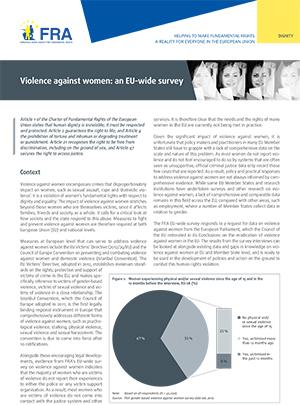
    Dit factsheet presenteert enkele voorbeelden van de enquêtebevindingen, naast algemene overwegingen als mogelijke stappen in de bestrijding van geweld tegen vrouwen.


  • Report / Paper / Summary
    5
    March
    2014
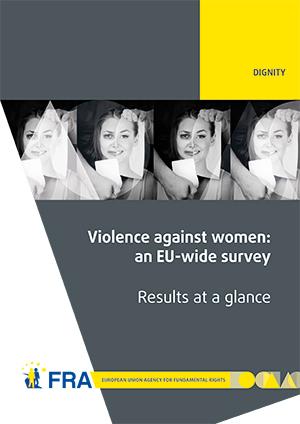
    Geweld tegen vrouwen ondermijnt de elementaire grondrechten van de vrouw, zoals waardigheid, toegang tot de rechter en gendergelijkheid. Zo is bijvoorbeeld een op de drie vrouwen slachtoffer geweest van fysiek en/of seksueel geweld sinds de leeftijd van 15 jaar, is een op de vijf vrouwen slachtoffer geweest van stalking en is een op de twee vrouwen geconfronteerd geweest met een of meerdere vormen van seksuele intimidatie.
    FRA
  • Report / Paper / Summary
    5
    March
    2014
    This FRA survey is the first of its kind on violence against women across the 28 Member States of the European Union (EU). It is based on interviews with 42,000 women across the EU, who were asked about their experiences of physical, sexual and psychological violence, including incidents of intimate partner violence (‘domestic violence’).
  • Report / Paper / Summary
    20
    December
    2013
    This thematic situation report examines the effectiveness of responses by public authorities, civil society organisations and others to counter racism, discrimination, intolerance and extremism in Greece and Hungary. The report goes on to make proposals for fighting racist crime, increasing trust in the police, and combating extremism throughout the EU.
  • Report / Paper / Summary
    December
    2013
    The Fundamental Rights Conference 2013 was organised by the European Union Agency for Fundamental Rights (FRA) in cooperation with the Lithuanian Presidency of the Council of the EU. The focus of the conference was on the issue of ‘Combating hate crime in the EU’.
  • In brief / Factsheet
    8
    November
    2013
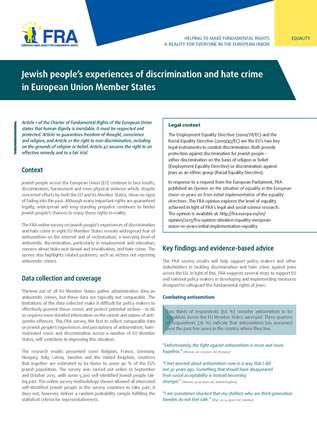
    Jewish people across the European Union (EU) continue to face insults, discrimination, harassment and even physical violence which, despite concerted efforts by both the EU and its Member States, show no signs of fading into the past. Although many important rights are guaranteed legally, widespread and long-standing prejudice continues to hinder Jewish people’s chances to enjoy these rights in reality.
  • Report / Paper / Summary
    8
    November
    2013
    This FRA survey is the first-ever to collect comparable data on Jewish people’s experiences and perceptions of antisemitism, hate-motivated crime and discrimination across a number of EU Member States, specifically in Belgium, France, Germany, Hungary, Italy, Latvia, Sweden and the United Kingdom. Its findings reveal a worrying level of discrimination, particularly in employment and education, a widespread fear of victimisation and heightening concern about antisemitism online.
  • Report / Paper / Summary
    18
    September
    2013
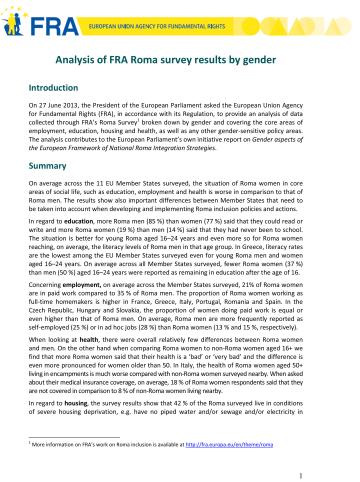
    This paper provides an analysis of data collected through FRA’s Roma Survey broken down by gender and covering the core areas of employment, education, housing and health, as well as any other gender‐sensitive policy areas. The paper is the result of a request made by the President of the European Parliament to the European Union Agency for Fundamental Rights (FRA) on 27 June 2013.
  • Report / Paper / Summary
    26
    July
    2013
    This report analyses the current international and European legal standards and compares EU Member States’ laws in the area of legal capacity. Evidence from fieldwork research supports the legal analysis, providing eloquent testimony to the obstacles many persons with disabilities face in securing equal enjoyment of their fundamental rights.
  • In brief / Factsheet
    17
    May
    2013
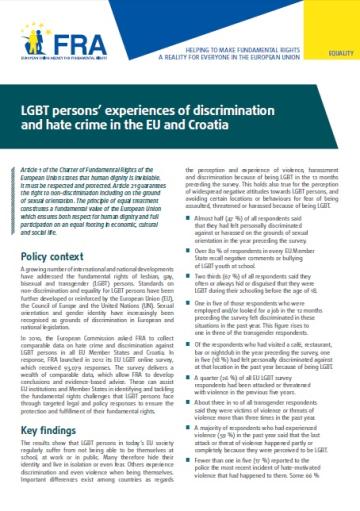
    In 2010, the European Commission asked FRA to collect comparable data on discrimination and hate crime experienced by LGBT persons in all EU Member States and Croatia. In response, FRA launched in 2012 its EU LGBT online survey, which received 93,079 responses.