This report provides a partial update on the findings of the 2017 European Union Agency for Fundamental Rights (FRA) report Surveillance by intelligence services: Fundamental rights safeguards and remedies in the EU. It was prepared at the request of the European Parliament, which asked FRA to update its 2017 findings to support the work of its committee of inquiry to investigate the use of Pegasus and equivalent surveillance spyware (PEGA).
Artificial intelligence is everywhere and affects everyone – from deciding what content people see on their social media feeds to determining who will receive state benefits. AI technologies are typically based on algorithms that make predictions to support or even fully automate decision-making.
Europe stands at a delicate moment in its history. It is a moment of existential significance for the wellbeing and sustainability of our societies. It is emerging from the pandemic caused by the coronavirus disease, only to face a set of major overlapping challenges. These pose profound questions about the political, economic and societal future of the continent. To discuss elements of a human rights vision for the future and to identify opportunities for action, FRA brought together a group of sixty human rights leaders and experts with diverse backgrounds
from across the continent. This report distils the meeting discussions, including analysis and ideas, and concludes with proposals for action. It does not represent the views either of individual participants or of FRA.
Europe stands at a delicate moment in its history, facing a convergence of major tests. Each of them taken on their own is significant. Together, they pose profound questions about the political, economic, and societal future of the continent. This is a moment for strong commitment to put human rights at the heart of our vision for Europe’s future. It is also time to demonstrate our determination to work together to this end. Against this backdrop, the EU Agency for Fundamental Rights (FRA) brought together around sixty human rights leaders and experts from across the continent to discuss elements of a human rights vision for the future and to identify opportunities for action. A full conference report will be available soon, including the specific ideas and proposals which arose from the meeting. Meanwhile, this is a summary of the conclusions.
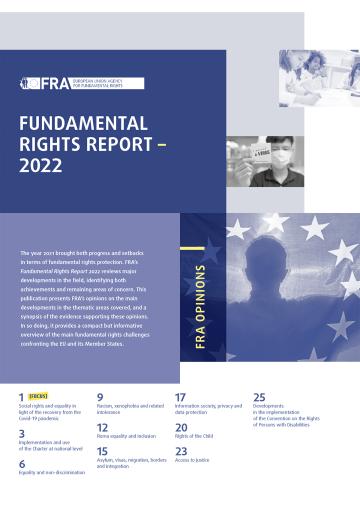
FRA’s Fundamental Rights Report 2022 reviews major developments in the field in 2021, identifying both achievements and areas of concern. It also presents FRA’s opinions on these developments, including a synopsis of the evidence supporting these opinions.
This focus looks at the impact of the pandemic on social rights. It examines the measures in national recovery and resilience plans that address the social vulnerabilities among a variety of population groups in the EU, including women, children and young people in situations of vulnerability, people with disabilities, older people, Roma and people in precarious working conditions.
Het jaar 2021 kende zowel vooruitgang als tegenslagen bij de bescherming van de grondrechten. Het Verslag over de grondrechten 2022 van FRA evalueert de belangrijkste ontwikkelingen op het gebied van de grondrechten, waarbij niet alleen wordt ingegaan op de successen die zijn behaald, maar ook wordt gewezen op de resterende punten van zorg. Deze publicatie zet de adviezen van FRA op een rij over de belangrijkste ontwikkelingen binnen deze thematische gebieden en geeft in het kort de feitelijke gegevens weer waarop deze adviezen berusten.
Kinderen hebben net als ieder ander rechten. Zij genieten alle mensen- en grondrechten en vallen onder speciale regelgeving in verband met hun specifieke kenmerken. Dit handboek wil illustreren hoe de Europese wetgeving en jurisprudentie voorzien in de specifieke belangen en behoeften van kinderen, maar laat ook zien hoe belangrijk ouders en voogden en andere wettelijke vertegenwoordigers zijn. Het geeft in voorkomend geval aan op welke gebieden de rechten en verantwoordelijkheden voornamelijk bij de verzorgers van kinderen liggen. Dit handboek beoogt om de bekendheid met en de kennis van de rechtsnormen die de rechten van het kind in Europa beschermen en bevorderen, te vergroten. Het is een naslagwerk over het recht van de Europese Unie (EU) en de Raad van Europa (RvE) met betrekking tot deze onderwerpen en licht toe hoe elk onderwerp is geregeld in het EU-recht, met inbegrip van het Handvest van de grondrechten van de Europese Unie, en in het Europees Verdrag voor de Rechten van de Mens (EVRM), het Europees Sociaal Handvest (ESH) en andere RvE-instrumenten.
Het jaar 2020 kende zowel vooruitgang als
teleurstellingen bij de bescherming van grondrechten.
In het Verslag over de grondrechten 2021 van het
FRA worden de belangrijkste ontwikkelingen op het
gebied van de grondrechten geëvalueerd en wordt
niet alleen ingegaan op de behaalde successen,
maar ook gewezen op blijvende punten van zorg.
FRA’s Fundamental Rights Report 2021 reviews major developments in the field in 2020, identifying both achievements and areas of concern. It also presents FRA’s opinions on these developments, including a synopsis of the evidence supporting these opinions. This year’s focus chapter explores the impact of the COVID-19 pandemic on fundamental rights. The remaining chapters cover: the EU Charter of Fundamental Rights; equality and non-discrimination; racism, xenophobia and related intolerance; Roma equality and inclusion; asylum, borders and migration; information society, privacy and data protection; rights of the child; access to justice; and the implementation of the Convention on the Rights of Persons with Disabilities.



 Report / Paper / Summary4December2025
 Report / Paper / Summary24May2023
 Report / Paper / Summary8December2022