Data

Adatvédelem, magánélet és új technológiák

<p>More of our everyday lives are online &mdash; both at work and home. Meanwhile, terror attacks intensify calls for more surveillance. Concerns grow over the safety of our privacy and personal data.</p>
<p>FRA helps lawmakers and practitioners protect your rights in a connected world.</p>

    Termékek

    Publications and Data

    Displaying results 21 - 30 of 106
    Report / Paper / Summary
    24
    May
    2023
    This report provides a partial update on the findings of the 2017 European Union Agency for Fundamental Rights (FRA) report Surveillance by intelligence services: Fundamental rights safeguards and remedies in the EU. It was prepared at the request of the European Parliament, which asked FRA to update its 2017 findings to support the work of its committee of inquiry to investigate the use of Pegasus and equivalent surveillance spyware (PEGA).
    Report / Paper / Summary
    8
    December
    2022
    Artificial intelligence is everywhere and affects everyone – from deciding what content people see on their social media feeds to determining who will receive state benefits. AI technologies are typically based on algorithms that make predictions to support or even fully automate decision-making.
    Report / Paper / Summary
    11
    November
    2022
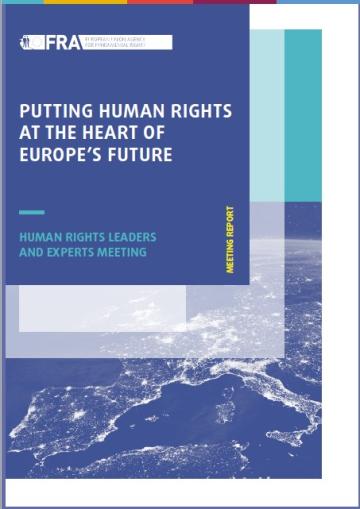
    Europe stands at a delicate moment in its history. It is a moment of existential significance for the wellbeing and sustainability of our societies. It is emerging from the pandemic caused by the coronavirus disease, only to face a set of major overlapping challenges. These pose profound questions about the political, economic and societal future of the continent. To discuss elements of a human rights vision for the future and to identify opportunities for action, FRA brought together a group of sixty human rights leaders and experts with diverse backgrounds
    from across the continent. This report distils the meeting discussions, including analysis and ideas, and concludes with proposals for action. It does not represent the views either of individual participants or of FRA.
    Report / Paper / Summary
    16
    September
    2022
    Europe stands at a delicate moment in its history, facing a convergence of major tests. Each of them taken on their own is significant. Together, they pose profound questions about the political, economic, and societal future of the continent. This is a moment for strong commitment to put human rights at the heart of our vision for Europe’s future. It is also time to demonstrate our determination to work together to this end. Against this backdrop, the EU Agency for Fundamental Rights (FRA) brought together around sixty human rights leaders and experts from across the continent to discuss elements of a human rights vision for the future and to identify opportunities for action. A full conference report will be available soon, including the specific ideas and proposals which arose from the meeting. Meanwhile, this is a summary of the conclusions.
    Fundamental Rights Report
    8
    June
    2022
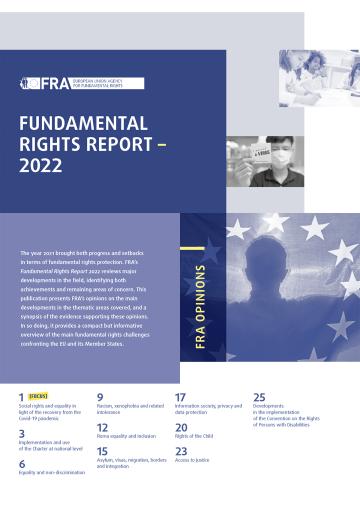
    FRA’s Fundamental Rights Report 2022 reviews major developments in the field in 2021, identifying both achievements and areas of concern. It also presents FRA’s opinions on these developments, including a synopsis of the evidence supporting these opinions.
    Fundamental Rights Report
    8
    June
    2022
    This focus looks at the impact of the pandemic on social rights. It examines the measures in national recovery and resilience plans that address the social vulnerabilities among a variety of population groups in the EU, including women, children and young people in situations of vulnerability, people with disabilities, older people, Roma and people in precarious working conditions.
    Fundamental Rights Report
    8
    June
    2022
    A 2021-es év egyaránt hozott előrelépést és visszaesést az alapvető jogok védelme terén. Az FRA 2022-es Alapjogi jelentése áttekinti a terület főbb fejleményeit, valamint meghatározza az elért eredményeket és a fennmaradó aggályos területeket. Ez a kiadvány bemutatja az FRA véleményét az érintett témakörök főbb fejleményeiről, valamint a véleményeket alátámasztó bizonyítékok összefoglalóját.
    Handbook / Guide / Manual
    7
    April
    2022
    BG, EL, HU, RO, SV, and UK version now available
    17 April 2025
    A gyermekek teljes jogú jogosultak. Megilleti őket az összes emberi és alapvető jog, és sajátos jellemzőikre tekintettel rájuk különleges szabályok vonatkoznak. E kézikönyv célja annak bemutatása, hogy az európai jog és ítélkezési gyakorlat hogyan kezeli a gyermekek sajátos érdekeit és szükségleteit. Bemutatja a szülők és gyámok vagy más törvényes képviselők jelentőségét is, és adott esetben utal arra, ha egyes jogok és felelősségek elsősorban a gyermekek gondviselőit illetik. Forrásként szolgál mind az Európai Unió (EU), mind az Európa Tanács e témákhoz kapcsolódó jogával kapcsolatban, és kifejti, hogy az egyes kérdéseket hogyan szabályozza az uniós jog, ezen belül az Európai Unió Alapjogi Chartája, illetve az emberi jogok európai egyezménye (EJEE), az Európai Szociális Charta és az Európa Tanács más eszközei.
    Publication series: FRA-CoE Handbooks
    Fundamental Rights Report
    10
    June
    2021
    A 2020-as év előrelépést és egyúttal visszaeséseket
    is hozott az alapjogok védelme terén. Az FRA 2021. évi
    alapjogi jelentése áttekinti a terület legfontosabb
    fejleményeit, és felhívja a figyelmet az eredményekre,
    illetve az aggályos kérdésekre.
    Fundamental Rights Report
    10
    June
    2021
    FRA’s Fundamental Rights Report 2021 reviews major developments in the field in 2020, identifying both achievements and areas of concern. It also presents FRA’s opinions on these developments, including a synopsis of the evidence supporting these opinions. This year’s focus chapter explores the impact of the COVID-19 pandemic on fundamental rights. The remaining chapters cover: the EU Charter of Fundamental Rights; equality and non-discrimination; racism, xenophobia and related intolerance; Roma equality and inclusion; asylum, borders and migration; information society, privacy and data protection; rights of the child; access to justice; and the implementation of the Convention on the Rights of Persons with Disabilities.