eu-charter

Karta praw podstawowych Unii Europejskiej

Artykuł 25 - Prawa osób w podeszłym wieku

Artykuł 25 - Prawa osób w podeszłym wieku

Unia uznaje i szanuje prawo osób w podeszłym wieku do godnego i niezależnego życia oraz do uczestniczenia w życiu społecznym i kulturalnym.

Wyjaśnienia

  • Text:

    Artykuł ten wywodzi się z artykułu 23 zmienionej Europejskiej Karty Społecznej oraz artykułów 24 i 25 Wspólnotowej Karty Socjalnych Praw Podstawowych Pracowników. Uczestnictwo w życiu kulturalnym i społecznym oczywiście obejmuje także uczestnictwo w życiu politycznym.

    Source:
    Dziennik Urzędowy Unii Europejskiej C 303/17 - 14.12.2007
    Preamble - Explanations relating to the Charter of Fundamental Rights:
    Poniższe wyjaśnienia zostały pierwotnie sporządzone w ramach uprawnień Prezydium Konwentu, który opracował Kartę praw podstawowych Unii Europejskiej. Zostały uaktualnione pod kierunkiem Prezydium Konwentu Europejskiego z uwzględnieniem dostosowań dokonanych w tekście Karty przez ten Konwent (w szczególności w artykułach 51 i 52) oraz ewolucji prawa Unii. Mimo, że wyjaśnienia te nie posiadają wartości prawnej, są one cennym narzędziem wykładni przeznaczonym do wyjaśnienia postanowień Karty.

Orzecznictwo

krajowego prawa konstytucyjnego

30 results found

  • Constitution of the Italian Republic
    Kraj:
    Italy

    Art. 38. (...) Workers have the right to be assured adequate means for their needs and necessities in the case of accidents, illness, disability, old age and involuntary unemployment. (…)

  • Sweden / Instrument of Government
    Kraj:
    Sweden

    Chapter 1 - Basic principles of the form of government:
    Article 2 (…) The public institutions shall combat discrimination of persons on grounds of gender, colour, national or ethnic origin, linguistic or religious affiliation, functional disability, sexual orientation, age or other circumstance affecting the individual. (...)

  • Constitution of Finland
    Kraj:
    Finland

    Section 19 The right to social security [...] Everyone shall be guaranteed by an Act the right to basic subsistence in the event of unemployment, illness, and disability and during old age as well as at the birth of a child or the loss of a provider.

  • Constitution of Ireland
    Kraj:
    Ireland

    Article 45.4.1. The state pledges itself to safeguard with especial care the economic interests of the weaker sections of the community, and, where necessary,
    to contribute to the support of the infirm, the
    widow, the orphan, and the aged. Article 45.4.2. The state shall endeavour to ensure that the strength and health of workers, men and women, and the tender age of children shall not be abused and that citizens shall not be forced by economic necessity to enter avocations unsuited to their sex, age or strength.

  • Constitution of Malta
    Kraj:
    Malta

     Constitution of MaltaArticle 17(…) (2) Workers are entitled to reasonable insurance on a contributory basis for their requirements in case of accident, illness, disability, old-age and involuntary unemployment. (…)

  • Constitution of the Republic of Bulgaria
    Kraj:
    Bulgaria

    Art. 51. [...] (3) The aged without relatives and unable to support themselves [...] shall receive special protection from the State and society.

  • Constitution of the Republic of Croatia
    Kraj:
    Croatia

    Article 64
    (4)Children shall be obliged to take care of their elderly and infirm parents.

    Article 65
    (1)Everyone shall have the duty to protect children and infirm persons.

  • Constitution of the Republic of Estonia
    Kraj:
    Estonia

    Article 28. (…) Every citizen of Estonia is entitled to government assistance in the case of old age, incapacity for work, loss of provider, or need. The categories and extent of the assistance, and the conditions and procedure for its allocation are provided by law. Unless otherwise provided by law, citizens of foreign states and stateless persons in Estonia enjoy this right equally with citizens of Estonia. (…)

  • Constitution of the Republic of Latvia
    Kraj:
    Latvia

    109. Everyone has the right to social security in old age, for work disability, for unemployment and in other cases as provided by law.

  • Constitution of the Republic of Lithuania
    Kraj:
    Lithuania

    Article 38. The duty of children shall be to respect their parents, to take care of them in their old age, and to preserve their heritage. Article 52. The State shall guarantee its citizens the right to receive old-age and disability pensions, as well as social assistance in the event of unemployment, sickness, widowhood, the loss of the breadwinner, and in other cases provided for by law.

  • Constitution of the Republic of Poland
    Kraj:
    Poland

    Article 19The Republic of Poland shall take special care of veterans of the struggle for independence, particularly war invalids. Article 671. A citizen shall have the right to social security whenever incapacitated for work by reason of sickness or invalidism as well as having attained retirement age.(...)Article 68(...)3. Public authorities shall ensure special health care to children, pregnant women, handicapped people and persons of advanced age.

  • Costituzione della Repubblica Italiana
    Kraj:
    Italy

    Art. 38. (...) I lavoratori hanno diritto che siano preveduti ed assicurati mezzi adeguati alle loro esigenze di vita in caso di infortunio, malattia, invalidità e vecchiaia, disoccupazione involontaria.

  • Czechia / Charter of Fundamental Rights and Freedoms
    Kraj:
    Czechia

    Article 30 (1) Citizens have the right to adequate material security in old age and during periods of work incapacity, as well as in the case of the loss of their provider. (2) Everyone who suffers from material need has the right to such assistance as is necessary to ensure her a basic living standard. (3) Detailed provisions shall be set by law.

  • De Belgische Grondwet
    Kraj:
    Belgium

    Art. 22. Ieder heeft recht op eerbiediging van zijn privé-leven en zijn gezinsleven, behoudens in de gevallen en onder de voorwaarden door de wet bepaald.
    De wet, het decreet of de in artikel 134 bedoelde regel waarborgen de bescherming van dat recht. Art. 23.Ieder heeft het recht een menswaardig leven te leiden. (...)

  • Eesti Vabariigi Põhiseadus
    Kraj:
    Estonia

    § 28. (...) Eesti kodanikul on õigus riigi abile vanaduse, töövõimetuse, toitjakaotuse ja puuduse korral. Abi liigid, ulatuse ning saamise tingimused ja korra sätestab seadus. Kui seadus ei sätesta teisiti, siis on see õigus võrdselt Eesti kodanikuga ka Eestis viibival välisriigi kodanikul ja kodakondsuseta isikul. (...)

  • Konstytucja Rzeczypospolitej Polskiej
    Kraj:
    Poland

    Art. 19 Rzeczpospolita Polska specjalną opieką otacza weteranów walk o niepodległość, zwłaszcza inwalidów wojennych. Art. 671. Obywatel ma prawo do zabezpieczenia społecznego w razie niezdolności do pracy ze względu na chorobę lub inwalidztwo oraz po osiągnięciu wieku emerytalnego.(...)Art. 68(...)3. Władze publiczne są obowiązane do zapewnienia szczególnej opieki zdrowotnej dzieciom, kobietom ciężarnym, osobom niepełnosprawnym i osobom w podeszłym wieku.

  • La Constitution Belge
    Kraj:
    Belgium

    Art. 22. Chacun a droit au respect de sa vie privée et familiale, sauf dans les cas et conditions fixés par la loi.
    La loi, le décret ou la règle visée à l'article 134 garantissent la protection de ce droit. Art. 23. Chacun a le droit de mener une vie conforme à la dignité humaine. (...)

  • Latvijas Republikas Satversme
    Kraj:
    Latvia

    109. Ikvienam ir tiesības uz sociālo nodrošinājumu vecuma, darbnespējas, bezdarba un citos likumā noteiktajos gadījumos.

  • Lietuvos Respublikos Konstitucija
    Kraj:
    Lithuania

    38 straipsnis. Vaikų pareiga - gerbti tėvus, globoti juos senatvėje ir tausoti jų palikimą. 52 straipsnisValstybė laiduoja piliečių teisę gauti senatvės ir invalidumo pensijas, socialinę paramą nedarbo, ligos, našlystės, maitintojo netekimo ir kitais įstatymų numatytais atvejais.

  • Magyarország Alaptörvénye
    Kraj:
    Hungary

    XV. cikk (SZABADSÁG ÉS FELELŐSSÉG) [...] (5) Magyarország külön intézkedésekkel védi a gyermekeket, a nőket, az időseket és a fogyatékkal élőket. XIX. cikk (SZABADSÁG ÉS FELELŐSSÉG) [...] (4) Magyarország az időskori megélhetés biztosítását a társadalmi szolidaritáson alapuló egységes állami nyugdíjrendszer fenntartásával és önkéntesen létrehozott társadalmi intézmények működésének lehetővé tételével segíti elő. Törvény az állami nyugdíjra való jogosultság feltételeit a nők fokozott védelmének követelményére tekintettel is megállapíthatja. 40. cikk (Az Állam) A közteherviselés és a nyugdíjrendszer alapvető szabályait a közös szükségletek kielégítéséhez való kiszámítható hozzájárulás és az időskori létbiztonság érdekében sarkalatos törvény határozza meg.

Prawo unijne

2 results found

  • Community Charter of the Fundamental Social Rights of Workers (not in force)

    25. Any person who has reached retirement age but who is not entitled to a pension or who does not have other means of subsistence, must be entitled to sufficient resources and to medical and social assistance specifically suited to his needs.

  • Community Charter of the Fundamental Social Rights of Workers (not in force)

    24. Every worker of the European Community must, at the time of retirement, be able to enjoy resources affording him or her a decent standard of living.

Prawo międzynarodowe

5 results found

PRODUKTY

  • Opinion / Position Paper
    23
    July
    2025
    This position paper examines how the EU can counter the instrumentalisation of migrants while also upholding fundamental rights. Instrumentalisation refers to countries outside the EU using migration to exert political pressure. This position paper defines the phenomenon, provides examples, and outlines legal obligations under EU law. It provides legal analysis and warns that some responses risk undermining fundamental rights at the EU’s external borders, including the right to asylum. To counter instrumentalisation and uphold fundamental rights, the position paper proposes practical measures for Member States to take, such as sanctions, border controls, and cooperation with private operators.
  • Fundamental Rights Report
    10
    June
    2025
    The Fundamental Rights Report 2025 is the annual report of the European Union Agency for Fundamental Rights (FRA). It provides an overview of the state of fundamental rights in the EU and highlights selected critical developments and trends in 2024. The report covers issues such as inclusive elections, gender-based violence, and the implementation of the EU Charter of Fundamental Rights. It presents FRA’s opinions on these developments, setting out the actions that the EU and Member States should take. This annual publication is a valuable resource for those seeking to stay informed about the EU’s shifting landscape of fundamental rights.
  • Opinion / Position Paper
    6
    February
    2025
    This FRA Position Paper outlines the Agency’s position on the creation of 'return hubs' in non-EU countries for migrants who have been ordered to leave the EU. Considering the serious fundamental rights risks connected with running return hubs, this legal analysis presents the conditions that would have to be met for return hubs to respect fundamental rights and comply with EU law. These include setting up agreements with the host countries and creating independent human rights monitoring mechanisms. The position paper does not examine centres in third countries that process asylum applications.
  • Report / Paper / Summary
    13
    September
    2023
    Europe’s ageing population is ever-increasing, and our societies are becoming more digitalised. Many public services are now available online, with many more services in the process of being digitalised. But the digitalisation of public services poses a risk of exclusion for older persons. In this new report, FRA explores the impact of digitalisation on the fundamental rights of older persons. The report maps the current legislation, policies and practices fostering digital inclusion. It provides an overview of the laws at the national level that provide for equal access to public services, both online and offline. The findings show how Member States safeguard older person’s rights to access services undergoing digitalisation. It outlines how Member States can support digital skills and ensure older people can fully participate in public life.

  • Fundamental Rights Report
    8
    June
    2023
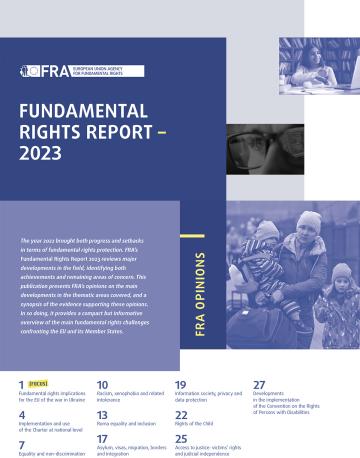
    Rok 2022 przyniósł zarówno postęp, jak i regres pod względem ochrony praw podstawowych. Sprawozdanie FRA na temat praw podstawowych z 2023 r. zawiera przegląd najważniejszych zmian, jakie miały miejsce w tym obszarze, wskazując zarówno na osiągnięcia, jak i kwestie, które nadal wymagają stosownych działań. W niniejszej publikacji przedstawiono opinie FRA na temat najważniejszych zmian, jakie miały miejsce w uwzględnionych obszarach tematycznych, oraz podsumowanie dowodów, na których oparto te opinie.
  • Fundamental Rights Report
    8
    June
    2022
    FRA’s Fundamental Rights Report 2022 reviews major developments in the field in 2021, identifying both achievements and areas of concern. It also presents FRA’s opinions on these developments, including a synopsis of the evidence supporting these opinions.
  • Fundamental Rights Report
    8
    June
    2022
    This focus looks at the impact of the pandemic on social rights. It examines the measures in national recovery and resilience plans that address the social vulnerabilities among a variety of population groups in the EU, including women, children and young people in situations of vulnerability, people with disabilities, older people, Roma and people in precarious working conditions.
  • Fundamental Rights Report
    10
    June
    2021
    FRA’s Fundamental Rights Report 2021 reviews major developments in the field in 2020, identifying both achievements and areas of concern. It also presents FRA’s opinions on these developments, including a synopsis of the evidence supporting these opinions. This year’s focus chapter explores the impact of the COVID-19 pandemic on fundamental rights. The remaining chapters cover: the EU Charter of Fundamental Rights; equality and non-discrimination; racism, xenophobia and related intolerance; Roma equality and inclusion; asylum, borders and migration; information society, privacy and data protection; rights of the child; access to justice; and the implementation of the Convention on the Rights of Persons with Disabilities.
  • Fundamental Rights Report
    10
    June
    2021
    This focus looks at COVID-19’s impact on fundamental rights. It underscores that a human rights-based approach to tackling the pandemic requires balanced measures that are based on law, necessary, temporary and proportional. It also requires addressing the pandemic’s socio-economic impact, protecting the vulnerable and fighting racism.