Operationalising the Pact on Migration and Asylum: Experiences from the hotspot approach

TABLE OF CONTENT
Search inside this publication
Swift identification and registration of all new arrivals help protect refugees against refoulement and children from going missing. When registering new arrivals, national authorities must respect the Charter, in particular human dignity (Article 1) and the rights of the child, the elderly and of persons with disabilities (Articles 24-26).
The Pact requires Member States to screen all new arrivals, as well as to identify and register them in the Eurodac database. Under the revised Eurodac Regulation children older than six years must also be fingerprinted.
One aspect which raised FRA’s concern at the hotspots relates to fingerprinting. In 2015, there had been allegations of excessive use of force when taking fingerprints for Eurodac in Italy (FRA 2016 opinion), an issue that has not since re-emerged.
In this regard, selected lessons learnt from the hotspot approach are that:
- Effective information provision and counselling to secure compliance with fingerprinting for Eurodac reduces the need to resort to use of force. FRA’s 2015 checklist (page 2), referenced in Recital (51) of the Eurodac Regulation, provides guidance on how to achieve this.
- Having basic skills in noticing signs that a person may be traumatised and being trained on how to mitigate the risk of re-traumatisation or other complications during fingerprinting, promotes dignified treatment.
- To respect dignity when photographing and fingerprinting new arrivals, the Italian handbook on vulnerabilities (vademecum) underlines the need to provide appropriate space to guarantee privacy, the presence of female staff, and the assistance of cultural mediators.
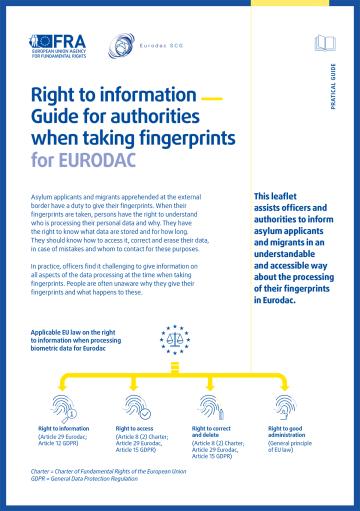
- FRA observed that – in practice – providing information on data processing with respect to Eurodac is challenging. A joint leaflet (2019) by FRA and the Eurodac Supervision Coordination Group assists officers in informing asylum applicants and migrants in an understandable and accessible way about data processing in Eurodac.
- In cases of disputed nationality of new arrivals, recording the declared nationality as well as the presumed nationality reduces errors and limits subsequent cumbersome correction procedures.