eu-charter

Carta drepturilor fundamentale a Uniunii Europene

Articolul 10 - Libertatea de gândire, de conștiință și de religie

Articolul 10 - Libertatea de gândire, de conștiință și de religie

(1) Orice persoană are dreptul la libertatea de gândire, de conștiință și de religie. Acest drept implică libertatea de a-și schimba religia sau convingerea, precum și libertatea de a-și manifesta religia sau convingerea individual sau colectiv, în public sau în particular, prin intermediul cultului, învățământului, practicilor și îndeplinirii riturilor.

(2) Dreptul la obiecție pe motive de conștiință este recunoscut în conformitate cu legile interne care reglementează exercitarea acestui drept.

Explicaţii

  • Text:

    Dreptul garantat la alineatul (1) corespunde dreptului garantat la articolul 9 din CEDO şi, în conformitate cu articolul 52 alineatul (3) din cartă, are acelaşi înţeles şi acelaşi domeniu de aplicare ca şi acesta. De aceea, restrângerile acestuia trebuie să respecte dispoziţiile articolului 9 alineatul (2) menţionat anterior, având următorul text: `Libertatea de a-şi manifesta religia sau convingerile nu poate face obiectul altor restrângeri decât acelea care, prevăzute de lege, constituie măsuri necesare, într-o societate democratică, pentru siguranţa publică, protecţia ordinii, a sănătăţii sau a moralei publice ori pentru protejarea drepturilor şi libertăţilor altora`.
    Dreptul garantat la alineatul (2) corespunde tradiţiilor constituţionale naţionale şi evoluţiei legislaţiilor interne în acest domeniu.

    Source:
    Jurnalul Oficial al Uniunii Europene C 303/17 - 14.12.2007
    Preamble - Explanations relating to the Charter of Fundamental Rights:
    Explicaţiile redate în continuare au fost redactate iniţial sub autoritatea prezidiului Convenţiei care a elaborat Carta drepturilor fundamentale a Uniunii Europene. Acestea au fost actualizate sub autoritatea prezidiului Convenţiei Europene, având în vedere adaptarea de către respectiva Convenţie a textului cartei (în special la articolele 51 şi 52), precum şi evoluţia dreptului Uniunii. Cu toate că aceste explicaţii nu au valoare juridică în sine, acestea constituie un preţios instrument de interpretare destinat clarificării dispoziţiilor cartei.

Jurisprudență

Dreptul constituțional național

30 results found

  • Magyarország Alaptörvénye
    Țara:
    Hungary

    VII. cikk (SZABADSÁG ÉS FELELŐSSÉG) (1) Mindenkinek joga van a gondolat, a lelkiismeret és a vallás szabadságához. Ez a jog magában foglalja a vallás vagy más meggyőződés szabad megválasztását vagy megváltoztatását és azt a szabadságot, hogy vallását vagy más meggyőződését mindenki vallásos cselekmények, szertartások végzése útján vagy egyéb módon, akár egyénileg, akár másokkal együttesen, nyilvánosan vagy a magánéletben kinyilvánítsa vagy kinyilvánítását mellőzze, gyakorolja vagy tanítsa.
    (2) Az azonos hitelveket követők vallásuk gyakorlása céljából sarkalatos törvényben meghatározott szervezeti formában működő vallási közösséget hozhatnak létre.
    (3) Az állam és a vallási közösségek különváltan működnek. A vallási közösségek önállóak.
    (4) Az állam és a vallási közösségek a közösségi célok elérése érdekében együttműködhetnek. Az együttműködésről a vallási közösség kérelme alapján az Országgyűlés dönt. Az együttműködésben részt vevő vallási közösségek bevett egyházként működnek. A bevett egyházaknak a közösségi célok elérését szolgáló feladatokban való részvételükre tekintettel az állam sajátos jogosultságokat biztosít.
    (5) A vallási közösségekre vonatkozó közös szabályokat, valamint az együttműködés feltételeit, a bevett egyházakat és a rájuk vonatkozó részletes szabályokat sarkalatos törvény határozza meg.

  • Netherlands / Constitution of the Kingdom of the Netherlands
    Țara:
    Netherlands

    Article 6 1. Everyone shall have the right to profess freely his religion or belief, either individually or in community with others, without prejudice to his responsibility under the law. 2. Rules concerning the exercise of this right other than in buildings and enclosed places may be laid down by Act of Parliament for the protection of health, in the interest of traffic and to combat or prevent disorders.

  • Portugal / Constitution of the Portuguese Republic
    Țara:
    Portugal

    Article 41 (Freedom of conscience, of religion and of form of worship) (1) Freedom of conscience, religion and worship shall be inviolable. (2) No one shall be persecuted, deprived of rights or exempted from civic obligations or duties because of his convictions or religious observance. (3) No authority shall question anyone in relation to his convictions or religious observance, save in order to gather statistical data that cannot be individually identified, nor shall anyone be prejudiced in any way for refusing to answer. (4) Churches and other religious communities shall be separate from the state and free to organise themselves and to perform their ceremonies and their worship. (5) Freedom to teach any religion within the denomination in question and to use appropriate media for the pursuit of its activities shall be guaranteed. (6) The right to be a conscientious objector, as laid down by law, shall be guaranteed.

  • România / Constituția României
    Țara:
    România

    Articolul 29(1) Libertatea gândirii si a opiniilor, precum si libertatea credintelor religioase nu pot fi îngradite sub nici o forma. Nimeni nu poate fi constrâns sa adopte o opinie ori sa adere la o credinta religioasa, contrare convingerilor sale. (2) Libertatea constiintei este garantata; ea trebuie sa se manifeste în spirit de toleranta si de respect reciproc. (3) Cultele religioase sunt libere si se organizeaza potrivit statutelor proprii, în conditiile legii. (4) În relatiile dintre culte sunt interzise orice forme, mijloace, acte sau actiuni de învrajbire religioasa. (5) Cultele religioase sunt autonome fata de stat si se bucura de sprijinul acestuia, inclusiv prin înlesnirea asistentei religioase în armata, în spitale, în penitenciare, în azile si în orfelinate. (6) Parintii sau tutorii au dreptul de a asigura, potrivit propriilor convingeri, educatia copiilor minori a caror raspundere le revine.

  • Slovakia / Constitution of the Slovak Republic
    Țara:
    Slovakia

    Article 24(1) Freedom of thought, conscience, religion and belief shall be guaranteed. This right shall include the right to change religion or belief and the right to refrain from a religious affiliation. Everyone has the right to express his or her mind publicly. (2) Everyone has the right to manifest freely his or her religion or belief either alone or in association with others, privately or publicly, in worship, religious acts, maintaining ceremonies or to participate in teaching. (3) Churches and religious communities administer their own affairs themselves; in particular, they constitute their bodies, appoint clericals, organize the teaching of religion, and establish religious orders and other clerical institutions independent of state bodies. (4) The exercise of rights under paragraphs 1 to 3 may be restricted only by a law, if such a measure is necessary in a democratic society to protect public order, health, morals, or the rights and freedoms of others.

    Article 25(1) The defence of the Slovak Republic is a duty and a matter of honour for citizens. The law shall lay down the scope of the compulsory military service. (2) No one shall be forced to perform military service if it is against her conscience or religion. Details shall be laid down by law.

  • Slovenia / Constitution of the Republic of Slovenia
    Țara:
    Slovenia

    Article 7 The state and religious communities shall be separate. Religious communities shall enjoy equal rights; they shall pursue their activities freely.
    Article 41 Religious and other beliefs may be freely professed in private and public life. No one shall be obliged to declare his religious or other beliefs. Parents have the right to provide their children with a religious and moral upbringing in accordance with their beliefs. The religious and moral guidance given to children must be appropriate to their age and maturity, and be consistent with their free conscience and religious and other beliefs or convictions.

  • Spain / Constitution of the Kingdom of Spain
    Țara:
    Spain

    Section 16(1). Freedom of ideology, religion and worship of individuals and communities is guaranteed, with no other restriction on their expression than may be necessary to maintain public order as protected by law.2. No one may be compelled to make statements regarding his or her ideology, religion or beliefs. 3. No religion shall have a state character. The public authorities shall take into account the religious beliefs of Spanish society and shall consequently maintain appropriate cooperation relations with the Catholic Church and other confessions.

    Section 30(1) Citizens have the right and the duty to defend Spain. (2) The law shall determine the military obligations of Spaniards and shall regulate, with all due guarantees, conscientious objection as well as other grounds for exemption from compulsory military service; it may also, when appropriate, impose a community service in place of military service. (...)

  • Suomen perustuslaki
    Țara:
    Finland

    11 § Uskonnon ja omantunnon vapaus Jokaisella on uskonnon ja omantunnon vapaus. Uskonnon ja omantunnon vapauteen sisältyy oikeus tunnustaa ja harjoittaa uskontoa, oikeus ilmaista vakaumus ja oikeus kuulua tai olla kuulumatta uskonnolliseen yhdyskuntaan. Kukaan ei ole velvollinen osallistumaan omantuntonsa vastaisesti uskonnon harjoittamiseen.

  • The Fundamental Law of Hungary
    Țara:
    Hungary

    Article VII (Freedom and Responsibility) (1) Everyone shall have the right to freedom of thought, conscience and religion. This right
    shall include the freedom to choose or change one’s religion or other belief, and the freedom
    of everyone to manifest, abstain from manifesting, practice or teach his or her religion or other belief through religious acts, rites or otherwise, either individually or jointly with others, either in public or in private life. (2) People sharing the same principles of faith may, for the practice of their religion, establish religious communities operating in the organisational form specified in a cardinal Act. (3) The State and religious communities shall operate separately. Religious communities shall
    be autonomous. (4) The State and religious communities may cooperate to achieve community goals. At the request of a religious community, the National Assembly shall decide on such cooperation. The religious communities participating in such cooperation shall operate as established
    churches. The State shall provide specific privileges to established churches with regard to their participation in the fulfilment of tasks that serve to achieve community goals. (5) The common rules relating to religious communities, as well as the conditions of cooperation, the established churches and the detailed rules relating to established churches shall be laid down in a cardinal Act.

  • Το Σύνταγμα της Ελλάδας
    Țara:
    Greece

    Άρθρο 13 (1) H ελευθερία της θρησκευτικής συνείδησης είναι απαραβίαστη. H απόλαυση των ατoμικών και πoλιτικών δικαιωμάτων δεν εξαρτάται από τις θρησκευτικές πεπoιθήσεις καθενός. (2). Kάθε γνωστή θρησκεία είναι ελεύθερη και τα σχετικά με τη λατρεία της τελoύνται ανεμπόδιστα υπό την πρoστασία των νόμων. H άσκηση της λατρείας δεν επιτρέπεται να πρoσβάλλει τη δημόσια τάξη ή τα χρηστά ήθη. O πρoσηλυτισμός απαγoρεύεται. (3). Oι λειτoυργoί όλων των γνωστών θρησκειών υπόκεινται στην ίδια επoπτεία της Πoλιτείας και στις ίδιες υπoχρεώσεις απέναντί της, όπως και oι λειτoυργoί της επικρατoύσας θρησκείας. (4). Kανένας δεν μπoρεί, εξαιτίας των θρησκευτικών τoυ πεπoιθήσεων, να απαλλαγεί από την εκπλήρωση των υπoχρεώσεων πρoς τo Kράτoς ή να αρνηθεί να συμμoρφωθεί πρoς τoυς νόμoυς. (5). Kανένας όρκoς δεν επιβάλλεται χωρίς νόμo, πoυ oρίζει και τoν τύπo τoυ.

Legislația UE

2 results found

  • Protocol (No 29) on the system of public broadcasting in the Member States


    .

  • Council Regulation (EC) No 1099/2009 of 24 September 2009 on the protection of animals at the time of killing

    [...]

    (18) Derogation from stunning in case of religious slaughter taking place in slaughterhouses was granted by Directive 93/119/EC. Since Community provisions applicable to religious slaughter have been transposed differently depending on national contexts and considering that national rules take into account dimensions that go beyond the purpose of this Regulation, it is important that derogation from stunning animals prior to slaughter should be maintained, leaving, however, a certain level of subsidiarity to each Member State. As a consequence, this Regulation respects the freedom of religion and the right to manifest religion or belief in worship, teaching, practice and observance, as enshrined in Article 10 of the Charter of Fundamental Rights of the European Union.

    [...]

Drept internațional

0 results found

Produse

  • Report / Paper / Summary
    9
    November
    2017
    This report provides an overview of data on antisemitism as recorded by
    international organisations and by official and unofficial sources in the 28 European
    Union (EU) Member States, based on their own definitions and categorisations.
  • Report / Paper / Summary
    13
    December
    2016
    Antisemitism can be expressed in the form of verbal and physical attacks, threats,
    harassment, property damage and graffiti or other forms of text, including on the
    internet. The present report relates to manifestations of antisemitism as they are
    recorded by international organisations, and by official and unofficial sources in the
    28 EU Member States.
  • Report / Paper / Summary
    30
    September
    2015
    Regardless of ethnic origin, religion or belief, everyone living in the Union has a fundamental right to be treated equally, to be respected and to be protected from violence. This contribution paper to the Annual Colloquium
    on Fundamental Rights provides evidence of the fact that such respect is lacking, and suggests ways in which governments can ensure they fulfil their duty to safeguard this right for everyone living in the EU.
  • Report / Paper / Summary
    30
    September
    2015
    Antisemitism can be expressed in the form of verbal and physical attacks, threats, harassment, property damage, graffiti or other forms of text, including on the internet. This report relates to manifestations of antisemitism as they are recorded by official and unofficial sources in the 28 European Union (EU) Member States.
  • Report / Paper / Summary
    11
    February
    2015
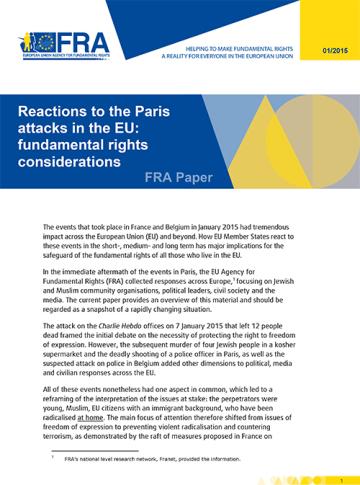
    The events that took place in France and Belgium in January 2015 had tremendous impact across the European Union (EU) and beyond. In the immediate aftermath of the events in Paris, FRA collected responses across Europe, focusing on Jewish and Muslim community organisations, political leaders, civil society and the media. The current paper provides an overview of this material and should be regarded as a snapshot of a rapidly changing situation.
  • Report / Paper / Summary
    20
    December
    2013
    This thematic situation report examines the effectiveness of responses by public authorities, civil society organisations and others to counter racism, discrimination, intolerance and extremism in Greece and Hungary. The report goes on to make proposals for fighting racist crime, increasing trust in the police, and combating extremism throughout the EU.
  • In brief / Factsheet
    8
    November
    2013
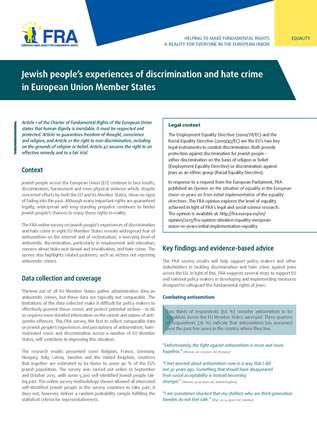
    Jewish people across the European Union (EU) continue to face insults, discrimination, harassment and even physical violence which, despite concerted efforts by both the EU and its Member States, show no signs of fading into the past. Although many important rights are guaranteed legally, widespread and long-standing prejudice continues to hinder Jewish people’s chances to enjoy these rights in reality.
  • Report / Paper / Summary
    8
    November
    2013
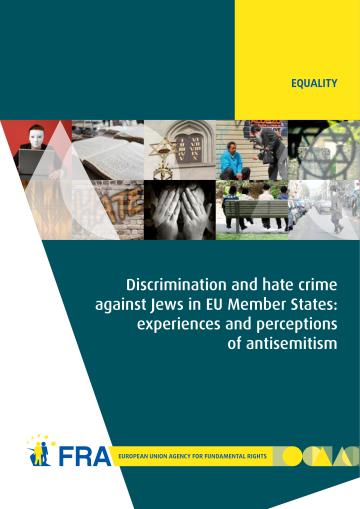
    This FRA survey is the first-ever to collect comparable data on Jewish people’s experiences and perceptions of antisemitism, hate-motivated crime and discrimination across a number of EU Member States, specifically in Belgium, France, Germany, Hungary, Italy, Latvia, Sweden and the United Kingdom. Its findings reveal a worrying level of discrimination, particularly in employment and education, a widespread fear of victimisation and heightening concern about antisemitism online.
  • Report / Paper / Summary
    27
    November
    2012
    Discrimination and intolerance persist in the European Union (EU) despite the best efforts of Member States to root them out, FRA research shows. Verbal abuse, physical attacks and murders motivated by prejudice target EU society in all its diversity, from visible minorities to those with disabilities. This FRA report is designed to help the EU and its Member States to tackle these fundamental rights violations both by making them more visible and bringing perpetrators to account.
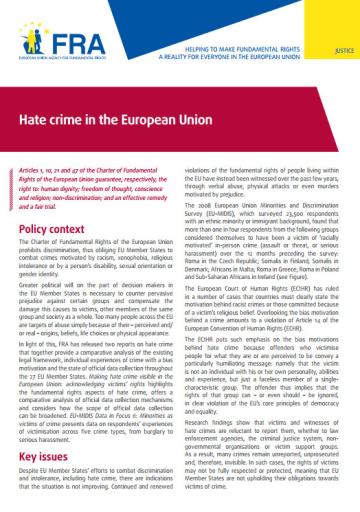
  • In brief / Factsheet
    27
    November
    2012
    Despite EU Member States’ efforts to combat discrimination and intolerance, including hate crime, there are indications that the situation is not improving. Continued and renewed violations of the fundamental rights of people living within the EU have instead been witnessed over the past few years, through verbal abuse, physical attacks or even murders motivated by prejudice.