eu-charter

Carta drepturilor fundamentale a Uniunii Europene

Articolul 26 - Integrarea persoanelor cu handicap

Articolul 26 - Integrarea persoanelor cu handicap

Uniunea recunoaște și respectă dreptul persoanelor cu handicap de a beneficia de măsuri care să le asigure autonomia, integrarea socială și profesională, precum și participarea la viața comunității.

Explicaţii

  • Text:

    Principiul conţinut în acest articol se întemeiază pe articolul 15 din Carta socială europeană şi este inspirat în egală măsură din punctul 26 din Carta comunitară a drepturilor sociale fundamentale ale lucrătorilor.

    Source:
    Jurnalul Oficial al Uniunii Europene C 303/17 - 14.12.2007
    Preamble - Explanations relating to the Charter of Fundamental Rights:
    Explicaţiile redate în continuare au fost redactate iniţial sub autoritatea prezidiului Convenţiei care a elaborat Carta drepturilor fundamentale a Uniunii Europene. Acestea au fost actualizate sub autoritatea prezidiului Convenţiei Europene, având în vedere adaptarea de către respectiva Convenţie a textului cartei (în special la articolele 51 şi 52), precum şi evoluţia dreptului Uniunii. Cu toate că aceste explicaţii nu au valoare juridică în sine, acestea constituie un preţios instrument de interpretare destinat clarificării dispoziţiilor cartei.

Jurisprudență

Dreptul constituțional național

42 results found

  • Võrdse kohtlemise seadus
    Țara:
    Estonia

    § 1. Seaduse eesmärk ja reguleerimisala
    (1) Seaduse eesmärk on tagada isikute kaitse diskrimineerimise eest rahvuse (etnilise kuuluvuse), rassi, nahavärvuse, usutunnistuse või veendumuste, vanuse, puude või seksuaalse sättumuse alusel.
    (2) Käesoleva paragrahvi lõikes 1 nimetatud eesmärgi saavutamiseks sätestab seadus:
    1) võrdse kohtlemise põhimõtted;
    2) ülesanded võrdse kohtlemise põhimõtte rakendamisel ja edendamisel;
    3) diskrimineerimisvaidluste lahendamise.
    § 5. Puue. Käesoleva seaduse tähenduses on puue inimese anatoomilise, füsioloogilise või psüühilise struktuuri või funktsiooni kaotus või kõrvalekalle, millel on oluline ja pikaajaline ebasoodus mõju igapäevatoimingute sooritamisele.

  • КОНСТИТУЦИЯ на Република България
    Țara:
    Bulgaria

    Чл. 48 [...] (2) Държавата създава условия за осъществяване на правото на труд на лицата с физически и психически увреждания.

Legislația UE

3 results found

  • Community Charter of the Fundamental Social Rights of Workers (not in force)

    Disabled persons
    26. All disabled persons, whatever the origin and nature of their disablement, must be entitled to additional concrete measures aimed at improving their social and professional integration. These measures must concern, in particular, according to the capacities of the beneficiaries, vocational training,
    ergonomics, accessibility, mobility, means of transport and housing.

  • Directive (EU) 2019/882 of the European Parliament and of the Council of 17 April 2019 on the accessibility requirements for products and services

    .

  • Council Directive 2000/78/EC of 27 November 2000 establishing a general framework for equal treatment in employment and occupation

    Preamble  

    (2) The principle of equal treatment between women and men is well established by an important body of Community law, in particular in Council Directive 76/207/EEC of 9 February 1976 on the implementation of the principle of equal treatment for men and women as regards access to employment, vocational training and promotion, and working conditions(5).

    (3) In implementing the principle of equal treatment, the Community should, in accordance with Article 3(2) of the EC Treaty, aim to eliminate inequalities, and to promote equality between men and women, especially since women are often the victims of multiple discrimination.

    (4) The right of all persons to equality before the law and protection against discrimination constitutes a universal right recognised by the Universal Declaration of Human Rights, the United Nations Convention on the Elimination of All Forms of Discrimination against Women, United Nations Covenants on Civil and Political Rights and on Economic, Social and Cultural Rights and by the European Convention for the Protection of Human Rights and Fundamental Freedoms, to which all Member States are signatories. Convention No 111 of the International Labour Organisation (ILO) prohibits discrimination in the field of employment and occupation.

    (6) The Community Charter of the Fundamental Social Rights of Workers recognises the importance of combating every form of discrimination, including the need to take appropriate action for the social and economic integration of elderly and disabled people.

    (8) The Employment Guidelines for 2000 agreed by the European Council at Helsinki on 10 and 11 December 1999 stress the need to foster a labour market favourable to social integration by formulating a coherent set of policies aimed at combating discrimination against groups such as persons with disability. They also emphasise the need to pay particular attention to supporting older workers, in order to increase their participation in the labour force.

    (10) On 29 June 2000 the Council adopted Directive 2000/43/EC(6) implementing the principle of equal treatment between persons irrespective of racial or ethnic origin. That Directive already provides protection against such discrimination in the field of employment and occupation.

    (11) Discrimination based on religion or belief, disability, age or sexual orientation may undermine the achievement of the objectives of the EC Treaty, in particular the attainment of a high level of employment and social protection, raising the standard of living and the quality of life, economic and social cohesion and solidarity, and the free movement of persons.

    (12) To this end, any direct or indirect discrimination based on religion or belief, disability, age or sexual orientation as regards the areas covered by this Directive should be prohibited throughout the Community. This prohibition of discrimination should also apply to nationals of third countries but does not cover differences of treatment based on nationality and is without prejudice to provisions governing the entry and residence of third-country nationals and their access to employment and occupation.

    Article 1: Purpose

    The purpose of this Directive is to lay down a general framework for combating discrimination on the grounds of religion or belief, disability, age or sexual orientation as regards employment and occupation, with a view to putting into effect in the Member States the principle of equal treatment.

    Article 2: Concept of discrimination

    1. For the purposes of this Directive, the "principle of equal treatment" shall mean that there shall be no direct or indirect discrimination whatsoever on any of the grounds referred to in Article 1.

    2. For the purposes of paragraph 1:

    (a) direct discrimination shall be taken to occur where one person is treated less favourably than another is, has been or would be treated in a comparable situation, on any of the grounds referred to in Article 1;

    (b) indirect discrimination shall be taken to occur where an apparently neutral provision, criterion or practice would put persons having a particular religion or belief, a particular disability, a particular age, or a particular sexual orientation at a particular disadvantage compared with other persons unless:

    (i) that provision, criterion or practice is objectively justified by a legitimate aim and the means of achieving that aim are appropriate and necessary, or

    (ii) as regards persons with a particular disability, the employer or any person or organisation to whom this Directive applies, is obliged, under national legislation, to take appropriate measures in line with the principles contained in Article 5 in order to eliminate disadvantages entailed by such provision, criterion or practice.

    3. Harassment shall be deemed to be a form of discrimination within the meaning of paragraph 1, when unwanted conduct related to any of the grounds referred to in Article 1 takes place with the purpose or effect of violating the dignity of a person and of creating an intimidating, hostile, degrading, humiliating or offensive environment. In this context, the concept of harassment may be defined in accordance with the national laws and practice of the Member States.

    Article 5: Reasonable accommodation for disabled persons

    In order to guarantee compliance with the principle of equal treatment in relation to persons with disabilities, reasonable accommodation shall be provided. This means that employers shall take appropriate measures, where needed in a particular case, to enable a person with a disability to have access to, participate in, or advance in employment, or to undergo training, unless such measures would impose a disproportionate burden on the employer. This burden shall not be disproportionate when it is sufficiently remedied by measures existing within the framework of the disability policy of the Member State concerned.

    Article 9: Defence of rights

    1. Member States shall ensure that judicial and/or administrative procedures, including where they deem it appropriate conciliation procedures, for the enforcement of obligations under this Directive are available to all persons who consider themselves wronged by failure to apply the principle of equal treatment to them, even after the relationship in which the discrimination is alleged to have occurred has ended.

    2. Member States shall ensure that associations, organisations or other legal entities which have, in accordance with the criteria laid down by their national law, a legitimate interest in ensuring that the provisions of this Directive are complied with, may engage, either on behalf or in support of the complainant, with his or her approval, in any judicial and/or administrative procedure provided for the enforcement of obligations under this Directive.

    3. Paragraphs 1 and 2 are without prejudice to national rules relating to time limits for bringing actions as regards the principle of equality of treatment.

Drept internațional

8 results found

Produse

  • Periodic updates / Series
    28
    May
    2020
    The Coronavirus pandemic continues to interrupt everyday life in the EU in unprecedented ways. But the way it affects our societies is shifting. As governments gradually lift some of the measures put in place to contain the spread of COVID-19, new fundamental rights concerns arise: how to ensure that the rights to life and health are upheld as daily life transitions to a ‘new normal’. This Bulletin looks at declarations of states of emergency, or equivalent, and how they came under scrutiny. It considers the impact on fundamental rights in important areas of daily life, and includes a thematic focus on the processing of users’ data to help contain COVID-19, particularly by contact-tracing apps. It covers the period 21 March – 30 April 2020.
  • Report / Paper / Summary
    4
    December
    2018
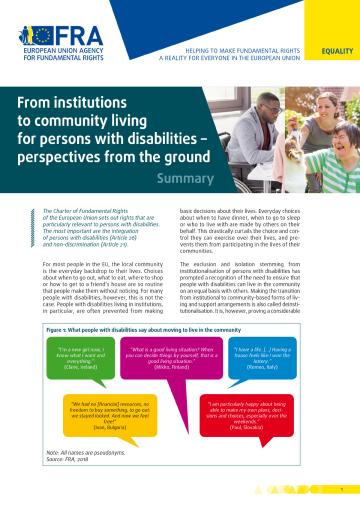
    The European Union Agency for Fundamental Rights
    (FRA) wanted to contribute to making steps to implement
    deinstitutionalisation more effective, by capturing
    concrete evidence of what is and what is
    not working on the ground. To do this, the agency
    conducted extensive fieldwork research in five EU
    Member States at different stages of the deinstitutionalisation
    process.
    This summary report presents the key findings of
    that fieldwork and the FRA opinions stemming from
    them.
  • Report / Paper / Summary
    4
    December
    2018
    The Convention on the Rights of Persons with Disabilities commits both the EU and all of its Member States to realising the right of persons with disabilities to live independently in the community – which includes achieving deinstitutionalisation for those residing in institutional settings. But much remains to be done to make this a reality in practice. This report presents the main insights gained during fieldwork on the drivers of and barriers to deinstitutionalisation. Focusing on the local level, it gives voice to a diverse set of actors – most importantly, to people with disabilities themselves.
  • Report / Paper / Summary
    12
    October
    2017
    This report assesses to what extent Member States have implemented the right to independent living, focusing on the effect commitments and funds are having on persons with disabilities’ daily lives. Taken together, the reports provide important insights that can support ongoing processes of change.
  • Report / Paper / Summary
    12
    October
    2017
    The transition from institution- to community-based support for persons with disabilities is a complex process that requires multifaceted efforts. These include putting in place commitments and structures for achieving deinstitutionalisation and measuring outcomes for persons with disabilities. This report shows that effectively funding the deinstitutionalisation process is a vital element.
  • Report / Paper / Summary
    12
    October
    2017
    Discussions are under way at the European Union (EU) and national levels about how best to realise the transition from institutional to community-based support. This report contributes to these by bringing together some of the key issues that have emerged from the EU Agency for Fundamental Rights’ (FRA) human rights indicators on Member States’ political and practical commitment to deinstitutionalisation.
  • Easy-to-read report
    2
    December
    2015
    This book will tell you about violence and children with disabilities. It looks at violence, where it happens, and why people are violent.
  • Report / Paper / Summary
    2
    December
    2015
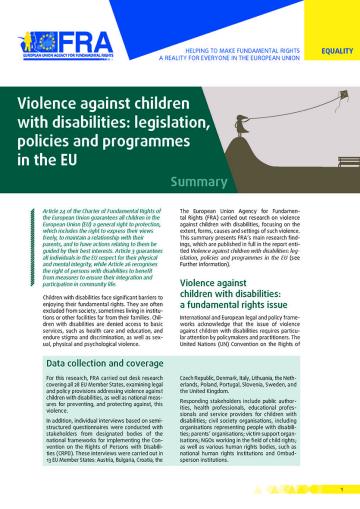
    Children with disabilities face significant barriers to enjoying their fundamental rights. They are often excluded from society, sometimes living in facilities far from their families. They are also denied access to basic services, such as health care and education, and endure stigma and discrimination, as well as sexual, physical and psychological violence. This summary report outlines relevant international and European standards and reviews national legislation and policies addressing violence against children with disabilities. The summary also explores the extent and different causes, settings and forms of such violence, and presents measures and initiatives to prevent it.
  • Report / Paper / Summary
    2
    December
    2015
    Children with disabilities face significant barriers to enjoying their fundamental rights. They are often excluded from society, sometimes living in facilities far from their families. They are also denied access to basic services, such as health care and education, and endure stigma and discrimination, as well as sexual, physical and psychological violence. FRA scrutinised the important but underreported issue of violence against children with disabilities, carrying out desk research and conducting interviews with knowledgeable stakeholders. This report presents the results of that research.
  • Report / Paper / Summary
    11
    May
    2015
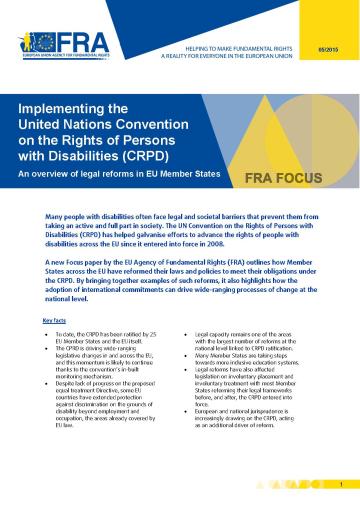
    A new Focus paper by the EU Agency of Fundamental Rights (FRA) outlines how Member States across the EU have reformed their laws and policies to meet their obligations under the CRPD. By bringing together examples of such reforms, it also highlights how the adoption of international commitments can drive wide-ranging processes of change at the national level.