Often living in substandard and overcrowded housing conditions, Roma and Travellers face an increased risk of contracting COVID-19. They are also disproportionately affected by measures taken to contain the virus. This FRA Bulletin takes a closer look at this reality in 15 EU Member States, focusing on education; employment; poverty; healthcare; housing; and anti-Gypsyism. It also outlines civil society efforts to tackle the diverse challenges triggered by the Coronavirus pandemic.
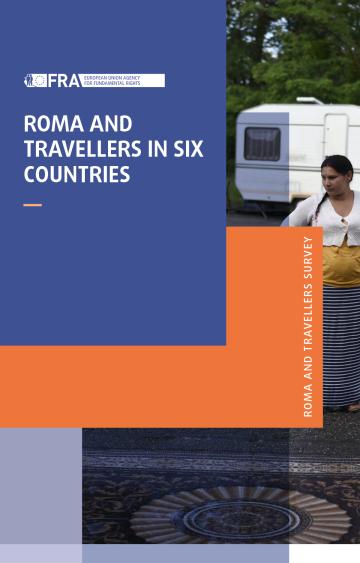
This report presents findings from FRA’s 2019 survey on Roma and Travellers in Belgium, France, Ireland, the Netherlands, Sweden and the United Kingdom. The survey included interviews with almost 4,700 Roma and Travellers, collecting information on more than 8,200 individuals living in their households.
Antisemitism can be expressed in the form of verbal and physical attacks, threats, harassment, discrimination and unequal treatment, property damage and graffiti or other forms of speech or text, including on the internet. Antisemitic incidents and hate crimes violate fundamental rights, especially the right to human dignity, the right to equality of treatment and the freedom of thought, conscience and religion.
FRA’s second survey on LGBTI people in the EU, North Macedonia and Serbia surveyed almost 140,000 participants. This technical report presents a detailed overview of the survey methodology used by FRA when collecting the survey data.
As we enter the second half of 2020, the constraints on our daily lives brought about by the Coronavirus pandemic have become a firm reality. New local lockdowns and the reintroduction of restrictive measures prompted by fresh outbreaks of the virus are a stark reminder that COVID-19 continues to shape our lives – and our enjoyment of fundamental rights – in profound ways. There is compelling evidence of how the pandemic has exacerbated existing challenges in our societies. This FRA Bulletin outlines some of the measures EU Member States adopted to safely reopen their societies and economies while continuing to mitigate the spread of COVID-19. It highlights the impact these measures may have on civil, political and socioeconomic rights.
This paper presents key findings from FRA’s second consultation of its Fundamental Rights Platform, focusing on the experiences of civil society organisations (CSOs) working on human rights. FRA started an annual consultation with organisations participating in its platform in 2018.
The EU Agency for Fundamental Rights has been regularly collecting data on asylum and migration since September 2015. This report focuses on the fundamental rights situation of people arriving in Member States and EU candidate countries particularly affected by migration. It addresses fundamental rights concerns between 1 April and 30 June 2020.
FRA’s Fundamental Rights Survey collected data from 35,000 people about their experiences, perceptions and opinions on a range of issues that are variously encompassed by human rights. This report presents a small selection of the survey results. It focuses on findings with respect to respondents’ opinions about human – or fundamental rights; their views and perceptions on the functioning of democratic societies – as a pillar on which human rights can flourish; and on their thoughts on and engagement with public services that have a duty to enforce human rights law and to protect people’s rights.
Το 2019 υπήρξε έτος προόδου αλλά και προβλημάτων
όσον αφορά την προστασία των θεμελιωδών
δικαιωμάτων. Στην Έκθεση για τα Θεμελιώδη
Δικαιώματα 2020 του FRA εξετάζονται οι
σημαντικότερες εξελίξεις στον τομέα και
προσδιορίζονται όχι μόνο τα επιτεύγματα, αλλά και
τα ζητήματα που εξακολουθούν να προκαλούν
ανησυχία. Στην παρούσα δημοσίευση
παρουσιάζονται οι γνώμες του FRA σχετικά με τις
κυριότερες εξελίξεις στους εξεταζόμενους θεματικούς
τομείς και συνοπτική τεκμηρίωση των γνωμών
αυτών. Με αυτόν τον τρόπο, παρέχεται μια συνοπτική
και ταυτόχρονα κατατοπιστική επισκόπηση των
βασικών προκλήσεων τις οποίες αντιμετωπίζουν η ΕΕ
και τα κράτη μέλη στον τομέα των θεμελιωδών
δικαιωμάτων.
The year 2019 brought both progress and setbacks in terms of fundamental rights protection. FRA’s Fundamental Rights Report 2020 reviews major developments in the field, identifying both achievements and remaining areas of concern. This publication presents FRA’s opinions on the main developments in the thematic areas covered, and a synopsis of the evidence supporting these opinions. In so doing, it provides a compact but informative overview of the main fundamental rights challenges confronting the EU and its Member States.
En el año 2019 se produjeron tanto avances como
retrocesos en materia de protección de los derechos
fundamentales. El Informe sobre los derechos
fundamentales 2020 de la Agencia de los Derechos
Fundamentales de la Unión Europea (FRA) analiza
los principales acontecimientos en este ámbito,
destacando tanto los progresos realizados como
las dificultades que todavía persisten. La publicación
presenta los dictámenes de la FRA sobre los
principales avances realizados en los ámbitos
temáticos contemplados, así como un resumen
de las pruebas que respaldan tales dictámenes.
Esto permite disponer de una visión de conjunto,
compacta, pero muy ilustrativa, de los principales
desafíos en materia de derechos fundamentales
a los que se enfrentan la UE y sus Estados miembros.
FRA’s Fundamental Rights Report 2020 reviews major developments in the field in 2019, identifying both achievements and areas of concern. It also presents FRA’s opinions on these developments, including a synopsis of the evidence supporting these opinions. This year’s focus chapter explores how to unlock the full potential of the EU Charter of Fundamental Rights.
The EU Agency for Fundamental Rights has been regularly collecting data on migration since September 2015. This report focuses on the fundamental rights situation of people arriving in Member States and EU candidate countries particularly affected by large migration movements. It addresses key fundamental rights concerns between 1 January and 31 March 2020.
This report presents select findings from FRA’s 2019 survey on LGBTI people in the EU and North Macedonia and Serbia. With almost 140,000 participants, it is the largest survey of its kind. It follows the agency’s first survey on LGBT people in the EU, conducted in 2012. The new survey results show little progress over the past seven years.
The EU Agency for Fundamental Rights has been regularly collecting data on migration since September 2015. This report focuses on the fundamental rights situation of people arriving in Member States and EU candidate countries particularly affected by large migration movements. It addresses key fundamental rights concerns between 1 October and 31 December 2019.
Denne rapport beskriver udvalgte resultater fra FRA’s anden store EU-dækkende undersøgelse af migranter og mindretal (EU-MIDIS II). Den undersøger erfaringerne fra næsten 6 000 personer af afrikansk herkomst i 12 EU-medlemsstater. Resultaterne viser, at snart tyve år efter vedtagelsen af EU’s lovgivning om forbud mod forskelsbehandling møder personer af afrikansk herkomst i EU udbredte og rodfæstede fordomme og udstødelse.
Across the EU, people of African descent face widespread and entrenched prejudice and exclusion. Racial discrimination and harassment are commonplace. Experiences with racist violence vary, but reach as high as 14 %. Discriminatory profiling by the police is a common reality. Hurdles to inclusion are multi-faceted, particularly when it comes to looking for jobs and housing.
Tässä raportissa esitellään yhteenveto Euroopan unionin perusoikeusviraston (FRA) toisesta laajamittaisesta EU:n laajuisesta maahanmuuttajia ja vähemmistöjä koskevasta kyselytutkimuksesta (EU-MIDIS II). Siinä tarkastellaan lähes 6 000 afrikkalaistaustaisen henkilön kokemuksia EU:n 12 jäsenvaltiossa. Tulokset osoittavat, että EU:ssa asuvat afrikkalaistaustaiset henkilöt kärsivät laajamittaisista ja sitkeistä ennakkoluuloista ja syrjäytymisestä vielä lähes 20 vuotta EU:n
syrjinnänvastaisen lainsäädännön hyväksymisen jälkeen
Dan ir-rapport jiddeskrivi fil-qosor xi riżultati magħżula mit-tieni stħarriġ tal-FRA fuq skala kbira
madwar l-UE rigward il-migranti u l-minoranzi (EU-MIDIS II). Huwa jeżamina l-esperjenzi ta’
kważi 6,000 persuna ta’ dixxendenza Afrikana fi 12-il Stat Membru tal-UE. Ir-riżultati juru li,
kważi għoxrin sena wara l-adozzjoni ta’ liġijiet tal-UE li jipprojbixxu d-diskriminazzjoni, persuni
ta’ dixxendenza Afrikana fl-UE għadhom jiffaċċjaw preġudizzju u esklużjoni mifruxa u stabbiliti.