Displaying 1 - 20 of 406
  • Report / Paper / Summary
    23
    June
    2026
    The publication is an excerpt from the full report: Places of care = places of safety? Violence against persons with disabilities in institutions. The report looks at the breadth and depth of violence and neglect faced by people with disabilities living in institutions. It includes key findings and calls for better protection, greater prevention of violence, and clear accountability. It urges the EU and its Member States to implement their obligations on equality and fundamental rights. It is available in English, German, Croatian, Italian, Latvian, Polish, Portuguese, Slovakian and Slovenian.
  • 11
    June
    2026
    The Fundamental Rights Report: Challenges and Achievements in 2025 is FRA’s flagship annual publication. It provides an overview of the state of fundamental rights in the EU and highlights selected critical developments from 2025. This year, it focuses on four areas: rights protection in a rapidly changing digital environment; the housing crisis and rising homelessness rates; employment challenges for people from non-EU countries; and the implementation of the EU Charter of Fundamental Rights. The publication is a valuable resource for those seeking to stay informed about the EU’s shifting landscape of fundamental rights.
  • Handbook / Guide / Manual
    9
    June
    2026
    The European Convention on Human Rights and European Union law provide an increasingly
    important framework for the protection of the rights of foreigners. EU legislation relating
    to asylum, borders and immigration is developing fast. There is an impressive body of case
    law by the European Court of Human Rights relating in particular to Articles 3, 5, 8 and 13
    of the European Convention on Human Rights. The Court of Justice of the European Union is
    asked more and more frequently to pronounce on the interpretation of EU law provisions
    in this field. The fourth edition of this handbook, updated to June 2026, presents this EU
    legislation and the body of case law by the two European courts in an accessible way. A new chapter in the handbook focuses on monitoring compliance with fundamental rights and investigations into rights violations. It is intended for legal practitioners, judges, prosecutors, immigration officials and non-governmental organisations in the EU and Council of Europe Member States.
  • Report / Paper / Summary
    1
    June
    2026
    The report contains a comprehensive and thorough account of the activities carried out by FRA in the implementation of its mandate and programme of work during 2025. It provides a detailed account of the results achieved in relation to the objectives set out in the annual work programme and the five strategic areas defined in the FRA strategic plan for 2023–2028, of financial and management information and of the risks related to the organisation’s activities and measures.
  • 21
    April
    2026
    From 2015 to 2023, FRA regularly published bulletins on fundamental rights issues related to migration and asylum. As part of the EU's 2024 Asylum and Migration Management Regulation, FRA is now restarting this reporting ahead of the June 2026 implementation of the EU Migration and Asylum Pact. This first bulletin in the new series takes stock of the situation of migrants, asylum seekers and refugees as of March 2026. It looks at key developments between January 2025 and the end of March 2026, as well as ongoing problems and new areas of concern.
  • 14
    April
    2026
    In response to increased arrivals of asylum seekers, in 2015 the European Commission introduced the hotspot approach. Under this approach, the European Commission and EU agencies supported Greece and Italy in identifying, registering and fingerprinting newly arrived people. FRA regularly visited the initial reception facilities hosting them. This report looks back at the lessons learnt from 10 years of FRA visits. It identifies recurring risks to rights and highlights practical measures and promising practices to prevent or address them. These ‘lessons learnt’ can inform the implementation of the 2024 Pact on Migration and Asylum in line with the EU Charter of Fundamental Rights.
  • 27
    March
    2026
    This publication presents findings from an EU-wide survey on public attitudes to children’s use of social media. It presents people’s key concerns and their views on the minimum age limits for accessing social media platforms. The survey draws on the views of both teenagers and adults – those most directly affected. The findings offer a useful evidence base for policy discussions on social media age restrictions in the EU.
  • 24
    February
    2026
    The start of Russia’s war of aggression against Ukraine on 24 February 2022 shocked the global community and gave rise to a
    series of urgent fundamental rights challenges across Europe. While much attention has focused on the scale of devastation and its wider impact on all Ukrainians, the war has also inflicted profound personal harm. This report sheds light on the violence, sexual harassment and exploitation experienced by women displaced from Ukraine. Drawing on a survey and in-depth interviews with women from Ukraine, the report documents the prevalence, forms and patterns of gender-based violence and sets out practical measures to improve safety, access to justice and support.
  • Our recent report looks at the breadth and depth of violence and neglect faced by people with disabilities living in institutions. It highlights the shortcomings by EU Member States in preventing violence and protecting those who are at a higher risk of experiencing it, in line with the UN Convention on the Rights of Persons with Disabilities. This video explains the key issues as well as the actions needed to ensure that a person’s need for care and support should never come at the expense of their safety and dignity.
  • 8
    December
    2025
    This report examines how human rights impact assessments (HRIAs) are built into lawmaking across the EU and its Member States. It highlights that, although progress has been made, the use of HRIAs remains uneven and often superficial. In many EU countries, the EU Charter of Fundamental Rights is frequently overlooked. The report identifies insufficient consultation with external experts, limited stakeholder participation and a lack of evaluation once laws are in force. To address these gaps, it offers practical recommendations for more systematic, inclusive and evidence-based HRIAs that strengthen human rights protection and ensure better, more accountable legislation throughout the EU.
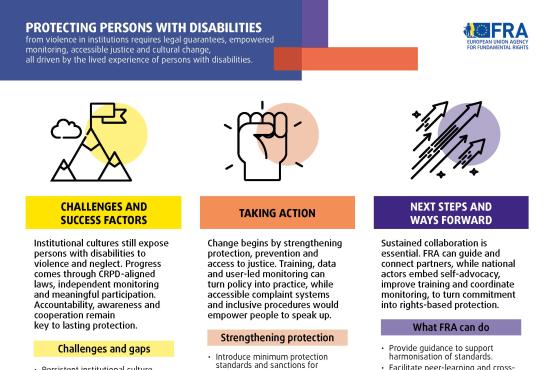
  • Protecting persons with disabilities from violence in institutions requires legal guarantees, empowered monitoring, accessible justice and cultural change. All of these actions should be driven by the lived experience of persons with disabilities.
  • 4
    December
    2025
    Artificial Intelligence comes with both benefits and risks. Safe AI use that accounts for fundamental rights is thus crucial. While the 2024 EU AI Act was a milestone in this regard, its broad definitions regarding AI systems and high-risk AI could introduce loopholes for fundamental rights compliance. This report offers an empirical basis for much-needed practical guidance on the Act’s implementation. Based on interviews with AI developers, sellers, and users, FRA addresses challenges of its use in critical domains, like asylum, education, and employment. Our findings help guide next steps in realising the AI Act’s potential to ensure responsible innovation.
  • 27
    November
    2025
    This report looks at the breadth and depth of violence and neglect faced by people with disabilities living in institutions. It highlights the shortcomings by EU Member States in preventing violence and protecting those who are at a higher risk of experiencing it, in line with the UN Convention on the Rights of Persons with Disabilities. Based on research across all EU Member States and FRA observer candidate countries, the report calls for better protection, stronger prevention of violence, and clear accountability. It urges the EU and its Member States to implement their obligations around equality and fundamental rights.
  • 30
    October
    2025
    This factsheet summarises key Court of Justice of the European Union (CJEU) and European Court of Human Rights (ECtHR) cases on reasonable accommodation for persons with disabilities. Building on Article 2 of the United Nations Convention on the Rights of Persons with Disabilities (UNCRPD), the courts address employment, physical accessibility, and education. In collaboration, the EU Agency for Fundamental Rights and the European Court of Human Rights produced this short publication. It is designed to aid lawyers and policymakers in understanding and applying the jurisprudence in this area.
  • 8
    October
    2025
    The Entry/Exit System (EES), launching in 2025, will register non-EU nationals crossing the EU’s external borders. This FRA guidance helps border guards apply the new rules in line with EU fundamental rights. It offers practical tips on informing people, collecting biometric data and supporting people with specific needs. Based on fieldwork at 10 border crossing points in 6 Member States, the guidance will ensure rights are respected under the new system. A separate guidance publication for managers accompanies this publication.
  • 2
    October
    2025
    This report examines the fundamental rights and living conditions of Roma and Travellers across 10 EU Member States and
    3 accession countries. The survey evaluates progress towards the EU Roma strategic framework’s 2030 objectives, covering areas such as discrimination, poverty, education, employment, health, and housing.
  • 1
    September
    2025
    This factsheet focuses on the European arrest warrant and EU Member States obligations to respect fundamental rights. EU law and the European Convention on Human Rights sometimes overlap. The publication clarifies where there are similar principles in different legislation and provides examples of case law. In collaboration, the EU Agency for Fundamental Rights and the European Court of Human Rights produced this short publication. It is designed to aid lawyers and policymakers in understanding and applying the jurisprudence in this area. The August 2025 version now contains recent case-law developments.
  • 17
    September
    2025
    This report highlights the discrimination, harassment, violence, and non-consensual medical interventions faced by intersex people across 30 European countries, based on responses from nearly 2,000 participants in FRA's 2023 EU LGBTIQ Survey III. It reveals that many intersex individuals also identify as trans, non-binary, gender-diverse and have varied sexual orientations, which further compounds their experiences of discrimination. The report aims to support the development of laws and policies that promote the inclusion and dignity of intersex people.
  • 23
    July
    2025
    This position paper examines how the EU can counter the instrumentalisation of migrants while also upholding fundamental rights. Instrumentalisation refers to countries outside the EU using migration to exert political pressure. This position paper defines the phenomenon, provides examples, and outlines legal obligations under EU law. It provides legal analysis and warns that some responses risk undermining fundamental rights at the EU’s external borders, including the right to asylum. To counter instrumentalisation and uphold fundamental rights, the position paper proposes practical measures for Member States to take, such as sanctions, border controls, and cooperation with private operators.