Online fraud represents a major criminal threat, affecting a growing number of people across the EU. This report presents findings from an EU-wide Eurobarometer survey of 26 453 respondents, focusing on responses to survey questions developed by FRA. It explores the prevalence of online fraud, who is most at risk, and which schemes people are most likely to fall victim to. It also looks at the reporting rate to the police and contact with other services, and at the impact on victims.
The ability to communicate freely and privately online is protected under Article 7 of the EU Charter; it is a crucial enabler of other fundamental rights, particularly as the world becomes increasingly digital. This paper presents results from an EU-wide survey about people’s views on encryption of their private online communication. It looks, for example, at concern regarding access by outside actors to information shared when using private messaging applications. The results indicate that people highly value encryption and at the same time have concerns about online communications being accessed without their knowledge or permission. It provides a timely evidence base to shape policy discussions on internal security and digital privacy.
This publication presents findings from an EU-wide survey on public attitudes to children’s use of social media. It presents people’s key concerns and their views on the minimum age limits for accessing social media platforms. The survey draws on the views of both teenagers and adults – those most directly affected. The findings offer a useful evidence base for policy discussions on social media age restrictions in the EU.
This factsheet examines mass surveillance and its impact on human rights within the context of EU law and the European Convention on Human Rights. EU law and the Convention sometimes overlap. The publication clarifies where there are similar principles in different legislation and provides examples of relevant case law.
Data protection rules protect privacy and prevent personal information from misuse. When the general data protection regulation (GDPR) came into force in 2018, it strengthened the role of data protection authorities. These supervisory bodies are the key enforcers of the fundamental right of protection of personal data. This report analyses the challenges they face in the GDPR implementation. The findings complement the European Commission's forthcoming evaluation of the GDPR.
This report provides a partial update on the findings of the 2017 European Union Agency for Fundamental Rights (FRA) report Surveillance by intelligence services: Fundamental rights safeguards and remedies in the EU. It was prepared at the request of the European Parliament, which asked FRA to update its 2017 findings to support the work of its committee of inquiry to investigate the use of Pegasus and equivalent surveillance spyware (PEGA).
This document presents data from the FRA Fundamental Rights Survey. It includes data on opinions and experiences of people in the European Union (EU) linked to data protection and technology.
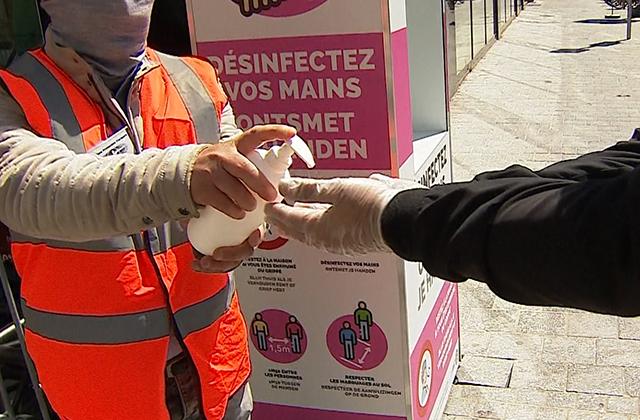
In this vlog Michael O'Flaherty outlines fundamental rights considerations when developing technological responses to public health, as he introduces the focus of FRA's next COVID-19 bulletin.
Тази брошура помага на служителите и органите да информират кандидатите за убежище и мигрантите по разбираем и достъпен начин относно обработката на техните пръстови отпечатъци в системата Евродак.
Tento leták má napomoci úředníkům a úřadům informovat žadatele o azyl a migranty srozumitelně a přístupnou cestou o zpracování jejich otisků prstů v systému Eurodac.
Denne folder hjælper grænsevagter og myndigheder med at informere asylansøgere og immigranter om behandlingen af deres fingeraftryk i Eurodac på en forståelig og lettilgængelig måde.
Dieses Merkblatt unterstützt Beamte und Behörden bei der verständlichen und anschaulichen Information von Asylbewerbern und Migranten über die Verarbeitung ihrer Fingerabdrücke in Eurodac.
Το παρόν φυλλάδιο βοηθά τους αρμόδιους υπαλλήλους και τις αρχές να ενημερώνουν με εύκολο και απλό τρόπο τους αιτούντες άσυλο και τους μετανάστες σχετικά με την επεξεργασία των δακτυλικών τους αποτυπωμάτων στο Eurodac.
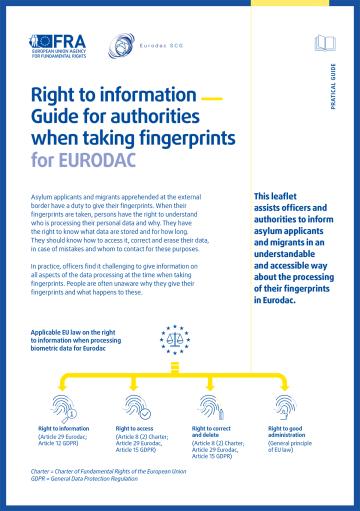
This leaflet assists officers and authorities to inform asylum applicants and migrants in an understandable and accessible way about the processing of their fingerprints in Eurodac.
Este folleto ayuda a los funcionarios y a las autoridades a informar a los solicitantes de asilo y a los inmigrantes, de un modo comprensible y accesible, sobre el tratamiento de sus huellas dactilares en Eurodac.
See teabeleht aitab ametnikel ja ametiasutustel teavitada varjupaigataotlejaid ning rändajaid arusaadaval ja kättesaadaval viisil nende sõrmejälgede töötlemisest Eurodac-süsteemis.
Tämä esite auttaa virkamiehiä ja viranomaisia kertomaan turvapaikanhakijoille ja maahanmuuttajille ymmärrettävällä ja helposti saavutettavalla tavalla sormenjälkien käsittelystä Eurodacissa.
Ce dépliant aide les agents et les autorités à informer de manière compréhensible et accessible les demandeurs d’asile et les migrants sur le traitement de leurs empreintes digitales dans Eurodac.
Ovaj letak pomaže službenicima i nadležnim tijelima da na razumljiv i pristupačan način obavijeste podnositelje zahtjeva za azil i migrante o obradi njihovih otisaka prstiju u Eurodacu.
Ez a szóróanyag támogatja a hatóságok dolgozóit abban, hogy közérthető és hozzáférhető módon tudják tájékoztatni a bevándorlókat és menedékkérőket az ujjlenyomataik Eurodac általi feldolgozásáról.