Justice

Spravedlnost, práva obětí a justiční spolupráce

<p>Your access to justice is a fundamental right. It is central to making your other rights a reality.</p>
<p>It protects rights of the individual. It puts right civil wrongs. It holds power to account. We shine a light on obstacles to access to justice. And we give evidence-based advice on overcoming them.</p>

Highlights
    Produkty

    Publications and Data

    Displaying results 81 - 90 of 136
    Fundamental Rights Report
    30
    May
    2016
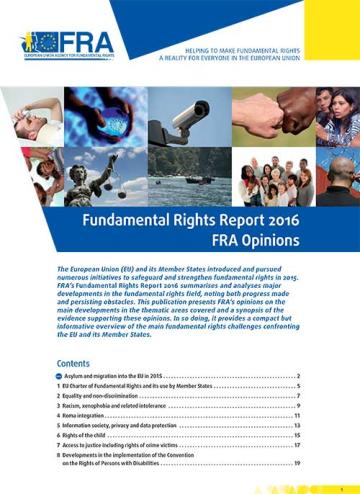
    The European Union (EU) and its Member States introduced and pursued
    numerous initiatives to safeguard and strengthen fundamental rights in 2015.
    FRA’s Fundamental Rights Report 2016 summarises and analyses major
    developments in the fundamental rights field, noting both progress made
    and persisting obstacles. This publication presents FRA’s opinions on the
    main developments in the thematic areas covered and a synopsis of the
    evidence supporting these opinions. In so doing, it provides a compact but
    informative overview of the main fundamental rights challenges confronting
    the EU and its Member States.
    Report / Paper / Summary
    28
    April
    2016
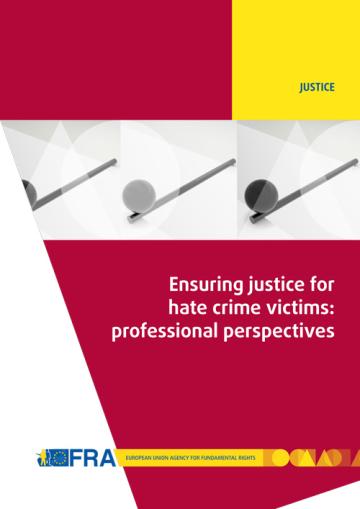
    Hate crime is the most severe expression of discrimination, and a core fundamental rights abuse. Various initiatives target such crime, but most hate crime across the EU remains unreported and unprosecuted, leaving victims without redress. To counter this trend, it is essential for Member States to improve access to justice for victims. Drawing on interviews with representatives from criminal courts, public prosecutors’ offices, the police, and NGOs involved in supporting hate crime victims, this report sheds light on the diverse hurdles that impede victims’ access to justice and the proper recording of hate crime.
    Opinion / Position Paper
    15
    April
    2016
    This opinion underlines the importance of drawing on existing data and information in any assessment of the values in Article 2 TEU, and outlines how this could be done.
    Report / Paper / Summary
    17
    March
    2016
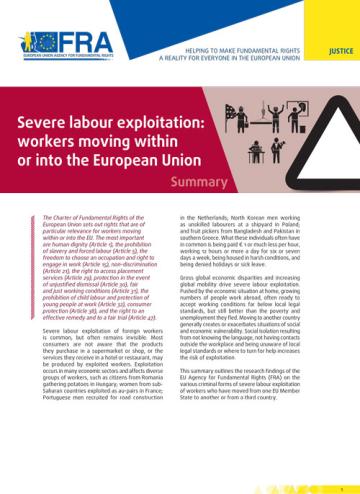
    Worker exploitation is not an isolated or marginal phenomenon. But despite its pervasiveness
    in everyday life, severe labour exploitation and its adverse effects on third-country nationals
    and EU citizens - as workers, but also as consumers - have to date not received much
    attention from researchers. This report identifies risk factors contributing to such exploitation and
    discusses means of improving the situation and highlights the challenges EU institutions and
    Member States face in making the right of workers who have moved within or into the EU
    to decent working conditions a reality.
    Opinion / Position Paper
    21
    December
    2015
    The proposal to establish a possible legislative instrument supplementing the existing European Criminal Records Information System with information on third-country nationals convicted in the EU raises a number of fundamental rights issues.
    Report / Paper / Summary
    18
    November
    2015
    This report, drafted in response to the European Parliament’s call for thorough research on fundamental rights protection in the context of surveillance, maps and analyses the legal frameworks on surveillance in place in EU Member States.
    Report / Paper / Summary
    18
    November
    2015
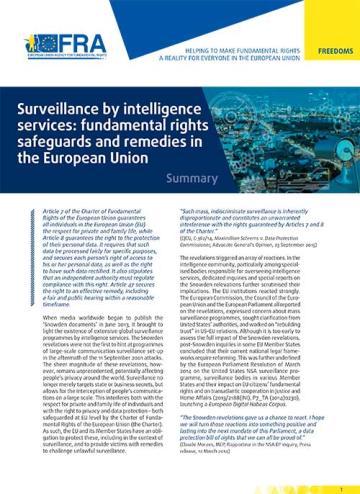
    In April 2014, the European Parliament requested the European Union Agency for Fundamental Rights (FRA) “to undertake in–depth research on the protection of fundamental rights in the context
    of surveillance”. This summary presents FRA’s main research findings, which are published in full in the report entitled Surveillance by intelligence services: fundamental rights safeguards and remedies in the EU – Mapping Member States’ legal frameworks.
    Page
    Infographic
    Report / Paper / Summary
    5
    August
    2015
    This report seeks to demonstrate that the fulfilment of fundamental rights can help to improve the situation and achieve the strategic goals set out in the Europe 2020 growth strategy, which aims to establish a smart, sustainable and inclusive economy.