Newsroom

Migrantinnen und Migranten in einer irregulären Situation können Opfer von ausbeuterischen Arbeitgebern werden. Die EU verfügt über Vorschriften, um Wanderarbeitnehmerinnen und -arbeitnehmer, die sich in einer irregulären Situation befinden, vor Ausbeutung und Missbrauch zu schützen. Doch nach wie vor gibt es Defizite bei der Durchsetzung dieser Vorschriften, so ein neuer Bericht der Agentur der Europäischen Union für Grundrechte (FRA). Arbeitnehmerinnen und Arbeitnehmer kennen ihre Rechte nicht oder wissen nicht, wie sie sich beschweren können, und wenn sie es tun, erhalten sie möglicherweise nicht die ihnen zustehende Entschädigung. Die EU-Länder sollten die Rechte von Wanderarbeitnehmerinnen und -arbeitnehmern gemäß den geltenden EU-Rechtsvorschriften besser schützen.

On World Refugee Day on 20 June, the Council of Europe and the EU Agency for Fundamental Rights (FRA) are joining forces to strengthen their cooperation on human rights protection at the European borders.
On 22 June, FRA Director Michael O’Flaherty will speak about young people as agents of change during a youth conference organised by the Portuguese Presidency of the Council of the EU.
So far this year, almost five people per day on average died crossing the Mediterranean Sea to reach Europe, estimates the International Organization for Migration. Ahead of World Refugee Day 2021, the EU Agency for Fundamental Rights points to ongoing difficulties facing civil society rescue efforts in the Mediterranean, complicated by the Covid-19 pandemic.
FRA will host a national round-table discussion on 21 June on the role of the Fundamental Rights Charter in the EU. The European Commission Representation in Malta is FRA’s partner for the event.
FRA will take part in a meeting of the European Commission’s subgroup on national action plans against racism.
The European Guardianship Network will discuss on 22 June the training materials for guardians that FRA and its contractor Defence for Children International Italy are developing. The draft manual targets trainers of guardians. The content covers ten modules.
-
The FRA Director will visit the Netherlands from 23 to 25 June. He will meet the head of the European Commission Representation in The Hague, Didier Herbert, representatives of civil society organisations and FRA’s Dutch Management Board member, Rick Lawson on 23 June.
On 16 June, the EU Agency for Fundamental Rights publishes the seventh of its bulletins on the fundamental rights impact of the COVID-19 pandemic. In his vlog FRA Director draws attention to fundamental rights issues related to the roll out of the vaccines in the EU 27 Member States.
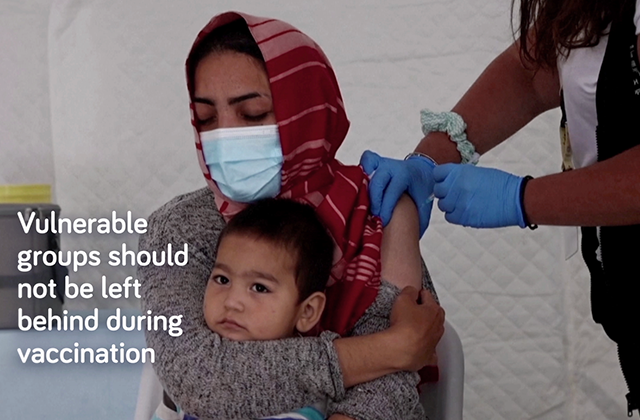
Die Impfkampagnen zeitigen allmählich Ergebnisse im weltweiten Kampf gegen die Covid-19-Pandemie. In einigen Ländern hat sich die Situation jedoch wieder verschlechtert. Insbesondere Menschen in prekären Situationen, wie Häftlinge, Obdachlose und Migrantinnen und Migranten, laufen Gefahr, von den Covid-19-Impfungen ausgeschlossen zu werden, so das jüngste Coronavirus-Bulletin der Agentur der Europäischen Union für Grundrechte (FRA). Die FRA fordert die EU-Länder auf, dafür zu sorgen, dass alle Menschen einen fairen und gleichberechtigten Zugang zu Impfstoffen erhalten.
FRA gave online training to 40 representatives of small-sized, grassroots and local human rights NGOs on communication strategies and campaigning.
The yearly joint FRA-European Judicial Training Network training on the EU Fundamental Rights Charter in national proceedings took place from 7 to 8 June.
The annual European Judicial Training Network study visit of judges and prosecutors to FRA this year went virtual.
FRA invites Slovenian civil society organisations active in its civil society network, the Fundamental Rights Platform (FRP), for an online exchange on 18 June.
FRA Director Michael O’Flaherty and the Council of Europe Secretary General Marija Pejčinović Burić held wide-ranging talks on 10 June in Vienna.
FRA spoke during a funder’s briefing webinar on 9 June.
FRA will introduce findings from its Getting the future rights – artificial intelligence and fundamental rights report during the ENISA Annual Privacy Forum.
On 17 June, FRA meets with Roma and pro-Roma civil society, as part of its civil society cooperation mechanism, the Fundamental Rights Platform.
FRA will host a virtual seminar for legal staff of several ministries of the Slovenian government in the run-up to Slovenia’s Presidency of the Council of the EU. It aims at setting out the relevance and role of the EU’s Fundamental Rights Charter at the EU and national level.
On 16 June, Spain’s Ministry of Justice, in cooperation with FRA, will launch a cycle of conferences on the application of the EU Charter of Fundamental Rights. They aim to improve the knowledge of the Charter among legal actors in Spain, so that the Charter is duly applied in the country.