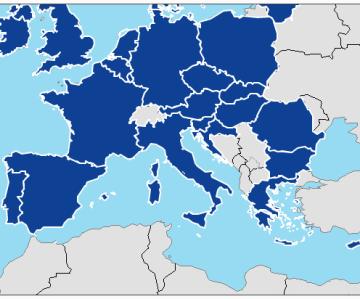
The EU Agency for Fundamental Rights has been regularly collecting data on migration since September 2015. This report focuses on the fundamental rights situation of people arriving in Member States and EU candidate countries particularly affected by large migration movements. It addresses key fundamental rights concerns between 1 October and 31 December 2019.
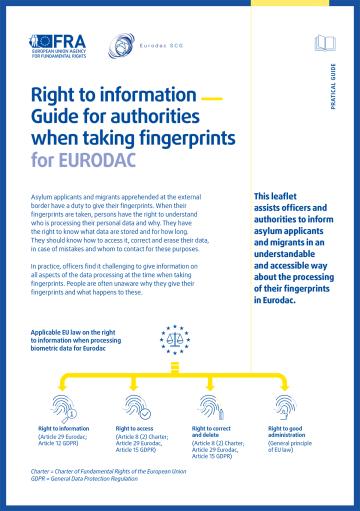
This leaflet assists officers and authorities to inform asylum applicants and migrants in an understandable and accessible way about the processing of their fingerprints in Eurodac.
Growing global efforts to encourage responsible business conduct that respects human rights include steps to ensure access to effective remedies when breaches occur. In 2017, the European Commission asked the EU Agency for Fundamental Rights (FRA) to collect evidence on such access in the EU Member States, with the ultimate goal of identifying the EU actions most needed in this field. FRA’s resulting research involved two phases: desk research on different incidents of abuse; and interview-based fieldwork on professionals’ views on the availability and effectiveness of different complaint avenues.
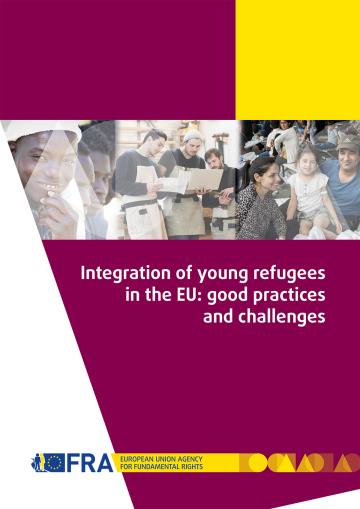
Over 2.5 million people applied for international protection in the 28 EU Member States in 2015 and 2016. Many of those who were granted some form of protection are young people, who are likely to stay and settle in the EU. The EU Agency for Fundamental Rights interviewed some of them, as well as professionals working with them in 15 locations across six EU Member States: Austria, France, Germany, Greece, Italy and Sweden. This report presents the result of FRA’s fieldwork research, focusing on young people between the
ages of 16 and 24.
Based on its findings and research FRA provides practical guidance to support the implementation of fundamental rights in the EU Member States. This series contains practical guidance on: Initial-reception facilities at external borders; Apprehension of migrants in an irregular situation; Guidance on how to reduce the risk of refoulement in external border management when working in or together with third countries; Fundamental rights implications of the obligation to provide fingerprints for Eurodac; Twelve operational fundamental rights considerations for law enforcement when processing Passenger Name Record (PNR) data and Border controls and fundamental rights at external land borders.
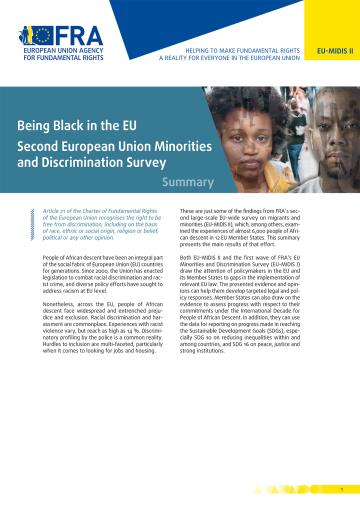
Across the EU, people of African descent face widespread and entrenched prejudice and exclusion. Racial discrimination and harassment are commonplace. Experiences with racist violence vary, but reach as high as 14 %. Discriminatory profiling by the police is a common reality. Hurdles to inclusion are multi-faceted, particularly when it comes to looking for jobs and housing.
The Charter is most effective, and has a real impact on people’s lives, when parliaments, governments and courts at local, regional and national levels all actively apply it. The national sphere is particularly relevant. A strong fundamental rights architecture and committed national governments and parliaments are key to letting the Charter unfold its potential at this level. Civil society organisations (CSOs) and national human rights institutions (NHRIs) are also crucial given their contributions to the protection and promotion of Charter rights.
This annual overview provides an update of the most recent figures on antisemitic incidents, covering the period 1 January 2008 – 31 December 2018, across the EU Member States, where data are available. It includes a section that presents evidence from international organisations. In addition, for the first time, it provides an overview of how Member States that have adopted or endorsed the non-legally binding working definition of antisemitism adopted by the International Holocaust Remembrance Alliance (IHRA) (2016) use or intend to use it.
The EU Agency for Fundamental Rights has been regularly collecting data on asylum and
migration since September 2015. This report focuses on the fundamental rights situation
of people arriving in Member States and EU candidate countries particularly affected by
migration. It addresses fundamental rights concerns between 1 July and 30 September 2019.
In this edition Michael O'Flaherty reports back from his visit to the asylum seeker facility in Lesbos and calls for the support of all EU Member States to improve in particular the situation of unaccompanied children.
Individuals who are not entitled to stay in the European Union are typically subject to being returned to their home countries. This includes children who are not accompanied by their parents or by another primary caregiver. But returning such children, or finding another durable solution, is a delicate matter, and doing so in full compliance with fundamental rights protections can be difficult. This focus paper therefore aims to help national authorities involved in return-related tasks, including child-protection services, to ensure full rights compliance.
FRA’s second EU Minorities and Discrimination survey (EU-MIDIS II) collected information from over 25,000 respondents with different ethnic minority and immigrant backgrounds across all 28 EU Member States. The main findings from the survey, published in 2017, pointed to a number of differences in the way women and men with immigrant backgrounds across the European Union (EU) experience how their rights are respected. This report summarises some of the most relevant survey findings in this regard, which show the need for targeted, gender-sensitive measures that promote the integration of – specifically – women who are immigrants or descendants of immigrants.
The EU Agency for Fundamental Rights has been regularly collecting data on migration since September 2015. This report focuses on the fundamental rights situation of people arriving in Member States and EU candidate countries particularly affected by migration movements. It addresses fundamental rights concerns between 1 April and 30 June 2019.
In the latest edition of his video blog, FRA Director Michael O'Flaherty focuses on the migration situation in the Mediterranean Sea and makes three proposals.
This report is the EU Fundamental Rights Agency’s fourth on the topic of severe labour exploitation. Based on interviews with 237 exploited workers, it paints a bleak picture of severe exploitation and abuse. The workers include both people who came to the EU, and EU nationals who moved to another EU country. They were active in diverse sectors, and their legal status also varied.
In 2018, some 2,299 people are estimated to have died or gone missing at sea while crossing the sea to reach Europe to escape war or persecution or to pursue a better life. This is on average more than six people per day. Before mid-2017, a significant share of migrants in distress at sea have been rescued by civil society vessels deployed with a humanitarian mandate to reduce fatalities and bring rescued migrants to safety. In 2018, however, authorities in some Member States viewed civil society-deployed rescue vessels with hostility. As a reaction, they seized rescue vessels, arrested crew members, and initiated legal procedures against them (more than a dozen altogether). In some cases, rescue vessels were blocked in harbours due to flag issues.
The EU Agency for Fundamental Rights has been regularly collecting data on migration since
September 2015. This report focuses on the fundamental rights situation of people arriving in
Member States and EU candidate countries particularly affected by migration movements.
It addresses fundamental rights concerns between 1 January and 31 March 2019.