• Report / Paper / Summary
    29
    Mai
    2024
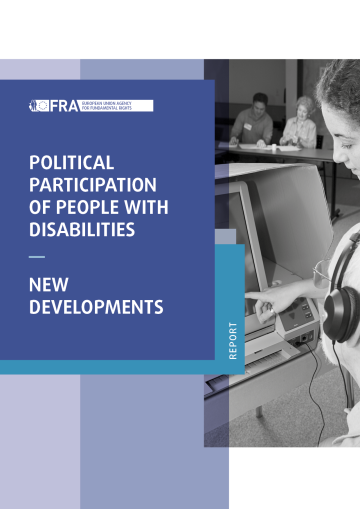
    Ahead of the EU elections, this report explores the political participation of people with disabilities. Although some Member States removed restrictions on the right to vote and to stand for elections, barriers still exist. This report is an update of new developments following FRA’s last report published in 2014. It sets out ways forward to ensure people with disabilities have equal opportunities, in line with the EU Charter of Fundamental Rights and the Convention on the Rights of Persons with Disabilities.
    Lisa F. Young/Adobe Stock
  • Report / Paper / Summary
    14
    Mai
    2024
    FRA’s third LGBTIQ survey shows that people still experience hate-motivated violence and discrimination. Trans and intersex people face even greater victimisation. Yet, signs of progress show that the EU’s and Member States’ efforts can positively affect people’s lives. More LGBTIQ people are open about their sexual orientation, gender identity, gender expression and sex characteristics.
  • Report / Paper / Summary
    10
    April
    2024
    Racism in the police can include discriminatory racial profiling practices through to excessive use of force. Incidents like these highlight deeper systemic issues that need addressing. Many in society are affected by racism in policing, not only the individuals or communities targeted. Lack of trust in policing can fuel social exclusion and damages the foundations of a fair and equal society, however promising practices are developing to address these issues. This is the first EU-wide report on racism in policing. FRA’s findings identify gaps in regulatory frameworks and propose concrete steps for action.
  • Report / Paper / Summary
    2
    Februar
    2024
    This technical report provides all the relevant technical information on the design, implementation and finalisation of the survey on immigrants and descendants of immigrants. Details of the data collection process also contribute to the iterative improvement of survey methodologies, especially when it comes to surveying populations and groups that are considered ‘hard-to-reach’ or difficult to survey.
  • Report / Paper / Summary
    31
    Januar
    2024
    Children’s rights exist to ensure the safety and wellbeing of every child. Improved child protection systems ensure that these rights are met. In recent years, the EU has taken significant steps to improve child protection systems. This mapping of child protection systems gives an overview of the state of such systems at national level and developments since 2015. It promotes the improvement of integrated child protection systems. It is an update of FRA’s mapping of child protection systems in 2015, based on data collected in 2023 in the 27 EU Member States. By publishing this, FRA aims to support securing the sustainable well-being, safety and rights of all children living in the EU.
  • Report / Paper / Summary
    29
    November
    2023
    Online hate speech is a growing problem in today’s digitalised societies. Women, Black people, Jews and Roma are often targets of online hate speech. Online hate proliferates where human content moderators miss offensive content. Also, algorithms are prone to errors. They may multiply errors over time and may even end up promoting online hate. This report presents the challenges in identifying and detecting online hate. Hate of any kind should not be tolerated, regardless of whether it is online or offline. The report discusses the implications for fundamental rights to support creating a rights-compliant digital environment.
  • Periodic updates / Series
    7
    November
    2023
    Antisemitic incidents and hate crimes violate fundamental rights. This report provides an overview of antisemitic incidents in 2022. It reveals persistent gaps in the recording of antisemitism across Europe that impedes efforts to effectively counter hatred towards Jews. It covers antisemitic incidents reported in the 27 EU Member States in 2022 and includes available data of the same year from Albania, the Republic of North Macedonia and Serbia. As this is a yearly publication covering the period 01/01/2022–31/12/2022, it does not include antisemitic incidents reported in 2023. This is the 19th edition and is the only annual source of data of this nature for the EU.
  • Report / Paper / Summary
    25
    Oktober
    2023
    FRA's first Being Black in the EU report exposed widespread and entrenched racism against people of African descent in Europe. Now updated with new data, this report revisits the situation revealing persistent racial discrimination, harassment and violence. Overall, experiences of racial discrimination increased in the EU countries since 2016, reaching as high as 77%. The lack of progress is alarming despite binding anti-discrimination law in the EU since 2000 and significant EU policy developments since then.
  • Report / Paper / Summary
    20
    Oktober
    2023
    FRA’s strategic priorities and objectives are based on the agency’s role and mission as defined in its amended founding regulation. They build on FRA’s 2018–2022 strategy as well as how it performed, its experience and its vision. Their design takes into account future fundamental rights challenges facing Europe, the agency’s mandate, the broader operational context and the resources available.
  • Report / Paper / Summary
    13
    September
    2023
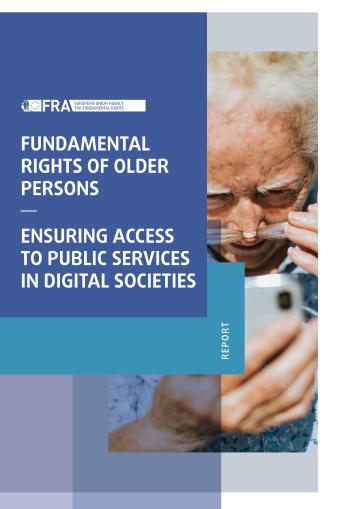
    Europe’s ageing population is ever-increasing, and our societies are becoming more digitalised. Many public services are now available online, with many more services in the process of being digitalised. But the digitalisation of public services poses a risk of exclusion for older persons. In this new report, FRA explores the impact of digitalisation on the fundamental rights of older persons. The report maps the current legislation, policies and practices fostering digital inclusion. It provides an overview of the laws at the national level that provide for equal access to public services, both online and offline. The findings show how Member States safeguard older person’s rights to access services undergoing digitalisation. It outlines how Member States can support digital skills and ensure older people can fully participate in public life.

  • Fundamental Rights Report
    8
    Juni
    2023
    Russia’s unprovoked war of aggression against Ukraine has resulted in massive internal and external population displacement. The European Union (EU) rapidly activated its Temporary Protection Directive for the first time since it was adopted in 2001. This entitled nearly 4 million people to legal residence and access to work, housing and legal assistance, education and healthcare.
  • Fundamental Rights Report
    8
    Juni
    2023
    La guerre d'agression non provoquée de la Russie contre l'Ukraine a entraîné des déplacements massifs de personnes à l'intérieur et à l'extérieur du pays. L'Union européenne (UE) a rapidement activé sa directive relative à la protection
    temporaire pour la première fois depuis son adoption en 2001. Cela a donné à près de 4 millions de personnes le droit à un séjour régulier et à un accès au travail, au logement, à l'assistance juridique, à l'éducation et aux soins de santé.
  • Fundamental Rights Report
    8
    Juni
    2023
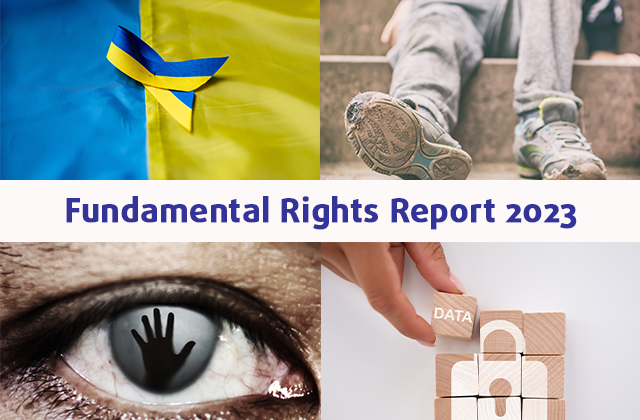
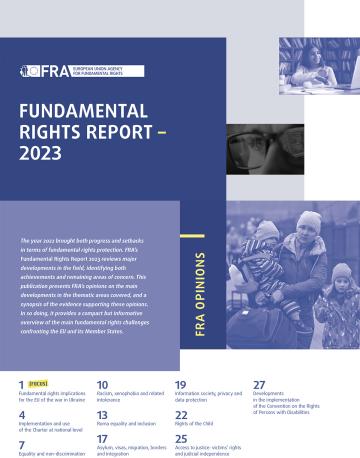
    FRA’s Fundamental Rights Report 2023 reviews major developments in the field in 2022, identifying both achievements and areas of concern. It also presents FRA’s opinions on these developments, including a synopsis of the evidence supporting these opinions.
  • Fundamental Rights Report
    8
    Juni
    2023
    A 2022-es év egyaránt hozott előrelépést és visszaesést az alapvető jogok védelme terén. Az FRA 2023. évi alapjogi jelentése áttekinti a terület legfontosabb fejleményeit, valamint meghatározza az elért eredményeket és a fennmaradó aggályos területeket. Ez a kiadvány bemutatja az FRA véleményét az érintett témakörök főbb fejleményeiről, valamint a véleményeket alátámasztó bizonyítékok összefoglalóját.
  • Fundamental Rights Report
    8
    Juni
    2023
    Il 2022 è stato caratterizzato sia da progressi sia da battute d’arresto in termini di tutela dei diritti fondamentali. Il Fundamental Rights Report 2023 (Relazione sui diritti fondamentali per il 2023) dell’Agenzia dell’Unione europea per i diritti fondamentali (FRA) fa il punto della situazione sui principali sviluppi in materia, individuando i risultati ottenuti e i settori che destano ancora preoccupazione.
  • Fundamental Rights Report
    8
    Juni
    2023
    Pagrindinių teisių apsaugos srityje 2022 m. būta ir sėkmės, ir nesėkmės. FRA 2023 m. pagrindinių teisių ataskaitoje apžvelgiami pagrindiniai pokyčiai pagrindinių teisių srityje, nurodant ir pasiekimus, ir sritis, keliančias nuolatinį susirūpinimą. Šiame leidinyje pateikiamos FRA išvados apie pagrindinius pokyčius atitinkamose teminėse srityse ir šias išvadas pagrindžiantys įrodymai.
  • Fundamental Rights Report
    8
    Juni
    2023
    Pamattiesību aizsardzības jomā 2022. gadā bija vērojami gan sasniegumi, gan neveiksmes. FRA 2023. gada ziņojumā par pamattiesībām aplūkoti galvenie jaunumi pamattiesību jomā, nosakot gan sasniegumus, gan jomas, kas aizvien rada bažas. Šajā publikācijā sniegti FRA atzinumi par galvenajiem jaunumiem attiecīgajās tematiskajās jomās un šos atzinumus pamatojošs pierādījumu apkopojums.
  • Fundamental Rights Report
    8
    Juni
    2023
    Is-sena 2022 ġabet magħha kemm progress kif ukoll ostakli f’termini ta’ protezzjoni tad-drittijiet fundamentali. Ir-Rapport dwar id-Drittijiet Fundamentali 2023 tal-FRA jirrieżamina l-iżviluppi ewlenin fil-qasam, filwaqt li jidentifika kemm ilkisbiet kif ukoll l-oqsma ta’ tħassib li fadal. Din ilpubblikazzjoni tippreżenta l-opinjonijiet tal-FRA dwar
    l-iżviluppi ewlenin fl-oqsma tematiċi koperti u taqsira tal-evidenza li tappoġġa dawn l-opinjonijiet.