• Fundamental Rights Report
    8
    June
    2023
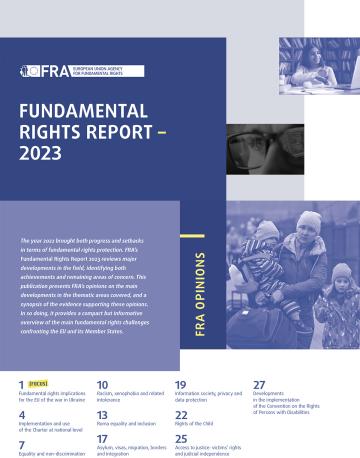
    Is-sena 2022 ġabet magħha kemm progress kif ukoll ostakli f’termini ta’ protezzjoni tad-drittijiet fundamentali. Ir-Rapport dwar id-Drittijiet Fundamentali 2023 tal-FRA jirrieżamina l-iżviluppi ewlenin fil-qasam, filwaqt li jidentifika kemm ilkisbiet kif ukoll l-oqsma ta’ tħassib li fadal. Din ilpubblikazzjoni tippreżenta l-opinjonijiet tal-FRA dwar
    l-iżviluppi ewlenin fl-oqsma tematiċi koperti u taqsira tal-evidenza li tappoġġa dawn l-opinjonijiet.
  • Fundamental Rights Report
    8
    June
    2023
    Het jaar 2022 kende zowel vooruitgang als tegenslagen bij de bescherming van de grondrechten. In het Verslag over de grondrechten 2023 van FRA worden de belangrijkste ontwikkelingen op het gebied van de grondrechten geëvalueerd en wordt niet alleen ingegaan op de behaalde successen, maar ook gewezen op blijvende punten van zorg. Deze publicatie geeft een overzicht van FRA- adviezen over de belangrijkste ontwikkelingen binnen thematische gebieden en geeft in het kort de feitelijke gegevens weer waarop deze adviezen berusten.
  • Fundamental Rights Report
    8
    June
    2023
    Rok 2022 przyniósł zarówno postęp, jak i regres pod względem ochrony praw podstawowych. Sprawozdanie FRA na temat praw podstawowych z 2023 r. zawiera przegląd najważniejszych zmian, jakie miały miejsce w tym obszarze, wskazując zarówno na osiągnięcia, jak i kwestie, które nadal wymagają stosownych działań. W niniejszej publikacji przedstawiono opinie FRA na temat najważniejszych zmian, jakie miały miejsce w uwzględnionych obszarach tematycznych, oraz podsumowanie dowodów, na których oparto te opinie.
  • Fundamental Rights Report
    8
    June
    2023
    O ano de 2022 trouxe avanços e retrocessos na proteção dos direitos fundamentais. O Relatório sobre os Direitos Fundamentais 2023 da FRA analisa os principais desenvolvimentos neste domínio, identificando tanto as realizações quanto os problemas que persistem. A presente publicação apresenta os pareceres da FRA relacionados com os principais desenvolvimentos nas áreas temáticas versadas e uma sinopse dos factos comprovados que sustentam tais pareceres.
  • Fundamental Rights Report
    8
    June
    2023
    Anul 2022 a adus atât progrese, cât și regrese în ceea ce privește protecția drepturilor fundamentale. Raportul privind drepturile fundamentale 2023 al FRA analizează evoluțiile majore din domeniu, identificând atât realizările, cât și problemele îngrijorătoare rămase nesoluționate. Această publicație prezintă opiniile FRA în legătură cu principalele evoluții înregistrate în domeniile tematice vizate, precum și o sinteză a dovezilor care vin în sprijinul acestor opinii.
  • Fundamental Rights Report
    8
    June
    2023
    Z hľadiska ochrany základných práv priniesol rok 2022 pokrok i určité nezdary. V publikácii agentúry FRA Správa o základných právach 2023 je uvedený prehľad hlavného vývoja v tejto oblasti, poukazuje sa na úspechy, ale aj na oblasti, ktoré ešte stále vyvolávajú obavy. V tejto publikácii sa nachádzajú stanoviská agentúry FRA k základným výsledkom vývoja v jednotlivých tematických oblastiach, ako aj súhrn dôkazov k týmto stanoviskám.
  • Fundamental Rights Report
    8
    June
    2023
    Leta 2022 je bil na področju varstva temeljnih pravic sicer dosežen napredek, a je bilo hkrati opazno tudi nazadovanje. Poročilo o temeljnih pravicah za leto 2023, ki ga je pripravila Agencija Evropske unije za temeljne pravice (FRA), povzema razvoj glavnih dogodkov na tem področju ter izpostavlja dosežke in področja, ki so še vedno zaskrbljujoča. Predstavlja mnenja agencije FRA o glavnem razvoju dogodkov na obravnavanih tematskih področjih in podaja utemeljitve za ta mnenja.
  • Fundamental Rights Report
    8
    June
    2023
    År 2022 innebar både framgångar och motgångar för skyddet av de grundläggande rättigheterna. FRA:s Rapport om grundläggande rättigheter 2023 innehåller en granskning av de viktigaste händelserna på området och pekar ut både framsteg och återstående problemområden. I publikationen presenteras FRA:s yttranden om den huvudsakliga utvecklingen på de berörda tematiska områdena, tillsammans med en översikt över det underlag som ligger till grund för dessa yttranden.
  • Periodic updates / Series
    30
    May
    2023
    Over the span of nearly eight years, there have been developments in showing respect for the human rights of those who arrive at the EU’s borders. Russia’s war of aggression against Ukraine has shown how a large and sudden influx of people can be managed effectively and respectfully. Notwithstanding the improvements, the growing number of people crossing or attempting to enter the EU pose a wide range of fundamental rights challenges.

    In this bulletin, FRA takes stock of concerns and improvements regarding the fundamental rights of migrants, asylum seekers and refugees. It highlights the EU Member States’ legal and practical responses. It identifies key trends, promising practices, long-standing and emerging patterns, and persistent concerns.
  • Report / Paper / Summary
    24
    May
    2023
    This report provides a partial update on the findings of the 2017 European Union Agency for Fundamental Rights (FRA) report Surveillance by intelligence services: Fundamental rights safeguards and remedies in the EU. It was prepared at the request of the European Parliament, which asked FRA to update its 2017 findings to support the work of its committee of inquiry to investigate the use of Pegasus and equivalent surveillance spyware (PEGA).
  • Report / Paper / Summary
    27
    February
    2023
    FRA’s 2021 survey on Roma was conducted in Croatia, Czechia, Greece, Hungary, Italy, Portugal, Romania, and Spain, as well as in North Macedonia and Serbia. It includes interviews with more than 8,400 Roma, collecting information on more than 20,000 individuals living in their households. This technical report provides a detailed overview of the survey methodology used by FRA when collecting the survey data.
  • Report / Paper / Summary
    22
    February
    2023
    Directive 2012/29/EU represents a milestone in the development of victims’ rights. It establishes minimum standards for the rights, support and protection of victims of crime. It defines the scope of support services, guarantees the right to effective protection against secondary victimisation and comprehensively regulates the measures required for this purpose. This report covers three core components underpinning victims’ rights: support services, crime reporting, and protection from secondary and repeat victimisation. Examples highlight the relevant legal provisions in Member States and how specific rights under the Victims’ Rights Directive work in practice.
  • Periodic updates / Series
    13
    December
    2022
    National Human Rights Institutions (NHRIs) continue to play a key role in upholding fundamental rights. FRA keeps track of the accreditation status and the mandates of the NHRIs. In 2022, the NHRI in Cyprus was upgraded to an ‘A-status’ institution. In addition, the mandates of six NHRIs changed to include child protection or the protection of LGBTI people.
  • Report / Paper / Summary
    8
    December
    2022
    Artificial intelligence is everywhere and affects everyone – from deciding what content people see on their social media feeds to determining who will receive state benefits. AI technologies are typically based on algorithms that make predictions to support or even fully automate decision-making.
  • Report / Paper / Summary
    3
    November
    2022
    Antisemitic incidents and hate crimes violate fundamental rights, especially the right to human dignity, the right to equality of treatment and the freedom of thought, conscience and religion. This report provides an overview of available data on antisemitism as recorded by official and unofficial sources in the EU Member States and in Albania, North Macedonia and Serbia. The data provided by the countries are supplemented with information from international organisations.
  • Report / Paper / Summary
    25
    October
    2022
    02 November 2022
    This report presents findings from FRA’s 2021 survey on Roma in Croatia, Czechia, Greece, Hungary, Italy, Portugal, Romania and Spain, as well as in North Macedonia and Serbia. The survey includes interviews with more than 8,400 Roma, collecting information on more than 20,000 individuals living in their households. By focusing on Roma, the survey provides unique data and information that are not available from European general population surveys, which do not disaggregate on grounds of ethnic origin. The findings present a bleak but familiar picture of exclusion, deprivation, discrimination and racism.

  • Periodic updates / Series
    21
    October
    2022
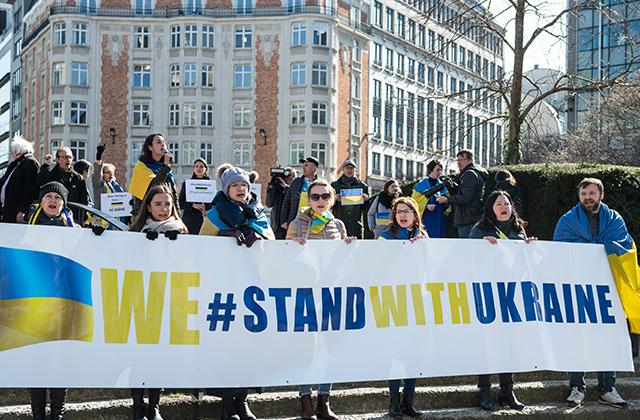
    The Russian invasion of Ukraine triggered solidarity from EU governments, local authorities and society as they welcomed more than 7 million people fleeing the aggression. The European Union’s rapid response, activating the EU Temporary Protection Directive, offered welcome relief and much-needed support to those in need. It allowed displaced persons the opportunity to quickly settle and to work, travel and access services across the EU. But other pressing human rights issues have come to the fore and remain high on the EU’s agenda, such as human trafficking, sexual and gender-based violence, hate crime and hate-fuelled disinformation.
  • Handbook / Guide / Manual
    14
    October
    2022
    Η παρακολούθηση της κατάστασης των θεμελιωδών δικαιωμάτων στα εξωτερικά σύνορα της ΕΕ θα πρέπει να είναι συστηματική και τακτική για μια σειρά δραστηριοτήτων διαχείρισης των συνόρων, όπως είναι η επιτήρηση των συνόρων, οι συλλήψεις στα χερσαία, θαλάσσια και εναέρια σύνορα, καθώς και η λειτουργία των μηχανισμών παραπομπής, ακόμη και σε περίπτωση μαζικών αφίξεων. Οι παρούσες γενικές κατευθυντήριες γραμμές έχουν ως στόχο να βοηθήσουν τα κράτη μέλη της ΕΕ να συγκροτήσουν εθνικούς ανεξάρτητους μηχανισμούς για την παρακολούθηση της συμμόρφωσης προς τα θεμελιώδη δικαιώματα στα εξωτερικά σύνορα της ΕΕ, σύμφωνα με την πρόταση κανονισμού για τον έλεγχο διαλογής που ανακοινώθηκε στις 23 Σεπτεμβρίου 2020 από την Ευρωπαϊκή Επιτροπή. Εκπονήθηκαν από τον Οργανισμό Θεμελιωδών Δικαιωμάτων της Ευρωπαϊκής Ένωσης κατόπιν αιτήματος της Επιτροπής.
  • Handbook / Guide / Manual
    14
    October
    2022
    ** As of 19 September 2024 a new version of this guidance has been issued. Please see the link below. **

    Fundamental rights monitoring at EU external borders should be systematically and regularly carried out for a range of border management activities. These include border surveillance, apprehensions at land, sea and air borders, and the operation of referral mechanisms, including in the event of mass arrivals. This general guidance provides assistance to EU Member States in setting up national independent mechanisms to monitor fundamental rights compliance at EU external borders, in line with the proposed screening regulation of 23 September 2020 by the European Commission. The EU Agency for Fundamental Rights prepared this guidance at the request of the Commission.
  • Handbook / Guide / Manual
    14
    October
    2022
    El control del respeto de los derechos fundamentales en las fronteras exteriores de la UE debe llevarse a cabo de forma sistemática y regular para determinadas actividades de gestión fronteriza. Estas actividades incluyen la vigilancia de fronteras, las detenciones en las fronteras terrestres, marítimas y aéreas, y el funcionamiento de los mecanismos de devolución, incluso en el caso de llegadas masivas. Esta guía general proporciona asistencia a los Estados miembros de la Unión Europea (UE) para crear mecanismos nacionales independientes con el fin de supervisar el cumplimiento de los derechos fundamentales en las fronteras exteriores de la UE, de acuerdo con la propuesta de reglamento de control de 23 de septiembre de 2020 de la Comisión Europea. La Agencia de Derechos Fundamentales de la UE elaboró esta guía a solicitud de la Comisión.