eu-charter

EU:n perusoikeuskirja

31 artikla - Oikeudenmukaiset ja kohtuulliset työolot ja työehdot

31 artikla - Oikeudenmukaiset ja kohtuulliset työolot ja työehdot

1. Jokaisella työntekijällä on oikeus terveellisiin, turvallisiin ja ihmisarvoisiin työoloihin ja työehtoihin.
2. Jokaisella työntekijällä on oikeus enimmäistyöajan rajoitukseen sekä päivittäisiin ja viikoittaisiin lepoaikoihin ja palkalliseen vuosilomaan.

Selitykset

  • Text:

    1. Tämän artiklan 1 kohta perustuu toimenpiteistä työntekijöiden turvallisuuden ja terveyden parantamisen edistämiseksi työssä annettuun direktiiviin 89/391/ETY. Sen pohjana on myös sosiaalisen peruskirjan 3 artikla ja työntekijöiden sosiaalisia perusoikeuksia koskevan yhteisön peruskirjan 19 kohta sekä siltä osin kuin on kyse oikeudesta nauttia arvostusta työssä, tarkistetun sosiaalisen peruskirjan 26 artikla. Ilmaus `työehdot` on käsitettävä Euroopan unionin toiminnasta tehdyn sopimuksen 156 artiklan mukaisesti.

    2. Artiklan 2 kohta perustuu tietyistä työajan järjestämistä koskevista seikoista annettuun direktiiviin 93/104/EY sekä Euroopan sosiaalisen peruskirjan 2 artiklaan sekä työntekijöiden sosiaalisia perusoikeuksia koskevan yhteisön peruskirjan 8 kohtaan.

    Source:
    Euroopan unionin perusoikeuskirjan selitykset
    Preamble - Explanations relating to the Charter of Fundamental Rights:
    Nämä selitykset on alun perin laatinut Euroopan unionin perusoikeuskirjan valmistelukunnan puheenjohtajisto. Eurooppa-valmistelukunnan puheenjohtajisto on saattanut ne ajan tasalle tämän valmistelukunnan perusoikeuskirjaan tekemien tekstimuutosten (erityisesti 51 ja 52 artikla) ja unionin oikeuden myöhemmän kehittymisen perusteella. Vaikka niillä ei sellaisenaan ole oikeudellista merkitystä, ne ovat arvokas tulkinnan väline, jonka tarkoituksena on selventää perusoikeuskirjan määräyksiä.

Oikeuskäytäntö

Kansallinen perustuslakilaki

45 results found

  • De Belgische Grondwet
    Maa:
    Belgium

    Artikel 23.Ieder heeft het recht een menswaardig leven te leiden.Daartoe waarborgen de wet, het decreet of de in artikel 134 bedoelde regel, rekening houdend met de overeenkomstige plichten, de economische, sociale en culturele rechten, waarvan ze de voorwaarden voor de uitoefening bepalen.Die rechten omvatten inzonderheid: 1° het recht op arbeid en op de vrije keuze van beroepsarbeid in het raam van een algemeen werkgelegenheidsbeleid dat onder meer gericht is op het waarborgen van een zo hoog en stabiel mogelijk werkgelegenheidspeil, het recht op billijke arbeidsvoorwaarden en een billijke beloning, alsmede het recht op informatie, overleg en collectief onderhandelen;(...)

  • Eesti Vabariigi Põhiseadus
    Maa:
    Estonia

    § 29. (...) Töötingimused on riigi kontrolli all. (...)

  • Industrial Relations Act
    Maa:
    Germany

     (Betriebsverfassungsgesetz, BetrVG) A law which regulates the relationship between employer and the employees, represented by the work council and their rights and duties.

  • Konstytucja Rzeczypospolitej Polskiej
    Maa:
    Poland

    Art. 24Praca znajduje się pod ochroną Rzeczypospolitej Polskiej. Państwo sprawuje nadzór nad warunkami wykonywania pracy. Art. 65(...) 4. Minimalną wysokość wynagrodzenia za pracę lub sposób ustalania tej wysokości określa ustawa.Art. 661. Każdy ma prawo do bezpiecznych i higienicznych warunków pracy. Sposób realizacji tego prawa oraz obowiązki pracodawcy określa ustawa.2. Pracownik ma prawo do określonych w ustawie dni wolnych od pracy i corocznych płatnych urlopów; maksymalne normy czasu pracy określa ustawa.

  • La Constitution Belge
    Maa:
    Belgium

    Article 23.Chacun a le droit de mener une vie conforme à la dignité humaine.A cette fin, la loi, le décret ou la règle visée à l'article 134 garantissent, en tenant compte des obligations correspondantes, les droits économiques, sociaux et culturels, et déterminent les conditions de leur exercice.Ces droits comprennent notamment: 1° le droit au travail et au libre choix d'une activité professionnelle dans le cadre d'une politique générale de l'emploi, visant entre autres à assurer un niveau d'emploi aussi stable et élevé que possible, le droit à des conditions de travail et à une rémunération équitables, ainsi que le droit d'information, de consultation et de négociation collective; (...)

  • Labour Code
    Maa:
    Bulgaria

     Chapter VI deals with Major Obligations of the Parties to the Employment Relationship, including working conditions.

  • Labour Law
    Maa:
    Latvia

    Section 7 - Principle of Equal Rights(1) Everyone has an equal right to work, to fair, safe and healthy working conditions, as well as to fair work remuneration.(...)

  • Latvijas Republikas Satversme
    Maa:
    Latvia

    107. Ikvienam darbiniekam ir tiesības saņemt veiktajam darbam atbilstošu samaksu, kas nav mazāka par valsts noteikto minimumu, kā arī tiesības uz iknedēļas brīvdienām un ikgadēju apmaksātu atvaļinājumu.

  • Lietuvos Respublikos Konstitucija
    Maa:
    Lithuania

    48 straipsnis. Kiekvienas žmogus gali laisvai pasirinkti darbą bei verslą ir turi teisę turėti tinkamas, saugias ir sveikas darbo sąlygas, gauti teisingą apmokėjimą už darbą ir socialinę apsaugą nedarbo atveju.Užsieniečių darbą Lietuvos Respublikoje reguliuoja įstatymas.Priverčiamasis darbas draudžiamas. 49 straipsnis. Kiekvienas dirbantis žmogus turi teisę turėti poilsį ir laisvalaikį, taip pat kasmetines mokamas atostogas.Darbo laiko trukmę apibrėžia įstatymas.

  • Luxembourg / Constitution of the Grand Ducal of Luxembourg
    Maa:
    Luxembourg

    Art. 34. La sécurité sociale, la protection de la santé et les droits des travailleurs sont réglés par la loi quant à leurs principes.

  • Magyarország Alaptörvénye
    Maa:
    Hungary

    XVII. cikk (SZABADSÁG ÉS FELELŐSSÉG) […] (3) Minden munkavállalónak joga van az egészségét, biztonságát és méltóságát tiszteletben tartó munkafeltételekhez.
    (4) Minden munkavállalónak joga van a napi és heti pihenőidőhöz, valamint az éves fizetett szabadsághoz.

  • Netherlands / Constitution of the Kingdom of the Netherlands
    Maa:
    Netherlands

    Article 19 (...) 2. Rules concerning the legal status and protection of working persons and concerning co-determination shall be laid down by Act of Parliament.

  • Portugal / Constitution of the Portuguese Republic
    Maa:
    Portugal

     Article 59 (Workers' rights) (1) Regardless of age, sex, race, citizenship, place of origin, religion and political and ideological convictions, every worker shall possess the right: (a) To the remuneration of his work in accordance with its volume, nature and quality, with respect for the principle of equal pay for equal work and in such a way as to guarantee a proper living; (b) That work be organised in keeping with social dignity and in such a way as to provide personal fulfilment and to make it possible to reconcile professional and family life; (c) To work in conditions that are hygienic, safe and healthy; (d) To rest and leisure time, a maximum limit on the working day, a weekly rest period and periodic paid holidays; (e) To material assistance when he involuntarily finds himself unemployed; (f) To assistance and fair reparation when he is the victim of a work-related accident or occupational illness. (2) The state shall be charged with ensuring the working, remuneratory and rest-related conditions to which workers are entitled, particularly by: (a) Setting and updating a national minimum wage which, among other factors, shall have particular regard to workers’ needs, increases in the cost of living, the level to which the sectors of production have developed, the requirements imposed by economic and financial stability, and the accumulation of capital for development purposes; (b) Setting national limits on working hours; (c) Ensuring special work-related protection for women during pregnancy and following childbirth, as well as for minors, the disabled and those whose occupations are particularly strenuous or take place in unhealthy, toxic or dangerous conditions; (d) In cooperation with social organisations, ensuring the systematic development of a network of rest and holiday centres; (e) Protecting emigrant workers’ working conditions and guaranteeing their social benefits; (f) Protecting student workers’ working conditions. (3) Salaries shall enjoy special guarantees, as laid down by law.

  • Romania / Constitution of Romania
    Maa:
    Romania

    Article 41(...) (2) All employees have the right to measures of social protection. These concern employees' safety and health, working conditions for women and young people, the setting up of a minimum gross salary per economy, weekends, paid rest leave, work performed under difficult and special conditions, as well as other specific conditions, as stipulated by the law. (3) The normal duration of a working day is of maximum eight hours, on the average.

  • Slovakia / Constitution of the Slovak Republic
    Maa:
    Slovakia

     Article 36 Employees have the right to just and satisfying working conditions. The law guarantees, above all a) the right to remuneration for work done, sufficient to ensure them a dignified standard of living, b) protection against arbitrary dismissal and discrimination at the work place, c) labor safety and the protection of health at work, d) the longest admissible working time, e) adequate rest after work, f) the shortest admissible period of paid leave, g) the right to collective bargaining.

  • Slovenia / Constitution of the Republic of Slovenia
    Maa:
    Slovenia

    Article 66 (Security of Employment)The state shall create opportunities for employment and work, and shall ensure the protection of both by law. 

  • Spain / Constitution of the Kingdom of Spain
    Maa:
    Spain

    Article 40 (...) 2. Likewise, the public authorities shall promote a policy guaranteeing professional training and retraining; they shall ensure labour safety and hygiene and shall provide for the need of rest by limiting the duration of working day, by periodic paid holidays, and by promoting suitable centres.

  • Suomen perustuslaki
    Maa:
    Finland

    18 § Oikeus työhön ja elinkeinovapaus Jokaisella on oikeus lain mukaan hankkia toimeentulonsa valitsemallaan työllä, ammatilla tai elinkeinolla. Julkisen vallan on huolehdittava työvoiman suojelusta. (...)

  • The Belgian Constitution
    Maa:
    Belgium

    Article 23.Everyone has the right to lead a life in keeping with human dignity.
    To this end, the laws, federate laws and rules referred to in Article 134 guarantee
    economic, social and cultural rights, taking into account corresponding obligations, and
    determine the conditions for exercising them.
    These rights include among others:
    1° the right to employment and to the free choice of an occupation within the context
    of a general employment policy, aimed among others at ensuring a level of employment that is as stable and high as possible, the right to fair terms of employment and to fair
    remuneration, as well as the right to information, consultation and collective negotiation; (...)

  • The Constitutional Act of Denmark
    Maa:
    Denmark

    Section 75 . Subsection 1. In order to advance the public interest, efforts shall be made to guarantee work for every able-bodied citizen on terms that will secure his existence.

Unionin oikeus

11 results found

  • Directive (EU) 2024/2831 of the European Parliament and of the Council of 23 October 2024 on improving working conditions in platform work

    Preamble 


    (2) Article 31 of the Charter of Fundamental Rights of the European Union (the ‘Charter’) provides for the right of every worker to fair and just working conditions which respect his or her health, safety and dignity. Article 27 of the Charter protects the workers’ right to information and consultation within the undertaking. Article 8 of the Charter provides that everyone has the right to the protection of personal data concerning him or her. Article 12 of the Charter provides that everyone has the right to freedom of assembly and of association at all levels. Article 16 of the Charter recognises the freedom to conduct a business. Article 21 of the Charter prohibits discrimination.

    Article 7: Limitations on the processing of personal data by means of automated monitoring systems or automated decision-making systems

    1.   Digital labour platforms shall not, by means of automated monitoring systems or automated decision-making systems:

    (a) process any personal data on the emotional or psychological state of a person performing platform work;

    (b) process any personal data in relation to private conversations, including exchanges with other persons performing platform work and the representatives of persons performing platform work;

    (c) collect any personal data of a person performing platform work while that person is not offering or performing platform work;

    (d) process personal data to predict the exercise of fundamental rights, including the freedom of association, the right of collective bargaining and action or the right to information and consultation as laid down in the Charter;

    (e) process any personal data to infer the racial or ethnic origin, migration status, political opinions, religious or philosophical beliefs, disability, state of health, including chronic disease or HIV status, emotional or psychological state, trade union membership, sex life or sexual orientation;

    (f) process any biometric data, as defined in Article 4, point (14), of Regulation (EU) 2016/679, of a person performing platform work to establish that person’s identity by comparing that data to stored biometric data of natural persons in a database.

  • Community Charter of the Fundamental Social Rights of Workers (not in force)

    8. Every worker of the European Community shall have a right to a weekly rest period' and to annual paid leave, the duration of which must be progressively harmonized' in accordance with national practices.

  • Directive 2003/88/EC of the European Parliament and of the Council of 4 November 2003 concerning certain aspects of the organisation of working time

    .

  • Community Charter of the Fundamental Social Rights of Workers (not in force)

    Health protection and safety at the
    workplace
    19. Every worker must enjoy satisfactory health and safety conditions in his working environment. Appropriate measures must be taken in order to achieve further harmonization of conditions in this area while maintaining the improvements made. These measures shall take account, in particular, of the
    need for the training, information, consultation and balanced participation of workers as regards the risks incurred and the steps taken to eliminate or reduce them. The provisions regarding implementation of the internal market shall help to ensure such protection.

  • Treaty on the Functioning of the European Union

    Article 156

    (ex Article 140 TEC)

    With a view to achieving the objectives of Article 151 and without prejudice to the other provisions of the Treaties, the Commission shall encourage cooperation between the Member States and facilitate the coordination of their action in all social policy fields under this Chapter, particularly in matters relating to:

    - employment,

    - labour law and working conditions,

    - basic and advanced vocational training,

    - social security,

    - prevention of occupational accidents and diseases,

    - occupational hygiene,

    - the right of association and collective bargaining between employers and workers.

    To this end, the Commission shall act in close contact with Member States by making studies, delivering opinions and arranging consultations both on problems arising at national level and on those of concern to international organisations, in particular initiatives aiming at the establishment of guidelines and indicators, the organisation of exchange of best practice, and the preparation of the necessary elements for periodic monitoring and evaluation. The European Parliament shall be kept fully informed.

    Before delivering the opinions provided for in this Article, the Commission shall consult the Economic and Social Committee.

  • Council Directive of 12 June 1989 on the introduction of measures to encourage improvements in the safety and health of workers at work (89/391/EEC)

    .

  • Directive (EU) 2019/1152 of the European Parliament and of the Council of 20 June 2019 on transparent and predictable working conditions in the European Union

    .

  • Consolidated version of the Treaty on the Functioning of the European Union

    Article 153 (ex Article 137 TEC)

    1. With a view to achieving the objectives of Article 151, the Union shall support and complement the activities of the Member States in the following fields:

    (a) improvement in particular of the working environment to protect workers' health and safety;

    (b) working conditions;

    (c) social security and social protection of workers;

    (d) protection of workers where their employment contract is terminated;

    (e) the information and consultation of workers;

    (f) representation and collective defence of the interests of workers and employers, including co-determination, subject to paragraph 5;

    (g) conditions of employment for third-country nationals legally residing in Union territory;

    (h) the integration of persons excluded from the labour market, without prejudice to Article 166;

    (i) equality between men and women with regard to labour market opportunities and treatment at work;

    (j) the combating of social exclusion;

    (k) the modernisation of social protection systems without prejudice to point (c).

    2. To this end, the European Parliament and the Council:

    (a) may adopt measures designed to encourage cooperation between Member States through initiatives aimed at improving knowledge, developing exchanges of information and best practices, promoting innovative approaches and evaluating experiences, excluding any harmonisation of the laws and regulations of the Member States;

    (b) may adopt, in the fields referred to in paragraph 1(a) to (i), by means of directives, minimum requirements for gradual implementation, having regard to the conditions and technical rules obtaining in each of the Member States. Such directives shall avoid imposing administrative, financial and legal constraints in a way which would hold back the creation and development of small and medium-sized undertakings. The European Parliament and the Council shall act in accordance with the ordinary legislative procedure after consulting the Economic and Social Committee and the Committee of the Regions.

    In the fields referred to in paragraph 1(c), (d), (f) and (g), the Council shall act unanimously, in accordance with a special legislative procedure, after consulting the European Parliament and the said Committees.

    The Council, acting unanimously on a proposal from the Commission, after consulting the European Parliament, may decide to render the ordinary legislative procedure applicable to paragraph 1(d), (f) and (g).

    3. A Member State may entrust management and labour, at their joint request, with the implementation of directives adopted pursuant to paragraph 2, or, where appropriate, with the implementation of a Council decision adopted in accordance with Article 155.

    In this case, it shall ensure that, no later than the date on which a directive or a decision must be transposed or implemented, management and labour have introduced the necessary measures by agreement, the Member State concerned being required to take any necessary measure enabling it at any time to be in a position to guarantee the results imposed by that directive or that decision.

    4. The provisions adopted pursuant to this Article:

    - shall not affect the right of Member States to define the fundamental principles of their social security systems and must not significantly affect the financial equilibrium thereof,

    - shall not prevent any Member State from maintaining or introducing more stringent protective measures compatible with the Treaties.

    5. The provisions of this Article shall not apply to pay, the right of association, the right to strike or the right to impose lock-outs.

  • Consolidated version of the Treaty on the Functioning of the European Union

    Article 156 (ex Article 140 TEC)

    With a view to achieving the objectives of Article 151 and without prejudice to the other provisions of the Treaties, the Commission shall encourage cooperation between the Member States and facilitate the coordination of their action in all social policy fields under this Chapter, particularly in matters relating to:

    - employment,

    - labour law and working conditions,

    - basic and advanced vocational training,

    - social security,

    - prevention of occupational accidents and diseases,

    - occupational hygiene,

    - the right of association and collective bargaining between employers and workers.

    To this end, the Commission shall act in close contact with Member States by making studies, delivering opinions and arranging consultations both on problems arising at national level and on those of concern to international organisations, in particular initiatives aiming at the establishment of guidelines and indicators, the organisation of exchange of best practice, and the preparation of the necessary elements for periodic monitoring and evaluation. The European Parliament shall be kept fully informed.

    Before delivering the opinions provided for in this Article, the Commission shall consult the Economic and Social Committee.

  • Directive (EU) 2022/2041 of the European Parliament and of the Council of 19 October 2022 on adequate minimum wages in the European Union

    [...]

    (3) Article 31 of the Charter of Fundamental Rights of the European Union (4) (the ‘Charter’) provides for the right of every worker to working conditions which respect his or her health, safety and dignity. Article 27 of the Charter provides for the right of workers to information and consultation. Article 28 of the Charter provides for the right of workers and employers, or their respective organisations, in accordance with Union law and national laws and practices, to negotiate and conclude collective agreements at the appropriate levels. Article 23 of the Charter provides for the right to equality between women and men in all areas, including employment, work and pay.

    [...]

Kansainvälinen oikeus

1 results found

  • R204 - Transition from the Informal to the Formal Economy Recommendation, 2015 (No. 204)

    V. Rights and social protection
    ‘17. Members should:
    (a) take immediate measures to address the unsafe and unhealthy working conditions that often characterize work in the informal economy; and
    (b) promote and extend occupational safety and health protection to employers and workers in the informal economy.
    18. Through the transition to the formal economy, Members should progressively extend, in law and practice, to all workers in the informal economy, social security, maternity protection, decent working conditions and a minimum wage that takes into account the needs of workers and considers relevant factors, including but not limited to the cost of living and the general level of wages in their country.
    19. In building and maintaining national social protection floors within their social security system and facilitating the transition to the formal economy, Members should pay particular attention to the needs and circumstances of those in the informal economy and their families.
    20. Through the transition to the formal economy, Members should progressively extend the coverage of social insurance to those in the informal economy and, if necessary, adapt administrative procedures, benefits and contributions, taking into account their contributory capacity.
    21. Members should encourage the provision of and access to affordable quality childcare and other care services in order to promote gender equality in entrepreneurship and employment opportunities and to enable the transition to the formal economy.‘

Tuotteet

  • In brief / Factsheet
    6
    September
    2018
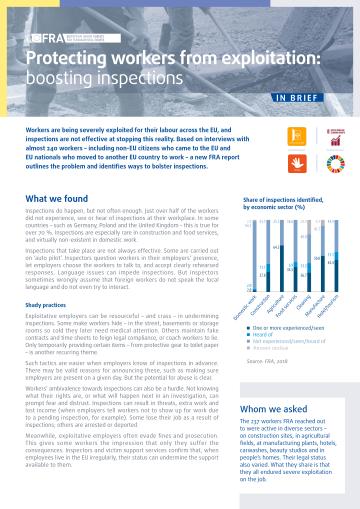
    Workers are being severely exploited for their labour across the EU, and
    inspections are not effective at stopping this reality. Based on interviews with
    almost 240 workers – including non-EU citizens who came to the EU and
    EU nationals who moved to another EU country to work – a new FRA report
    outlines the problem and identifies ways to bolster inspections.
  • Report / Paper / Summary
    5
    September
    2018
    Severe labour exploitation is widespread across the European Union. While workplace inspections can help counter this phenomenon, they need to be strengthened to do so effectively. Based on interviews and focus group discussions with almost 240 exploited workers active in diverse economic sectors, this report provides important evidence on how unscrupulous employers manipulate and undermine inspections, and on what can be done to counteract such efforts.
  • Report / Paper / Summary
    15
    June
    2018
    The stories of the domestic workers FRA interviewed for this paper reveal appalling working conditions and fundamental rights abuses in private homes across the EU. These stories indicate that, seven years on from FRA’s first report on domestic workers in 2011, little has changed in terms of the risks and experiences of severe labour exploitation domestic workers in the EU face.
  • Report / Paper / Summary
    15
    March
    2017
    Integrating migrants, refugees and their descendants is of critical importance for the future of the European Union. This report examines Member States’ integration policies and action plans for promoting their participation in society, focusing on non-discrimination, education, employment, language learning and political engagement.
  • Report / Paper / Summary
    17
    March
    2016
    Worker exploitation is not an isolated or marginal phenomenon. But despite its pervasiveness
    in everyday life, severe labour exploitation and its adverse effects on third-country nationals
    and EU citizens - as workers, but also as consumers - have to date not received much
    attention from researchers. This report identifies risk factors contributing to such exploitation and
    discusses means of improving the situation and highlights the challenges EU institutions and
    Member States face in making the right of workers who have moved within or into the EU
    to decent working conditions a reality.
  • Report / Paper / Summary
    2
    June
    2015
    Worker exploitation is not an isolated or marginal phenomenon. But despite its pervasiveness in everyday life, severe labour exploitation and its adverse effects on third-country nationals and EU citizens - as workers, but also as consumers - have to date not received much attention from researchers.
  • Report / Paper / Summary
    8
    December
    2011
    The European Union Agency for Fundamental Rights held its annual Fundamental Rights Conference 'Dignity and rights of irregular migrants' in Warsaw on 21-22 November 2011. This paper summarises the discussions that took place during the conference and presents follow-up activities to be undertaken by FRA.
  • In brief / Factsheet
    21
    November
    2011
    International and European human rights law impose an obligation on EU Member States to guarantee human rights to all individuals within their jurisdiction. This includes irregular migrants.
    FRA 2011
  • Report / Paper / Summary
    21
    November
    2011
    This report, based on comparative research on the fundamental rights situation of irregular migrants in Europe, advises on how fundamental rights should be incorporated in policies, laws and administrative practices affecting migrants in irregular situations.
  • Report / Paper / Summary
    21
    July
    2011
    The 2003-2008 update on the exclusion and discrimination of migrants, minorities and employment in the 27 EU Member States provides a comparative overview and analysis of data and information documenting discrimination in the workplaces and labour markets across the European Union.