eu-charter

Cairt um Chearta Bunúsacha an Aontais Eorpaigh

Brollach

Tá sé beartaithe ag pobail na hEorpa, trí aontas níos buandlúithe fós a chruthú eatarthu, todhchaí shíochánta arna fothú ar chomhluachanna a roinnt.
Ós feasach dó an oidhreacht spioradálta, mhorálta atá aige, tá an tAontas fothaithe ar luachanna dodhealaithe uilechoiteanna dhínit an duine, na saoirse, an chomhionannais agus na dlúthpháirtíochta; tá sé bunaithe ar phrionsabail an daonlathais agus an smachta reachta. Cuireann sé an duine i gceartlár a ghníomhaíochtaí trí shaoránacht an Aontais a chur ar bun agus trí limistéar saoirse, slándála agus ceartais a chruthú.
Rannchuidíonn an tAontas leis na comhluachanna sin a chaomhnú agus a fhorbairt agus urraim á tabhairt aige d’éagsúlacht chultúir agus thraidisiúin phobail na hEorpa, d'fhéiniúlacht náisiúnta na mBallstát agus d'eagrúchán a n-údarás poiblí ar leibhéal náisiúnta, ar leibhéal réigiúnach agus ar leibhéal áitiúil; féachann sé le forbairt chothromúil inbhuanaithe a chur chun cinn agus áirithíonn sé saorghluaiseacht daoine, seirbhísí, earraí agus caipitil, agus saoirse bunaíochta.
Chuige sin, is gá cosaint na gceart bunúsach a neartú i bhfianaise an fhoráis sa tsochaí, an dul chun cinn sóisialta agus forbairtí eolaíocha agus teicneolaíocha trí na cearta sin a dhéanamh níos sofheicthe i gCairt.
Athdhaingníonn an Chairt seo, ag féachaint go cuí d'inniúlachtaí agus do chúraimí an Aontais agus do phrionsabal na coimhdeachta, na cearta a leanann go háirithe as na traidisiúin bhunreachtúla agus as na hoibleagáidí idirnáisiúnta is coiteann do na Ballstáit, as an gCoinbhinsiún Eorpach chun Cearta an Duine agus Saoirsí Bunúsacha a Chosaint, as na Cairteanna Sóisialta arna nglacadh ag an Aontas agus ag Comhairle na hEorpa, agus as cásdlí Chúirt Bhreithiúnais an Aontais Eorpaigh agus na Cúirte Eorpaí um Chearta an Duine. Sa chomhthéacs sin, déanfaidh cúirteanna an Aontais agus na mBallstát an Chairt a léiriú le haird chuí ar na míniúcháin arna n-ullmhú faoi údarás Praesidium an Choinbhinsiúin a dhréachtaigh an Chairt agus arna dtabhairt suas chun dáta faoi fhreagracht Praesidium an Choinbhinsiúin Eorpaigh.
Tá freagrachtaí agus dualgais i dtaca le daoine eile, leis an bpobal daonna agus leis na glúnta atá le teacht ag gabháil le teachtadh na gceart sin.
Dá dheasca sin, aithníonn an tAontas na cearta, na saoirsí agus na prionsabail atá leagtha amach anseo thíos.

Mínithe

  • Text:
    Source:
    Preamble - Explanations relating to the Charter of Fundamental Rights:

Cásdlí

0 results found

National Constitutional Law

0 results found

Dlí an AE

0 results found

Dlí idirnáisiúnta

0 results found

Táirgí

  • Report / Paper / Summary
    12
    December
    2023
    Russia’s invasion of Ukraine forced millions of people to flee. Arriving in EU countries, they received protection in EU law under the Temporary Protection Directive. Many have begun to build a new life in their host country and enrich our societies in new ways. Local authorities took the lead in ensuring access to fundamental rights under temporary protection. This report explores the measures to ensure access to housing, education, employment and healthcare in 26 cities and regional authorities across 12 EU Member States. Despite unprecedented coordination and cooperation to overcome challenges, many uncertainties remain. Longer-term solutions will be needed after the directive expires in March 2025. Based on the information collected, the report identifies 12 priority actions and builds on FRA’s bulletins and survey findings on experiences of people displaced from Ukraine.
  • Report / Paper / Summary
    29
    November
    2023
    Online hate speech is a growing problem in today’s digitalised societies. Women, Black people, Jews and Roma are often targets of online hate speech. Online hate proliferates where human content moderators miss offensive content. Also, algorithms are prone to errors. They may multiply errors over time and may even end up promoting online hate. This report presents the challenges in identifying and detecting online hate. Hate of any kind should not be tolerated, regardless of whether it is online or offline. The report discusses the implications for fundamental rights to support creating a rights-compliant digital environment.
  • Periodic updates / Series
    22
    November
    2023
    FRA publishes annual updates on the forced return monitoring systems that EU Member States have set up under Article 8 (6) of the EU’s Return Directive (2008/115/EC). This latest update covers the period until the end of 2022.
  • Periodic updates / Series
    7
    November
    2023
    Antisemitic incidents and hate crimes violate fundamental rights. This report provides an overview of antisemitic incidents in 2022. It reveals persistent gaps in the recording of antisemitism across Europe that impedes efforts to effectively counter hatred towards Jews. It covers antisemitic incidents reported in the 27 EU Member States in 2022 and includes available data of the same year from Albania, the Republic of North Macedonia and Serbia. As this is a yearly publication covering the period 01/01/2022–31/12/2022, it does not include antisemitic incidents reported in 2023. This is the 19th edition and is the only annual source of data of this nature for the EU.
  • Report / Paper / Summary
    31
    October
    2023
    Fundamental rights are an important consideration in European border management. Virtually all activities can have an impact on rights – from risk analysis to training, border checks and border surveillance. Safeguards in laws regulating European border management aim to protect rights. This report is a contribution to the first review of the European Border and Coast Guard Regulation (EU) 2019/1896 that offers an opportunity to reflect on how best to improve the fundamental rights situation at the external borders of the EU.
  • Report / Paper / Summary
    25
    October
    2023
    FRA's first Being Black in the EU report exposed widespread and entrenched racism against people of African descent in Europe. Now updated with new data, this report revisits the situation revealing persistent racial discrimination, harassment and violence. Overall, experiences of racial discrimination increased in the EU countries since 2016, reaching as high as 77%. The lack of progress is alarming despite binding anti-discrimination law in the EU since 2000 and significant EU policy developments since then.
  • Report / Paper / Summary
    20
    October
    2023
    FRA’s strategic priorities and objectives are based on the agency’s role and mission as defined in its amended founding regulation. They build on FRA’s 2018–2022 strategy as well as how it performed, its experience and its vision. Their design takes into account future fundamental rights challenges facing Europe, the agency’s mandate, the broader operational context and the resources available.
  • Periodic updates / Series
    18
    October
    2023
    Civil society organisations struggle to maintain an environment safe from threats and attacks. FRA’s sixth annual update on civic space explores the challenges for organisations across the EU. While there has been significant development since FRA began monitoring the situation in 2018, civil society organisations remain under immense pressure. Abusive lawsuits and attacks against those involved in migrant search and rescue at sea are just some of the challenges identified. This report presents ways forward to protect civil society and human rights.
  • Periodic updates / Series
    11
    October
    2023
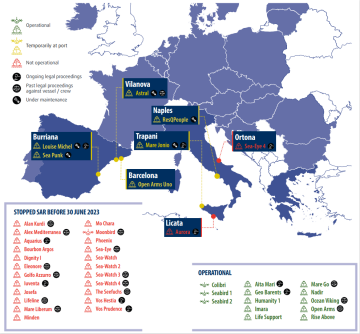
    Since October 2018, FRA has been publishing regular updates on NGO ships involved in search and rescue (SAR) operations in the Mediterranean, and the status of legal proceedings against them. This latest update covers until the end of June 2023.
    FRA
  • Periodic updates / Series
    29
    September
    2023
    Russia’s invasion of Ukraine posed new challenges for the EU. Millions were forced to flee the war. As a result of the scale of people’s displacement, the EU activated for the first time the Temporary Protection Directive (TPD). More than 1.3 million children sought international protection in the EU. This bulletin explores the respect, protection and fulfilment of the fundamental rights of displaced children and ways to safeguard their rights. The third in a series, this bulletin builds on the evidence in FRA’s Bulletin #1 and #2 on the experiences of displaced people seeking safety in the EU.