eu-charter

Listina Evropske unije o temeljnih pravicah

Preambula

Evropski narodi so pri oblikovanju vse tesnejše zveze odločeni na podlagi skupnih vrednot deliti mirno prihodnost. Unija, ki se zaveda svoje duhovne in moralne dediščine, temelji na nedeljivih in univerzalnih vrednotah človekovega dostojanstva, svobode, enakopravnosti in solidarnosti; temelji na načelu demokracije in na načelu pravne države. Posameznika postavlja v središče svojih dejavnosti z vzpostavitvijo državljanstva Unije in oblikovanjem območja svobode, varnosti in pravice.
Ob spoštovanju raznolikosti kultur in tradicij evropskih narodov ter nacionalne identitete držav članic in organizacije njihovih organov oblasti na državni, regionalni in lokalni ravni Unija prispeva k ohranjanju in razvijanju teh skupnih vrednot, prizadeva si za spodbujanje uravnoteženega in trajnostnega razvoja ter zagotavlja prosti pretok oseb, storitev, blaga in kapitala ter svobodo ustanavljanja.
V ta namen je treba glede na spremembe v družbi, socialni napredek ter znanstveni in tehnični razvoj okrepiti varstvo temeljnih pravic z Listino, ki te pravice še bolj poudarja.
Ta listina ob upoštevanju pristojnosti in nalog Unije ter načela subsidiarnosti potrjuje pravice, ki izhajajo zlasti iz skupnih ustavnih tradicij in mednarodnih obveznosti držav članic, Evropske konvencije o varstvu človekovih pravic in temeljnih svoboščin, socialnih listin, ki sta jih sprejela Unija in Svet Evrope, ter sodne prakse Sodišča Evropske unije in Evropskega sodišča za človekove pravice. V tem okviru sodišča Unije in držav članic Listino razlagajo ob ustreznem upoštevanju pojasnil, oblikovanih pod vodstvom predsedstva Konvencije, ki je Listino sestavilo, in ki so bila dopolnjena pod vodstvom predsedstva Evropske konvencije.
Uživanje teh pravic je povezano z odgovornostmi in dolžnostmi do soljudi, človeške skupnosti in prihodnjih generacij.
Zato Unija priznava pravice, svoboščine in načela, navedena v nadaljevanju.

Pojasnila

  • Text:
    Source:
    Preamble - Explanations relating to the Charter of Fundamental Rights:

Sodna praksa

0 results found

Nacionalnem ustavnem pravu

0 results found

Pravo EU

0 results found

Mednarodno pravo

0 results found

Gradivo

  • Report / Paper / Summary
    12
    December
    2023
    Russia’s invasion of Ukraine forced millions of people to flee. Arriving in EU countries, they received protection in EU law under the Temporary Protection Directive. Many have begun to build a new life in their host country and enrich our societies in new ways. Local authorities took the lead in ensuring access to fundamental rights under temporary protection. This report explores the measures to ensure access to housing, education, employment and healthcare in 26 cities and regional authorities across 12 EU Member States. Despite unprecedented coordination and cooperation to overcome challenges, many uncertainties remain. Longer-term solutions will be needed after the directive expires in March 2025. Based on the information collected, the report identifies 12 priority actions and builds on FRA’s bulletins and survey findings on experiences of people displaced from Ukraine.
  • Report / Paper / Summary
    29
    November
    2023
    Online hate speech is a growing problem in today’s digitalised societies. Women, Black people, Jews and Roma are often targets of online hate speech. Online hate proliferates where human content moderators miss offensive content. Also, algorithms are prone to errors. They may multiply errors over time and may even end up promoting online hate. This report presents the challenges in identifying and detecting online hate. Hate of any kind should not be tolerated, regardless of whether it is online or offline. The report discusses the implications for fundamental rights to support creating a rights-compliant digital environment.
  • Periodic updates / Series
    22
    November
    2023
    FRA publishes annual updates on the forced return monitoring systems that EU Member States have set up under Article 8 (6) of the EU’s Return Directive (2008/115/EC). This latest update covers the period until the end of 2022.
  • Periodic updates / Series
    7
    November
    2023
    Antisemitic incidents and hate crimes violate fundamental rights. This report provides an overview of antisemitic incidents in 2022. It reveals persistent gaps in the recording of antisemitism across Europe that impedes efforts to effectively counter hatred towards Jews. It covers antisemitic incidents reported in the 27 EU Member States in 2022 and includes available data of the same year from Albania, the Republic of North Macedonia and Serbia. As this is a yearly publication covering the period 01/01/2022–31/12/2022, it does not include antisemitic incidents reported in 2023. This is the 19th edition and is the only annual source of data of this nature for the EU.
  • Report / Paper / Summary
    31
    October
    2023
    Fundamental rights are an important consideration in European border management. Virtually all activities can have an impact on rights – from risk analysis to training, border checks and border surveillance. Safeguards in laws regulating European border management aim to protect rights. This report is a contribution to the first review of the European Border and Coast Guard Regulation (EU) 2019/1896 that offers an opportunity to reflect on how best to improve the fundamental rights situation at the external borders of the EU.
  • Report / Paper / Summary
    25
    October
    2023
    FRA's first Being Black in the EU report exposed widespread and entrenched racism against people of African descent in Europe. Now updated with new data, this report revisits the situation revealing persistent racial discrimination, harassment and violence. Overall, experiences of racial discrimination increased in the EU countries since 2016, reaching as high as 77%. The lack of progress is alarming despite binding anti-discrimination law in the EU since 2000 and significant EU policy developments since then.
  • Report / Paper / Summary
    20
    October
    2023
    FRA’s strategic priorities and objectives are based on the agency’s role and mission as defined in its amended founding regulation. They build on FRA’s 2018–2022 strategy as well as how it performed, its experience and its vision. Their design takes into account future fundamental rights challenges facing Europe, the agency’s mandate, the broader operational context and the resources available.
  • Periodic updates / Series
    18
    October
    2023
    Civil society organisations struggle to maintain an environment safe from threats and attacks. FRA’s sixth annual update on civic space explores the challenges for organisations across the EU. While there has been significant development since FRA began monitoring the situation in 2018, civil society organisations remain under immense pressure. Abusive lawsuits and attacks against those involved in migrant search and rescue at sea are just some of the challenges identified. This report presents ways forward to protect civil society and human rights.
  • Periodic updates / Series
    11
    October
    2023
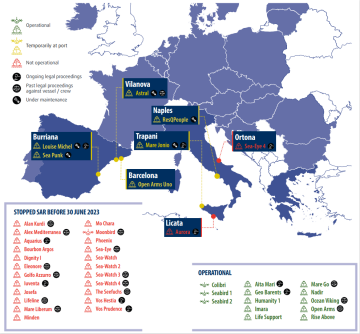
    Since October 2018, FRA has been publishing regular updates on NGO ships involved in search and rescue (SAR) operations in the Mediterranean, and the status of legal proceedings against them. This latest update covers until the end of June 2023.
    FRA
  • Periodic updates / Series
    29
    September
    2023
    Russia’s invasion of Ukraine posed new challenges for the EU. Millions were forced to flee the war. As a result of the scale of people’s displacement, the EU activated for the first time the Temporary Protection Directive (TPD). More than 1.3 million children sought international protection in the EU. This bulletin explores the respect, protection and fulfilment of the fundamental rights of displaced children and ways to safeguard their rights. The third in a series, this bulletin builds on the evidence in FRA’s Bulletin #1 and #2 on the experiences of displaced people seeking safety in the EU.