eu-charter

Charte des droits fondamentaux de l'Union européenne

Préambule

Les peuples d'Europe, en établissant entre eux une union sans cesse plus étroite, ont décidé de partager un avenir pacifique fondé sur des valeurs communes. Consciente de son patrimoine spirituel et moral, l'Union se fonde sur les valeurs indivisibles et universelles de dignité humaine, de liberté, d'égalité et de solidarité; elle repose sur le principe de la démocratie et le principe de l'État de droit. Elle place la personne au coeur de son action en instituant la citoyenneté de l'Union et en créant un espace de liberté, de sécurité et de justice.
L'Union contribue à la préservation et au développement de ces valeurs communes dans le respect de la diversité des cultures et des traditions des peuples d'Europe, ainsi que de l'identité nationale des États membres et de l'organisation de leurs pouvoirs publics aux niveaux national, régional et local; elle cherche à promouvoir un développement équilibré et durable et assure la libre circulation des personnes, des services, des marchandises et des capitaux, ainsi que la liberté d'établissement.
À cette fin, il est nécessaire, en les rendant plus visibles dans une Charte, de renforcer la protection des droits fondamentaux à la lumière de l'évolution de la société, du progrès social et des développements scientifiques et technologiques.
La présente Charte réaffirme, dans le respect des compétences et des tâches de l'Union, ainsi que du principe de subsidiarité, les droits qui résultent notamment des traditions constitutionnelles et des obligations internationales communes aux États membres, de la Convention européenne de sauvegarde des droits de l'Homme et des libertés fondamentales, des Chartes sociales adoptées par l'Union et par le Conseil de l'Europe, ainsi que de la jurisprudence de la Cour de justice de l'Union européenne et de la Cour européenne des droits de l'Homme. Dans ce contexte, la Charte sera interprétée par les juridictions de l'Union et des États membres en prenant dûment en considération les explications établies sous l'autorité du praesidium de la Convention qui a élaboré la Charte et mises à jour sous la responsabilité du praesidium de la Convention européenne.
La jouissance de ces droits entraîne des responsabilités et des devoirs tant à l'égard d'autrui qu'à l'égard de la communauté humaine et des générations futures.
En conséquence, l'Union reconnaît les droits, les libertés et les principes énoncés ci-après.

Explications

  • Texte:
    Source:
    Preamble - Explanations relating to the Charter of Fundamental Rights:

Références à la jurisprudence

0 results found

Droit constitutionnel national

0 results found

Droit de l'UE

0 results found

Droit international

0 results found

Produits

  • Report / Paper / Summary
    12
    décembre
    2023
    Russia’s invasion of Ukraine forced millions of people to flee. Arriving in EU countries, they received protection in EU law under the Temporary Protection Directive. Many have begun to build a new life in their host country and enrich our societies in new ways. Local authorities took the lead in ensuring access to fundamental rights under temporary protection. This report explores the measures to ensure access to housing, education, employment and healthcare in 26 cities and regional authorities across 12 EU Member States. Despite unprecedented coordination and cooperation to overcome challenges, many uncertainties remain. Longer-term solutions will be needed after the directive expires in March 2025. Based on the information collected, the report identifies 12 priority actions and builds on FRA’s bulletins and survey findings on experiences of people displaced from Ukraine.
  • Report / Paper / Summary
    29
    novembre
    2023
    Online hate speech is a growing problem in today’s digitalised societies. Women, Black people, Jews and Roma are often targets of online hate speech. Online hate proliferates where human content moderators miss offensive content. Also, algorithms are prone to errors. They may multiply errors over time and may even end up promoting online hate. This report presents the challenges in identifying and detecting online hate. Hate of any kind should not be tolerated, regardless of whether it is online or offline. The report discusses the implications for fundamental rights to support creating a rights-compliant digital environment.
  • Periodic updates / Series
    22
    novembre
    2023
    FRA publishes annual updates on the forced return monitoring systems that EU Member States have set up under Article 8 (6) of the EU’s Return Directive (2008/115/EC). This latest update covers the period until the end of 2022.
  • Periodic updates / Series
    7
    novembre
    2023
    Antisemitic incidents and hate crimes violate fundamental rights. This report provides an overview of antisemitic incidents in 2022. It reveals persistent gaps in the recording of antisemitism across Europe that impedes efforts to effectively counter hatred towards Jews. It covers antisemitic incidents reported in the 27 EU Member States in 2022 and includes available data of the same year from Albania, the Republic of North Macedonia and Serbia. As this is a yearly publication covering the period 01/01/2022–31/12/2022, it does not include antisemitic incidents reported in 2023. This is the 19th edition and is the only annual source of data of this nature for the EU.
  • Report / Paper / Summary
    31
    octobre
    2023
    Fundamental rights are an important consideration in European border management. Virtually all activities can have an impact on rights – from risk analysis to training, border checks and border surveillance. Safeguards in laws regulating European border management aim to protect rights. This report is a contribution to the first review of the European Border and Coast Guard Regulation (EU) 2019/1896 that offers an opportunity to reflect on how best to improve the fundamental rights situation at the external borders of the EU.
  • Report / Paper / Summary
    25
    octobre
    2023
    FRA's first Being Black in the EU report exposed widespread and entrenched racism against people of African descent in Europe. Now updated with new data, this report revisits the situation revealing persistent racial discrimination, harassment and violence. Overall, experiences of racial discrimination increased in the EU countries since 2016, reaching as high as 77%. The lack of progress is alarming despite binding anti-discrimination law in the EU since 2000 and significant EU policy developments since then.
  • Report / Paper / Summary
    20
    octobre
    2023
    FRA’s strategic priorities and objectives are based on the agency’s role and mission as defined in its amended founding regulation. They build on FRA’s 2018–2022 strategy as well as how it performed, its experience and its vision. Their design takes into account future fundamental rights challenges facing Europe, the agency’s mandate, the broader operational context and the resources available.
  • Periodic updates / Series
    18
    octobre
    2023
    Civil society organisations struggle to maintain an environment safe from threats and attacks. FRA’s sixth annual update on civic space explores the challenges for organisations across the EU. While there has been significant development since FRA began monitoring the situation in 2018, civil society organisations remain under immense pressure. Abusive lawsuits and attacks against those involved in migrant search and rescue at sea are just some of the challenges identified. This report presents ways forward to protect civil society and human rights.
  • Periodic updates / Series
    11
    octobre
    2023
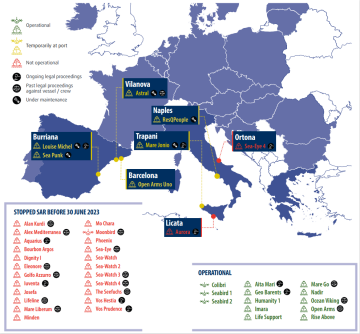
    Since October 2018, FRA has been publishing regular updates on NGO ships involved in search and rescue (SAR) operations in the Mediterranean, and the status of legal proceedings against them. This latest update covers until the end of June 2023.
    FRA
  • Periodic updates / Series
    29
    septembre
    2023
    Russia’s invasion of Ukraine posed new challenges for the EU. Millions were forced to flee the war. As a result of the scale of people’s displacement, the EU activated for the first time the Temporary Protection Directive (TPD). More than 1.3 million children sought international protection in the EU. This bulletin explores the respect, protection and fulfilment of the fundamental rights of displaced children and ways to safeguard their rights. The third in a series, this bulletin builds on the evidence in FRA’s Bulletin #1 and #2 on the experiences of displaced people seeking safety in the EU.