This report outlines Member States’ approaches to age requirements and limits
regarding child participation in judicial proceedings; procedural safeguards for, and rights of, children involved in criminal
proceedings; as well as issues related to depriving children of their liberty.
W niniejszym sprawozdaniu określa się podejścia państw członkowskich do wymogów dotyczących wieku i ograniczeń w zakresie uczestnictwa dzieci w postępowaniach sądowych; gwarancje proceduralne oraz prawa dzieci biorących udział w postępowaniu karnym; a także kwestie dotyczące pozbawiania dzieci wolności.
The right to access justice and all other relevant procedural rights are not just rights in themselves; they also protect against violations of every other right. Respect for children’s rights in the area of justice is therefore essential. International treaties, the Charter of Fundamental Rights of the European Union, European Union (EU) secondary law, and national legislation provide a number of relevant rights.
This report outlines the fundamental rights implications of collecting, storing and using
biometric and other data in EU IT systems in the area of asylum and migration.
In view of the increasing numbers of refugees, asylum seekers and migrants entering the EU, the EU Agency for Fundamental Rights has been collecting relevant data since September 2015. These focus on the fundamental rights situation of people arriving in Member States particularly affected by large migration movements. The countries covered are: Austria, Bulgaria, Croatia, Denmark, Finland, France, Germany, Greece, Hungary, Italy, the Netherlands, Poland, Spain and Sweden.
European non-discrimination law, as constituted in particular by the EU non-discrimination directives, and Article 14 of and Protocol 12 to the European Convention on Human Rights, prohibits discrimination across a range of contexts and grounds. This handbook examines European non-discrimination law stemming from these two sources as complementary systems, drawing on them interchangeably to the extent that they overlap, while highlighting differences where these exist.
Id-dritt Ewropew tan-nondiskriminazzjoni, kif ikkostitwit b’mod partikolari mid-direttivi tal-UE dwar in-nondiskriminazzjoni, u l-Artikolu 14 u l-Protokoll 12 tal-Konvenzjoni Ewropea dwar id-Drittijiet tal-Bniedem, jipprojbixxi d-diskriminazzjoni f’firxa ta’ kuntesti u raġunijiet. Dan il-manwal jeżamina d-dritt Ewropew tan-nondiskriminazzjoni li jirriżulta minn dawn iż-żewġ sorsi bħala sistemi
komplementari, u jużahom b’mod interkambjabbli sal-punt li jikkoinċidu, filwaqt li jenfasizza d-differenzi fejn dawn jeżistu.
In view of the increasing numbers of refugees, asylum seekers and migrants entering the EU, the EU Agency for Fundamental Rights has been collecting relevant data since September 2015. These focus on the fundamental rights situation of people arriving in Member States particularly affected by large migration movements. The countries covered are: Austria, Bulgaria, Croatia, Denmark, Finland, France, Germany, Greece, Hungary, Italy, the Netherlands, Poland, Spain and Sweden.
EU Member States’ legal and practical responses to migrants and refugees implicate several of their fundamental rights, as enshrined in the Charter of Fundamental Rights of the European Union (EU). The EU Agency for Fundamental Rights (FRA) has regularly reported on these issues since September 2015. This report highlights key trends and persistent concerns between October 2016 and December 2017. It focuses on five areas: access to territory, reception conditions, asylum procedures, unaccompanied children and immigration detention.
Vormünder sind zentral in einem System zum Schutz von Kindern, die vorübergehend oder dauerhaft aus ihrem familiären Umfeld herausgelöst wurden und deren Interessen nicht von ihren Eltern vertreten werden können. Zwischen den Mitgliedstaaten der Europäischen Union (EU) und auch innerhalb der Mitgliedstaaten gibt es große Unterschiede in den Arten von Vormundschaft. Dieser Bericht untersucht die wesentlichen Merkmale von Vormundschaftssystemen, die den Bedürfnissen schutzbedürftiger Kinder gerecht werden sollen. Dies schließt Kinder ein, die Opfer von Menschenhandel und anderen Formen der Ausbeutung sind, und Kinder, die Gefahr laufen, Opfer von Menschenhandel oder anderen Formen der Ausbeutung zu werden.
Guardians are a key element of a protection system for children who are temporarily or
permanently deprived of their family environment and cannot have their interests represented
by their parents. Great disparities exist between the types of guardianship provided
to children in and within European Union (EU) Member States. This report explores the key
features of guardianship systems put in place to cater for the needs of all children in need
of protection, including child victims and those at risk of becoming victims of trafficking in
human beings or of other forms of exploitation.
Les tuteurs sont une composante essentielle d’un système de protection des enfants qui sont, de façon temporaire ou permanente, privés de leur milieu familial et qui ne peuvent pas faire représenter leurs intérêts par leurs parents. De fortes disparités existent entre les types de tutelle dont les enfants bénéficient, tant entre les États membres de l’Union européenne qu’au sein même de ces pays. Ce rapport explore les principales caractéristiques des régimes de tutelle mis en place pour satisfaire aux besoins de tous les enfants qui nécessitent une protection, notamment les enfants victimes de la traite des personnes, ou d’autres formes d’exploitation, ainsi que ceux qui sont exposés au risque de le devenir.
FRA’s Second European Union Minorities and Discrimination Survey surveys around 26,000 individuals from different ethnic minority and immigrant backgrounds across all 28 EU Member States. This technical report presents a detailed overview of the research methods used by FRA when collecting the survey data.
Seventeen years after adoption of EU laws that forbid discrimination, immigrants, descendants of immigrants, and minority ethnic groups continue to face widespread discrimination across the EU and in all areas of life – most often when seeking employment. For many, discrimination is a recurring experience. This is just one of the findings of FRA’s second European Union Minorities and Discrimination Survey (EU-MIDIS II), which collected information from over 25,500 respondents with different ethnic minority and immigrant backgrounds across all 28 EU Member States.
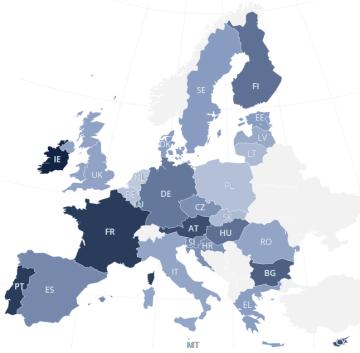
International treaties, the Charter of Fundamental Rights of the European Union, European Union (EU) secondary law and national legislation provide a number of rights to citizens. The maps and tables presented show the various patterns concerning age requirements for children to acquire rights in the EU. They also identify inconsistencies, protection gaps and restrictions deriving from different age thresholds. The reference period was until April 2016. Any legislative developments since then have been included whenever relevant or if known.
The transition from institution- to community-based support for persons with disabilities is a complex process that requires multifaceted efforts. These include putting in place commitments and structures for achieving deinstitutionalisation and measuring outcomes for persons with disabilities. This report shows that effectively funding the deinstitutionalisation process is a vital element.
Discussions are under way at the European Union (EU) and national levels about how best to realise the transition from institutional to community-based support. This report contributes to these by bringing together some of the key issues that have emerged from the EU Agency for Fundamental Rights’ (FRA) human rights indicators on Member States’ political and practical commitment to deinstitutionalisation.
This report assesses to what extent Member States have implemented the right to independent living, focusing on the effect commitments and funds are having on persons with disabilities’ daily lives. Taken together, the reports provide important insights that can support ongoing processes of change.
Muslims living in the EU face discrimination in a broad range of settings – and particularly when looking for work, on the job, and when trying to access public or private services. The report examines how characteristics – such as an individual's first and last name, skin colour and the wearing of visible religious symbols like a headscarf, for example – may trigger discriminatory treatment and harassment.