Denne folder hjælper grænsevagter og myndigheder med at informere asylansøgere og immigranter om behandlingen af deres fingeraftryk i Eurodac på en forståelig og lettilgængelig måde.
Το παρόν φυλλάδιο βοηθά τους αρμόδιους υπαλλήλους και τις αρχές να ενημερώνουν με εύκολο και απλό τρόπο τους αιτούντες άσυλο και τους μετανάστες σχετικά με την επεξεργασία των δακτυλικών τους αποτυπωμάτων στο Eurodac.
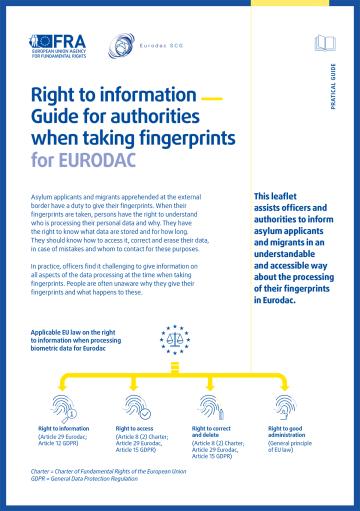
This leaflet assists officers and authorities to inform asylum applicants and migrants in an understandable and accessible way about the processing of their fingerprints in Eurodac.
Este folleto ayuda a los funcionarios y a las autoridades a informar a los solicitantes de asilo y a los inmigrantes, de un modo comprensible y accesible, sobre el tratamiento de sus huellas dactilares en Eurodac.
See teabeleht aitab ametnikel ja ametiasutustel teavitada varjupaigataotlejaid ning rändajaid arusaadaval ja kättesaadaval viisil nende sõrmejälgede töötlemisest Eurodac-süsteemis.
Tämä esite auttaa virkamiehiä ja viranomaisia kertomaan turvapaikanhakijoille ja maahanmuuttajille ymmärrettävällä ja helposti saavutettavalla tavalla sormenjälkien käsittelystä Eurodacissa.
Ez a szóróanyag támogatja a hatóságok dolgozóit abban, hogy közérthető és hozzáférhető módon tudják tájékoztatni a bevándorlókat és menedékkérőket az ujjlenyomataik Eurodac általi feldolgozásáról.
Ši atmintinė padės pareigūnams ir institucijoms suprantamai ir prieinama forma informuoti prieglobsčio prašytojus ir migrantus apie jų pirštų atspaudų tvarkymą sistemoje EURODAC.
Niniejsza ulotka pomaga funkcjonariuszom i organom w zrozumiały i przystępny sposób informować osoby wnioskujące o azyl oraz migrantów o przetwarzaniu ich odcisków palców w systemie Eurodac.
Este folheto apoia as pessoas no terreno e as autoridades a prestar informação aos requerentes de asilo e aos migrantes intercetados nas fronteiras externas de modo acessível e compreensível sobre o tratamento das impressões digitais no Eurodac.
Acest pliant ajută ofițerii și autoritățile să informeze solicitanții de azil și migranții într-un mod ușor de înțeles și accesibil cu privire la prelucrarea amprentelor lor în Eurodac.
Detta informationsblad hjälper myndigheter och deras anställda att informera asylsökande och migranter på ett begripligt och lättillgängligt sätt om hur deras fingeravtryck behandlas i Eurodac.
The Charter is most effective, and has a real impact on people’s lives, when parliaments, governments and courts at local, regional and national levels all actively apply it. The national sphere is particularly relevant. A strong fundamental rights architecture and committed national governments and parliaments are key to letting the Charter unfold its potential at this level. Civil society organisations (CSOs) and national human rights institutions (NHRIs) are also crucial given their contributions to the protection and promotion of Charter rights.
This annual overview provides an update of the most recent figures on antisemitic incidents, covering the period 1 January 2008 – 31 December 2018, across the EU Member States, where data are available. It includes a section that presents evidence from international organisations. In addition, for the first time, it provides an overview of how Member States that have adopted or endorsed the non-legally binding working definition of antisemitism adopted by the International Holocaust Remembrance Alliance (IHRA) (2016) use or intend to use it.
The EU Agency for Fundamental Rights has been regularly collecting data on asylum and
migration since September 2015. This report focuses on the fundamental rights situation
of people arriving in Member States and EU candidate countries particularly affected by
migration. It addresses fundamental rights concerns between 1 July and 30 September 2019.
The EU Agency for Fundamental Rights has been regularly collecting data on migration since September 2015. This report focuses on the fundamental rights situation of people arriving in Member States and EU candidate countries particularly affected by migration movements. It addresses fundamental rights concerns between 1 April and 30 June 2019.