Europejskie prawo antydyskryminacyjne, ukonstytuowane w szczególności w unijnych dyrektywach dotyczących niedyskryminacji oraz art. 14 i Protokole nr 12 do Konwencji o ochronie praw człowieka i podstawowych wolności, zakazuje dyskryminacji w różnych kontekstach i z różnych przyczyn. W niniejszym podręczniku przeanalizowano europejskie prawo antydyskryminacyjne pochodzące z tych dwóch uzupełniających się źródeł, sięgając do nich wymiennie w tych obszarach, w których się pokrywają, i podkreślając istniejące różnice.
Dreptul european privind nediscriminarea, așa cum a fost constituit prin directivele UE privind
nediscriminarea și prin articolul 14 din Convenția europeană pentru apărarea drepturilor omului și
a libertăților fundamentale și prin Protocolul nr. 12 la convenție, interzice discriminarea într-o serie
de contexte și pentru o gamă largă de criterii. Prezentul manual analizează dreptul european privind
nediscriminarea rezultat din aceste două surse cu titlu de sisteme complementare, făcând referire
la oricare dintre acestea în măsura în care se suprapun și semnalând diferențele, acolo unde există.
Európske antidiskriminačné právo ustanovené antidiskriminačnými smernicami EÚ, ako aj článkom
14 Európskeho dohovoru Rady Európy o ochrane ľudských práv a základných slobôd a jeho protokolu
č. 12 zakazuje diskrimináciu v celom rade súvislostí a na základe rozmanitých dôvodov. V tejto
príručke sa skúma európske antidiskriminačné právo prameniace z týchto dvoch zdrojov ako
komplementárnych systémov, pričom sa z nich striedavo vychádza v rozsahu, v akom sa prekrývajú,
a zdôrazňujú sa prípadné rozdiely.
Evropsko protidiskriminacijsko pravo, kot ga določajo zlasti protidiskriminacijske direktive Evropske
unije, člen 14 Evropske konvencije o človekovih pravicah in 12. Protokol k tej konvenciji, prepoveduje
diskriminacijo na različnih področjih in zaradi različnih razlogov. Ta priročnik pojasnjuje evropsko
protidiskriminacijsko pravo, kot izhaja iz navedenih dveh komplementarnih sistemov. Izmenjuje
navaja področja, kjer se ureditvi vsebinsko prekrivata, in izpostavlja razlike med njima.
Den europeiska icke-diskrimineringslagstiftningen, som i huvudsak består av EU:s ickediskrimineringsdirektiv och artikel 14 i och protokoll nr 12 till Europakonventionen om de mänskliga rättigheterna, förbjuder diskriminering på en rad olika grunder och i olika sammanhang. Den här handboken innehåller en genomgång av den europeiska icke-diskrimineringslagstiftning som härrör från dessa två källor. De ses som två kompletterande system som delvis överlappar varandra. I de fall de skiljer sig åt påpekas detta.
Европейското право в областта на недискриминацията, както е предвидено в директивите
на ЕС относно недискриминацията, в член 14 и в Протокол 12 към Европейската конвенция
за правата на човека, забранява дискриминацията в рамките на широк набор от видове
контекст и основания. В настоящия наръчник се разглежда европейско право в областта на
недискриминацията, което произхожда от тези два източника като допълващи се системи.
Те му служат взаимозаменяемо дотолкова, че се припокриват, като същевременно се
подчертават съществуващите разлики.
Evropské antidiskriminační právo, které tvoří směrnice EU o zákazu diskriminace a článek 14 a protokol č. 12 Evropské úmluvy o ochraně lidských práv a základních svobod, zakazuje diskriminaci v celé řadě situací a z celé řady důvodů. Tato příručka zkoumá evropské antidiskriminační právo vycházející z uvedených dvou zdrojů jako vzájemně se doplňující systémy, využívá jejich vzájemné zaměnitelnosti v míře, v jaké se tyto systémy překrývají, a upozorňuje na jejich rozdíly, pokud existují.
Den europæiske lovgivning om ikke-forskelsbehandling, som består af EU’s direktiver om ikkeforskelsbehandling og artikel 14 i den europæiske menneskerettighedskonvention (EMRK) samt protokol nr. 12 hertil, forbyder forskelsbehandling i en række sammenhænge og af en række årsager. I denne håndbog ser vi på EU-lovgivningen om ikke-forskelsbehandling i henhold til disse to kilder som komplementære systemer, idet de vil blive brugt i flæng, hvis de overlapper hinanden, mens evt. forskelle vil blive fremhævet.
This survey involved interviews with 25,515 people with different ethnic minority and immigrant backgrounds across 28 EU countries. It explores issues concerning discrimination as well as experiences of harassment, hate-motivated violence and discriminatory profiling.
Muslims living in the EU face discrimination in a broad range of settings – and particularly when looking for work, on the job, and when trying to access public or private services. The report examines how characteristics – such as an individual's first and last name, skin colour and the wearing of visible religious symbols like a headscarf, for example – may trigger discriminatory treatment and harassment.
The Agency, in close cooperation with the Maltese Presidency of the EU Council, held a high-level symposium where the fundamental rights issues that are currently high on the EU’s political agenda were discussed.
Diverse efforts at both EU and national levels sought to bolster fundamental rights protection in 2016, while some measures threatened to undermine such protection.
Hate crime is the most severe expression of discrimination and a core fundamental rights abuse. The European Union (EU) has demonstrated its resolve to tackle hate crime with legislation such as the 2008 Framework Decision on combating certain forms and expressions of racism and xenophobia by means of criminal law. Nonetheless, the majority of hate crimes perpetrated in the EU remain unreported and therefore invisible, leaving victims without redress.
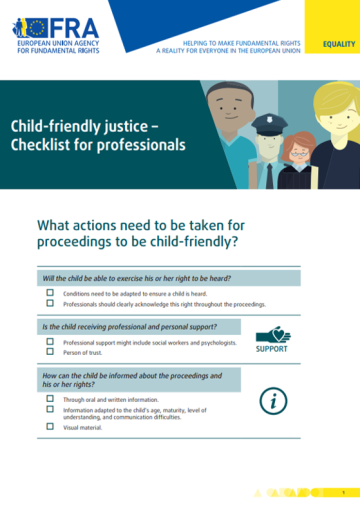
The treatment of children in justice systems remains a concern across the European Union (EU). With this checklist, FRA aims to help professionals by providing a list of actions that need to be taken for judicial proceedings to be child-friendly.
Around 2.5 million children participate in judicial proceedings across the European Union (EU)
every year, affected by parental divorce or as victims of, or witnesses to, crime. Although their
effective participation in such proceedings is vital for improving the operation of justice, the
treatment of children in justice systems remains a concern.
Around 2.5 million children participate in judicial proceedings across the European Union (EU) every year, affected by parental divorce or as victims of, or witnesses to, crime. Although their effective participation in such proceedings is vital for improving the operation of justice, the treatment of children in justice systems remains a concern. FRA investigated to what extent children’s rights to be heard, to be informed, to be protected, and to non-discrimination are fulfilled in practice.
Access to justice is an important element of the rule of law. It enables individuals to protect themselves against infringements of their rights, to remedy civil wrongs, to hold executive power accountable and to defend themselves in criminal proceedings. This handbook summarises the key European legal principles in the area of access to justice, focusing on civil and criminal law.
The European Union (EU) and its Member States introduced and pursued
numerous initiatives to safeguard and strengthen fundamental rights in 2015.
FRA’s Fundamental Rights Report 2016 summarises and analyses major
developments in the fundamental rights field, noting both progress made
and persisting obstacles. This publication presents FRA’s opinions on the
main developments in the thematic areas covered and a synopsis of the
evidence supporting these opinions. In so doing, it provides a compact but
informative overview of the main fundamental rights challenges confronting
the EU and its Member States.
Hate crime is the most severe expression of discrimination, and a core fundamental rights abuse. Various initiatives target such crime, but most hate crime across the EU remains unreported and unprosecuted, leaving victims without redress. To counter this trend, it is essential for Member States to improve access to justice for victims. Drawing on interviews with representatives from criminal courts, public prosecutors’ offices, the police, and NGOs involved in supporting hate crime victims, this report sheds light on the diverse hurdles that impede victims’ access to justice and the proper recording of hate crime.
Worker exploitation is not an isolated or marginal phenomenon. But despite its pervasiveness
in everyday life, severe labour exploitation and its adverse effects on third-country nationals
and EU citizens - as workers, but also as consumers - have to date not received much
attention from researchers. This report identifies risk factors contributing to such exploitation and
discusses means of improving the situation and highlights the challenges EU institutions and
Member States face in making the right of workers who have moved within or into the EU
to decent working conditions a reality.