eu-charter

Carta drepturilor fundamentale a Uniunii Europene

Articolul 24 - Drepturile copilului

Articolul 24 - Drepturile copilului

(1) Copiii au dreptul la protecția și îngrijirile necesare pentru asigurarea bunăstării lor. Ei își pot exprima în mod liber opinia. Aceasta se ia în considerare în problemele care îi privesc, în funcție de vârsta și gradul lor de maturitate.
(2) În toate acțiunile referitoare la copii, indiferent dacă sunt realizate de autorități publice sau de instituții private, interesul superior al copilului trebuie să fie considerat primordial.
(3) Orice copil are dreptul de a întreține cu regularitate relații personale și contacte directe cu ambii părinți, cu excepția cazului în care acestea sunt contrare interesului său.

Explicaţii

  • Text:

    Acest articol se întemeiază pe Convenţia de la New York privind drepturile copilului, semnată la 20 noiembrie 1989 şi ratificată de toate statele membre şi, în special, pe articolele 3, 9, 12 şi 13 din aceasta.

    Alineatul (3) ia în considerare faptul că, în cadrul instituirii unui spaţiu de libertate, securitate şi justiţie, legislaţia Uniunii în materie civilă cu incidenţă transfrontalieră, pentru care competenţele sunt conferite de articolul 81 din Tratatul privind funcţionarea Uniunii Europene, poate cuprinde, în special, drepturile de vizitare care îi permit copilului să întreţină periodic relaţii personale şi contacte directe cu ambii părinţi.

    Source:
    Jurnalul Oficial al Uniunii Europene C 303/17 - 14.12.2007
    Preamble - Explanations relating to the Charter of Fundamental Rights:
    Explicaţiile redate în continuare au fost redactate iniţial sub autoritatea prezidiului Convenţiei care a elaborat Carta drepturilor fundamentale a Uniunii Europene. Acestea au fost actualizate sub autoritatea prezidiului Convenţiei Europene, având în vedere adaptarea de către respectiva Convenţie a textului cartei (în special la articolele 51 şi 52), precum şi evoluţia dreptului Uniunii. Cu toate că aceste explicaţii nu au valoare juridică în sine, acestea constituie un preţios instrument de interpretare destinat clarificării dispoziţiilor cartei.

Jurisprudență

Dreptul constituțional național

45 results found

  • Costituzione della Repubblica Italiana
    Țara:
    Italy

    Art. 30. E' dovere e diritto dei genitori, mantenere, istruire ed educare i figli, anche se nati fuori del matrimonio.Nei casi di incapacità dei genitori, la legge provvede a che siano assolti i loro compiti.La legge assicura ai figli nati fuori dal matrimonio ogni tutela giuridica e sociale, compatibile con i diritti dei membri della famiglia legittima.La legge detta le norme e i limiti per la ricerca della paternità. Art. 31 La Repubblica (...) Protegge la maternità e l'infanzia e la gioventù, favorendo gli istituti necessari a tale scopo. Art. 34. La scuola è aperta a tutti. L'istruzione inferiore, impartita per almeno otto anni, è obbligatoria e gratuita.I capaci e meritevoli, anche se privi di mezzi, hanno diritto di raggiungere i gradi più alti degli studi. La Repubblica rende effettivo questo diritto con borse di studio, assegni alle famiglie ed altre provvidenze, che devono essere attribuite per concorso.

  • De Belgische Grondwet
    Țara:
    Belgium

    Article 22Ieder heeft recht op eerbiediging van zijn privé-leven en zijn gezinsleven, behoudens in de gevallen en onder de voorwaarden door de wet bepaald.De wet, het decreet of de in artikel 134 bedoelde regel waarborgen de bescherming van dat recht. Article 22bisElk kind heeft recht op eerbiediging van zijn morele, lichamelijke, geestelijke en seksuele integriteit.Elk kind heeft het recht zijn mening te uiten in alle aangelegenheden die het aangaan; met die mening wordt rekening gehouden in overeenstemming met zijn leeftijd en zijn onderscheidingsvermogen. Elk kind heeft recht op maatregelen en diensten die zijn ontwikkeling bevorderen. Het belang van het kind is de eerste overweging bij elke beslissing die het kind aangaat. De wet, het decreet of de in artikel 134 bedoelde regel waarborgen deze rechten van het kind.

  • Eesti Vabariigi Põhiseadus
    Țara:
    Estonia

    § 26.Igaühel on õigus perekonna- ja eraelu puutumatusele. Riigiasutused, kohalikud omavalitsused ja nende ametiisikud ei tohi kellegi perekonna- ega eraellu sekkuda muidu, kui seaduses sätestatud juhtudel ja korras tervise, kõlbluse, avaliku korra või teiste inimeste õiguste ja vabaduste kaitseks, kuriteo tõkestamiseks või kurjategija tabamiseks.
    § 27.Perekond rahva püsimise ja kasvamise ning ühiskonna alusena on riigi kaitse all.Abikaasad on võrdõiguslikud.Vanematel on õigus ja kohustus kasvatada oma lapsi ja hoolitseda nende eest. Seadus sätestab vanemate ja laste kaitse. Perekond on kohustatud hoolitsema oma abivajavate liikmete eest. 

  • Federal Constitutional Act on the Rights of Children
    Țara:
    Austria

    Article 1 Each child shall be entitled to the protection and care that is necessary for his/her well-being, to optimal development and self-realisation as well as to the protection of his/her interests with regards to intergenerational equity. The wellbeing of the child shall be the primary consideration in respect of all measures affecting children that are taken by public and private institutions. Article 2 (1) Each child shall be entitled to have personal relations and direct contacts with both parents on a regular basis unless this is detrimental to the well-being of the child. Article 4 Each child has the right to adequate involvement and consideration of his/her opinion regarding all matters affecting the child in a manner that is commensurate with his/her age and development.

  • Grundgesetz für die Bundesrepublik Deutschland
    Țara:
    Germany

    Artikel 6 (...) (3) Gegen den Willen der Erziehungsberechtigten dürfen Kinder nur auf Grund eines Gesetzes von der Familie getrennt werden, wenn die Erziehungsberechtigten versagen oder wenn die Kinder aus anderen Gründen zu verwahrlosen drohen. (...) (5) Den unehelichen Kindern sind durch die Gesetzgebung die gleichen Bedingungen für ihre leibliche und seelische Entwicklung und ihre Stellung in der Gesellschaft zu schaffen wie den ehelichen Kindern.

  • Jugendwohlfahrtsgesetz 1989
    Țara:
    Austria
  • Konstytucja Rzeczypospolitej Polskiej
    Țara:
    Poland

    Art. 48.1. Rodzice mają prawo do wychowania dzieci zgodnie z własnymi przekonaniami. Wychowanie to powinno uwzględniać stopień dojrzałości dziecka, a także wolność jego sumienia i wyznania oraz jego przekonania. 2. Ograniczenie lub pozbawienie praw rodzicielskich może nastąpić tylko w przypadkach określonych w ustawie i tylko na podstawie prawomocnego orzeczenia sądu. Art. 68(...) 3. Władze publiczne są obowiązane do zapewnienia szczególnej opieki zdrowotnej dzieciom, kobietom ciężarnym, osobom niepełnosprawnym i osobom w podeszłym wieku.(...) 5. Władze publiczne popierają rozwój kultury fizycznej, zwłaszcza wśród dzieci i młodzieży.Art. 72.1. Rzeczpospolita Polska zapewnia ochronę praw dziecka. Każdy ma prawo żądać od organów władzy publicznej ochrony dziecka przed przemocą, okrucieństwem, wyzyskiem i demoralizacją.2. Dziecko pozbawione opieki rodzicielskiej ma prawo do opieki i pomocy władz publicznych.3. W toku ustalania praw dziecka organy władzy publicznej oraz osoby odpowiedzialne za dziecko są obowiązane do wysłuchania i w miarę możliwości uwzględnienia zdania dziecka.4. Ustawa określa kompetencje i sposób powoływania Rzecznika Praw Dziecka.

  • La Constitution Belge
    Țara:
    Belgium

    Artikel 22Chacun a droit au respect de sa vie privée et familiale, sauf dans les cas et conditions fixés par la loi.La loi, le décret ou la règle visée à l'article 134 garantissent la protection de ce droit. Article 22bisChaque enfant a droit au respect de son intégrité morale, physique, psychique et sexuelle.Chaque enfant a le droit de s'exprimer sur toute question qui le concerne; son opinion est prise en considération, eu égard à son âge et à son discernement. Chaque enfant a le droit de bénéficier des mesures et services qui concourent à son développement.Dans toute décision qui le concerne, l'intérêt de l'enfant est pris en considération de manière primordiale. La loi, le décret ou la règle visée à l'article 134 garantissent ces droits de l'enfant.

  • Lastekaitseseadus
    Țara:
    Estonia

    § 2. Seaduse eesmärk
    Käesolev seadus kehtestatakse last väärtustava ning lapse arengut soodustava käitumise ja elulaadi kujundamiseks ühiskonnas, last toetava keskkonna loomiseks, lapse huvide esikohale seadmiseks, lapse elukvaliteedi parendamiseks, lapse igakülgse arengu toetamiseks ning tervist ja heaolu ohustavates tingimustes olevale lapsele õigeaegse ja asjakohase abi ja hoolduse tagamiseks kooskõlas Ühinenud Rahvaste Organisatsiooni lapse õiguste konventsiooni ja selle lisaprotokollidega (edaspidi konventsioon) ning Euroopa Liidu põhiõiguste harta ja teiste asjakohaste õigusaktidega.
    § 3. Seaduse kohaldamisala
    (1) Käesolevas seaduses sätestatut kohaldatakse riigi ja kohaliku omavalitsuse üksuste ametiasutustele ning nende ametiisikutele, avalik-õiguslikele ja eraõiguslikele juriidilistele isikutele ning füüsilistele isikutele, kes oma tegevuses puutuvad kokku laste ja lastekaitsega.
    (2) Käesolev seadus peab lapseks iga alla 18-aastast isikut. Kui isiku vanus ei ole teada ja on põhjust arvata, et ta on alla 18-aastane, käsitatakse isikut lapsena, kuni ei ole tõendatud vastupidist.

  • Latvijas Republikas Satversme
    Țara:
    Latvia

    110. Valsts aizsargā un atbalsta laulību — savienību starp vīrieti un sievieti, ģimeni, vecāku un bērna tiesības. Valsts īpaši palīdz bērniem invalīdiem, bērniem, kas palikuši bez vecāku gādības vai cietuši no varmācības.

  • Lietuvos Respublikos Konstitucija
    Țara:
    Lithuania

    26 straipsnis. Tėvai ir globėjai nevaržomi rūpinasi vaikų ir globotinių religiniu ir doroviniu auklėjimu pagal savo įsitikinimus. 38 straipsnis. Šeima yra visuomenės ir valstybės pagrindas. Valstybė saugo ir globoja šeimą, motinystę, tėvystę ir vaikystę. Tėvų teisė ir pareiga - auklėti savo vaikus dorais žmonėmis ir ištikimais piliečiais, iki pilnametystės juos išlaikyti. Vaikų pareiga - gerbti tėvus, globoti juos senatvėje ir tausoti jų palikimą. 39 straipsnis. Nepilnamečius vaikus gina įstatymas.

  • Luxembourg / Constitution of the Grand Ducal of Luxembourg
    Țara:
    Luxembourg

    Art. 15.  ... (5) Dans toute décision qui le concerne, l’intérêt de l’enfant est pris en considération de manière primordiale. 

    Chaque enfant peut exprimer son opinion librement sur toute question qui le concerne. Son opinion est prise en considération, eu égard à son âge et à son discernement. 

    Chaque enfant a droit à la protection, aux mesures et aux soins nécessaires à son bien-être et son développement. 

    ...

  • Magyarország Alaptörvénye
    Țara:
    Hungary

    L) cikk (Alapvetés)
    (1) Magyarország védi a házasság intézményét mint férfi és nő között, önkéntes elhatározás alapján létrejött életközösséget, valamint a családot mint a nemzet fennmaradásának alapját. A családi kapcsolat alapja a házasság, illetve a szülő-gyermek viszony. […]

    XV. cikk (SZABADSÁG ÉS FELELŐSSÉG) […] (5) Magyarország külön intézkedésekkel védi a családokat, a gyermekeket, a nőket, az időseket és a fogyatékkal élőket.

    XVI. cikk (SZABADSÁG ÉS FELELŐSSÉG) (1) Minden gyermeknek joga van a megfelelő testi, szellemi és erkölcsi fejlődéséhez szükséges védelemhez és gondoskodáshoz.
    (2) A szülőknek joguk van megválasztani a gyermeküknek adandó nevelést.
    (3) A szülők kötelesek kiskorú gyermekükről gondoskodni. E kötelezettség magában foglalja gyermekük taníttatását.
    (4) A nagykorú gyermekek kötelesek rászoruló szüleikről gondoskodni.

    XXX. cikk (SZABADSÁG ÉS FELELŐSSÉG) […] (2) A közös szükségletek fedezéséhez való hozzájárulás mértékét a gyermeket nevelők esetében a gyermeknevelés kiadásainak figyelembevételével kell megállapítani.

  • Portugal / Constitution of the Portuguese Republic
    Țara:
    Portugal

    Article 36 (Family, marriage and filiation) (4) Children born outside marriage shall not be discriminated against on that ground; terms describing filiation that are discriminatory shall not be used by the law or by government departments. (6) Children shall not be separated from their parents unless the parents fail to perform their fundamental duties towards the children, and in that case only by judicial decision.
    ...
    Article 69 (Childhood) (1) With a view to their integral development, children shall possess the right to protection by society and the state, especially from all forms of abandonment, discrimination and oppression and from the abusive exercise of authority in the family or any other institution. (2) The state shall ensure special protection for children who are orphaned, abandoned or deprived of a normal family environment in any way. (3) Labour by minors of school age shall be prohibited as laid down by law.

    Article 70 (Youth) (1) In order to ensure the effective enjoyment of their economic, social and cultural rights, young people shall receive special protection, particularly: (a) In education, vocational training and culture; (b) In access to their first job, at work and in relation to social security; (c) In access to housing; (d) In physical education and sport; (e) In the use of their free time. (2) The priority objectives of the youth policy shall be the development of young people’s personality, the creation of the conditions needed for their effective integration into the active life, a love of free creativity and a sense of community service. (3) Acting in cooperation with families, schools, businesses, residents’ organisations, cultural associations and foundations and cultural and recreational groups, the state shall foster and support youth organisations in the pursuit of the said objectives, as well as international youth exchanges.

  • România / Constituția României
    Țara:
    România

    Articolul 49(1) Copiii si tinerii se bucura de un regim special de protectie si de asistenta în realizarea drepturilor lor. (2) Statul acorda alocatii pentru copii si ajutoare pentru îngrijirea copilului bolnav ori cu handicap. Alte forme de protectie sociala a copiilor si a tinerilor se stabilesc prin lege. (3) Exploatarea minorilor, folosirea lor în activitati care le-ar dauna sanatatii, moralitatii sau care le-ar pune în primejdie viata ori dezvoltarea normala sunt interzise. (4) Minorii sub vârsta de 15 ani nu pot fi angajati ca salariati. (5) Autoritatile publice au obligatia sa contribuie la asigurarea conditiilor pentru participarea libera a tinerilor la viata politica, sociala, economica, culturala si sportiva a tarii.

  • Slovakia / Constitution of the Slovak Republic
    Țara:
    Slovakia

    Article 41 (...) (3) Children born in and out of wedlock enjoy equal rights. (4) Child care and upbringing are the rights of parents; children have the right to parental care and upbringing. Parents' rights can be restricted and minors can be separated from their parents against their will only by a court ruling on the basis of law. (5) Parents caring for children are entitled to assistance from the state. (6) Details concerning rights under paragraphs 1 to 5 shall be laid down by law.

  • Slovenia / Constitution of the Republic of Slovenia
    Țara:
    Slovenia

    Article 53 (...) The state shall protect the family, motherhood, fatherhood, children and young people and shall create the necessary conditions for such protection.

    Article 54 Parents have the right and duty to maintain, educate and raise their children. This right and duty may be revoked or restricted only for such reasons as are provided by law in order to protect the child's interests. Children born out of wedlock have the same rights as children born within it.

    Article 56 Children shall enjoy special protection and care. Children shall enjoy human rights and fundamental freedoms consistent with their age and maturity. Children shall be guaranteed special protection from economic, social, physical, mental or other exploitation and abuse. Such protection shall be regulated by law. Children and minors who are not cared for by their parents, who have no parents or who are without proper family care shall enjoy the special protection of the state. Their position shall be regulated by law.

  • Spain / Constitution of the Kingdom of Spain
    Țara:
    Spain

    Section 39 (1) The public authorities ensure social, economic and legal protection of the family. (2) The public authorities likewise ensure full protection of children, who are equal before the law, regardless of their parentage, and of mothers, whatever their marital status. The law shall provide for the possibility of the investigation of paternity. (3) Parents must provide their children, whether born within or outside wedlock, with assistance of every kind while they are still under age and in other circumstances in which the law so establishes. (4) Children shall enjoy the protection provided for in the international agreements safeguarding their rights

  • Suomen perustuslaki
    Țara:
    Finland

    6 § Yhdenvertaisuus (...) Lapsia on kohdeltava tasa-arvoisesti yksilöinä, ja heidän tulee saada vaikuttaa itseään koskeviin asioihin kehitystään vastaavasti. 12 § Sananvapaus ja julkisuus Jokaisella on sananvapaus. Sananvapauteen sisältyy oikeus ilmaista, julkistaa ja vastaanottaa tietoja, mielipiteitä ja muita viestejä kenenkään ennakolta estämättä. Tarkempia säännöksiä sananvapauden käyttämisestä annetaan lailla. Lailla voidaan säätää kuvaohjelmia koskevia lasten suojelemiseksi välttämättömiä rajoituksia. 19 § Oikeus sosiaaliturvaan (...) Lailla taataan jokaiselle oikeus perustoimeentulon turvaan työttömyyden, sairauden, työkyvyttömyyden ja vanhuuden aikana sekä lapsen syntymän ja huoltajan menetyksen perusteella. Julkisen vallan on turvattava, sen mukaan kuin lailla tarkemmin säädetään, jokaiselle riittävät sosiaali- ja terveyspalvelut ja edistettävä väestön terveyttä. Julkisen vallan on myös tuettava perheen ja muiden lapsen huolenpidosta vastaavien mahdollisuuksia turvata lapsen hyvinvointi ja yksilöllinen kasvu. (...)

  • The Belgian Constitution
    Țara:
    Belgium

    Article 22Everyone has the right to the respect of his private and family life, except in the cases and conditions determined by law. The laws, federate laws and rules referred to in Article 134 guarantee the protection of this right. Article 22bisEach child is entitled to have his or her moral, physical, mental and sexual integrity respected.Each child has the right to express his or her views in all matters affecting him or her, the views of the child being given due weight in accordance with his or her age and maturity.Each child has the right to benefit from measures and facilities which promote his or her development.In all decisions concerning children, the interest of the child is a primary consideration. The law, federate law or rule referred to in Article 134 ensures these rights of the child.

Legislația UE

28 results found

  • Directive (EU) 2024/1385 of the European Parliament and of the Council of 14 May 2024 on combating violence against women and domestic violence

    Preamble  


    (2) Equality between women and men and non-discrimination are core values of the Union and fundamental rights enshrined, respectively, in Article 2 of the Treaty on European Union (TEU) and in Articles 21 and 23 of the Charter of Fundamental Rights of the European Union (the ‘Charter’). Violence against women and domestic violence endanger those very values and rights, undermining women and girls’ rights to equality in all areas of life and hindering their equal societal and professional participation.

    (3) Violence against women and domestic violence is a violation of fundamental rights such as the right to human dignity, the right to life and integrity of the person, the prohibition of inhuman or degrading treatment or punishment, the right to respect for private and family life, the right to liberty and security, the right to the protection of personal data, the right to non-discrimination, including on the grounds of sex, and the rights of the child, as enshrined in the Charter and the United Nations Convention on the Rights of the Child.


    (6) Violence against women and domestic violence can be exacerbated where it intersects with discrimination based on a combination of sex and any other ground or grounds of discrimination as referred to in Article 21 of the Charter, namely race, colour, ethnic or social origin, genetic features, language, religion or belief, political or any other opinion, membership of a national minority, property, birth, disability, age or sexual orientation (‘intersectional discrimination’). Member States should therefore pay due regard to victims affected by such intersectional discrimination by taking specific measures. Persons affected by intersectional discrimination are at a heightened risk of experiencing gender-based violence. Consequently, Member States should take that heightened level of risk into consideration when implementing the measures provided for by this Directive, especially regarding the individual assessment to identify victims’ protection needs, specialist support to victims and training and information for professionals likely to come into contact with victims.


    (20) The dissemination of images, videos or other material depicting sexually explicit activities or the intimate parts of a person without that person’s consent to the public by means of ICT should not be criminalised, where such non-criminalisation is necessary to safeguard the fundamental rights protected under the Charter, in particular the freedom of expression, including the freedom to receive and impart information and ideas in an open and democratic society, as well as the freedom of the arts and sciences, including academic freedom. Moreover, the offence should not cover the handling of material by public authorities, in particular to conduct criminal proceedings or to prevent, detect or investigate crime, and Member States should be able to exempt a person from responsibility under specific circumstances, for example where telephone or internet helplines handle material in order to report an offence to authorities.


    (26) The offence of cyber incitement to violence or hatred presupposes that the incitement is not expressed in a purely private context but publicly through the use of ICT. Therefore, it should require dissemination to the public, which should be understood as entailing making a given item of material which amounts to incitement to violence or hatred accessible, through ICT, to a potentially unlimited number of persons, namely making the material easily accessible to users in general, without requiring further action by the person who provided the material, irrespective of whether those persons actually access the information in question. Accordingly, where access to the material requires registration or admittance to a group of users, that information should be considered to be disseminated to the public only where users seeking to access the material are automatically registered or admitted without a human decision or without selecting to whom access is granted. In assessing whether material qualifies as amounting to incitement to hatred or violence, the competent authorities should take into account the fundamental right to freedom of expression as enshrined in Article 11 of the Charter.


    (33) In the case of domestic violence and violence against women, especially where committed by close family members or intimate partners, victims might be under such duress from the offender that they fear to reach out to the competent authorities, even if their lives are in danger. Therefore, Member States should ensure that their confidentiality rules do not constitute an obstacle for healthcare professionals to report to the competent authorities, where they have reasonable grounds to believe that there is an imminent risk of serious physical harm. Such reporting is justified because such acts might not be reported by those who experience or directly witness them. Similarly, instances of domestic violence or violence against women which affect children are often only intercepted by third parties noticing irregular behaviour or physical harm to the child. Children need to be effectively protected from such forms of violence and adequate measures promptly taken. Therefore, professionals who come into contact with child victims, including healthcare, social services or education professionals, should not be constrained by confidentiality rules where they have reasonable grounds to believe that serious physical harm has been inflicted on a child. Where professionals report such instances of violence, Member States should ensure that they are not held liable for breach of confidentiality. However, legal professional privilege should be protected, in accordance with Article 7 of the Charter, as justified by the fundamental role assigned to lawyers in a democratic society. Where provided for by national law, the clergy-penitent privilege, or equivalent principles applicable in order to safeguard the freedom of religion, should also be protected. In addition, the possibility for professionals to report such instances of violence is without prejudice to national rules on confidentiality of sources applicable in the context of the media.


    (42) Victims are often in need of specific support. To ensure they effectively receive offers of support, the competent authorities should refer victims to appropriate support services. That should, in particular, be the case where an individual assessment has found that the victim has particular support needs. When determining whether to refer child victims to support services, the best interests of those victims should be a primary consideration, as laid down in Article 24 of the Charter. Member States should ensure that the processing of related personal data by competent authorities is based on law, in accordance with the relevant provisions concerning the lawfulness of processing set out in Regulation (EU) 2016/679 of the European Parliament and of the Council  and in accordance with Directive (EU) 2016/680 of the European Parliament and of the Council. Such law should include appropriate personal data safeguards that respect the essence of the right to data protection and provide for suitable and specific measures to safeguard the fundamental rights and the interests of individuals. Where competent authorities transfer victims’ personal data to support services for the purposes of victim referral, they should ensure that the data transferred are limited to what is necessary to inform the support services of the circumstances of the case, so that victims receive appropriate support and protection. A support service should only store personal data for as long as necessary and, in any event, for no longer than five years, or a shorter period of time if established in national law, after the last contact between the support service and the victim.


    (68) To effectively address negative consequences for children, support measures for children should include specialised psychological counselling adapted to the age, developmental needs and individual situation of the child, together with paediatric care where necessary, and be provided as soon as the competent authorities have reasonable grounds to believe that children might have been victims, including child witnesses. When providing support to children, the rights of the child, as laid down in Article 24 of the Charter, should be a primary consideration.

    Article 16: Individual assessment to identify victims’ protection needs

    4.   The individual assessment as referred to in paragraph 2 shall take into account the victim’s individual circumstances, including whether the victim experiences discrimination based on a combination of sex and any other ground or grounds of discrimination as referred to in Article 21 of the Charter (‘intersectional discrimination’), and, therefore, faces a heightened risk of violence, and the victim’s own account and assessment of the situation. It shall be conducted in the best interest of the victim, paying special attention to the need to avoid secondary or repeat victimisation.

    Article 23: Measures to remove certain online material

    4.   Member States shall ensure that the orders and other measures referred to in paragraph 1 are taken following transparent procedures and are subject to adequate safeguards, in particular to ensure that those orders and other measures are limited to what is necessary and proportionate and that due account is taken of the rights and interests of all relevant parties involved, including their fundamental rights in accordance with the Charter.

    Member States shall ensure that hosting service providers, other relevant intermediary service providers and content providers affected by an order as referred to in the second subparagraph of paragraph 1 have a right to an effective judicial remedy. Such right shall include the right to challenge such an order before the courts of the Member State of the competent authority that issued the order.

    Article 47: Freedom of the press and freedom of expression in other media

    This Directive shall not affect special liability regimes relating to fundamental principles on the freedom of the press and the freedom of expression in protected media which exist in Member States as of 13 June 2024, provided that such regimes can be applied in full compliance with the Charter.

  • Directive 2011/93/EU of the European Parliament and of the Council of 13 December 2011 on combating the sexual abuse and sexual exploitation of children and child pornography

    Preamble 

    (2) In accordance with Article 6(1) of the Treaty on European Union, the Union recognises the rights, freedoms and principles set out in the Charter of Fundamental Rights of the European Union, in which Article 24(2) provides that in all actions relating to children, whether taken by public authorities or private institutions, the child’s best interests must be a primary consideration. Moreover, the Stockholm Programme — An Open and Secure Europe Serving and Protecting Citizens (4) gives a clear priority to combating the sexual abuse and sexual exploitation of children and child pornography.


    (6) Serious criminal offences such as the sexual exploitation of children and child pornography require a comprehensive approach covering the prosecution of offenders, the protection of child victims, and prevention of the phenomenon. The child’s best interests must be a primary consideration when carrying out any measures to combat these offences in accordance with the Charter of Fundamental Rights of the European Union and the United Nations Convention on the Rights of the Child. Framework Decision 2004/68/JHA should be replaced by a new instrument providing such comprehensive legal framework to achieve that purpose.

  • Regulation (EU) 2024/1689 of the European Parliament and of the Council of 13 June 2024 laying down harmonised rules on artificial intelligence

    Preamble 


    (28) Aside from the many beneficial uses of AI, it can also be misused and provide novel and powerful tools for manipulative, exploitative and social control practices. Such practices are particularly harmful and abusive and should be prohibited because they contradict Union values of respect for human dignity, freedom, equality, democracy and the rule of law and fundamental rights enshrined in the Charter, including the right to non-discrimination, to data protection and to privacy and the rights of the child.


    (48) The extent of the adverse impact caused by the AI system on the fundamental rights protected by the Charter is of particular relevance when classifying an AI system as high risk. Those rights include the right to human dignity, respect for private and family life, protection of personal data, freedom of expression and information, freedom of assembly and of association, the right to non-discrimination, the right to education, consumer protection, workers’ rights, the rights of persons with disabilities, gender equality, intellectual property rights, the right to an effective remedy and to a fair trial, the right of defence and the presumption of innocence, and the right to good administration. In addition to those rights, it is important to highlight the fact that children have specific rights as enshrined in Article 24 of the Charter and in the United Nations Convention on the Rights of the Child, further developed in the UNCRC General Comment No 25 as regards the digital environment, both of which require consideration of the children’s vulnerabilities and provision of such protection and care as necessary for their well-being. The fundamental right to a high level of environmental protection enshrined in the Charter and implemented in Union policies should also be considered when assessing the severity of the harm that an AI system can cause, including in relation to the health and safety of persons.

    Article 1: Subject matter

    1.   The purpose of this Regulation is to improve the functioning of the internal market and promote the uptake of human-centric and trustworthy artificial intelligence (AI), while ensuring a high level of protection of health, safety, fundamental rights enshrined in the Charter, including democracy, the rule of law and environmental protection, against the harmful effects of AI systems in the Union and supporting innovation.

  • Regulation (EU) 2016/1953 of the European Parliament and of the Council of 26 October 2016 on the establishment of a European travel document for the return of illegally staying third-country nationals

    Preamble 
    (22)Member States should respect their respective obligations under international and Union law, notably the Charter of Fundamental Rights of the European Union, in particular the protection in the event of removal, expulsion or extradition provided for in Article 19 and the duty referred to in Article 24(2).

  • Directive (EU) 2024/1346 of the European Parliament and of the Council of 14 May 2024 laying down standards for the reception of applicants for international protection

    Preamble 


    (31) Applicants who are in detention should be treated with full respect for human dignity and their reception should be specifically designed to meet their needs in that situation. In particular, Member States should ensure that Article 24 of the Charter and Article 37 of the 1989 United Nations Convention on the Rights of the Child are applied.


    (38) In applying this Directive, Member States should seek to ensure full respect for the principles of the best interests of the child and of family unity, in accordance with the Charter, the 1989 United Nations Convention on the Rights of the Child, the European Convention for the Protection of Human Rights and Fundamental Freedoms and, where applicable, the Council of Europe Convention on Preventing and Combating Violence against Women and Domestic Violence.


    (75) This Directive respects the fundamental rights and observes the principles recognised in particular by the Charter. In particular, this Directive seeks to ensure full respect for human dignity and to promote the application of Articles 1, 4, 6, 7, 18, 21, 24 and 47 of the Charter and has to be implemented accordingly.

    Article 19: General rules on material reception conditions and health care

    2.   Member States shall ensure that material reception conditions and health care received in accordance with Article 22 provide an adequate standard of living for applicants, which guarantees their subsistence, protects their physical and mental health and respects their rights under the Charter.

    Article 21: Reception conditions in a Member State other than the one in which the applicant is required to be present

    From the moment applicants have been notified of a decision to transfer them to the Member State responsible in accordance with Regulation (EU) 2024/1351, they shall not be entitled to the reception conditions set out in Articles 17 to 20 of this Directive in any Member State other than the one in which they are required to be present in accordance with Regulation (EU) 2024/1351. This shall be without prejudice to the need to ensure a standard of living in accordance with Union law, including the Charter, and international obligations.

  • Regulation (EU) 2024/1351 of the European Parliament and of the Council of 14 May 2024 on asylum and migration management

    Preamble 

    (46) In accordance with the 1989 United Nations Convention on the Rights of the Child and with the Charter, the best interests of the child should be a primary consideration of Member States when applying this Regulation. In assessing the best interests of the child, Member States should, in particular, take due account of the minor’s well-being and social development in the short, medium and long term, safety and security considerations and the views of the minor in accordance with his or her age and maturity, including his or her background. In addition, specific procedural guarantees for unaccompanied minors should be laid down on account of their particular vulnerability, including the appointment of a representative.


    (48) In accordance with the European Convention for the Protection of Human Rights and Fundamental Freedoms and with the Charter, respect for private and family life should be a primary consideration of Member States when applying this Regulation.


    (62) In order to guarantee the effective protection of the applicants' fundamental rights to respect for private and family life, the rights of the child and the protection against inhuman and degrading treatment because of a transfer, applicants should have a right to an effective remedy, limited to those rights, in accordance, in particular, with Article 47 of the Charter and the relevant case-law of the Court of Justice of the European Union.


    (63) In order to facilitate the smooth application of this Regulation, Member States should in all cases indicate the Member State responsible in Eurodac after having concluded the procedures for determining the Member State responsible, including in cases where the responsibility results from the failure to respect the time limits for sending or replying to take charge requests, carrying out a transfer, as well as in cases where the Member State of first application becomes responsible or it is impossible to carry out the transfer to the Member State primarily responsible due to a real risk that the applicant will be subjected to inhuman or degrading treatment within the meaning of Article 4 of the Charter as a result of the transfer to that Member State and subsequently another Member State is determined as responsible.


    (87) This Regulation respects the fundamental rights and observes the principles which are guaranteed in Union and international law, including in the Charter. In particular, this Regulation seeks to ensure full observance of the right to asylum guaranteed by Article 18 of the Charter as well as the rights recognised under Articles 1, 4, 7, 24 and 47 thereof. Member States should therefore apply this Regulation accordingly, in full observance of those fundamental rights.

    Article 16: Access to the procedure for examining an application for international protection

    3.   Where it is impossible for a Member State to transfer an applicant to the Member State primarily designated as responsible because there are substantial grounds for believing that the applicant, because of the transfer to that Member State, would face a real risk of violation of the applicant’s fundamental rights that amounts to inhuman or degrading treatment within the meaning of Article 4 of the Charter, the determining Member State shall continue to examine the criteria set out in Chapter II or the clauses set out in Chapter III of this Part in order to establish whether another Member State can be designated as responsible.

    Article 18 : Consequences of non-compliance

    1.   Provided that the applicant has been informed of his or her obligations and the consequences of non-compliance therewith in accordance with Article 11(1), point (b), of Regulation (EU) 2024/1356 or Article 5(1) and 21 of Directive (EU) 2024/1346, the applicant shall not be entitled to the reception conditions set out in Articles 17 to 20 of that Directive in any Member State other than the one in which he or she is required to be present pursuant to Article 17(4) of this Regulation from the moment he or she has been notified of a decision to transfer him or her to the Member State responsible.

    The first subparagraph shall be without prejudice to the need to ensure a standard of living in accordance with Union law, including the Charter, and international obligations.

    Article 43: Remedies

    1.   The applicant or another person as referred to in Article 36(1), points (b) and (c), shall have the right to an effective remedy, in the form of an appeal or a review, in fact and in law, against a transfer decision before a court or tribunal.

    The scope of such remedy shall be limited to an assessment of:

    (a) whether the transfer would, for the person concerned, result in a real risk of inhuman or degrading treatment within the meaning of Article 4 of the Charter;

  • Directive 2011/95 - Standards for the qualification of third-country nationals or stateless persons as beneficiaries of international protection, for a uniform status for refugees or for persons eligible for subsidiary protection, and for the content of t

    Preamble 

    (10) This Directive respects the fundamental rights and observes the principles recognised in particular by the Charter of Fundamental Rights of the European Union. In particular this Directive seeks to ensure full respect for human dignity and the right to asylum of applicants for asylum and their accompanying family members.

    (16) This Directive respects the fundamental rights and observes the principles recognised in particular by the Charter of Fundamental Rights of the European Union.  In particular this Directive seeks to ensure full respect for  human dignity and the right to asylum of applicants for  asylum and their accompanying family members and to  promote the application of Articles 1, 7, 11, 14, 15, 16, 
    18, 21, 24, 34 and 35 of that Charter, and should  therefore be implemented accordingly.


    (34) With regard to social assistance and health care, the modalities and detail of the provision of core benefits to beneficiaries of subsidiary protection status should be determined by national law. The possibility of limiting the benefits for beneficiaries of subsidiary protection status to core benefits is to be understood in the sense that this notion covers at least minimum income support, assistance in case of illness, pregnancy and parental assistance, in so far as they are granted to nationals according to the legislation of the Member State concerned.

    (35) Access to health care, including both physical and mental health care, should be ensured to beneficiaries of refugee or subsidiary protection status.

    Article 2: Definitions
    For the purposes of this Directive the following definitions shall apply:
    (a) ‘international protection’ means refugee status and subsidiary protection status as defined in points (e) and (g);
    (d) ‘refugee’ means a third-country national who, owing to a well-founded fear of being persecuted for reasons of race, religion, nationality, political opinion or membership of a particular social group, is outside the country of nationality and is unable or, owing to such fear, is unwilling to avail himself or herself of the protection of that country, or a stateless person, who, being outside of the country of former habitual residence for the same reasons as mentioned above, is unable or, owing to such fear, unwilling to return to it, and to whom Article 12 does not apply; [...]
    (e) ‘refugee status’ means the recognition by a Member State of a third-country national or a stateless person as a refugee;
    (f) ‘person eligible for subsidiary protection’ means a third-country national or a stateless person who does not qualify as a refugee but in respect of whom substantial grounds have been shown for believing that the person concerned, if returned to his or her country of origin, or in the case of a stateless person, to his or her country of former habitual residence, would face a real risk of suffering serious harm as defined in Article 15, and to whom Article 17(1) and (2) does not apply, and is unable, or, owing to such risk, unwilling to avail himself or herself of the protection of that country;
    (g) ‘subsidiary protection status’ means the recognition by a Member State of a third-country national or a stateless person as a person eligible for subsidiary protection; [...]

    Article 13: Granting of refugee status
    Member States shall grant refugee status to a third-country national or a stateless person who qualifies as a refugee in accordance with Chapters II and III.‘

    Article 18: Granting of subsidiary protection status
    Member States shall grant subsidiary protection status to a third-country national or a stateless person eligible for subsidiary protection in accordance with Chapters II and V.‘

    Article 21: Protection from refoulement

    1.   Member States shall respect the principle of non-refoulement in accordance with their international obligations.

    2.   Where not prohibited by the international obligations mentioned in paragraph 1, Member States may refoule a refugee, whether formally recognised or not, when:

    (a) there are reasonable grounds for considering him or her as a danger to the security of the Member State in which he or she is present; or

    (b) he or she, having been convicted by a final judgement of a particularly serious crime, constitutes a danger to the community of that Member State.

    3.   Member States may revoke, end or refuse to renew or to grant the residence permit of (or to) a refugee to whom paragraph 2 applies.

    Article 22: Information

    Member States shall provide persons recognised as being in need of international protection, as soon as possible after the respective protection status has been granted, with access to information, in a language likely to be understood by them, on the rights and obligations relating to that status.

    Article 23: Maintaining family unity

    1.   Member States shall ensure that family unity can be maintained.

    2.   Member States shall ensure that family members of the beneficiary of refugee or subsidiary protection status, who do not individually qualify for such status, are entitled to claim the benefits referred to in Articles 24 to 34, in accordance with national procedures and as far as it is compatible with the personal legal status of the family member.

    In so far as the family members of beneficiaries of subsidiary protection status are concerned, Member States may define the conditions applicable to such benefits.

    In these cases, Member States shall ensure that any benefits provided guarantee an adequate standard of living.

    3.   Paragraphs 1 and 2 are not applicable where the family member is or would be excluded from refugee or subsidiary protection status pursuant to Chapters III and V.

    4.   Notwithstanding paragraphs 1 and 2, Member States may refuse, reduce or withdraw the benefits referred therein for reasons of national security or public order.

    5.   Member States may decide that this Article also applies to other close relatives who lived together as part of the family at the time of leaving the country of origin, and who were wholly or mainly dependent on the beneficiary of refugee or subsidiary protection status at that time.

    Article 26: Access to employment

    1.   Member States shall authorise beneficiaries of refugee status to engage in employed or self-employed activities subject to rules generally applicable to the profession and to the public service, immediately after the refugee status has been granted.

    2.   Member States shall ensure that activities such as employment-related education opportunities for adults, vocational training and practical workplace experience are offered to beneficiaries of refugee status, under equivalent conditions as nationals.

    3.   Member States shall authorise beneficiaries of subsidiary protection status to engage in employed or self-employed activities subject to rules generally applicable to the profession and to the public service immediately after the subsidiary protection status has been granted. The situation of the labour market in the Member States may be taken into account, including for possible prioritisation of access to employment for a limited period of time to be determined in accordance with national law. Member States shall ensure that the beneficiary of subsidiary protection status has access to a post for which the beneficiary has received an offer in accordance with national rules on prioritisation in the labour market.

    4.   Member States shall ensure that beneficiaries of subsidiary protection status have access to activities such as employment-related education opportunities for adults, vocational training and practical workplace experience, under conditions to be decided by the Member States.

    5.   The law in force in the Member States applicable to remuneration, access to social security systems relating to employed or self-employed activities and other conditions of employment shall apply.

    Article 27: Access to education

    1.   Member States shall grant full access to the education system to all minors granted refugee or subsidiary protection status, under the same conditions as nationals.

    2.   Member States shall allow adults granted refugee or subsidiary protection status access to the general education system, further training or retraining, under the same conditions as third country nationals legally resident.

    3.   Member States shall ensure equal treatment between beneficiaries of refugee or subsidiary protection status and nationals in the context of the existing recognition procedures for foreign diplomas, certificates and other evidence of formal qualifications.

    Article 28: Social welfare

    1.   Member States shall ensure that beneficiaries of refugee or subsidiary protection status receive, in the Member State that has granted such statuses, the necessary social assistance, as provided to nationals of that Member State.

    2.   By exception to the general rule laid down in paragraph 1, Member States may limit social assistance granted to beneficiaries of subsidiary protection status to core benefits which will then be provided at the same levels and under the same eligibility conditions as nationals.

    Article 29: Health care

    1.   Member States shall ensure that beneficiaries of refugee or subsidiary protection status have access to health care under the same eligibility conditions as nationals of the Member State that has granted such statuses.

    2.   By exception to the general rule laid down in paragraph 1, Member States may limit health care granted to beneficiaries of subsidiary protection to core benefits which will then be provided at the same levels and under the same eligibility conditions as nationals.

    3.   Member States shall provide, under the same eligibility conditions as nationals of the Member State that has granted the status, adequate health care to beneficiaries of refugee or subsidiary protection status who have special needs, such as pregnant women, disabled people, persons who have undergone torture, rape or other serious forms of psychological, physical or sexual violence or minors who have been victims of any form of abuse, neglect, exploitation, torture, cruel, inhuman and degrading treatment or who have suffered from armed conflict.

  • Regulation (EU) 2024/1359 of the European Parliament and of the Council of 14 May 2024 addressing situations of crisis and force majeure in the field of migration and asylum and amending Regulation (EU) 2021/1147

    Preamble 

    (8) This Regulation respects the fundamental rights of third-country nationals and stateless persons and observes the principles recognised by the Charter of Fundamental Rights of the European Union (the ‘Charter’), in particular the respect and protection of human dignity, prohibition of torture and inhuman or degrading treatment or punishment, respect for private and family life, the principle of the best interests of the child, the right to asylum and protection in the event of removal, expulsion or extradition, as well as the Geneva Convention Relating to the Status of Refugees of 28 July 1951, as supplemented by the New York Protocol of 31 January 1967 (the ‘Geneva Convention’). This Regulation should be implemented in compliance with the Charter and general principles of Union law as well as with international law. In order to reflect the primary consideration that must be given to the best interests of the child, in line with the 1989 United Nations Convention on the Rights of the Child, and the need to respect family life, as well as to ensure the protection of the health of the persons concerned, safeguards should be applied in respect of minors and their family members, and of applicants for international protection (‘applicants’) whose state of health requires specific and adequate support. The rules and guarantees set out in Regulation (EU) 2024/1348 should continue to apply in respect of persons subject to the derogations provided for in this Regulation, except where this Regulation provides otherwise. The rules set out in Directive (EU) 2024/1346 of the European Parliament and of the Council (7), including those concerning the detention of applicants, should continue to apply from the moment an application for international protection is made.


    (18) In a situation of instrumentalisation, third-country nationals and stateless persons could apply for international protection at the external border or in a transit zone of a Member State, often being persons apprehended in connection with unauthorised crossings of the external border by land, sea or air or who are disembarked following search and rescue operations. This can lead, in particular, to an unexpected significant increase in the caseload of applications for international protection at the external borders. In that regard, effective and genuine access to the international protection procedure must be ensured in accordance with Article 18 of the Charter and the Geneva Convention.


    (42) In situations of crisis and force majeure, the Member State should be authorised to derogate from Regulation (EU) 2024/1348 in order to register applications for international protection no later than four weeks after they are made. Such an extension should be without prejudice to the rights of asylum applicants guaranteed by the Charter, Regulation (EU) 2024/1348 and Directive (EU) 2024/1346. Without prejudice to the exception provided for during the period between the request and the adoption of the Council implementing decision, in a situation of crisis, characterised by mass arrivals of third-country nationals and stateless persons, the extension of the registration period should only be applied during the time period set out in the initial Council implementing decision.

    Article 1: Subject matter

    2.   Temporary measures adopted pursuant to this Regulation shall meet the requirements of necessity and proportionality, be appropriate to achieving their stated objectives and ensuring the protection of the rights of applicants and beneficiaries of international protection, and be consistent with the obligations of the Member States under the Charter, international law and the Union asylum acquis. This Regulation shall not affect the fundamental principles and guarantees, established by the legislative acts from which derogations are allowed pursuant to this Regulation.

  • Directive 2011/36/EU of the European Parliament and of the Council of 5 April 2011 on preventing and combating trafficking in human beings and protecting its victims, and replacing Council Framework Decision 2002/629/JHA

    Preamble 
    (1) Trafficking in human beings is a serious crime, often committed within the framework of organised crime, a gross violation of fundamental rights and explicitly prohibited by the Charter of Fundamental Rights of the European Union. Preventing and combating trafficking in human beings is a priority for the Union and the Member States.


    (8) Children are more vulnerable than adults and therefore at greater risk of becoming victims of trafficking in human beings. In the application of this Directive, the child’s best interests must be a primary consideration, in accordance with the Charter of Fundamental Rights of the European Union and the 1989 United Nations Convention on the Rights of the Child.

    (10) This Directive is without prejudice to the principle of non-refoulement in accordance with the 1951 Convention relating to the Status of Refugees (Geneva Convention), and is in accordance with Article 4 and Article 19(2) of the Charter of Fundamental Rights of the European Union.


    (33) This Directive respects fundamental rights and observes the principles recognised in particular by the Charter of Fundamental Rights of the European Union and notably human dignity, the prohibition of slavery, forced labour and trafficking in human beings, the prohibition of torture and inhuman or degrading treatment or punishment, the rights of the child, the right to liberty and security, freedom of expression and information, the protection of personal data, the right to an effective remedy and to a fair trial and the principles of the legality and proportionality of criminal offences and penalties. In particular, this Directive seeks to ensure full respect for those rights and principles and must be implemented accordingly.

    Article 1: Subject matter

    This Directive establishes minimum rules concerning the definition of criminal offences and sanctions in the area of trafficking in human beings. It also introduces common provisions, taking into account the gender perspective, to strengthen the prevention of this crime and the protection of the victims thereof.

  • Directive 2013/32/EU of the European Parliament and of the Council of 26 June 2013 on common procedures for granting and withdrawing international protection (recast)

    Preamble 
    (33) The best interests of the child should be a primary consideration of Member States when applying this Directive, in accordance with the Charter of Fundamental Rights of the European Union (the Charter) and the 1989 United Nations Convention on the Rights of the Child. In assessing the best interest of the child, Member States should in particular take due account of the minor’s well-being and social development, including his or her background.

    (39) In determining whether a situation of uncertainty prevails in the country of origin of an applicant, Member States should ensure that they obtain precise and up-to-date information from relevant sources such as EASO, UNHCR, the Council of Europe and other relevant international organisations. Member States should ensure that any postponement of conclusion of the procedure fully complies with their obligations under Directive 2011/95/EU and Article 41 of the Charter, without prejudice to the efficiency and fairness of the procedures under this Directive.


    (60) This Directive respects the fundamental rights and observes the principles recognised by the Charter. In particular, this Directive seeks to ensure full respect for human dignity and to promote the application of Articles 1, 4, 18, 19, 21, 23, 24, and 47 of the Charter and has to be implemented accordingly.

    Article 13: Obligations of the applicants

    1. Member States shall impose upon applicants the obligation to cooperate with the competent authorities with a view to establishing their identity and other elements referred to in Article 4(2) of Directive 2011/95/EU. Member States may impose upon applicants other obligations to cooperate with the competent authorities insofar as such obligations are necessary for the processing of the application.

    2. In particular, Member States may provide that:

    (a) applicants are required to report to the competent authorities or to appear before them in person, either without delay or at a specified time;

    (b) applicants have to hand over documents in their possession relevant to the examination of the application, such as their passports;

    (c) applicants are required to inform the competent authorities of their current place of residence or address and of any changes thereof as soon as possible. Member States may provide that the applicant shall have to accept any communication at the most recent place of residence or address which he or she indicated accordingly;

    (d) the competent authorities may search the applicant and the items which he or she is carrying. Without prejudice to any search carried out for security reasons, a search of the applicant’s person under this Directive shall be carried out by a person of the same sex with full respect for the principles of human dignity and of physical and psychological integrity;

    (e) the competent authorities may take a photograph of the applicant; and

    (f) the competent authorities may record the applicant’s oral statements, provided he or she has previously been informed thereof.

    ...

    Article 30: Collection of information on individual cases

    For the purposes of examining individual cases, Member States shall not:

    (a) disclose information regarding individual applications for international protection, or the fact that an application has been made, to the alleged actor(s) of persecution or serious harm;

    (b) obtain any information from the alleged actor(s) of persecution or serious harm in a manner that would result in such actor(s) being directly informed of the fact that an application has been made by the applicant in question, and would jeopardise the physical integrity of the applicant or his or her dependants, or the liberty and security of his or her family members still living in the country of origin.

    ...

    Article 45: Procedural rules

    1. Member States shall ensure that, where the competent authority is considering withdrawing international protection from a third-country national or stateless person in accordance with Article 14 or 19 of Directive 2011/95/EU, the person concerned enjoys the following guarantees:

    (a) to be informed in writing that the competent authority is reconsidering his or her qualification as a beneficiary of international protection and the reasons for such a reconsideration; and

    (b) to be given the opportunity to submit, in a personal interview in accordance with Article 12(1)(b) and Articles 14 to 17 or in a written statement, reasons as to why his or her international protection should not be withdrawn.

    2. In addition, Member States shall ensure that within the framework of the procedure set out in paragraph 1:

    (a) the competent authority is able to obtain precise and up-to-date information from various sources, such as, where appropriate, from EASO and UNHCR, as to the general situation prevailing in the countries of origin of the persons concerned; and

    (b) where information on an individual case is collected for the purposes of reconsidering international protection, it is not obtained from the actor(s) of persecution or serious harm in a manner that would result in such actor(s) being directly informed of the fact that the person concerned is a beneficiary of international protection whose status is under reconsideration, or jeopardise the physical integrity of the person or his or her dependants, or the liberty and security of his or her family members still living in the country of origin.

    3. Member States shall ensure that the decision of the competent authority to withdraw international protection is given in writing. The reasons in fact and in law shall be stated in the decision and information on how to challenge the decision shall be given in writing.

    4. Once the competent authority has taken the decision to withdraw international protection, Article 20, Article 22, Article 23(1) and Article 29 are equally applicable.

    5. By way of derogation from paragraphs 1 to 4 of this Article, Member States may decide that international protection shall lapse by law where the beneficiary of international protection has unequivocally renounced his or her recognition as such. A Member State may also provide that international protection shall lapse by law where the beneficiary of international protection has become a national of that Member State. 

Drept internațional

6 results found

  • Committee on the Protection of the Rights of All Migrant Workers and Members of Their Families, Committee on the Rights of the Child, Joint general comment No. 4 (2017) of the Committee on the Protection of the Rights of All Migrant Workers and Members...
  • Committee on the Rights of the Child General comment No. 15 (2013) on the right of the child to the enjoyment of the highest attainable standard of health (art. 24)
  • Committee on the Rights of the Child General comment No. 17 (2013) on the right of the child to rest, leisure, play, recreational activities, cultural life and the arts (art. 31)
  • Committee on the Rights of the Child, General comment No. 14 (2013) on the right of the child to have his or her best interests taken as a primary consideration (art. 3, para. 1 )
  • Committee on the Rights of the Child, General comment No. 20 (2016) on the implementation of the rights of the child during adolescence
  • Committee on the Protection of the Rights of All Migrant Workers and Members of Their Families, Committee on the Rights of the Child, Joint general comment No. 3 (2017) of the Committee on the Protection of the Rights of All Migrant Workers and Members...

Produse

  • Handbook / Guide / Manual
    7
    April
    2022
    BG, EL, HU, RO, SV, and UK version now available
    17 April 2025
    Copiii sunt îndreptățiți să se bucure de drepturi depline. Ei beneficiază de toate drepturile omului și de toate drepturile fundamentale și fac obiectul unor reglementări speciale, date fiind caracteristicile lor specifice. Manualul de față își propune să ilustreze modul în care legislația și jurisprudența europeană răspund intereselor și nevoilor specifice ale copiilor. De asemenea, ilustrează importanța rolului jucat de părinți și tutori sau alți reprezentanți legali și face referire, unde este cazul, la situațiile în care drepturile și responsabilitățile le revin în cea mai mare măsură persoanelor în grija cărora se află copiii. El constituie un punct de referință în ceea ce privește dreptul Uniunii Europene (UE) și al Consiliului Europei (CoE) cu privire la aceste domenii, deoarece explică modul în care este reglementat fiecare aspect în dreptul UE, inclusiv în Cartă, precum și în Convenția europeană a drepturilor omului (Convenția), în Carta socială europeană și în alte instrumente juridice ale CoE.
  • Report / Paper / Summary
    25
    October
    2022
    02 November 2022
    This report presents findings from FRA’s 2021 survey on Roma in Croatia, Czechia, Greece, Hungary, Italy, Portugal, Romania and Spain, as well as in North Macedonia and Serbia. The survey includes interviews with more than 8,400 Roma, collecting information on more than 20,000 individuals living in their households. By focusing on Roma, the survey provides unique data and information that are not available from European general population surveys, which do not disaggregate on grounds of ethnic origin. The findings present a bleak but familiar picture of exclusion, deprivation, discrimination and racism.
  • Fundamental Rights Report
    8
    June
    2022
    Anul 2021 a adus atât progrese, cât și pași înapoi în ceea ce privește protecția drepturilor fundamentale. Raportul privind drepturile fundamentale 2022 al FRA analizează evoluțiile majore din domeniu, identificând atât realizările, cât și problemele îngrijorătoare rămase nesoluționate. Această publicație prezintă opiniile FRA în legătură cu principalele evoluții înregistrate în domeniile tematice vizate, precum și o sinteză a dovezilor care vin în sprijinul acestor opinii.
  • Fundamental Rights Report
    11
    June
    2020
    Now available in all 24 official EU languages
    12 August 2020
    Anul 2019 a adus atât progrese, cât și pași înapoi în
    ceea ce privește protecția drepturilor fundamentale.
    Raportul privind drepturile fundamentale 2020 al FRA
    analizează evoluțiile majore din domeniu, identificând
    atât realizările, cât și problemele îngrijorătoare rămase
    nesoluționate. Această publicație prezintă opiniile FRA
    în legătură cu principalele evoluții înregistrate în
    domeniile tematice vizate, precum și o sinteză
    a dovezilor care vin în sprijinul acestor opinii. Astfel,
    raportul oferă o prezentare compactă, dar informativă
    a principalelor provocări legate de drepturile
    fundamentale cu care se confruntă UE și statele sale
    membre.
  • Handbook / Guide / Manual
    13
    June
    2019
    Manualul Copiii lipsiți de îngrijire părintească aflați într-un alt stat membru al UE decât statul lor
    de origine își propune să consolideze răspunsul tuturor actorilor relevanți din domeniul protecției
    copilului. Protecția acestor fete și băieți este de importanță capitală și reprezintă o obligație pentru
    statele membre ale UE, derivată din cadrul juridic internațional și european. Prezentul ghid pune
    accentul pe copiii care devin victime ale traficului de persoane și pe copiii aflați în pericol, punând în
    aplicare o acțiune prevăzută în Comunicarea din 2017 privind intensificarea acțiunii UE de combatere
    a traficului de persoane, și ține seama de tiparele identificate, inclusiv în ceea ce privește specificul
    de gen al infracțiunii.
  • Leaflet / Flyer
    20
    November
    2019
    French and German versions now available
    21 April 2020
    Child rights come first. Measures to ensure child protection and participation apply to all children in the EU. This brochure guides you to relevant FRA reports and tools that can support you when promoting and protecting the rights of all children in the EU.
  • Periodic updates / Series
    21
    July
    2026
    This is the second bulletin in FRA’s new quarterly series monitoring the situation of migrants, asylum seekers and refugees. It covers key developments and ongoing concerns from 1 April to 30 June 2026.

    Following regular reporting on fundamental rights issues related to migration and asylum from 2015 to 2023, FRA resumed the series in 2026 under the EU's 2024 Asylum and Migration Management Regulation, ahead of the June 2026 implementation of the EU Migration and Asylum Pact. The first bulletin, published in April 2026, covered developments from 1 January 2025 to 31 March 2026.
  • In brief / Factsheet
    30
    June
    2026
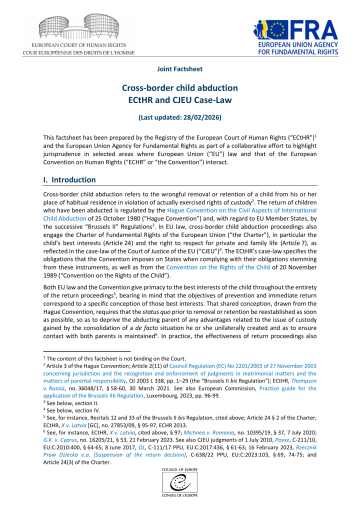
    This factsheet examines case law on cross-border child abduction, meaning the unlawful removal of a child from one EU Member State to another. Jointly published by the European Court of Human Rights and the EU Agency for Fundamental Rights, it explains how courts handle issues where EU law and human rights law overlap. It highlights key court decisions from the Court of Justice of the European Union (CJEU) and the European Court of Human Rights (ECtHR) to show how these two legal systems work together on issues of child abduction and prioritising the best interests of the child.
  • Handbook / Guide / Manual
    29
    June
    2026
    This guidance explains the role of a guardian assigned to a child during the screening and asylum procedure. It provides an overview of the different phases of the process and outlines a child’s legal rights throughout. The guidance includes topics such as lodging an application for international protection, preparing for the application interview and appealing against a negative decision. The European Union Agency for Asylum (EUAA) and the European Union Agency for Fundamental Rights (FRA) have developed a series of practical tools for guardians of unaccompanied children with international protection needs.
  • Handbook / Guide / Manual
    29
    June
    2026
    This guidance is for newly appointed guardians supporting a child who is applying for or has obtained international protection. It explains key terms, such as refugee status and subsidiary protection, as well as the legal framework for children’s rights in this context. The guidance also covers how to ensure the child’s participation and best interests during the asylum procedure. It is part of a series of practical tools developed by the European Union Agency for Asylum (EUAA) and the European Union Agency for Fundamental Rights (FRA) for guardians of unaccompanied children with international protection needs.