eu-charter

Carta drepturilor fundamentale a Uniunii Europene

Articolul 54 - Interzicerea abuzului de drept

Articolul 54 - Interzicerea abuzului de drept

Nici una dintre dispozițiile prezentei carte nu trebuie să fie interpretată ca implicând vreun drept de a desfășura orice activitate sau de a îndeplini orice act îndreptat împotriva oricăruia dintre drepturile și libertățile recunoscute prin prezenta cartă sau de a le impune restrângeri mai ample decât cele prevăzute prin prezenta cartă..

Explicaţii

  • Text:

    Acest articol corespunde articolului 17 din CEDO:

    `Nicio dispoziţie din prezenta convenţie nu poate fi interpretată ca implicând, pentru un stat, un grup, sau un individ, un drept oarecare de a desfăşura o activitate sau de a îndeplini un act ce urmăreşte distrugerea drepturilor sau a libertăţilor recunoscute de prezenta convenţie sau de a aduce limitări mai ample acestor drepturi şi libertăţi decât acelea prevăzute de această convenţie.`

    [*] Nota editorului: trimiterile la numerele articolelor din tratate au fost actualizate şi, totodată, au fost rectificate câteva erori materiale.

    Source:
    Jurnalul Oficial al Uniunii Europene C 303/17 - 14.12.2007
    Preamble - Explanations relating to the Charter of Fundamental Rights:
    Explicaţiile redate în continuare au fost redactate iniţial sub autoritatea prezidiului Convenţiei care a elaborat Carta drepturilor fundamentale a Uniunii Europene. Acestea au fost actualizate sub autoritatea prezidiului Convenţiei Europene, având în vedere adaptarea de către respectiva Convenţie a textului cartei (în special la articolele 51 şi 52), precum şi evoluţia dreptului Uniunii. Cu toate că aceste explicaţii nu au valoare juridică în sine, acestea constituie un preţios instrument de interpretare destinat clarificării dispoziţiilor cartei.

Jurisprudență

Dreptul constituțional național

16 results found

  • Basic Law for the Federal Republic of Germany
    Țara:
    Germany

    Article 18 Whoever abuses the freedom of expression, in particular the freedom of the press (paragraph (1) of Article 5), the freedom of teaching (paragraph (3) of Article 5), the freedom of assembly (Article 8), the freedom of association (Article 9), the privacy of correspondence, posts and telecommunications (Article 10), the rights of property (Article 14), or the right of asylum (Article 16a) in order to combat the free democratic basic order shall forfeit these basic rights. This forfeiture and its extent shall be declared by the Federal Constitutional Court.

  • Constitution of the Hellenic Republic
    URL:
    Țara:
    Greece

    Article 25(...) Abuse of rights shall be prohibited. (...)

  • Constitution of the Hellenic Republic
    Țara:
    Greece

    Article 25 (3) The abusive exercise of rights is not permitted […]

  • Constitution of the Republic of Bulgaria
    Țara:
    Bulgaria

    Art. 57. (2) Rights shall not be abused, nor shall they be exercised to the detriment of the rights or the legitimate interests of others.

  • Constitution of the Republic of Croatia
    Țara:
    Croatia


  • Constitution of the Republic of Estonia
    Țara:
    Estonia

    Article 10. The rights, freedoms and duties set out in this chapter do not preclude other rights, freedoms and duties which arise from the spirit of the Constitution or are in accordance therewith, and which are in conformity with the principles of human dignity, social justice and democratic government founded on the rule of law.

  • Czechia / Charter of Fundamental Rights and Freedoms
    Țara:
    Czechia

    Article 4 (...) (4) When employing the provisions concerning limitations upon the fundamental rights and freedoms, the essence and significance of these rights and freedoms must be preserved. Such limitations shall not be misused for purposes other than those for which they were enacted.

  • European Convention on Human Rights - Article 17
    Țara:
    Austria

    Article 17

    Nothing in this Convention may be interpreted as implying for any State, group or person any right to engage in any activity or perform any act aimed at the destruction of any of the rights and freedoms set forth herein or at their limitation to a greater extent than is provided for in the Convention.

  • Grundgesetz für die Bundesrepublik Deutschland
    Țara:
    Germany

    Artikel 18 Wer die Freiheit der Meinungsäußerung, insbesondere die Pressefreiheit (Artikel 5 Abs. 1), die Lehrfreiheit (Artikel 5 Abs. 3), die Versammlungsfreiheit (Artikel 8), die Vereinigungsfreiheit (Artikel 9), das Brief-, Post- und Fernmeldegeheimnis (Artikel 10), das Eigentum (Artikel 14) oder das Asylrecht (Artikel 16a) zum Kampfe gegen die freiheitliche demokratische Grundordnung mißbraucht, verwirkt diese Grundrechte. Die Verwirkung und ihr Ausmaß werden durch das Bundesverfassungsgericht ausgesprochen.

  • Konvention zum Schutze der Menschenrechte und Grundfreiheiten
    Țara:
    Austria

    Artikel 17 Keine Bestimmung dieser Konvention darf dahin ausgelegt werden, daß sie für einen Staat, eine Gruppe oder eine Person das Recht begründet, eine Tätigkeit auszuüben oder eine Handlung zu begehen, die auf die Abschaffung der in der vorliegenden Konvention festgelegten Rechte und Freiheiten oder auf weitergehende Beschränkungen dieser Rechte und Freiheiten, als in der Konvention vorgesehen, hinzielt.

  • Portugal / Constitution of the Portuguese Republic
    Țara:
    Portugal

    Article 16 (Scope and interpretation of fundamental rights) (1) The fundamental rights enshrined in the Constitution shall not exclude any other set out in applicable international laws and legal rules. (2) The constitutional precepts concerning fundamental rights must be interpreted and completed in harmony with the Universal Declaration of Human Rights.

    ...
    Article 18 (Legal force) (1) The constitutional precepts with regard to rights, freedoms and guarantees are directly applicable and are binding on public and private entities. (2) The law may only restrict rights, freedoms and guarantees in cases expressly provided for in the Constitution, and such restrictions must be limited to those needed to safeguard other constitutionally protected rights and interests. (3). Laws that restrict rights, freedoms and guarantees must have a general and abstract nature and may not have a retroactive effect or reduce the extent or scope of the essential content of the constitutional precepts.

  • Slovakia / Constitution of the Slovak Republic
    Țara:
    Slovakia

    Article 1 (1) The Slovak Republic is a sovereign, democratic state governed by the rule of law.(...)

  • The Constitution of the Republic of Cyprus
    Țara:
    Cyprus

    Article 34
    Nothing in this Part may be interpreted as implying for any Community, group or person any right to engage in any activity or perform any act aimed at the undermining or destruction of the constitutional order established by this Constitution or at the destruction of any of the rights and liberties set forth in this Part or at their limitation to a greater extent than is provided for therein.

  • Tο Σύνταγμα της Κυπριακής Δημοκρατίας
    Țara:
    Cyprus

    ΑΡΘΡΟΝ 34
    Ουδέν εκ των εν τω παρόντι, μέρει διαλαμβανομένων δύναται να ερμηνευθή ως παρέχον οιονδήποτε δικαίωμα εις οιονδήποτε κοινότητα, ομάδα ή άτομον να επιδοθή εις οιανδήποτε δράσιν ή εκτέλεσιν οιασδήποτε πράξεως σκοπούσης την υπονόμευσιν ή την κατάργησιν της υπό του Συντάγματος καθιδρυομένης συνταγματικής τάξεως ή την κατάργησιν οιουδήποτε εκ των εν τω παρόντι μέρει καθοριζομένων δικαιωμάτων ή ελευθεριών ή τον περιορισμόν αυτών εις μεγαλύτερον του οριζομένου εν τω παρόντι μέρει βαθμόν.

  • Το Σύνταγμα της Ελλάδας
    Țara:
    Greece

    Άρθρο 25 (3) Η καταχρηστική άσκηση δικαιώματος δεν επιτρέπεται. [...]

  • КОНСТИТУЦИЯ на Република България
    Țara:
    Bulgaria

    Чл. 57. (2) Не се допуска злоупотреба с права, както и тяхното упражняване, ако то накърнява права или законни интереси на други.

Legislația UE

0 results found

Drept internațional

0 results found

Produse

  • Fundamental Rights Report
    15
    March
    2005
    In 2003 the Agency commissioned a research team from the University of Nijmegen in the Netherlands (NISCO) to conduct a major analysis of data from the 2003 Eurobarometer Survey and the 2003 European Social Survey on attitudes towards minorities and migrants in different European countries. The researchers also compared the findings of the 2003 Eurobarometer with results of earlier Eurobarometer Surveys. The research team produced a statistical analysis, written up as four reports.
  • Fundamental Rights Report
    2
    December
    2004
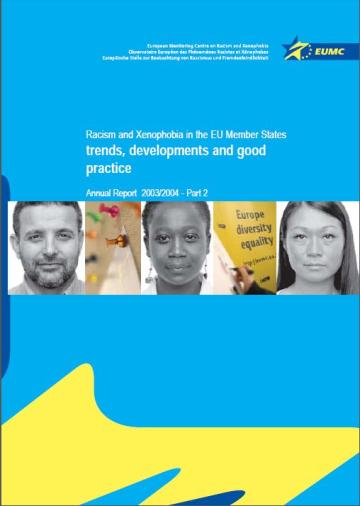
    In the Annual Report published on 2 December 2004, the Agency concludes that the education system in EU states is still failing migrant and minority pupils and racism against the Roma community continues.
  • Fundamental Rights Report
    1
    December
    2004
    The report analyses the existing and developing legal measures and remedies against discrimination of migrants and minorities, especially within the framework of the two EU anti-discrimination directives and their transposition into national legislation.
  • Report / Paper / Summary
    3
    May
    2004
    "Manifestations of Antisemitism in the EU 2002 - 2003" details manifestations of antisemitism in the EU over a two-year period from 2002-2003 using data available by October 2003 and proposes policies to counter it. The second report, "Perceptions of Antisemitism in the European Union" provides snapshot interviews with members of the Jewish community. The main report shows that there has been an increase in antisemitic incidents in five EU countries, (Belgium, France, Germany, the Netherlands and the UK). Those incidents ranged from hate mail to arson. In some other countries there has been little evidence of increase in antisemitism.
  • Report / Paper / Summary
    3
    May
    2004
    This report complements the report "Manifestations of Antisemitism in the EU 2002-2003" and consists of material from in-depth interviews with 35 persons from Jewish communities in eight European countries, covering their own perceptions of antisemitism.
  • Fundamental Rights Report
    1
    April
    2004
    This report presents the activities of the European Monitoring Centre on Racism and Xenophobia during 2003.
  • Report / Paper / Summary
    1
    January
    2004
    The Agency commissioned the material for this report from its National Focal Points in 15 EU Member States. The report constitutes a unique collection of evidence on various forms of discrimination and disadvantage experienced by migrants and minorities in the education sector. The Report finds that migrant and minority ethnic groups are over-represented in educational establishments with lower academic demands, have higher drop out rates, lower school completion rates, and sometimes even face segregation into 'special needs schools'. As well as documenting inequality, discrimination and process of exclusion, the report also examples of good practices in the field of education. The report finishes with selected recommendations for the EU and its Member States.
  • Fundamental Rights Report
    1
    December
    2003
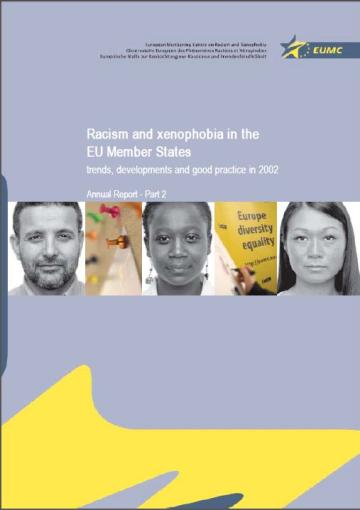
    The report was presented to the European Parliament beginning of December 2003, it provides information on the situation regarding racism and xenophobia in the Community and its Member States, and highlights examples of good practice.
  • Leaflet / Flyer
    1
    October
    2003
    During 2003 the two EU Council Directives on equality were due to be transposed into the legislation of Member States. This report, published by the EUMC in the same year, provides conclusive evidence for the necessity of these Directives, and indicates the need for corresponding anti-discrimination measures in employment.
  • Report / Paper / Summary
    1
    September
    2003
    For the EUMC, which has been established to combat racism and xenophobia, the rapid development of Internet websites has become a reminder of the powerful instrument the Internet can be, as well as the negative impact it is able to exercise.