Produse

    Publications and Data

    Displaying results 141 - 150 of 240
    Fundamental Rights Report
    6
    June
    2018
    The year 2017 brought both progress and setbacks in terms of rights protection. The European Pillar of Social Rights marked an important move towards a more ‘social Europe’. But, as experiences with the EU Charter of Fundamental Rights underscore, agreement on a text is merely a first step. Even in its eighth year as the EU's binding bill of rights, the Charter's potential was not fully exploited, highlighting the need to more actively promote its use.
    Fundamental Rights Report
    6
    June
    2018
    Anul 2017 a adus atât progrese, cât și regrese în ceea ce privește protecția drepturilor fundamentale. Raportul privind drepturile fundamentale 2018 al FRA analizează evoluțiile majore din domeniu, identificând atât realizările, cât și domeniile de interes nesoluționate.
    Periodic updates / Series
    28
    May
    2018
    In view of the increasing numbers of refugees, asylum seekers and migrants entering the EU, the EU Agency for Fundamental Rights has been collecting relevant data since September 2015. This report focuses on the fundamental rights situation of people arriving in Member States particularly affected by large migration movements. This report addresses fundamental rights concerns between 1 March-30 April 2018.
    Report / Paper / Summary
    17
    May
    2018
    Organizațiile societății civile din Uniunea Europeană joacă un rol esențial în promovarea drepturilor fundamentale, dar le este tot mai greu să-și continue activitatea din cauza restricțiilor
    juridice și practice. Deși există provocări în toate statele membre ale UE, natura și amploarea acestora variază. În general, datele și cercetările pe această temă – inclusiv cercetările comparative – lipsesc.
    Prin urmare, raportul FRA analizează diferitele tipuri și modele de provocări cu care se confruntă organizațiile societății civile care lucrează în domeniul drepturilor omului în UE. De asemenea, raportul scoate în evidență practici promițătoare care pot contracara aceste modele îngrijorătoare.
    Report / Paper / Summary
    25
    April
    2018
    The methods used to determine the age of
    an applicant may include “invasive” medical tests which interfere with the rights of the child, including their right to dignity,
    integrity and privacy. It is often a challenge to find the right balance between protecting children from harm and promoting
    their participation in these procedures. This report provides important insights and identifies the implications of collecting
    children’s biometric data and conducting age assessments.
    Opinion / Position Paper
    19
    April
    2018
    This Opinion by the European Union Agency for Fundamental Rights (FRA) aims to inform the European Parliament position concerning legislative proposals on interoperability between EU information technology systems (IT systems) presented on 12 December 2017 and currently discussed by the EU legislators.
    Report / Paper / Summary
    28
    March
    2018
    This report outlines the fundamental rights implications of collecting, storing and using
    biometric and other data in EU IT systems in the area of asylum and migration.
    Periodic updates / Series
    26
    March
    2018
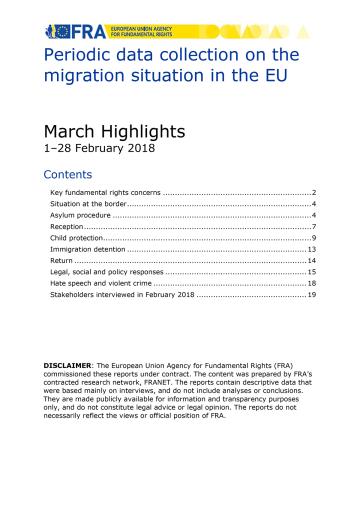
    In view of the increasing numbers of refugees, asylum seekers and migrants entering the EU, the EU Agency for Fundamental Rights has been collecting relevant data since September 2015. These focus on the fundamental rights situation of people arriving in Member States particularly affected by large migration movements. The countries covered are: Austria, Bulgaria, Croatia, Denmark, Finland, France, Germany, Greece, Hungary, Italy, the Netherlands, Poland, Spain and Sweden.
    Periodic updates / Series
    26
    February
    2018
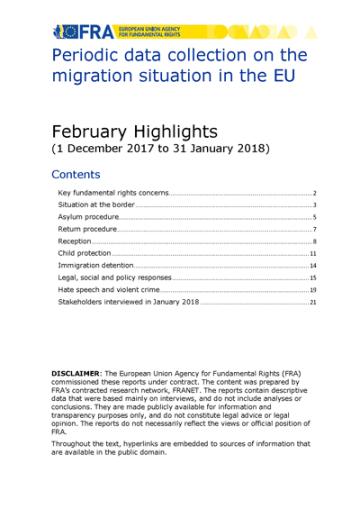
    In view of the increasing numbers of refugees, asylum seekers and migrants entering the EU, the EU Agency for Fundamental Rights has been collecting relevant data since September 2015. These focus on the fundamental rights situation of people arriving in Member States particularly affected by large migration movements. The countries covered are: Austria, Bulgaria, Croatia, Denmark, Finland, France, Germany, Greece, Hungary, Italy, the Netherlands, Poland, Spain and Sweden.