Equality

Infracțiuni motivate de ură

    Produse

    Publications and Data

    Displaying results 11 - 20 of 74
    Infographic
    Report / Paper / Summary
    10
    September
    2020
    Antisemitism can be expressed in the form of verbal and physical attacks, threats, harassment, discrimination and unequal treatment, property damage and graffiti or other forms of speech or text, including on the internet. Antisemitic incidents and hate crimes violate fundamental rights, especially the right to human dignity, the right to equality of treatment and the freedom of thought, conscience and religion.

    Report / Paper / Summary
    8
    November
    2019
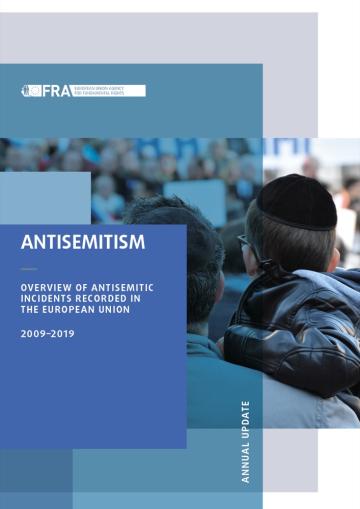
    This annual overview provides an update of the most recent figures on antisemitic incidents, covering the period 1 January 2008 – 31 December 2018, across the EU Member States, where data are available. It includes a section that presents evidence from international organisations. In addition, for the first time, it provides an overview of how Member States that have adopted or endorsed the non-legally binding working definition of antisemitism adopted by the International Holocaust Remembrance Alliance (IHRA) (2016) use or intend to use it.
    Report / Paper / Summary
    4
    July
    2019
    Based on FRA’s second large-scale survey on experiences and perceptions of antisemitism, this report focuses on the perspectives of young Jewish Europeans (aged 16-34) living in twelve EU Member States. It first describes this particular group and takes a look at defining antisemitism and understanding the place of Israel in it.
    Report / Paper / Summary
    18
    June
    2019
    This technical report presents in detail all the stages
    of the survey and the relevant information needed to
    assess the quality and reliability of the data, as well
    as considerations for interpreting the survey results.
    The following chapters of the report cover the procedures
    used in the development and administration
    of the survey.
    Fundamental Rights Report
    6
    June
    2019
    How much progress can we expect in a decade? Various rights-related instruments had been in place for 10 years in 2018, prompting both sobering and encouraging reflection on this question.
    Report / Paper / Summary
    8
    March
    2019
    Acest rezumat prezintă principalele constatări ale celui de al doilea sondaj al FRA privind experiențele evreilor legate de infracțiunile motivate de ură, discriminare și antisemitism în Uniunea Europeană – cel mai important sondaj printre evrei realizat vreodată la nivel internațional.
    Report / Paper / Summary
    12
    December
    2018
    Această lucrare prezintă evoluția jurisprudenței Curții Europene a Drepturilor
    Omului cu privire la infracțiunile motivate de ură, oferind o actualizare în ceea
    ce privește cele mai recente hotărâri. Abordarea infracțiunilor motivate de ură
    dintr-o perspectivă a drepturilor fundamentale arată cum datoria autorităților
    statelor membre de a investiga în mod eficient motivarea bazată pe prejudecată
    a infracțiunilor decurge din instrumentele cheie ale drepturilor omului, cum ar fi
    Convenția europeană a drepturilor omului.
    Report / Paper / Summary
    10
    December
    2018
    This report outlines the main findings of FRA’s second survey on Jewish people’s experiences with hate crime, discrimination and antisemitism in the European Union – the biggest survey of Jewish people ever conducted worldwide. Covering 12 EU Member States, the survey reached almost 16,500 individuals who identify as being Jewish. It follows up on the agency’s first survey, conducted in seven countries in 2012.
    Periodic updates / Series
    9
    November
    2018
    Antisemitism can be expressed in the form of verbal and physical attacks, threats,
    harassment, discrimination and unequal treatment, property damage and graffiti or other
    forms of speech or text, including on the internet. The present report provides an overview of data on antisemitism as recorded by
    international organisations and by official and unofficial sources in the 28 European
    Union (EU) Member States, based on their own definitions and categorisations.