Equality

Hasskriminalität

Highlights

  • Report / Paper / Summary
    29
    November
    2023
    Online hate speech is a growing problem in today’s digitalised societies. Women, Black people, Jews and Roma are often targets of online hate speech. Online hate proliferates where human content moderators miss offensive content. Also, algorithms are prone to errors. They may multiply errors over time and may even end up promoting online hate. This report presents the challenges in identifying and detecting online hate. Hate of any kind should not be tolerated, regardless of whether it is online or offline. The report discusses the implications for fundamental rights to support creating a rights-compliant digital environment.
  • Report / Paper / Summary
    12
    Dezember
    2018
    This paper discusses the evolution of European Court of Human Rights case law relating
    to hate crime, providing an update on the most recent rulings. Approaching hate crime
    from a fundamental rights perspective, it shows how Member State authorities’ duty to
    effectively investigate the bias motivation of crimes flows from key human rights
    instruments, such as the European Convention on Human Rights.
  • Report / Paper / Summary
    7
    Juli
    2021
    This report examines why victims do not report bias-motivated incidents and the barriers that they face when reporting incidents through national crime reporting systems. By mapping existing practices that have a bearing on the victim’s experiences when reporting bias-motivated violence and harassment, it aims to provide evidence to support national efforts to encourage and facilitate reporting – and ultimately assist Member States in delivering on their duties with regard to combating hate crime.
  • Report / Paper / Summary
    21
    Juni
    2018
    Across the European Union, people face hatred because of their skin colour, ethnicity, religion, gender or sexuality. In response, the EU and its Member States have introduced laws against hate crime and support services for victims. But these will only fulfil their potential if victims report hate-motivated harassment and violence to the police, and if police officers record such incidents as hate crimes. This report provides rich and detailed information on hate crime recording and data collection systems across the EU, including any systemic cooperation with civil society.
    Produkte
    12
    Dezember
    2018
    This paper discusses the evolution of European Court of Human Rights case law relating
    to hate crime, providing an update on the most recent rulings. Approaching hate crime
    from a fundamental rights perspective, it shows how Member State authorities’ duty to
    effectively investigate the bias motivation of crimes flows from key human rights
    instruments, such as the European Convention on Human Rights.
    Michael O'Flaherty focuses on the situation of the Jewish community living in the EU.
    10
    Dezember
    2018
    This report outlines the main findings of FRA’s second survey on Jewish people’s experiences with hate crime, discrimination and antisemitism in the European Union – the biggest survey of Jewish people ever conducted worldwide. Covering 12 EU Member States, the survey reached almost 16,500 individuals who identify as being Jewish. It follows up on the agency’s first survey, conducted in seven countries in 2012.
    9
    November
    2018
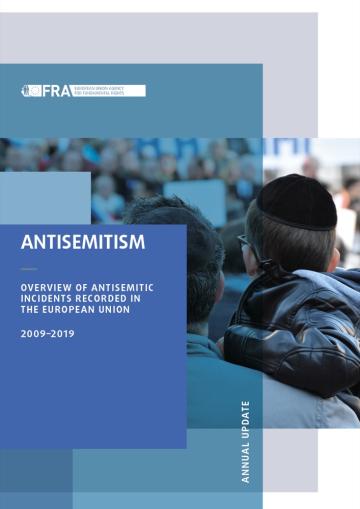
    Antisemitism can be expressed in the form of verbal and physical attacks, threats,
    harassment, discrimination and unequal treatment, property damage and graffiti or other
    forms of speech or text, including on the internet. The present report provides an overview of data on antisemitism as recorded by
    international organisations and by official and unofficial sources in the 28 European
    Union (EU) Member States, based on their own definitions and categorisations.
    21
    Juni
    2018
    Across the European Union, people face hatred because of their skin colour, ethnicity, religion, gender or sexuality. In response, the EU and its Member States have introduced laws against hate crime and support services for victims. But these will only fulfil their potential if victims report hate-motivated harassment and violence to the police, and if police officers record such incidents as hate crimes. This report provides rich and detailed information on hate crime recording and data collection systems across the EU, including any systemic cooperation with civil society.
    6
    Juni
    2018
    The year 2017 brought both progress and setbacks in terms of rights protection. The European Pillar of Social Rights marked an important move towards a more ‘social Europe’. But, as experiences with the EU Charter of Fundamental Rights underscore, agreement on a text is merely a first step. Even in its eighth year as the EU's binding bill of rights, the Charter's potential was not fully exploited, highlighting the need to more actively promote its use.
    17
    Mai
    2018
    Zivilgesellschaftliche Organisationen in der Europäischen Union spielen bei der Förderung
    der Grundrechte eine entscheidende Rolle, doch gestaltet sich dies – aufgrund rechtlicher
    und praktischer Einschränkungen – für sie immer schwieriger. In der vorliegenden Zusammenfassung werden die
    wichtigsten Ergebnisse des Berichts und die Stellungnahmen
    der FRA zu den Fragen, die damit aufgeworfen
    werden, skizziert.
    The EU's Agency for Fundamental Rights (FRA) and the OSCE Office for Democratic Institutions and Human Rights (ODIHR) work together to help states improve their ability to record and collect hate crime data through national workshops.
    21
    März
    2018
    Das europäische Antidiskriminierungsrecht verbietet insbesondere nach Maßgabe der Antidiskriminierungsrichtlinien der EU, des Artikels 14 der Europäischen Menschenrechtskonvention sowie des Protokolls Nr. 12 zu dieser Konvention die Diskriminierung in einer ganzen Reihe von Bereichen und aus einer Vielzahl von Gründen. Dieses Handbuch untersucht den europäischen Rechtsrahmen zur Nichtdiskriminierung, der sich auf diese beiden Quellen als einander ergänzende Systeme gründet, auf die unterschiedslos Bezug genommen wird, soweit sie sich überschneiden; zugleich wird gegebenenfalls auf bestehende Unterschiede aufmerksam gemacht.
    6
    Dezember
    2017
    Seventeen years after adoption of EU laws that forbid discrimination, immigrants, descendants of immigrants, and minority ethnic groups continue to face widespread discrimination across the EU and in all areas of life – most often when seeking employment. For many, discrimination is a recurring experience. This is just one of the findings of FRA’s second European Union Minorities and Discrimination Survey (EU-MIDIS II), which collected information from over 25,500 respondents with different ethnic minority and immigrant backgrounds across all 28 EU Member States.
    The EU Agency for Fundamental Rights (FRA) launches its second EU Minorities and Discrimination Survey (EU-MIDIS II).
    This survey involved interviews with 25,515 people with different ethnic minority and immigrant backgrounds across 28 EU countries. It explores issues concerning discrimination as well as experiences of harassment, hate-motivated violence and discriminatory profiling.
    This infographic illustrates the main experiences immigrants and ethnic minorities across the EU have when it comes to discrimination. It draws from the findings from FRA's EU-MIDIS II survey.
    This infographic illustrates the main experiences immigrants and ethnic minorities across the EU have when it comes to victimisation. It draws from the findings from FRA's EU-MIDIS II survey.
    This infographic illustrates the main experiences immigrants and ethnic minorities across the EU have when it comes to inclusion. It draws from the findings from FRA's EU-MIDIS II survey.
    9
    November
    2017
    This report provides an overview of data on antisemitism as recorded by
    international organisations and by official and unofficial sources in the 28 European
    Union (EU) Member States, based on their own definitions and categorisations.
    21
    September
    2017
    Muslimas und Muslime, die in der EU leben, werden in den unterschiedlichsten Situationen diskriminiert – insbesondere bei der Arbeitsplatzsuche, am Arbeitsplatz selbst und bei dem Versuch, Zugang zu öffentlichen oder privaten Dienstleistungen zu erlangen. Der Bericht untersucht, wie persönliche Merkmale – etwa der Vor- und Familienname oder die Hautfarbe einer Person – und das sichtbare Tragen religiöser Symbole, wie zum Beispiel ein Kopftuch zu diskriminierender Behandlung und Belästigung führen können.
    30
    Mai
    2017
    Auf europäischer und nationaler Ebene wurden 2016 vielfältige Anstrengungen unternommen, um den Schutz der Grundrechte zu stärken. Gleichzeitig drohten einige politische Maßnahmen, diesen Schutz zu untergraben.
    30
    Mai
    2017
    Diverse efforts at both EU and national levels sought to bolster fundamental rights protection in 2016, while some measures threatened to undermine such protection.
    Report / Paper / Summary
    10
    April
    2017
    Hasskriminalität ist die gravierendste Form der
    Diskriminierung und stellt eine fundamentale
    Verletzung der Grundrechte dar. Die Europäische
    Union (EU) ist entschlossen, gegen Hasskriminalität
    vorzugehen, und hat dies mit Rechtsvorschriften
    wie dem Rahmenbeschluss des Rates zur
    strafrechtlichen Bekämpfung bestimmter Formen
    und Ausdrucksweisen von Rassismus und
    Fremdenfeindlichkeit aus dem Jahr 2008 unter
    Beweis gestellt. Ungeachtet dessen wird die
    Mehrheit der in der EU begangenen Hassdelikte
    nicht angezeigt und bleibt daher unsichtbar, sodass
    die Opfer keine Wiedergutmachung erfahren.