eu-charter

Charta základných práv Európskej únie

Článok 18 - Právo na azyl

Článok 18 - Právo na azyl

Právo na azyl sa zaručuje dodržiavaním pravidiel Ženevského dohovoru z 28. júla 1951 a Protokolu z 31. januára 1967 týkajúcich sa postavenia utečencov a v súlade so Zmluvou o Európskej únii a so Zmluvou o fungovaní Európskej únie (ďalej len "zmluvy").

Vysvetlivky

  • Text:

    Znenie tohto článku je založené na článku 63 Zmluvy o ES, ktorý je v súčasnosti nahradený článkom 78 Zmluvy o fungovaní Európskej únie, ktorý Únii ukladá povinnosť dodržiavať Ženevský dohovor o postavení utečencov. Bolo dohodnuté, že sa má odkazovať na ustanovenia protokolov, ktoré sa vzťahujú na Spojené kráľovstvo a Írsko, a ktoré sú pripojené k zmluvám a na Dánsko, aby sa určil rozsah, v akom tieto členské štáty vykonávajú právo Únie v tejto oblasti a rozsah, v akom sa na ne vzťahuje tento článok. Tento článok je v súlade s Protokolom o azyle, ktorý je pripojený k zmluvám.

    Source:
    Úradný vestník Európskej únie C 303/17 - 14.12.2007
    Preamble - Explanations relating to the Charter of Fundamental Rights:
    Ďalej uvedené vysvetlivky boli pôvodne pripravené pod vedením predsedníctva konventu, ktorý vypracoval návrh Charty základných práv Európskej únie. Boli aktualizované pod vedením predsedníctva Európskeho konventu so zreteľom na úpravy, ktoré urobil tento konvent k textu charty (najmä k článkom 51 a 52), a vývoj práva Únie. Hoci tieto vysvetlivky nie sú ako také právne záväzné, predstavujú cenný nástroj výkladu, ktorý je určený na objasnenie ustanovení charty.

Prípadové právo

Vnútroštátne ústavné právo

27 results found

  • Sweden / Instrument of Government
    Štát:
    Sweden

    Chapter 2 - Fundamental rights and freedoms:

    Article 7 No Swedish citizen may be deported from or refused entry into the Realm. No Swedish citizen who is domiciled in the Realm or who has previously been domiciled in the Realm may be deprived of his or her citizenship. It may however be prescribed that children under the age of eighteen shall have the same nationality as their parents or as one parent;

    Article 25 For foreign nationals within the Realm, special limitations may be introduced to the following rights and freedoms: 1. Freedom of expression, freedom of information, freedom of assembly, freedom to demonstrate, freedom of association and freedom of worship (Article 1, paragraph one); 2. Protection against coercion to divulge an opinion (Article 2, sentence one); 3. Protection against physical violations also in cases other than cases under Articles 4 and 5, against body searches, house searches and other such invasions of privacy, against violations of confidential items of mail or communications and otherwise against violations involving surveillance and monitoring of the individual’s personal circumstances (Article 6); 4. Protection against deprivation of liberty (Article 8, sentence one); 5. The right to have a deprivation of liberty other than a deprivation of liberty on account of a criminal act or on suspicion of having committed such an act examined before a court of law (Article 9, paragraphs two and three); 6. Public court proceedings (Article 11, paragraph two, sentence two); 7. Authors’, artists’ and photographers’ rights to their works (Article 16); 8. the right to trade or practise a profession (Article 17); 9. The right to freedom of research (Article 18, paragraph two); and 10. Protection against violations on grounds of an opinion (Article 21, sentence three). The provisions of Article 22, paragraph one, paragraph two, sentence one and paragraph three shall apply with respect to the special limitations referred to in paragraph one.

  • Basic Law for the Federal Republic of Germany
    Štát:
    Germany

    Article 16a (1) Persons persecuted on political grounds shall have the right of asylum. (2) Paragraph (1) of this Article may not be invoked by a person who enters the federal territory from a member state of the European Communities or from another third state in which application of the Convention Relating to the Status of Refugees and of the Convention for the Protection of Human Rights and Fundamental Freedoms is assured. The states outside the European Communities to which the criteria of the first sentence of this paragraph apply shall be specified by a law requiring the consent of the Bundesrat. In the cases specified in the first sentence of this paragraph, measures to terminate an applicant’s stay may be implemented without regard to any legal challenge that may have been instituted against them. (3) By a law requiring the consent of the Bundesrat, states may be specified in which, on the basis of their laws, enforcement practices and general political conditions, it can be safely concluded that neither political persecution nor inhuman or degrading punishment or treatment exists. It shall be presumed that a foreigner from such a state is not persecuted, unless he presents evidence justifying the conclusion that, contrary to this presumption, he is persecuted on political grounds. (4) In the cases specified by paragraph (3) of this Article and in other cases that are plainly unfounded or considered to be plainly unfounded, the implementation of measures to terminate an applicant’s stay may be suspended by a court only if serious doubts exist as to their legality; the scope of review may be limited, and tardy objections may be disregarded. Details shall be determined by a law. (5) Paragraphs (1) to (4) of this Article shall not preclude the conclusion of international agreements of member states of the European Communities with each other or with those third states which, with due regard for the obligations arising from the Convention Relating to the Status of Refugees and the Convention for the Protection of Human Rights and Fundamental Freedoms, whose enforcement must be assured in the contracting states, adopt rules conferring jurisdiction to decide on applications for asylum, including the reciprocal recognition of asylum decisions.

  • Constitution of Finland
    Štát:
    Finland

    Section 9 Freedom of movement Finnish citizens and foreigners legally resident in Finland have the right to freely move within the country and to choose their place of residence. Everyone has the right to leave the country. Limitations on this right may be provided by an Act, if they are necessary for the purpose of safeguarding legal proceedings or for the enforcement of penalties or for the fulfilment of the duty of national defence. Finnish citizens shall not be prevented from entering Finland or deported or extradited or transferred from Finland to another country against their will. However, it may be laid down by an Act that due to a criminal act, for the purpose of legal proceedings, or in order to enforce a decision concerning the custody or care of a child, a Finnish citizen can be extradited or transferred to a country in which his or her human rights and legal protection are guaranteed. The right of foreigners to enter Finland and to remain in the country is regulated by an Act. A foreigner shall not be deported, extradited or returned to another country, if in consequence he or she is in danger of a death sentence, torture or other treatment violating human dignity. 

  • Constitution of the Italian Republic
    Štát:
    Italy

    Art. 10. (...) A foreigner who, in his home country, is denied the actual exercise of the democratic freedoms guaranteed by the Italian constitution shall be entitled to
    the right of asylum under the conditions established by law.

  • Constitution of the Republic of Bulgaria
    Štát:
    Bulgaria

    Art. 26. [...] (2) Foreigners residing in the Republic of Bulgaria shall be vested with all rights and obligations proceeding from this Constitution, except those rights and duties for which Bulgarian citizenship is required by this Constitution or by another law. Art. 27. (1) Foreigners residing legally in the country shall not be expelled or extradited to another State against their will, except in accordance with the provisions and the procedures established by law. (2) The Republic of Bulgaria shall grant asylum to foreigners persecuted for their opinions or activity in the defence of internationally recognized rights and freedoms. (3) The conditions and procedure for the granting of asylum shall be established by law.

  • Constitution of the Republic of Croatia
    Štát:
    Croatia

    Article 33
    Foreign citizens and stateless persons may be granted asylum in Croatia, unless they are being prosecuted for non-political crimes and activities contrary to the fundamental principles of international law.
    No alien legally in the territory of the Republic of Croatia shall be banished or extradited to another state, except in cases of enforcement of decisions made in compliance with an international treaty or law.

  • Constitution of the Republic of Poland
    Štát:
    Poland

    Article 56.1. Foreigners shall have a right of asylum in the Republic of Poland in accordance with principles specified by statute.2. Foreigners who, in the Republic of Poland, seek protection from oppression, may be granted the status of a refugee in accordance with international agreements to which the Republic of Poland is a party.

  • Costituzione della Repubblica Italiana
    Štát:
    Italy

    Art. 10. (...) Lo straniero, al quale sia impedito nel suo paese l'effettivo esercizio delle libertà democratiche garantite dalla Costituzione italiana, ha diritto d'asilo nel territorio della Repubblica, secondo le condizioni stabilite dalla legge.

  • Czechia / Charter of Fundamental Rights and Freedoms
    Štát:
    Czechia

    Article 43 The Czech and Slovak Federal Republic shall grant asylum to aliens who are being persecuted for the assertion of their political rights and freedoms. Asylum may be denied to a person who has acted contrary to fundamental human rights and freedoms.

  • Grundgesetz für die Bundesrepublik Deutschland
    Štát:
    Germany

    Artikel 16a (1) Politisch Verfolgte genießen Asylrecht. (2) Auf Absatz 1 kann sich nicht berufen, wer aus einem Mitgliedstaat der Europäischen Gemeinschaften oder aus einem anderen Drittstaat einreist, in dem die Anwendung des Abkommens über die Rechtsstellung der Flüchtlinge und der Konvention zum Schutze der Menschenrechte und Grundfreiheiten sichergestellt ist. Die Staaten außerhalb der Europäischen Gemeinschaften, auf die die Voraussetzungen des Satzes 1 zutreffen, werden durch Gesetz, das der Zustimmung des Bundesrates bedarf, bestimmt. In den Fällen des Satzes 1 können aufenthaltsbeendende Maßnahmen unabhängig von einem hiergegen eingelegten Rechtsbehelf vollzogen werden. (3) Durch Gesetz, das der Zustimmung des Bundesrates bedarf, können Staaten bestimmt werden, bei denen auf Grund der Rechtslage, der Rechtsanwendung und der allgemeinen politischen Verhältnisse gewährleistet erscheint, daß dort weder politische Verfolgung noch unmenschliche oder erniedrigende Bestrafung oder Behandlung stattfindet. Es wird vermutet, daß ein Ausländer aus einem solchen Staat nicht verfolgt wird, solange er nicht Tatsachen vorträgt, die die Annahme begründen, daß er entgegen dieser Vermutung politisch verfolgt wird. (4) Die Vollziehung aufenthaltsbeendender Maßnahmen wird in den Fällen des Absatzes 3 und in anderen Fällen, die offensichtlich unbegründet sind oder als offensichtlich unbegründet gelten, durch das Gericht nur ausgesetzt, wenn ernstliche Zweifel an der Rechtmäßigkeit der Maßnahme bestehen; der Prüfungsumfang kann eingeschränkt werden und verspätetes Vorbringen unberücksichtigt bleiben. Das Nähere ist durch Gesetz zu bestimmen. (5) Die Absätze 1 bis 4 stehen völkerrechtlichen Verträgen von Mitgliedstaaten der Europäischen Gemeinschaften untereinander und mit dritten Staaten nicht entgegen, die unter Beachtung der Verpflichtungen aus dem Abkommen über die Rechtsstellung der Flüchtlinge und der Konvention zum Schutze der Menschenrechte und Grundfreiheiten, deren Anwendung in den Vertragsstaaten sichergestellt sein muß, Zuständigkeitsregelungen für die Prüfung von Asylbegehren einschließlich der gegenseitigen Anerkennung von Asylentscheidungen treffen.

  • Konstytucja Rzeczypospolitej Polskiej
    Štát:
    Poland

    Art. 56.1. Cudzoziemcy mogą korzystać z prawa azylu w Rzeczypospolitej Polskiej na zasadach określonych w ustawie.2. Cudzoziemcowi, który w Rzeczypospolitej Polskiej poszukuje ochrony przed prześladowaniem, może być przyznany status uchodźcy zgodnie z wiążącymi Rzeczpospolitą Polską umowami międzynarodowymi.

  • Luxembourg / Constitution of the Grand Ducal of Luxembourg
    Štát:
    Luxembourg

    Art. 32. Le droit d’asile est garanti dans les conditions déterminées par la loi.

  • Magyarország Alaptörvénye
    Štát:
    Hungary

    XIV. cikk (SZABADSÁG ÉS FELELŐSSÉG) […] (3) Magyarország — ha sem származási országuk, sem más ország nem nyújt védelmet — kérelemre menedékjogot biztosít azoknak a nem magyar állampolgároknak, akiket hazájukban vagy a szokásos tartózkodási helyük szerinti országban faji, nemzeti hovatartozásuk, meghatározott társadalmi csoporthoz tartozásuk, vallási, illetve politikai meggyőződésük miatt üldöznek, vagy az üldöztetéstől való félelmük megalapozott.

  • Netherlands / Constitution of the Kingdom of the Netherlands
    Štát:
    Netherlands

    Article 2 (...) 2. The admission and expulsion of aliens shall be regulated by Act of Parliament.

  • Portugal / Constitution of the Portuguese Republic
    Štát:
    Portugal

    Article 33 (Deportation, extradition and right of asylum) (1) The deportation of Portuguese citizens from Portuguese territory is not permitted. (2) Deportation of anyone who properly entered or is properly remaining in Portuguese territory, has been granted a residence permit or has submitted a request for asylum that has not been refused may only be ordered by a judicial authority. The law shall assure expedite forms of decision in such cases. (3) The extradition of Portuguese citizens from Portuguese territory is only permissible where an international convention has established reciprocal extradition arrangements, in cases of terrorism or international organised crime, and on condition that the applicant state’s legal system enshrines guarantees of just and fair proceedings. (4) Extradition for crimes that are punishable under the applicant state’s law by a sentence or security measure which deprives or restricts freedom in perpetuity or for an undefined duration, is only permissible if the applicant state is a party to an international convention in this domain to which Portugal is bound, and offers guarantees that such a sentence or security measure will not be applied or executed. (5) The provisions of the previous paragraphs do not prejudice the application of the norms governing judicial cooperation in the criminal field that are laid down within the scope of the European Union. (6) The extradition or handing over of a person under any circumstances for political reasons, or for crimes which are punishable under the applicant state’s law by death or by any other sentence that results in irreversible damage to physical integrity, is not permitted. (7) Extradition may only be ordered by a judicial authority. (8) The right of asylum is guaranteed to foreigners and stateless persons who are the object, or are under grave threat, of persecution as a result of their activities in favour of democracy, social and national liberation, peace among peoples, freedom or the rights of the human person. (9) The law shall define the status of political refugee.

  • Preamble to the Constitution of 27 October 1946
    Štát:
    France

    § 4 Any man persecuted in virtue of his actions in favour of liberty may claim the right of asylum upon the territories of the Republic.

  • Préambule de la Constitution du 27 octobre 1946
    Štát:
    France

    § 4Tout homme persécuté en raison de son action en faveur de la liberté a droit d'asile sur les territoires de la République.

  • Refugees Act, Cap. 420 of the Laws of Malta, 2001
    Štát:
    Malta

    Article 8(1) A person may apply to the Commissioner, in the prescribed form, and shall be granted refugee protection, where it is established that he faces a well-founded fear of persecution on his country of origin or habitual residence int erms of the Convention.

  • Republic of Lithuania’s Law on the Legal Status of Aliens
    Štát:
    Lithuania

    Article 1.1. This Law shall establish the procedure of entry and exit, temporary or permanent residence, granting of asylum, the procedure of integration and naturalisation as well as the procedure for lodging appeals against the decisions on the legal status of aliens and shall regulate other issues relating to the legal status of aliens in the Republic of Lithuania. 2. The provisions of this Law have been harmonised with the provisions of legal acts of the European Union specified in the Annex to this Law. 3. The Law shall not apply to aliens who enjoy the privileges and immunities under international treaties and other legal acts of the Republic of Lithuania. 4. The provisions of other laws of the Republic of Lithuania shall apply to legal relations regulated by this Law to the extent they are not regulated by this Law.

  • Romania / Constitution of Romania
    Štát:
    Romania

    Article 18(1) Aliens and stateless persons living in Romania shall enjoy general protection of persons and assets, as guaranteed by the Constitution and other laws. (2) The right of asylum shall be granted and withdrawn under the provisions of the law, in compliance with the international treaties and conventions Romania is a party to.

Právo EÚ

14 results found

  • Treaty on the Functioning of the European Union

    Article 78 (ex Articles 63, points 1 and 2, and 64(2) TEC)

    1. The Union shall develop a common policy on asylum, subsidiary protection and temporary protection with a view to offering appropriate status to any third-country national requiring international protection and ensuring compliance with the principle of non-refoulement. This policy must be in accordance with the Geneva Convention of 28 July 1951 and the Protocol of 31 January 1967 relating to the status of refugees, and other relevant treaties.

    2. For the purposes of paragraph 1, the European Parliament and the Council, acting in accordance with the ordinary legislative procedure, shall adopt measures for a common European asylum system comprising:

    (a) a uniform status of asylum for nationals of third countries, valid throughout the Union;

    (b) a uniform status of subsidiary protection for nationals of third countries who, without obtaining European asylum, are in need of international protection;

    (c) a common system of temporary protection for displaced persons in the event of a massive inflow;

    (d) common procedures for the granting and withdrawing of uniform asylum or subsidiary protection status;

    (e) criteria and mechanisms for determining which Member State is responsible for considering an application for asylum or subsidiary protection;

    (f) standards concerning the conditions for the reception of applicants for asylum or subsidiary protection;

    (g) partnership and cooperation with third countries for the purpose of managing inflows of people applying for asylum or subsidiary or temporary protection.

    3. In the event of one or more Member States being confronted by an emergency situation characterised by a sudden inflow of nationals of third countries, the Council, on a proposal from the Commission, may adopt provisional measures for the benefit of the Member State(s) concerned. It shall act after consulting the European Parliament.

  • Regulation (EU) 2019/1896 of the European Parliament and of the Council of 13 November 2019 on the European Border and Coast Guard and repealing Regulations (EU) No 1052/2013 and (EU) 2016/1624

    Article 1

    Subject matter

    This Regulation establishes a European Border and Coast Guard to ensure European integrated border management at the external borders with a view to managing those borders efficiently in full compliance with fundamental rights and to increasing the efficiency of the Union return policy. This Regulation addresses migratory challenges and potential future challenges and threats at the external borders. It ensures a high level of internal security within the Union in full respect of fundamental rights, while safeguarding the free movement of persons within the Union. It contributes to the detection, prevention and combating of cross-border crime at the external borders.

  • Regulation (EU) 2019/1896 of the European Parliament and of the Council of 13 November 2019 on the European Border and Coast Guard and repealing Regulations (EU) No 1052/2013 and (EU) 2016/1624

    Preamble

    (103) This Regulation respects the fundamental rights and observes the principles recognised by Articles 2 and 6 TEU and by the Charter of Fundamental Rights of the European Union (‘the Charter’), in particular respect for human dignity, the right to life, the prohibition of torture and inhuman or degrading treatment or punishment, the prohibition of trafficking in human beings, the right to liberty and security, the right to the protection of personal data, the right of access to documents, the right to asylum and to protection against removal and expulsion, non-refoulement, non-discrimination and the rights of the child.

    Article 1: Subject matter

    This Regulation establishes a European Border and Coast Guard to ensure European integrated border management at the external borders with a view to managing those borders efficiently in full compliance with fundamental rights and to increasing the efficiency of the Union return policy.

    This Regulation addresses migratory challenges and potential future challenges and threats at the external borders. It ensures a high level of internal security within the Union in full respect of fundamental rights, while safeguarding the free movement of persons within the Union. It contributes to the detection, prevention and combating of cross-border crime at the external borders.

    Article 43: Instructions to the teams

    4.   Members of the teams shall, in the performance of their tasks and in the exercise of their powers, fully respect fundamental rights, including access to asylum procedures and human dignity, and shall pay particular attention to vulnerable persons. Any measures taken in the performance of their tasks and in the exercise of their powers shall be proportionate to the objectives pursued by such measures. While performing their tasks and exercising their powers, they shall not discriminate against persons on the basis of any grounds such as sex, race, colour, ethnic or social origin, genetic features, language, religion or belief, political or any other opinion, membership of a national minority, property, birth, disability, age or sexual orientation in line with Article 21 of the Charter.

  • Directive 2013/33/EU of the European Parliament and of the Council of 26 June 2013 laying down standards for the reception of applicants for international protection

Medzinárodné právo

5 results found

Informačné materiály

  • Fundamental Rights Report
    8
    June
    2022
    FRA’s Fundamental Rights Report 2022 reviews major developments in the field in 2021, identifying both achievements and areas of concern. It also presents FRA’s opinions on these developments, including a synopsis of the evidence supporting these opinions.
  • Report / Paper / Summary
    23
    March
    2022
    The EU is facing a large-scale humanitarian crisis. Over 10 days at the beginning of March, the EU Agency for Fundamental Rights (FRA) visited all EU countries bordering Ukraine and Moldova – Hungary, Poland, Romania and Slovakia.
  • Periodic updates / Series
    4
    March
    2022
    The EU Agency for Fundamental Rights has been regularly collecting data on asylum and migration since September 2015. This report focuses on the fundamental rights situation of people arriving in Member States and EU candidate countries particularly affected by migration. It addresses fundamental rights concerns between 1 October and 31 December 2021.
  • Periodic updates / Series
    24
    September
    2021
    The EU Agency for Fundamental Rights has been regularly collecting data on asylum and migration since September 2015. This report focuses on the fundamental rights situation of people arriving in Member States and EU candidate countries particularly affected by migration. It addresses fundamental rights concerns between 1 January and 30 June 2021.
  • Fundamental Rights Report
    10
    June
    2021
    Z hľadiska ochrany základných práv rok 2020 priniesol
    pokrok i určité nezdary. V publikácii agentúry FRA
    Správa o základných právach 2021 je uvedený
    prehľad hlavného vývoja v tejto oblasti, poukazuje
    sa na úspechy, ale aj na oblasti, ktoré ešte stále
    vyvolávajú obavy.
  • Fundamental Rights Report
    10
    June
    2021
    FRA’s Fundamental Rights Report 2021 reviews major developments in the field in 2020, identifying both achievements and areas of concern. It also presents FRA’s opinions on these developments, including a synopsis of the evidence supporting these opinions. This year’s focus chapter explores the impact of the COVID-19 pandemic on fundamental rights. The remaining chapters cover: the EU Charter of Fundamental Rights; equality and non-discrimination; racism, xenophobia and related intolerance; Roma equality and inclusion; asylum, borders and migration; information society, privacy and data protection; rights of the child; access to justice; and the implementation of the Convention on the Rights of Persons with Disabilities.
  • Periodic updates / Series
    25
    February
    2021
    The EU Agency for Fundamental Rights has been regularly collecting data on asylum and migration since September 2015. This report focuses on the fundamental rights situation of people arriving in Member States and EU candidate countries particularly affected by migration. It addresses fundamental rights concerns between 1 October and 31 December 2020.
  • Report / Paper / Summary
    18
    December
    2020
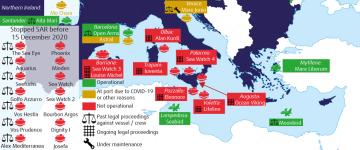
    In 2020 (until 15 December), the International Organization for Migration estimated that about 1,054 people have died or gone missing while crossing the Mediterranean Sea to reach Europe to escape war or persecution or to pursue a better life. This is an average of almost three people per day. In the past years, a significant number of migrants in distress at sea have been rescued by civil society vessels deployed with a humanitarian mandate to reduce fatalities and bring rescued migrants to safety. Since 2018, however, national authorities initiated some 50 administrative and criminal proceedings against crew members or vessels, also seizing the latter. In some cases, rescue vessels were blocked in harbours due to flag issues or the inability to meet maritime safety-related and other technical requirements.
  • Handbook / Guide / Manual
    17
    December
    2020
    Európsky dohovor o ľudských právach a právo Európskej únie poskytujú čoraz dôležitejší rámec na ochranu práv cudzincov. Právne predpisy Európskej únie týkajúce sa azylu, hraníc a prisťahovalectva sa rýchlo vyvíjajú. Existuje pôsobivý súbor judikatúry Európskeho súdu pre ľudské práva, ktorá sa týka najmä článkov 3, 5, 8 a 13 EDĽP. Od Súdneho dvora Európskej únie sa čoraz viac žiada, aby sa vyjadril k výkladu ustanovení práva Európskej únie v tejto oblasti. V treťom vydaní tejto príručky aktualizovanej do júla 2020 sa tieto právne predpisy Európskej únie a súbor judikatúry oboch európskych súdov prezentujú prístupným
    spôsobom. Je určená právnikom, sudcom, prokurátorom, imigračným úradníkom a mimovládnym organizáciám v členských štátoch EÚ a Rady Európy.
  • Country sheets
    20
    October
    2020
    The EU Fundamental Rights Agency published in 2019 its report on the ‘Integration of young refugees in the EU’. The report explored the challenges of young people who fled armed conflict or persecution and arrived in the EU in 2015 and 2016. The report is based on 426 interviews with experts working in the area of asylum and integration, as well as 163 interviews with young people, aged 16 to 24, conducted between October 2017 and June 2018 in 15 regions and cities located in six Member States: Austria, France, Germany, Greece, Italy and Sweden. The links on this page provide a summary of the information collected during this period for each country about unaccompanied children turning 18 and the change in people’s legal status once international protection is granted. These two issues had at the time been identified as moments requiring sufficient, consistent and systematic support, particularly from lawyers, social workers and guardians, to ensure successful integration.