eu-charter

Charta základných práv Európskej únie

Článok 52 - Rozsah a výklad práv a zásad

Článok 52 - Rozsah a výklad práv a zásad

1. Akékoľvek obmedzenie výkonu práv a slobôd uznaných v tejto charte musí byť ustanovené zákonom a rešpektovať podstatu týchto práv a slobôd. Za predpokladu dodržiavania zásady proporcionality možno tieto práva a slobody obmedziť len vtedy, ak je to nevyhnutné a skutočne to zodpovedá cieľom všeobecného záujmu, ktoré sú uznané Úniou, alebo ak je to potrebné na ochranu práv a slobôd iných. 2. Práva uznané v tejto charte, ktoré sú predmetom ustanovení zmlúv, sa vykonávajú za podmienok a v medziach vymedzených týmito zmluvami. 3. V rozsahu, v akom táto charta obsahuje práva, ktoré zodpovedajú právam zaručeným v Európskom dohovore o ochrane ľudských práv a základných slobôd, zmysel a rozsah týchto práv je rovnaký ako zmysel a rozsah práv ustanovených v uvedenom dohovore. Toto ustanovenie nebráni tomu, aby právo Únie priznávalo širší rozsah ochrany týchto práv. 4. V rozsahu, v akom táto charta uznáva základné práva vyplývajúce z ústavných tradícií spoločných pre členské štáty, sa tieto práva musia vykladať v súlade s týmito tradíciami. 5. Ustanovenia tejto charty, ktoré obsahujú zásady, môžu byť vykonávané legislatívnymi a exekutívnymi aktmi prijatými inštitúciami, orgánmi, úradmi a agentúrami Únie, a aktmi členských štátov, ak tieto vykonávajú právo Únie, pri výkone svojich príslušných právomocí. Možno sa ich dovolávať pred súdom len na účely výkladu a preskúmavania zákonnosti týchto aktov. 6. Vnútroštátne právne predpisy a prax sa musia zohľadniť v plnej miere tak, ako je to vymedzené v tejto charte. 7. Súdy Únie a členských štátov náležite prihliadajú na vysvetlivky vypracované s cieľom poskytnúť usmernenia pri výklade tejto charty.

Vysvetlivky

  • Text:

    Účelom článku 52 je ustanoviť rozsah pôsobnosti práv a zásad charty a upraviť pravidlá na ich výklad. Odsek 1 sa zaoberá režimom obmedzenia práv. Formulácia vychádza z judikatúry Súdneho dvora: `... podľa ustálenej judikatúry môžu byť obmedzenia uvalené na výkon základných slobôd, najmä v rámci spoločnej organizácie trhu za predpokladu, že tieto obmedzenia skutočne zodpovedajú cieľom vo všeobecnom záujme, ktoré sleduje Spoločenstvo, a nevytvárajú, s ohľadom na tieto ciele, neprimerané a neodôvodnené prekážky podkopávajúce samotnú podstatu týchto práv` (rozsudok z 13. apríla 2000 vo veci C-292/97, bod 45). Odkaz na všeobecné záujmy uznané Úniou zahŕňa tiež ciele uvedené v článku 3 Zmluvy o Európskej únii a iné záujmy chránené osobitnými ustanoveniami zmlúv, ako je článok 4 ods. 1 Zmluvy o Európskej únii, článok 35 ods. 3 a články 36 a 346 Zmluvy o fungovaní Európskej únie.
    Odsek 2 odkazuje na práva, ktoré už boli výslovne zaručené v Zmluve o založení Európskeho spoločenstva a uznané chartou a ktoré sa v súčasnosti nachádzajú v zmluvách (najmä práva vyplývajúce z občianstva Únie). Vysvetľuje, že tieto práva stále podliehajú podmienkam a obmedzeniam vzťahujúcim sa na právo Únie, na ktorom sú založené, a ktoré sú ustanovené v zmluvách. Charta nemení systém práv, ktorý bol vymedzený Zmluvou o ES a ktorý je prevzatý v zmluvách.
    Cieľom odseku 3 je zabezpečiť potrebnú súdržnosť medzi chartou a EDĽP ustanovením pravidla, že v rozsahu, v akom práva podľa tejto charty zodpovedajú právam zaručeným EDĽP, ich zmysel a rozsah, vrátane prípustných obmedzení, je rovnaký ako v prípade práv ustanovených EDĽP. Uvedené najmä znamená, že zákonodarca musí pri stanovovaní obmedzení pre tieto práva dodržiavať rovnaké normy, aké vyplývajú z podrobnej úpravy obmedzení ustanovených v EDĽP, ktoré sa preto vzťahujú na práva zahrnuté v tomto odseku bez toho, aby tým bola narušená autonómia práva Únie a Súdneho dvora Európskej únie.
    Odkaz na EDĽP sa vzťahuje na dohovor a jeho protokoly. Zmysel a rozsah zaručených práv je ustanovený nielen znením týchto právnych nástrojov, ale aj judikatúrou Európskeho súdu pre ľudské práva a Súdneho dvora Európskej únie. Posledná veta odseku umožňuje Únii zaručiť širšiu ochranu. V každom prípade, úroveň ochrany zabezpečená chartou nemôže byť nikdy nižšia ako úroveň, ktorá je zaručená EDĽP.
    Charta nebráni možnosti členských štátov využiť ustanovenie článku 15 EDĽP, ktorý umožňuje výnimky z práv zaručených EDĽP v prípade vojny alebo iného verejného ohrozenia štátnej existencie v prípade, keď prijímajú opatrenia v oblasti národnej obrany v prípade vojny a na udržanie poriadku v súlade s ich povinnosťami upravenými v článku 4 ods. 1 Zmluvy o Európskej únii a v článkoch 72 a 347 Zmluvy o fungovaní Európskej únie.
    Zoznam práv, ktoré môžu byť v tomto štádiu, bez dopadu na možný vývoj práva, právnych aktov a zmlúv, považované za zodpovedajúce právam v EDĽP v zmysle odseku 3, je uvedený nižšie. Neuvádza opätovne práva, ktoré sa dopĺňajú k právam uvedeným v EDĽP.
    1. Články charty, ktorých zmysel a rozsah je rovnaký ako v prípade zodpovedajúcich článkov EDĽP:
    - článok 2 zodpovedá článku 2 EDĽP,
    - článok 4 zodpovedá článku 3 EDĽP,
    - článok 5 ods. 1 a 2 zodpovedá článku 4 EDĽP,
    - článok 6 zodpovedá článku 5 EDĽP,
    - článok 7 zodpovedá článku 8 EDĽP,
    - článok 10 ods. 1 zodpovedá článku 9 EDĽP,
    - článok 11 zodpovedá článku 10 EDĽP bez toho, aby boli dotknuté akékoľvek obmedzenia, ktoré môže právo Únie uplatniť na právo členských štátov na zavedenie povolení uvedených v tretej vete článku 10 ods. 1 EDĽP,
    - článok 17 zodpovedá článku 1 Dodatkového protokolu k EDĽP,
    - článok 19 ods. 1 zodpovedá článku 4 Protokolu č. 4 k EDĽP,
    - článok 19 ods. 2 zodpovedá článku 3 EDĽP v zmysle výkladu Európskeho súdu pre ľudské práva,
    - článok 48 zodpovedá článku 6 ods. 2 a 3 EDĽP,
    - článok 49 ods. 1 (s výnimkou poslednej vety) a ods. 2 zodpovedá článku 7 EDĽP.

    2. Články, ktorých zmysel je rovnaký ako v prípade zodpovedajúcich článkov EDĽP, ale ktorých rozsah je širší:

    - článok 9 upravuje rovnakú oblasť ako článok 12 EDĽP, ale jeho rozsah pôsobnosti môže byť rozšírený o ďalšie formy manželstva, ak sú tieto formy zavedené vnútroštátnymi právnymi predpismi,
    - článok 12 ods. 1 zodpovedá článku 11 EDĽP, ale jeho rozsah pôsobnosti je rozšírený na úroveň Európskej únie,
    - článok 14 ods. 1 zodpovedá článku 2 Dodatkového protokolu k EDĽP, ale jeho rozsah pôsobnosti je rozšírený tak, že upravuje prístup k odbornému vzdelávaniu a príprave a ďalšiemu vzdelávaniu,
    - článok 14 ods. 3 zodpovedá článku 2 Dodatkového protokolu k EDĽP s ohľadom na rodičovské práva a povinnosti,
    - článok 47 ods. 2 a 3 zodpovedá článku 6 ods. 1 EDĽP, ale obmedzenie určovania občianskych práv a povinností alebo obvinení z trestných činov sa neuplatňuje v súvislosti s právom Únie a jeho vykonávaním,
    - článok 50 zodpovedá článku 4 Protokolu č. 7 k EDĽP, ale rozsah jeho pôsobnosti je medzi súdmi členských štátov rozšírený na úroveň Európskej únie,
    - nakoniec, občania Európskej únie nemôžu byť považovaní za cudzincov v rozsahu pôsobnosti práva Únie v dôsledku zákazu akejkoľvek diskriminácie z dôvodu štátnej príslušnosti. Obmedzenia, ktoré ustanovuje článok 16 EDĽP v súvislosti s právami cudzincov, sa na nich preto v tomto rámci nevzťahujú.
    Pravidlo výkladu uvedené v odseku 4 je založené na formulácii článku 6 ods. 3 Zmluvy o Európskej únii s náležitým zreteľom na spoločné ústavné tradície, ktorými sa riadi Súdny dvor (napr. rozsudok z 13. decembra 1979 vo veci 44/79 Hauer, Zb. 1979, s. 3727; rozsudok z 18. mája 1982 vo veci 155/79 AM&S, Zb. 1982, s. 1575). Podľa tohto pravidla, ktoré sa uprednostňuje pred rigidným prístupom `najmenšieho spoločného menovateľa`, by mali byť dotknuté práva charty vykladané spôsobom zaručujúcim vysokú mieru ochrany, ktorá je náležito prispôsobená právu Únie a je v súlade so spoločnými ústavnými tradíciami.
    Odsek 5 vysvetľuje rozdiel medzi `právami` a `zásadami` upravenými v charte. Na základe tohto rozdielu sú subjektívne práva rešpektované, zatiaľ čo zásady sú dodržiavané (článok 51 ods. 1). Zásady môžu byť vykonávané prostredníctvom legislatívnych alebo vykonávacích aktov (prijatých Úniou v súlade s jej právomocami a členskými štátmi, avšak iba v prípade, ak vykonávajú právo Únie); s ohľadom na uvedené sa pre súdy stávajú významnými, len pri výklade a preskúmavaní týchto aktov. Nespôsobujú však vznik priameho nároku na pozitívne konanie zo strany inštitúcií Únie alebo orgánov členských štátov, čo je v súlade s judikatúrou Súdneho dvora (pozri najmä judikatúru týkajúcu sa `zásady predchádzaniu škodám` uvedenú v článku 191 ods. 2 Zmluvy o fungovaní Európskej únie (rozsudok Súdu prvého stupňa z 11. septembra 2002 vo veci T-13/99, Pfizer/Rada, s množstvom odkazov na skoršiu judikatúru; a sériu rozsudkov k článku 33 (bývalý článok 39) o zásadách pôdohospodárskeho práva, napr. rozsudok Súdneho dvora vo veci C-265/85, Van den Berg/, Zb. 1987, s. 1155: preskúmanie zásady stabilizácie trhu a oprávnených očakávaní) a s prístupom ústavných systémov členských štátov k `zásadám`, najmä v oblasti sociálneho práva. Pre ilustráciu, príklady zásad uznaných v charte zahŕňajú napr. články 25, 26 a 37. V niektorých prípadoch môže článok charty obsahovať tak prvky práva, ako aj zásady, napr. články 23, 33 a 34.
    Odsek 6 odkazuje na rozličné články v charte, ktoré v duchu subsidiarity odkazujú na vnútroštátne právne predpisy a prax.

    Source:
    Úradný vestník Európskej únie C 303/17 - 14.12.2007
    Preamble - Explanations relating to the Charter of Fundamental Rights:
    Ďalej uvedené vysvetlivky boli pôvodne pripravené pod vedením predsedníctva konventu, ktorý vypracoval návrh Charty základných práv Európskej únie. Boli aktualizované pod vedením predsedníctva Európskeho konventu so zreteľom na úpravy, ktoré urobil tento konvent k textu charty (najmä k článkom 51 a 52), a vývoj práva Únie. Hoci tieto vysvetlivky nie sú ako také právne záväzné, predstavujú cenný nástroj výkladu, ktorý je určený na objasnenie ustanovení charty.

Prípadové právo

Vnútroštátne ústavné právo

25 results found

  • The Belgian Constitution
    Štát:
    Belgium

    Article 10. (...) Belgians are equal before the law;they alone are eligible for civil and military service,
    but for the exceptions that can be created by a law for particular cases.(...) Article 11bis.(...) The law,federate law or rule referred to inArticle 134 provides for women and men to sit on the permanent deputations of the provincial councils, the colleges of the burgomasters and aldermen,the councils and permanent committees of the public centres
    for social welfare and on the executives of any other inter-provincial, supra-municipal,
    inter-municipal or intra-municipal territorial body.
    The preceding paragraph does not apply when the law, federate law or rule referred
    to in Article 134 provides for the direct election of the members of the permanent
    deputations of the provincial councils, of aldermen, of the members of the councils and
    permanent committees of the social welfare centres or of the members of the executives
    of any other inter-provincial, supra-municipal, inter-municipal or intra-municipal territorial body Article 12. The freedom of the individual is guaranteed.
    No one can be prosecuted except in the cases provided for by the law, and in the
    form prescribed by the law Article 15. One’s home is inviolable no house search may take place except in the cases provided for by the law and in the form prescribed by the law. Article 16. No one can be deprived of his property except in the case of expropriation for a public purpose, in the cases and manner established by the law and in return for fair
    compensation paid beforehand. Article 21. A civil wedding should always precede the blessing of the marriage, apart from the exceptions to be established by the law if needed.
    Article 22. Everyone has the right to the respect of his private and family life, except in the cases and conditions determined by the law. Article 29. The confidentiality of letters is inviolable.
    The law determines which officials may violate the confidentiality of letters entrusted
    to the postal service. Article 31. No authorisation is necessary prior to taking legal action against civil
    servants for offences resulting from their administration, except with regard to what
    has been ruled on concerning ministers and members of the Community and Regional
    Government Article 32. Everyone has the right to consult any administrative document and to obtain a
    copy, except in the cases and conditions stipulated by the laws, federate laws or rules
    referred to in Article 134. Article 117. Members of the Community and Regional Parliaments are elected for a period of five years. The Community and Regional Parliaments are re-elected as a whole every fi e years.
    Elections for the Community and Regional Parliaments take place on the same day
    and coincide with elections for the European Parliament.
    In execution of a law as described in Article 118, § 2, fourth sub-paragraph, a federate
    law or a rule referred to in Article 134, passed in accordance with Article 118, § 2,
    fourth sub-paragraph, may derogate from the first and second paragraphs.”. Article 170 § 2.Taxes to the benefit of a Community or Region can only be introduced by a federate law or a rule as described in Article 134.
    The law determines, with respect to the taxes referred to in the first sub-paragraph,
    the exceptions that are proved to be necessary. § 3.A charge or tax can only be introduced by a province or a supra-municipal collectivity
    by the decision of its council.
    The law determines, with respect to the taxes described in the first paragraph, the
    exceptions that are proved to be necessary.
    The law can abolish, either totally or partially, the taxes referred to in the first
    sub-paragraph.
    § 4. A charge or tax can only be introduced by the metropolitan districts, federations
    of municipalities or by the municipalities by a decision of their council.
    The law determines, with respect to the taxes referred to in the first sub-paragraph,
    the exceptions that are proved to be necessary. Article 172. No privileges with regard to taxes can be introduced.
    No exemption or reduction of taxes can be introduced except by a law. Article 173. Except to the benefit of the provinces, the bodies responsible for polders and for draining and flood protection, and except for the cases formally excepted by the laws, the federate laws and rules referred to in Article 134, charges can only be claimed from citizens in the form of taxes to the benefit of the State, the Community,the Region, the metropolitan district, the federation of municipalities or the municipality. Article 185. Foreign troops may only be admitted to the service of the State, or occupy or crossthe territory by virtue of a law. Article 186. Military personnel can only be deprived of rank, honours and pensions in the manner described by the law. Article 191. All foreigners on Belgian soil benefit from the protection provided to persons and property, except for those exceptions provided for by the law.

  • The Constitution of the Republic of Cyprus
    Štát:
    Cyprus

    ARTICLE 1A
    No provision of the Constitution is deemed as annulling laws adopted, deeds carried out or measures taken by the Republic which are rendered necessary as a result of the obligations of the Republic as a member state of the European Union nor does it preclude Regulations, Directives or other acts or binding measures of a legislative character adopted by the European Union or by the European Communities or by the institutions or competent bodies under the treaties setting up the European Communities or the European Union from having legal force in the Republic.
    ARTICLE 179
    1. Without prejudice to the provisions of article 1A, the Constitution is the supreme law of the Republic.
    2. No law or decision of the House of Parliament or of each Communal Chamber and no act or decision of any organ, authority or person in the Republic exercising executive power or any administrative function shall in any way be repugnant to, or inconsistent with, any of the provisions of this Constitution.

  • Tο Σύνταγμα της Κυπριακής Δημοκρατίας
    Štát:
    Cyprus

    ΑΡΘΡΟΝ 1A
    Ουδεμία διάταξη του Συντάγματος θεωρείται ότι ακυρώνει νόμους που θεσπίζονται, πράξεις που διενεργούνται ή μέτρα που λαμβάνονται από τη Δημοκρατία τα οποία καθίστανται αναγκαία από τις υποχρεώσεις της ως κράτους μέλους της Ευρωπαϊκής Ένωσης ούτε εμποδίζει Κανονισμούς, Οδηγίες ή άλλες πράξεις ή δεσμευτικά μέτρα νομοθετικού χαρακτήρα που θεσπίζονται από την Ευρωπαϊκή Ένωση ή από τις Ευρωπαϊκές Κοινότητες ή από τα θεσμικά τους όργανα ή από τα αρμόδιά τους σώματα στη βάση των συνθηκών που ιδρύουν τις Ευρωπαϊκές Κοινότητες ή την Ευρωπαϊκή Ένωση από του να έχουν νομική ισχύ στη Δημοκρατία.
    ΑΡΘΡΟΝ 179
    1. Τηρουμένων των διατάξεων του άρθρου 1Α, το Σύνταγμα είναι ο υπέρτατος νόμος της Δημοκρατίας.
    2. Ουδείς νόμος ή απόφασις της Βουλής των Αντιπροσώπων ή εκατέρας Κοινοτικής Συνελεύσεων ως και ουδεμία πράξις ή απόφασις ιουδήποτε οργάνου, αρχής ή προσώπου εν τη Δημοκρατία ασκούντος εκτελεστικήν εξουσίαν ή οιονδήποτε διοικητικόν λειτούργημα δύναται να είναι καθ’ οιονδήποτε τρόπον αντίθετος ή ασύμφωνος προς οιανδήποτε των διατάξεων του Συντάγματος ή προς οποιαδήποτε υποχρέωση επιβάλλεται στη Δημοκρατία ως αποτέλεσμα της συμμετοχής της ως κράτους μέλους στην Ευρωπαϊκή Ένωση.

  • Ustav Republike Hrvatske
    Štát:
    Croatia

    Članak 3.
    Sloboda, jednakost, nacionalna ravnopravnost i ravnopravnost spolova, mirotvorstvo, socijalna pravda, poštivanje prava čovjeka, nepovredivost vlasništva, očuvanje prirode i čovjekova okoliša, vladavina prava i demokratski višestranački sustav najviše su vrednote ustavnog poretka Republike Hrvatske i temelj za tumačenje Ustava.

    Članak 16.
    Slobode i prava mogu se ograničiti samo zakonom da bi se zaštitila sloboda i prava drugih ljudi te pravni poredak, javni moral i zdravlje.
    Svako ograničenje slobode ili prava mora biti razmjerno naravi potrebe za ograničenjem u svakom pojedinom slučaju.

    Članak 17.
    U doba ratnog stanja ili neposredne ugroženosti neovisnosti i jedinstvenosti države, te velikih prirodnih nepogoda pojedine slobode i prava zajamčena Ustavom mogu se ograničiti. O tome odlučuje Hrvatski sabor dvotrećinskom većinom svih zastupnika, a ako se Hrvatski sabor ne može sastati, na prijedlog Vlade i uz supotpis predsjednika Vlade, Predsjednik Republike.

    Opseg ograničenja mora biti primjeren naravi pogibelji, a za posljedicu ne može imati nejednakost osoba s obzirom na rasu, boju kože, spol, jezik, vjeru, nacionalno ili socijalno podrijetlo.

    Niti u slučaju neposredne opasnosti za opstanak države ne može se ograničiti primjena odredbi Ustava o pravu na život, zabrani mučenja, surovog ili ponižavajućeg postupanja ili kažnjavanja, o pravnoj određenosti kažnjivih djela i kazni, te o slobodi misli, savjesti i vjeroispovijedi.

  • КОНСТИТУЦИЯ на Република България
    Štát:
    Bulgaria

    Чл. 57. (1) Основните права на гражданите са неотменими.
    (2) Не се допуска злоупотреба с права, както и тяхното упражняване, ако то накърнява права или законни интереси на други.
    (3) При обявяване на война, на военно или друго извънредно положение със закон може да бъде временно ограничено упражняването на отделни права на гражданите с изключение на правата, предвидени в чл. 28, 29, 31, ал. 1, 2 и 3, чл. 32, ал. 1 и чл. 37.

Právo EÚ

5 results found

  • Regulation (EU) 2024/1083 of the European Parliament and of the Council of 11 April 2024 establishing a common framework for media services in the internal market and amending Directive 2010/13/EU

    Preamble 


    (15) This Regulation does not affect the freedom of expression and information guaranteed to individuals under the Charter. The European Court of Human Rights has observed that in such a sensitive sector as the audiovisual media sector, in addition to its negative duty of non-interference, the public powers have a positive obligation to put in place an appropriate legislative and administrative framework to guarantee effective media pluralism


    (20) In order to avoid circumvention of the protection of journalistic sources and confidential communications and guarantee adequate respect for one’s private and family life, home and communications in accordance with the Charter, safeguards should also apply to persons who, because of their regular private or professional relationship with media service providers or members of their editorial staff, are likely to have information that could identify journalistic sources or confidential communications. That should include persons living in a close relationship in a joint household and on a stable and continuous basis and persons who are or have been professionally involved in the preparation, production or dissemination of programmes or press publications and who are only targeted due to their close links with media service providers, journalists or other members of the editorial staff. The protection of journalistic sources and confidential communications should also benefit the staff of media service providers, such as the technical staff, including cybersecurity experts, who could be targeted given the important support role they provide to journalists in their daily work, which requires solutions to ensure the confidentiality of journalists’ work, and the resulting likelihood that they have access to information concerning journalistic sources or confidential communications.

    (21) Protecting journalistic sources and confidential communications is consistent with and contributes to the protection of the fundamental right enshrined in Article 11 of the Charter. It is also crucial for safeguarding the ‘public watchdog’ role of media service providers and, in particular investigative journalists in democratic societies and for upholding the rule of law. In light thereof, ensuring an adequate level of protection for journalistic sources and confidential communications requires that measures for obtaining such information be authorised by an authority that can independently and impartially assess whether it is justified by an overriding reason of public interest, such as a court, a judge, a prosecutor acting in a judicial capacity, or another such authority with competence to authorise those measures in accordance with national law. It also requires that surveillance measures be subject to regular review by such an authority to ascertain whether the conditions justifying the use of the measure in question continue to be fulfilled. That requirement is also met where the purpose of the regular review is to verify whether the conditions justifying an extension of the authorisation for the use of the measure have been fulfilled.


    (26) Intrusive surveillance software should only be deployed where it is justified by an overriding reason of public interest, it is provided for in Union or national law, it is in compliance with Article 52(1) of the Charter as interpreted by the Court of Justice and with other Union law, it has been authorised ex ante or, in exceptional and urgent cases, subsequently confirmed by a judicial authority or an independent and impartial decision-making authority, it occurs in investigations of offences listed in Article 2(2) of Council Framework Decision 2002/584/JHA (9) punishable in the Member State concerned by a custodial sentence or a detention order of a maximum period of at least three years or in investigations of other serious offences punishable in the Member State concerned by a custodial sentence or a detention order of a maximum period of at least five years, as determined by the national law of that Member State, and provided that no other less restrictive measure would be adequate and sufficient to obtain the information sought. According to the principle of proportionality, limitations can be made to an individual’s rights and freedoms only if they are necessary and genuinely meet objectives of general interest recognised by the Union. Thus, as regards specifically the deployment of intrusive surveillance software, it is necessary to ascertain whether the offence in question attains a threshold of seriousness as laid down in this Regulation, whether, following an individual assessment of all the relevant circumstances in a given case, the investigation and prosecution of that offence merit the particularly intrusive interference with fundamental rights and economic freedoms consisting in the deployment of intrusive surveillance software, whether there is sufficient evidence that the offence in question has been committed, and whether the deployment of intrusive surveillance software is relevant for the purpose of establishing the facts related to the investigation and prosecution of that offence.


    (77) This Regulation respects the fundamental rights and observes the principles recognised by the Charter, in particular Articles 7, 8, 11, 16, 47, 50 and 52 thereof. Accordingly, this Regulation should be interpreted and applied with due respect for those rights and principles. In particular, nothing in this Regulation should be interpreted as interfering with the freedom of information, editorial freedom or the freedom of the press as enshrined in national constitutional law that is consistent with the Charter or as incentivising Member States to introduce requirements for the editorial content of press publications.

    Article 4: Rights of media service providers 

    4.   By way of derogation from paragraph 3, points (a) and (b), of this Article, Member States may take a measure referred to therein, provided that it:

    (a) is provided for by Union or national law;

    (b) is in compliance with Article 52(1) of the Charter and other Union law;

    (c) is justified on a case-by-case basis by an overriding reason of public interest and is proportionate; and

    (d) is subject to prior authorisation by a judicial authority or an independent and impartial decision-making authority or, in duly justified exceptional and urgent cases, is subsequently authorised by such an authority without undue delay.

    8.   Member States shall ensure that media service providers, their editorial staff or any persons who, because of their regular or professional relationship with a media service provider or its editorial staff, might have information related to or capable of identifying journalistic sources or confidential communications have a right to effective judicial protection, in line with Article 47 of the Charter, in cases regarding breaches of paragraphs 3 to 7 of this Article.

    Article 6: Duties of media services providers

    3.   Without prejudice to national constitutional law consistent with the Charter, media service providers providing news and current affairs content shall take measures that they deem appropriate with a view to guaranteeing the independence of editorial decisions. In particular, such measures shall aim to:

    (a) guarantee that editorial decisions can be taken freely within the established editorial line of the media service provider concerned; and

    (b) ensure that any actual or potential conflicts of interest that might affect the provision of news and current affairs content are disclosed.

  • Directive 2014/59/EU of the European Parliament and of the Council of 15 May 2014 establishing a framework for the recovery and resolution of credit institutions and investment firms

    (24) Where an institution does not present an adequate recovery plan, competent authorities should be empowered to require that institution to take measures necessary to redress the material deficiencies of the plan. That requirement may affect the freedom to conduct a business as guaranteed by Article 16 of the Charter. The limitation of that fundamental right is however necessary to meet the objectives of financial stability. More specifically, such a limitation is necessary in order to strengthen the business of institutions and avoid institutions growing excessively or taking excessive risks without being able to tackle setbacks and losses and to restore their capital base. The limitation is proportionate because it permits preventative action to the extent that it is necessary to address the deficiencies and therefore complies with Article 52 of the Charter.

    [...]

    (49) The limitations on the rights of shareholders and creditors should be in accordance with Article 52 of the Charter. The resolution tools should therefore be applied only to those institutions that are failing or likely to fail, and only when it is necessary to pursue the objective of financial stability in the general interest. In particular, resolution tools should be applied where the institution cannot be wound up under normal insolvency proceedings without destabilising the financial system and the measures are necessary in order to ensure the rapid transfer and continuation of systemically important functions and where there is no reasonable prospect for any alternative private solution, including any increase of capital by the existing shareholders or by any third party sufficient to restore the full viability of the institution. In addition, when applying resolutions tools and exercising resolution powers, the principle of proportionality and the particularities of the legal form of an institution should be taken into account.

    [...]

    (88) In accordance with Article 47 of the Charter, the parties concerned have a right to due process and to an effective remedy against the measures affecting them. Therefore, the decisions taken by the resolution authorities should be subject to a right of appeal.

  • Regulation (EU) 2021/1232 of the European Parliament and of the Council of 14 July 2021 on a temporary derogation from certain provisions of Directive 2002/58/EC as regards the use of technologies by providers

    Article 1

    Subject matter and scope

    1. This Regulation lays down temporary and strictly limited rules derogating from certain obligations laid down in Directive 2002/58/EC, with the sole objective of enabling providers of certain number-independent interpersonal communications services (‘providers’) to use, without prejudice to Regulation (EU) 2016/679, specific technologies for the processing of personal and other data to the extent strictly necessary to detect online child sexual abuse on their services and report it and to remove online child sexual abuse material from their services.

    2. This Regulation does not apply to the scanning of audio communications.

  • Directive (EU) 2022/2381 of the European Parliament and of the Council of 23 November 2022 on improving the gender balance among directors of listed companies and related measures

    Article 1

    Purpose

    This Directive aims to achieve a more balanced representation of women and men among the directors of listed companies by establishing effective measures that aim to accelerate progress towards gender balance, while allowing listed companies sufficient time to make the necessary arrangements for that purpose.

  • Directive (EU) 2018/1972 of the European Parliament and of the Council of 11 December 2018 establishing the European Electronic Communications Code

    (5) This Directive creates a legal framework to ensure freedom to provide electronic communications networks and services, subject only to the conditions laid down in this Directive and to any restrictions in accordance with Article 52(1) of the Treaty on the Functioning of the European Union (TFEU), in particular measures regarding public policy, public security and public health, and consistent with Article 52(1) of the Charter of Fundamental Rights of the European Union (the ‘Charter’).

    (6) This Directive is without prejudice to the possibility for each Member State to take the necessary measures to ensure the protection of its essential security interests, to safeguard public policy and public security, and to permit the investigation, detection and prosecution of criminal offences, taking into account that any limitation to the exercise of the rights and freedoms recognised by the Charter, in particular in Articles 7, 8 and 11 thereof, such as limitations regarding the processing of data, are to be provided for by law, respect the essence of those rights and freedoms and be subject to the principle of proportionality, in accordance with Article 52(1) of the Charter.

Medzinárodné právo

0 results found

Informačné materiály

  • Report / Paper / Summary
    4
    November
    2021
    This report outlines to what extent legal aid is available to those held in pre-removal detention in the 27 EU Member States, and in North Macedonia and Serbia, during procedures related to their return. These involve decisions on return, on detention pending removal, the removal itself and on bans on entry. The report also examines when people are entitled to free legal aid and how this aid is funded, as well as who provides representation and various factors that limit the scope of legal aid.
  • Fundamental Rights Report
    10
    June
    2021
    FRA’s Fundamental Rights Report 2021 reviews major developments in the field in 2020, identifying both achievements and areas of concern. It also presents FRA’s opinions on these developments, including a synopsis of the evidence supporting these opinions. This year’s focus chapter explores the impact of the COVID-19 pandemic on fundamental rights. The remaining chapters cover: the EU Charter of Fundamental Rights; equality and non-discrimination; racism, xenophobia and related intolerance; Roma equality and inclusion; asylum, borders and migration; information society, privacy and data protection; rights of the child; access to justice; and the implementation of the Convention on the Rights of Persons with Disabilities.
  • Handbook / Guide / Manual
    17
    December
    2020
    Európsky dohovor o ľudských právach a právo Európskej únie poskytujú čoraz dôležitejší rámec na ochranu práv cudzincov. Právne predpisy Európskej únie týkajúce sa azylu, hraníc a prisťahovalectva sa rýchlo vyvíjajú. Existuje pôsobivý súbor judikatúry Európskeho súdu pre ľudské práva, ktorá sa týka najmä článkov 3, 5, 8 a 13 EDĽP. Od Súdneho dvora Európskej únie sa čoraz viac žiada, aby sa vyjadril k výkladu ustanovení práva Európskej únie v tejto oblasti. V treťom vydaní tejto príručky aktualizovanej do júla 2020 sa tieto právne predpisy Európskej únie a súbor judikatúry oboch európskych súdov prezentujú prístupným
    spôsobom. Je určená právnikom, sudcom, prokurátorom, imigračným úradníkom a mimovládnym organizáciám v členských štátoch EÚ a Rady Európy.
  • Fundamental Rights Report
    11
    June
    2020
    FRA’s Fundamental Rights Report 2020 reviews major developments in the field in 2019, identifying both achievements and areas of concern. It also presents FRA’s opinions on these developments, including a synopsis of the evidence supporting these opinions. This year’s focus chapter explores how to unlock the full potential of the EU Charter of Fundamental Rights.
  • Report / Paper / Summary
    24
    February
    2017
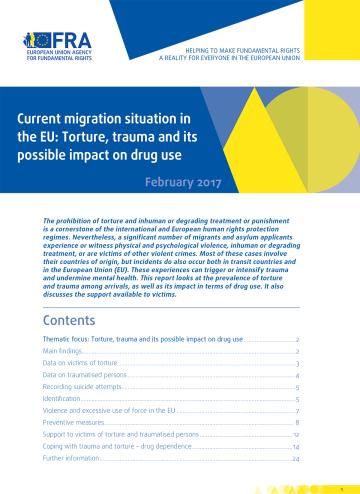
    This report looks at the prevalence of torture
    and trauma among arrivals, as well as its impact in terms of drug use. It also
    discusses the support available to victims.
  • Handbook / Guide / Manual
    22
    June
    2016
    Access to justice is an important element of the rule of law. It enables individuals to protect themselves against infringements of their rights, to remedy civil wrongs, to hold executive power accountable and to defend themselves in criminal proceedings. This handbook summarises the key European legal principles in the area of access to justice, focusing on civil and criminal law.