eu-charter

Listina Evropske unije o temeljnih pravicah

Člen 11 - Svoboda izražanja in obveščanja

Člen 11 - Svoboda izražanja in obveščanja

1. Vsakdo ima pravico do svobodnega izražanja. Ta pravica vključuje svobodo mnenja ter sprejemanja in širjenja vesti ali idej brez vmešavanja javnih organov in ne glede na državne meje.

2. Spoštujeta se svoboda in pluralnost medijev.

Pojasnila

  • Text:
    Source:
    Preamble - Explanations relating to the Charter of Fundamental Rights:

Sodna praksa

Nacionalnem ustavnem pravu

61 results found

  • Sweden / Instrument of Government
    Država:
    Sweden

    Chapter 2 - Fundamental rights and freedoms:

    Article 1 Everyone shall be guaranteed the following rights and freedoms in his or her relations with the public institutions: 1. freedom of expression: that is, the freedom to communicate information and express thoughts, opinions and sentiments, whether orally, pictorially, in writing, or in any other way; 2. freedom of information: that is, the freedom to procure and receive information and otherwise acquaint oneself with the utterances of others; 3. freedom of assembly: that is, the freedom to organise or attend meetings for the purposes of information or the expression of opinion or for any other similar purpose, or for the purpose of presenting artistic work; 4. freedom to demonstrate: that is, the freedom to organise or take part in demonstrations in a public place; 5. freedom of association: that is, the freedom to associate with others for public or private purposes (...);

    Article 2 No one shall in his or her relations with the public institutions be coerced to divulge an opinion in a political, religious, cultural or other such connection. Nor may anyone in his or her relations with the public institutions be coerced to participate in a meeting for the shaping of opinion or a demonstration or other manifestation of opinion, or to belong to a political association, religious community or other association for opinion
    referred to in sentence one;

    Article 3 No record in a public register concerning a Swedish citizen may be based without his or her consent solely on his or her political opinions.

  • Act on Free Access to Information and Amendments of Certain Acts
    Država:
    Slovakia

    §1 Subject of the ActThis act shall regulate the terms, procedure and scope of free access to information.

  • Basic Law for the Federal Republic of Germany
    Država:
    Germany

    Article 5 (1) Every person shall have the right freely to express and disseminate his opinions in speech, writing and pictures, and to inform himself without hindrance from generally accessible sources. Freedom of the press and freedom of reporting by means of broadcasts and films shall be guaranteed. There shall be no censorship. (2) These rights shall find their limits in the provisions of general laws, in provisions for the protection of young persons, and in the right to personal honour. (...) Article 17a (1) Laws regarding military and alternative service may provide that the basic right of members of the Armed Forces and of alternative service freely to express and disseminate their opinions in speech, writing and pictures (first clause of paragraph (1) of Article 5), the basic right of assembly (Article 8), and the right of petition (Article 17) insofar as it permits the submission of requests or complaints jointly with others, be restricted during their period of military or alternative service. (...)

  • Beschluß der Provisorischen Nationalversammlung vom 30. Oktober 1918
    Država:
    Austria

    Präambel/Promulgationsklausel Auf Grund des § 7 des Beschlusses der Provisorischen Nationalversammlung vom 30. Oktober 1918 über die grundlegenden Einrichtungen der Staatsgewalt wird beurkundet, daß der obenstehende Beschluß von der Provisorischen Nationalversammlung am 30. Oktober 1918 gefaßt worden ist. 1. Jede Zensur ist als dem Grundrecht der Staatsbürger widersprechend als rechtsungültig aufgehoben. 2. Die Einstellung von Druckschriften und die Erlassung eines Postverbotes gegen solche findet nicht mehr statt. Die bisher verfügten Einstellungen und Postverbote sind aufgehoben. Die volle Freiheit der Presse ist hergestellt. 3. Die Ausnahmsverfügungen betreffs des Vereins- und Versammlungsrechtes sind aufgehoben. Die volle Vereins- und Versammlungsfreiheit ohne Unterschied des Geschlechts ist hergestellt.

  • Bundesgesetz vom 12. Juni 1981 über die Presse und andere publizistische Medien (Mediengesetz)
    Država:
    Austria
  • Bundesverfassungsgesetz vom 10. Juli 1974 über die Sicherung der Unabhängigkeit des Rundfunks
    Država:
    Austria

    Artikel 1 (2) Die näheren Bestimmungen für den Rundfunk und seine Organisation sind bundesgesetzlich festzulegen. Ein solches Bundesgesetz hat insbesondere Bestimmungen zu enthalten, die die Objektivität und Unparteilichkeit der Berichterstattung, die Berücksichtigung der Meinungsvielfalt, die Ausgewogenheit der Programme sowie die Unabhängigkeit der Personen und Organe, die mit der Besorgung der im Abs. 1 genannten Aufgaben betraut sind, gewährleisten.

  • Constitution
    Država:
    France

    Article 4Political parties and groups shall contribute to the exercise of suffrage. They shall be formed and carry on their activities freely. They shall respect the principles of national sovereignty and democracy.They shall contribute to the implementation of the principle set out in the second paragraph of article 1 as provided for by statute. Statutes shall guarantee the expression of diverse opinions and the equitable participation of political parties and groups in the democratic life of the Nation.

  • Constitution
    Država:
    France

    Article 4Les partis et groupements politiques concourent à l'expression du suffrage. Ils se forment et exercent leur activité librement. Ils doivent respecter les principes de la souveraineté nationale et de la démocratie. Ils contribuent à la mise en oeuvre du principe énoncé au second alinéa de l'article 1er dans les conditions déterminées par la loi. La loi garantit les expressions pluralistes des opinions et la participation équitable des partis et groupements politiques à la vie démocratique de la Nation.

  • Constitution of Finland
    Država:
    Finland

    Section 12 Freedom of expression and the right of access to information Everyone has the freedom of expression. Freedom of expression entails the right to express, disseminate and receive information, opinions and other communications without prior prevention by anyone. More detailed provisions on the exercise of the freedom of expression are laid down by an Act. Provisions on restrictions relating to pictorial programmes that are necessary for the protection of children may be laid down by an Act. Documents and recordings in the possession of the authorities are public, unless their publication has for compelling reasons been specifically restricted by an Act. Everyone has the right of access to public documents and recordings.

  • Constitution of Ireland
    Država:
    Ireland

    Article 40.6 1. The State guarantees liberty for the exercise of the following rights, subject to public order and morality: i. The right of the citizens to express freely their convictions and opinions. The education of public opinion being, however, a matter of such grave import to the common good, the state shall endeavour to ensure that organs of public opinion, such as the radio, the press, the cinema, while preserving their rightful
    liberty of expression, including criticism
    of Government policy, shall not be used
    to undermine public order or morality or
    the authority of the state.

  • Constitution of Malta
    Država:
    Malta

    Article 41(1) Except with his own consent or by way of parental discipline, no person shall be hindered in the enjoyment of his freedom of expression, including freedom to hold opinion without interference, freedom to receive ideas and information without interference, freedom to communicate ideas and information without interference (whether the communication be to the public generally or to any person or class of persons) and freedom from interference with his correspondence. (2) Nothing contained in or done under the authority of any law shall be held to be inconsistent with or in contravention of subsection (1) of this section to the extent that the law in question makes provision (a) that is reasonably required (i) in the interests of defence, public safety, public order, public morality or decency, or public health; or (ii) for the purpose of protecting the reputations rights and freedoms of other persons, or the private lives of persons concerned in legal proceedings, preventing the disclosure of information received in confidence, maintaining the authority and independence of the courts, protecting the privileges of Parliament, or regulating telephony, telegraphy, posts, wireless broadcasting, television or other means of communication, public exhibitions or public entertainments; or (b) that imposes restrictions upon public officers, and except so far as that provision or, as the case may be, the thing done under the authority thereof is shown not to be reasonably justifiable in a democratic society. (3) Anyone who is resident in Malta may edit or print a newspaper or journal published daily or periodically: Provided that provision may be made by law (a) prohibiting or restricting the editing or printing of any such newspaper or journal by persons under twenty-one years of age; and (b) requiring any person who is the editor or printer of any such newspaper or journal to inform the prescribed authority to that effect and of his age and to keep the prescribed authority informed of his place of residence. (4) Where the police seize any edition of a newspaper as being the means whereby a criminal offence has been committed they shall within twenty-four hours of the seizure bring the seizure to the notice of the competent court and if the court is not satisfied that there is a prima facie case of such offence, that edition shall be returned to the person from whom it was seized. (5) No person shall be deprived of his citizenship under any provisions made under section 301(1) (b) of this Constitution or of his juridical capacity by reason only of his political opinions.

  • Constitution of the Hellenic Republic
    Država:
    Greece

    Article 5 (1). All persons shall have the right to develop freely their personality and to participate in the social, economic and political life of the country, insofar as they do not infringe the rights of others or violate the Constitution and the good usages. (2). All persons living within the Greek territory
    shall enjoy full protection of their life, honour
    and liberty irrespective of nationality, race
    or language and of religious or political beliefs. Exceptions shall be permitted only in cases provided by international law. The extradition of aliens prosecuted for their
    action as freedom-fighters shall be prohibited. (3). Personal liberty is inviolable. No one shall be prosecuted, arrested, imprisoned or otherwise confined except when and as the law provides.[..]; Article 14 (1). Every person may express and propagate his thoughts orally, in writing and through the
    press in compliance with the laws of the State. (2). The press is free. Censorship and all other preventive measures are prohibited. (3). The seizure of newspapers and other
    publications before or after circulation is prohibited. Seizure by order of the public prosecutor shall be allowed exceptionally after circulation and in case of: a) an offence against the Christian or any other known religion, b) an insult against the person of the President of the Republic, c) a publication which discloses information on the composition, equipment and set-up of the armed forces or the fortifications of the country, or which aims at the violent overthrow of the regime or is directed against the territorial integrity of the State, d) an obscene publication which is obviously offensive to public decency, in the cases stipulated by law. [...] Article 15 (1). The protective provisions for the press in
    the preceding article shall not be applicable to films, sound recordings, radio, television or any other similar medium for the transmission of speech or images. (2). Radio and television shall be under the direct control of the State. The control and imposition of administrative sanctions belong to the exclusive competence of the National Radio and Television Council, which is an independent authority, as specified by law. The direct control of the State, which may also assume the form of a prior permission status, shall aim at the objective and on equal terms transmission of information and news reports, as well as of works of literature and art, at ensuring the quality level of programs mandated by the social mission of radio and television and by the cultural development of the Country, as well as at the respect of the value of the human being and the protection of childhood and youth. [...]

  • Constitution of the Italian Republic
    Država:
    Italy

    Art. 21. Anyone has the right to freely express their thoughts in speech, writing, or any other form of communication. The press may not be subjected to any authorisation or censorship. Seizure may be permitted only by judicial order stating the reason and only for offences expressly determined by the law on the press or in case of
    violation of the obligation to identify the persons responsible for such offences. In such cases, when there is absolute urgency and timely intervention of the Judiciary is not possible, a periodical may be confiscated by the criminal police, which shall immediately and in no case later than 24 hours refer the matter to the Judiciary for validation. In default of such validation in the following 24 hours, the measure shall be revoked and considered null and void. The law may introduce general provisions for the disclosure of financial sources of periodical publications. Publications, performances, and other exhibits offensive to public morality shall be prohibited. Measures of preventive and repressive measure against such violations shall be established by law.

  • Constitution of the Republic of Bulgaria
    Država:
    Bulgaria

    Art. 38. No one shall be persecuted or restricted in his rights because of his views, nor shall be obligated or forced to provide information about his own or another person's views. Art. 39. (1) Everyone shall be entitled to express an opinion or to publicize it through words, written or oral, sound or image, or in any other way. (2) This right shall not be used to the detriment of the rights and reputation of others, or for the incitement of a forcible change of the constitutionally established order, the perpetration of a crime, or the incitement of enmity or violence against anyone.Art. 40. (1) The press and the other mass information media shall be free and shall not be subjected to censorship. (2) An injunction on or a confiscation of printed matter or another information medium shall be allowed only through an act of the judicial authorities in the case of an encroachment on public decency or incitement of a forcible change of the constitutionally established order, the perpetration of a crime, or the incitement of violence against anyone. An injunction suspension shall lose force if not followed by a confiscation within 24 hours.Art. 41. (1) Everyone shall be entitled to seek, obtain and disseminate information. This right shall not be exercised to the detriment of the rights and reputation of others, or to the detriment of national security, public order, public health and morality.[...]

  • Constitution of the Republic of Croatia
    Država:
    Croatia

    Article 38
    Freedom of thought and expression shall be guaranteed.
    Freedom of expression shall particularly encompass freedom of the press and other media, freedom of speech and public opinion, and free establishment of all institutions of public communication.
    Censorship shall be forbidden. Journalists shall have the right to freedom of reporting and access to information.
    The right to access to information held by any public authority shall be guaranteed.
    Restrictions on the right to access to information must be proportionate to the nature of the need for such restriction in each individual case and necessary in a free and democratic society, as stipulated by law.
    The right to correction is guaranteed to anyone whose constitutionally and legally established rights have been violated by public communication.

  • Constitution of the Republic of Estonia
    Država:
    Estonia

    Article 40. Everyone is entitled to freedom of conscience, freedom of religion and freedom of thought.
    Everyone is free to belong to any church or any religious society. There is no state church.
    Everyone is free to practise his or her religion, alone or in community with others, in public or in private, unless this is detrimental to public order, public health or public morality.
    Article 41. Everyone has the right to abide by his or her opinions and beliefs. No one may be compelled to change his or her opinions or beliefs.
    Beliefs are no defence for violating the law.
    No one may be held legally liable for his or her beliefs.
    Article 42. Government agencies, local authorities, and their officials may not gather or store information about the beliefs of a citizen of Estonia against the citizen’s free will.
    Article 44. Everyone is entitled to free access to information disseminated for public use.
    Pursuant to a procedure provided by law, all government agencies, local authorities, and their officials have a duty to provide information about their activities to any citizen of Estonia at his or her request, except for information whose disclosure is prohibited by law and information intended exclusively for internal use.
    Pursuant to a procedure provided by law, any citizen of Estonia is entitled to access information about himself or herself held by government agencies and local authorities and in government and local authority archives. This right may be circumscribed pursuant to law to protect the rights and freedoms of others, to protect the confidentiality of a child’s filiation, and in the interests of preventing a criminal offence, apprehending the offender, or of ascertaining the truth in a criminal case.
    Unless otherwise provided by law, citizens of foreign states and stateless persons in Estonia enjoy the rights specified in paragraphs two and three of this section equally with citizens of Estonia.
    Article 45. Everyone has the right to freely disseminate ideas, opinions, beliefs and other information by word, print, picture or other means. This right may be circumscribed by law to protect public order, public morality, and the rights and freedoms, health, honour and good name of others. This right may also be circumscribed by law in respect of public servants employed by the national government and local authorities, or in order to protect a state secret, trade secret or information received in confidence which has become known to the public servant by reason of his or her office, and to protect the family and private life of others, as well as in the interests of the administration of justice.
    There is no censorship.

  • Constitution of the Republic of Latvia
    Država:
    Latvia

    100. Everyone has the right to freedom of expression, which includes the right to freely receive, keep and distribute information and to express their views. Censorship is prohibited.

  • Constitution of the Republic of Lithuania
    Država:
    Lithuania

    Article 25. Everyone shall have the right to have his own convictions and freely express them. No one must be hindered from seeking, receiving, or imparting information and ideas. The freedom to express convictions, as well as to receive and impart information, may not be limited otherwise than by law when this is necessary to protect human health, honour or dignity, private life, or morals, or to defend the constitutional order. The freedom to express convictions and to impart information shall be incompatible with criminal actions—incitement to national, racial, religious, or social hatred, incitement to violence or to discrimination, as well as defamation and disinformation. Citizens shall have the right to receive, according to the procedure established by law, any information held about them by state institutions. Article 44. Censorship of mass information shall be prohibited.The State, political parties, political and public organisations, and other institutions or persons may not monopolise the mass media.

  • Constitution of the Republic of Poland
    Država:
    Poland

    Article 54.1. The freedom to express opinions, to acquire and to disseminate information shall be ensured to everyone. 2. Preventive censorship of the means of social communication and the licensing of the press shall be prohibited. Statutes may require the receipt of a permit for the operation of a radio or television station.

  • Costituzione della Repubblica Italiana
    Država:
    Italy

    Art. 21. Tutti hanno diritto di manifestare liberamente il proprio pensiero con la parola, lo scritto e ogni altro mezzo di diffusione. La stampa non può essere soggetta ad autorizzazioni o censure. Si può procedere a sequestro soltanto per atto motivato dell'autorità giudiziaria nel caso di delitti, per i quali la legge sulla stampa espressamente lo autorizzi, o nel caso di violazione delle norme che la legge stessa prescriva per l'indicazione dei responsabili. In tali casi, quando vi sia assoluta urgenza e non sia possibile il tempestivo intervento dell'autorità giudiziaria, il sequestro della stampa periodica può essere eseguito da ufficiali di polizia giudiziaria, che devono immediatamente, e non mai oltre ventiquattro ore, fare denunzia all'autorità giudiziaria. Se questa non lo convalida nelle ventiquattro ore successive, il sequestro si intende revocato e privo d'ogni effetto. La legge può stabilire, con norme di carattere generale, che siano resi noti i mezzi di finanziamento della stampa periodica. Sono vietate le pubblicazioni a stampa, gli spettacoli e tutte le altre manifestazioni contrarie al buon costume. La legge stabilisce provvedimenti adeguati a prevenire e a reprimere le violazioni.

Pravo EU

15 results found

  • Regulation (EU) 2022/2065 of the European Parliament and of the Council of 19 October 2022 on a Single Market For Digital Services and amending Directive 2000/31/EC (Digital Services Act)

    Article 34: Risk assessment

    1. Providers of very large online platforms and of very large online search engines shall diligently identify, analyse and assess any systemic risks in the Union stemming from the design or functioning of their service and its related systems, including algorithmic systems, or from the use made of their services.

    They shall carry out the risk assessments by the date of application referred to in Article 33(6), second subparagraph, and at least once every year thereafter, and in any event prior to deploying functionalities that are likely to have a critical impact on the risks identified pursuant to this Article. This risk assessment shall be specific to their services and proportionate to the systemic risks, taking into consideration their severity and probability, and shall include the following systemic risks:

    [...]

    (b) any actual or foreseeable negative effects for the exercise of fundamental rights, in particular the fundamental rights to human dignity enshrined in Article 1 of the Charter, to respect for private and family life enshrined in Article 7 of the Charter, to the protection of personal data enshrined in Article 8 of the Charter, to freedom of expression and information, including the freedom and pluralism of the media, enshrined in Article 11 of the Charter, to non-discrimination enshrined in Article 21 of the Charter, to respect for the rights of the child enshrined in Article 24 of the Charter and to a high-level of consumer protection enshrined in Article 38 of the Charter;

  • Council of the European Union: EU Human Rights Guidelines on Freedom of Expression Online and Offline

    ‘14. The right to freedom of expression includes freedom to seek and receive information. It is a key component of democratic governance as the promotion of participatory decision-making processes is unattainable without adequate access to information. For example the exposure of human rights violations may, in some circumstances, be assisted by the disclosure of information held by State entities. Ensuring access to information can serve to promote justice and reparation, in particular after periods of grave violations of human rights. The UN Human Rights Council has emphasized that the public and individuals are entitled to have access, to the fullest extent practicable, to information regarding the actions and decision-making processes of their Government‘
    ‘15. Every individual should have the right to ascertain in an intelligible form, whether, and if so what, personal data is held and stored about them and for what purposes. Every individual should also be able to ascertain which public authorities or private individuals or bodies control or may take decisions affecting the processing of his or her personal data kept in electronic or manual files. If such files contain incorrect personal data or data that have been collected or processed contrary to the provisions of the law, every individual should have the right to have his or her records rectified and in certain circumstances erased. States should make every effort to ensure easy, prompt, effective and practical access to such information. It is recognised that it can be relevant to consider data protection in the context of freedom of expression.‘
    ‘16.The Internet and digital technologies have expanded the possibilities of individuals and media to exercise the right to freedom of expression and freely access online information. Any restriction that prevents the flow of information offline or online must be in line with permissible limitations as set out in international human rights law.‘

  • Regulation (EU) 2015/2120 of the European Parliament and of the Council of 25 November 2015 laying down measures concerning open internet access and amending Directive 2002/22/EC on universal service and users’ rights relating to electronic communicati...

    Article 3 - Safeguarding of open internet access
    ‘1. End-users shall have the right to access and distribute information and content, use and provide applications and services, and use terminal equipment of their choice, irrespective of the end-user’s or provider’s location or the location, origin or destination of the information, content, application or service, via their internet access service.
    This paragraph is without prejudice to Union law, or national law that complies with Union law, related to the lawfulness of the content, applications or services.‘
    ‘3. Providers of internet access services shall not engage in traffic management measures going beyond those set out in the second subparagraph, and in particular shall not block, slow down, alter, restrict, interfere with, degrade or discriminate between specific content, applications or services, or specific categories thereof, except as necessary, and only for as long as necessary, in order to:
    (a) comply with Union legislative acts, or national legislation that complies with Union law, to which the provider of internet access services is subject, or with measures that comply with Union law giving effect to such Union legislative acts or national legislation, including with orders by courts or public authorities vested with relevant powers;
    (b) preserve the integrity and security of the network, of services provided via that network, and of the terminal equipment of end-users;
    (c) prevent impending network congestion and mitigate the effects of exceptional or temporary network congestion, provided that equivalent categories of traffic are treated equally.‘

  • Regulation (EU) 2017/1128 of the European Parliament and of the Council of 14 June 2017 on cross-border portability of online content services in the internal market

    Article 1 - Subject matter and scope
    ‘1. This Regulation introduces a common approach in the Union to the cross-border portability of online content services, by ensuring that subscribers to portable online content services which are lawfully provided in their Member State of residence can access and use those services when temporarily present in a Member State other than their Member State of residence.‘
    Article 3 - Obligation to enable cross-border portability of online content services
    ‘1. The provider of an online content service provided against payment of money shall enable a subscriber who is temporarily present in a Member State to access and use the online content service in the same manner as in the Member State of residence, including by providing access to the same content, on the same range and number of devices, for the same number of users and with the same range of functionalities.‘

  • Communication from the Commission to the European Parliament, the council, the European economic and social committee and the committee of the regions on tackling illegal content online

    ‘2. [...] The guidelines and principles set out in this Communication therefore do not only target the detection and removal of illegal content; they also seek to address concerns in relation to removal of legal content, sometimes called ‘over-removal’, which in turn impacts freedom of expression and media pluralism. Adequate safeguards should therefore be foreseen, and adapted to the specific type of illegal content concerned.‘
    ‘4.2.1 Online platforms should disclose their detailed content policies in their terms of service and clearly communicate this to their users. These terms should not only define the policy for removing or disabling access to content, but also spell out the safeguards that ensure that content-related measures do not lead to over-removal. In particular, online platforms' terms of service should clearly spell out any possibility for the users to contest removal decisions as part of an enhanced transparency of the platforms' general removal policies. This should help reduce the potential negative effect on the users' fundamental right to freedom of expression and information‘

Mednarodno pravo

8 results found

  • Council of Europe Recommendation CM/Rec(2015)6 of the Committee of Ministers to member States on the free, transboundary flow of information on the Internet

    ‘1.1. States have an obligation to guarantee to everyone within their jurisdiction the right to freedom of expression and the right to freedom of assembly and association, in full compliance with Articles 10 and 11 of the ECHR, which apply equally to the Internet. These rights and freedoms must be guaranteed without discrimination on any ground such as gender, sexual orientation, race, colour, language, religion, political or other opinion, national or social origin, association with a national minority, property, birth or other status.‘
    ‘1.2. States should protect and promote the global free flow of information on the Internet. They should ensure that interferences with Internet traffic within their territory pursue the legitimate aims set out in Article 10 of the ECHR and other relevant international agreements and do not have an unnecessary or disproportionate impact on the transboundary flow of information on the Internet.‘

  • Human Rights Committee, General comment No. 34 (2011) - Article 19 Freedoms of opinion and expression

    ‘Freedom of opinion
    9. Paragraph 1 of article 19 requires protection of the right to hold opinions without interference. This is a right to which the Covenant permits no exception or restriction. Freedom of opinion extends to the right to change an opinion whenever and for whatever reason a person so freely chooses. No person may be subject to the impairment of any rights under the Covenant on the basis of his or her actual, perceived or supposed opinions. All forms of opinion are protected, including opinions of a political, scientific, historic, moral or religious nature. It is incompatible with paragraph 1 to criminalize the holding of an opinion. The harassment, intimidation or stigmatization of a person, including arrest, detention, trial or imprisonment for reasons of the opinions they may hold, constitutes a violation of article 19, paragraph 1.
    10. Any form of effort to coerce the holding or not holding of any opinion is prohibited. Freedom to express one’s opinion necessarily includes freedom not to express one’s opinion.
    Freedom of expression
    11. Paragraph 2 requires States parties to guarantee the right to freedom of expression, including the right to seek, receive and impart information and ideas of all kinds regardless of frontiers. This right includes the expression and receipt of communications of every form of idea and opinion capable of transmission to others, subject to the provisions in article 19, paragraph 3, and article 20. It includes political discourse, commentary on one’s own and on public affairs, canvassing, discussion of human rights, journalism, cultural and artistic expression, teaching, and religious discourse. It may also include commercial advertising. The scope of paragraph 2 embraces even expression that may be regarded as deeply offensive, 22 although such expression may be restricted in accordance with the provisions of article 19, paragraph 3 and article 20.
    12. Paragraph 2 protects all forms of expression and the means of their dissemination. Such forms include spoken, written and sign language and such non-verbal expression as images and objects of art. Means of expression include books, newspapers, pamphlets, posters, banners, dress and legal submissions. They include all forms of audio-visual as well as electronic and internet-based modes of expression.‘

  • Recommendation CM/Rec(2016)1 of the Committee of Ministers to member States on protecting and promoting the right to freedom of expression and the right to private life with regard to network neutrality

    ‘1.1. Internet users have the right to freedom of expression, including the right to receive and impart information, by using services, applications and devices of their choice, in full compliance with Article 10 of the Convention. These rights must be enjoyed without discrimination on any ground such as gender, sexual orientation, race, colour, language, religion, political or other opinion, national or social origin, association with a national minority, property, birth or other status.‘
    ‘1.2. Internet users’ right to receive and impart information should not be restricted by means of blocking, slowing down, degrading or discriminating Internet traffic associated with particular content, services, applications or devices, or traffic associated with services provided on the basis of exclusive arrangements or tariffs.‘
    ‘1.3. Internet users should be entitled to an Internet connection with the characteristics defined in the contractual agreements that they have concluded with Internet access service providers on the basis of specific and adequate information that is provided to users with regard to all aspects which might affect their access to the Internet and their right to receive and impart information.‘

  • Recommendation CM/Rec(2016)4 of the Committee of Ministers to member States on the protection of journalism and safety of journalists and other media actors

    ‘2. The right to freedom of expression and information, as guaranteed by Article 10 of the Convention, constitutes one of the essential foundations of a democratic society and one of the basic conditions for its progress and the development of every individual. Freedom of expression is applicable not only to “information” or “ideas” that are favourably received or regarded as inoffensive or as a matter of indifference, but also to those that offend, shock or disturb the State or any sector of the population. In this way, freedom of expression facilitates robust public debate, which is another prerequisite of a democratic society characterised by pluralism, tolerance and broadmindedness. Any interference with the right to freedom of expression of journalists and other media actors therefore has societal repercussions as it is also an interference with the right of others to receive information and ideas and an interference with public debate.‘
    ‘3. The exercise of the right to freedom of expression carries with it duties and responsibilities, as stated in Article 10, paragraph 2. In the context of journalism, relevant duties and responsibilities are understood as including acting in good faith in order to provide accurate and reliable information, in accordance with the ethics of journalism.‘
    ‘5. Moreover, some types of hate speech which incite violence or hatred fall under Article 17 of the Convention (prohibition of abuse of rights) and are therefore not afforded protection because their aim is to destroy some of the rights and freedoms set forth in the Convention.‘
    ‘6. All human rights are universal, indivisible, interdependent and interrelated and there is important interplay between the right to freedom of expression and other human rights, such as the rights to freedom of thought, conscience and religion, the right to freedom of assembly and association and the right to vote in free and fair elections.‘

  • UN General Assembly resolution 71/199 (2017) - The right to privacy in the digital age

    ‘Recalling that the right to privacy is important for the exercise of freedom of expression, including the right to seek, receive and impart information, and contributes to the development of an individual’s ability to participate in political, economic, social and cultural life and that digital technology has a considerable impact on the enjoyment of these rights, ‘
    ‘Noting that, while metadata can provide benefits, certain types of metadata, when aggregated, can reveal personal information and can give an insightinto an individual’s behaviour, social relationships, private preferences and identity‘
    ‘Emphasizing that unlawful or arbitrary surveillance and/or interception of communications, as well as the unlawful or arbitrary collection of personal data, as highly intrusive acts, violate the right to privacy, can interfere with the right to freedom of expression and may contradict the tenets of a democratic society, including when undertaken on a mass scale‘

  • UN Human Rights Council Resolution 23/2 (2013) - The role of freedom of opinion and expression in women’s empowerment

    ‘Acknowledging the important role of women journalists and women human rights defenders in the exercise, promotion and protection of the right to freedom of opinion and expression and, in this context, expressing concern at the risks faced by these women in the exercise of their work, ‘
    ‘Affirms the fundamental role that freedom of opinion and expression plays in the ability of women to interact with society at large, in particular in the realms of economic and political participation, and reaffirmsthat the active participation of women, on equal terms with men, at all levels of decision-making, is essential to the achievement of equality, sustainable development, peace and democracy;‘

  • UN Human Rights Council Resolution 26/13 (2014) - The promotion, protection and enjoyment of human rights on the Internet

    ‘Noting also the importance of building confidence and trust in the Internet, not least with regard to freedom of expression, privacy and other human rights so that the potential of the Internet as, inter alia, an enabler for development and innovation can be realized, ‘
    ‘Affirms that the same rights that people have offline must also be protected online, in particular freedom of expression, which is applicable regardless of frontiers and through any media of one’s choice, in accordance with articles 19 of the Universal Declaration of Human Rights and the International Covenant on Civil and Political Rights; ‘

  • UN Human Rights Council Resolution 33/2 (2016) - The safety of journalists

    ‘Recognizing the crucial role of journalists and media workers in the context of elections, including to inform the public about candidates, their platforms and ongoing debates, and expressing serious concern that attacks against journalists and media workers increase during periods of elections, ‘
    ‘Bearing in mind that impunity for attacks and violence against journalists constitutes one of the greatest challenges to the safety of journalists, and that ensuring accountability for crimes committed against journalists is a key element in preventing future attacks ‘

Gradivo

  • Report / Paper / Summary
    8
    December
    2022
    Artificial intelligence is everywhere and affects everyone – from deciding what content people see on their social media feeds to determining who will receive state benefits. AI technologies are typically based on algorithms that make predictions to support or even fully automate decision-making.
  • Report / Paper / Summary
    28
    September
    2022
    Teroristična dejanja resno ogrožajo življenje in varnost ljudi ter so obsežen varnostni izziv za države članice. Zakonodaja, politike in drugi ukrepi za boj proti terorizmu lahko obenem neposredno ali posredno močno omejujejo temeljne pravice ter lahko škodljivo vplivajo na posameznike, skupine in družbo kot celoto. V tem povzetku so predstavljene glavne ugotovitve Agencije Evropske unije za temeljne pravice (FRA) iz njenega poročila o Direktivi (EU) 2017/541 o boju proti terorizmu, ki je glavni instrument kazenskega prava na ravni EU na področju boja proti terorizmu.
  • Report / Paper / Summary
    19
    July
    2022
    Civil society is a key component of Europe’s fundamental rights architecture. From supporting people affected by the pandemic to helping those fleeing the war in Ukraine, civil society plays a crucial role in upholding people’s rights. In so doing, it contributes to a healthy rule of law culture. FRA’s civic space report provides an overview of the many ways in which civil society contributes to the checks and balances that underpin the rule of law.
  • Fundamental Rights Report
    8
    June
    2022
    FRA’s Fundamental Rights Report 2022 reviews major developments in the field in 2021, identifying both achievements and areas of concern. It also presents FRA’s opinions on these developments, including a synopsis of the evidence supporting these opinions.
  • Report / Paper / Summary
    18
    November
    2021
    This report examines the EU’s main criminal law instrument in the field of counter-terrorism, Directive (EU) 2017/541. Specifically, it considers how the directive engages issues of fundamental rights, affecting individuals, groups and society as a whole.
  • Report / Paper / Summary
    22
    September
    2021
    Civil society organisations play a vital role in promoting fundamental rights, but they face diverse challenges across the European Union. This report presents FRA’s findings on a range of such challenges. The findings are based on research, and on two online consultations with civil society organisations, carried out in 2020.
  • Fundamental Rights Report
    10
    June
    2021
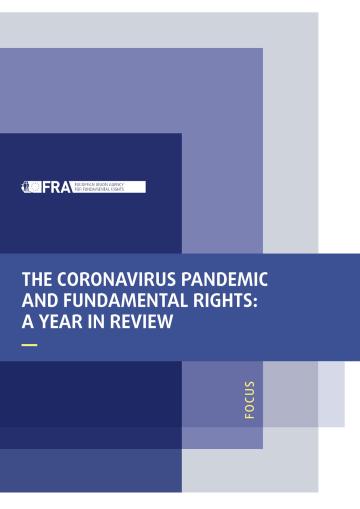
    FRA’s Fundamental Rights Report 2021 reviews major developments in the field in 2020, identifying both achievements and areas of concern. It also presents FRA’s opinions on these developments, including a synopsis of the evidence supporting these opinions. This year’s focus chapter explores the impact of the COVID-19 pandemic on fundamental rights. The remaining chapters cover: the EU Charter of Fundamental Rights; equality and non-discrimination; racism, xenophobia and related intolerance; Roma equality and inclusion; asylum, borders and migration; information society, privacy and data protection; rights of the child; access to justice; and the implementation of the Convention on the Rights of Persons with Disabilities.
  • Fundamental Rights Report
    10
    June
    2021
    This focus looks at COVID-19’s impact on fundamental rights. It underscores that a human rights-based approach to tackling the pandemic requires balanced measures that are based on law, necessary, temporary and proportional. It also requires addressing the pandemic’s socio-economic impact, protecting the vulnerable and fighting racism.
  • Report / Paper / Summary
    19
    February
    2021
    This is the second main report from FRA’s Fundamental Rights Survey, which collected data from 35,000 people on a range of issues. This report focuses on respondents’ experiences as victims of selected types of crime, including violence, harassment, and property crime. The report also examines how often these crimes are reported to the police, and presents further details relating to harassment and violence, such as the perpetrators and where the incidents took place.
  • Periodic updates / Series
    30
    June
    2020
    The Coronavirus pandemic continues to interrupt everyday life in the EU in unprecedented ways. But the way it affects our societies is shifting. As governments gradually lift some of the measures put in place to contain the spread of COVID-19, new fundamental rights concerns arise: how to ensure that the rights to life and health are upheld as daily life transitions to a ‘new normal’. This Bulletin looks at declarations of states of emergency, or equivalent, and how they came under scrutiny. It considers
    the impact on fundamental rights in important areas of daily life, and includes a thematic focus on the pandemic's impact on older people.