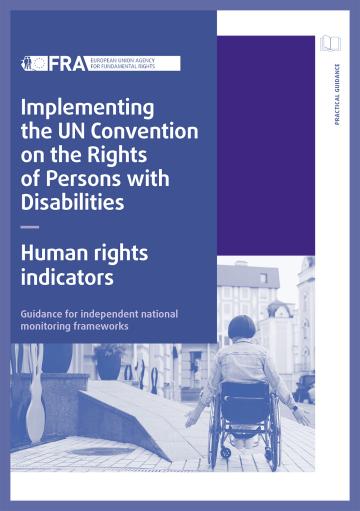
This guide helps independent national monitoring frameworks to fulfil their monitoring responsibility set out in Article 33 of the Convention on the Rights of Persons with Disabilities (CRPD). It focuses on the use of indicators. It does not deal with aspects such as compliance with the Paris Principles or the efficiency of complaints mechanisms. Its objective is to support national monitoring frameworks in designing or improving indicators for assessing progress of CRPD implementation at national level.
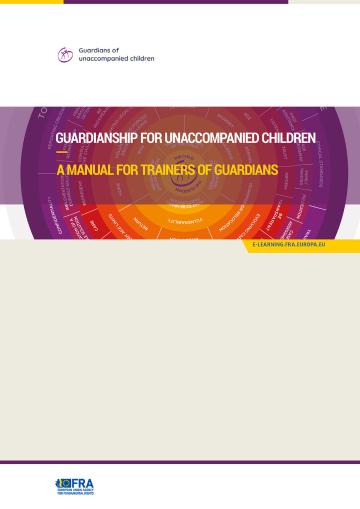
This manual is designed to help institutions, organisations and individuals to train guardians of unaccompanied children or to deliver ‘train-the-trainers’ courses. It can be used in a range of training contexts, such as professional and academic training, on-the-job training and continuing training. The manual is based on human and fundamental rights principles and ethical standards and recognises that the child and the guardian have their own personal stories, resources and capacities. It enhances guardians’ confidence to promote the child’s rights and best interests. It also enhances their confidence to act independently and impartially in relation to different state
officials, service providers and other community members.
FRA’s 2021 survey on Roma was conducted in Croatia, Czechia, Greece, Hungary, Italy, Portugal, Romania, and Spain, as well as in North Macedonia and Serbia. It includes interviews with more than 8,400 Roma, collecting information on more than 20,000 individuals living in their households. This technical report provides a detailed overview of the survey methodology used by FRA when collecting the survey data.
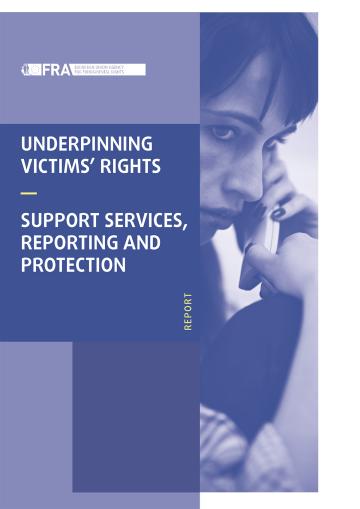
Directive 2012/29/EU represents a milestone in the development of victims’ rights. It establishes minimum standards for the rights, support and protection of victims of crime. It defines the scope of support services, guarantees the right to effective protection against secondary victimisation and comprehensively regulates the measures required for this purpose. This report covers three core components underpinning victims’ rights: support services, crime reporting, and protection from secondary and repeat victimisation. Examples highlight the relevant legal provisions in Member States and how specific rights under the Victims’ Rights Directive work in practice.
National Human Rights Institutions (NHRIs) continue to play a key role in upholding fundamental rights. FRA keeps track of the accreditation status and the mandates of the NHRIs. In 2022, the NHRI in Cyprus was upgraded to an ‘A-status’ institution. In addition, the mandates of six NHRIs changed to include child protection or the protection of LGBTI people.
Artificial intelligence is everywhere and affects everyone – from deciding what content people see on their social media feeds to determining who will receive state benefits. AI technologies are typically based on algorithms that make predictions to support or even fully automate decision-making.
The European Union Agency for Fundamental Rights (FRA) and the European Union Agency for Asylum (EUAA) joined forces to create this tool focusing on temporary protection for unaccompanied children fleeing Ukraine.
Europe stands at a delicate moment in its history. It is a moment of existential significance for the wellbeing and sustainability of our societies. It is emerging from the pandemic caused by the coronavirus disease, only to face a set of major overlapping challenges. These pose profound questions about the political, economic and societal future of the continent. To discuss elements of a human rights vision for the future and to identify opportunities for action, FRA brought together a group of sixty human rights leaders and experts with diverse backgrounds
from across the continent. This report distils the meeting discussions, including analysis and ideas, and concludes with proposals for action. It does not represent the views either of individual participants or of FRA.
Automation and AI have radically transformed how we work, live and play. In this video, Director of the EU Agency for Fundamental Rights, Michael O'Flaherty, discusses the implications of AI for our most basic of human rights.
Antisemitic incidents and hate crimes violate fundamental rights, especially the right to human dignity, the right to equality of treatment and the freedom of thought, conscience and religion. This report provides an overview of available data on antisemitism as recorded by official and unofficial sources in the EU Member States and in Albania, North Macedonia and Serbia. The data provided by the countries are supplemented with information from international organisations.
This report presents findings from FRA’s 2021 survey on Roma in Croatia, Czechia, Greece, Hungary, Italy, Portugal, Romania and Spain, as well as in North Macedonia and Serbia. The survey includes interviews with more than 8,400 Roma, collecting information on more than 20,000 individuals living in their households. By focusing on Roma, the survey provides unique data and information that are not available from European general population surveys, which do not disaggregate on grounds of ethnic origin. The findings present a bleak but familiar picture of exclusion, deprivation, discrimination and racism.
Since September 2021, two National Human Rights Institutions (NHRIs) had a change in their accreditation status, one applied for accreditation and five have had a change in tasks covered by their mandates. This new 2022 update provides an overview of developments in the accreditation status and mandates of NHRIs from September 2021 to May 2022. It is a follow up of FRA’s 2020 report on ‘Strong and effective national human rights institutions – challenges, promising practices and opportunities’ and the September 2021 update. It covers the 27 EU Member States and three candidate countries (Albania, North Macedonia and Serbia).
Every child has a right to be protected even when they are accused or suspected of committing a crime. The basic principles of justice apply to adults and children alike. But children face specific obstacles during criminal proceedings, such as a lack of understandable information about their rights, limited legal support and poor treatment. The report looks at the practical implementation of Directive (EU) 2016/800 on procedural safeguards for children who are suspects or accused persons in criminal proceedings in nine Member States – Austria, Belgium, Bulgaria, Germany, Estonia, Italy, Malta, Poland and Portugal.
FRA’s Fundamental Rights Report 2022 reviews major developments in the field in 2021, identifying both achievements and areas of concern. It also presents FRA’s opinions on these developments, including a synopsis of the evidence supporting these opinions.
This focus looks at the impact of the pandemic on social rights. It examines the measures in national recovery and resilience plans that address the social vulnerabilities among a variety of population groups in the EU, including women, children and young people in situations of vulnerability, people with disabilities, older people, Roma and people in precarious working conditions.
Le présent focus s’intéresse à l’impact de la pandémie sur les droits sociaux. Il examine les mesures des plans nationaux de relance et de résilience qui visent les vulnérabilités sociales de divers groupes de population dans l’UE, notamment les femmes, les enfants et les jeunes en situation de vulnérabilité, les personnes handicapées, les personnes âgées, les Roms et les personnes dont les conditions de travail sont précaires.
The year 2021 brought both progress and setbacks in terms of fundamental rights protection. FRA’s Fundamental Rights Report 2022 reviews major developments in the field, identifying both achievements and remaining areas of concern. This publication presents FRA’s opinions on the main developments in the thematic areas covered, and a synopsis of the evidence supporting these opinions.
L’année 2021 a été marquée à la fois par des avancées et par des reculs en termes de protection des droits fondamentaux. Le Rapport sur les droits fondamentaux 2022 de l’Agence des droits fondamentaux de l’Union européenne (FRA) examine les principales évolutions dans ce domaine, en recensant les progrès accomplis et les sujets de préoccupation persistants. La présente publication expose les avis de la FRA sur les principales évolutions dans les domaines thématiques couverts ainsi qu’un résumé des éléments factuels qui étayent ces avis.
Children are full-fledged holders of rights. They are beneficiaries of all human and fundamental rights and subjects of special regulations, given their specific characteristics. This handbook aims to illustrate how European law and case law accommodate the specific interests and needs of children. It also considers the importance of parents and guardians or other legal representatives and makes reference, where appropriate, to situations in which rights and responsibilities are most prominently vested in children’s carers. It is a point of reference on both European Union (EU) and Council of Europe (CoE) law related to these subjects, explaining how each issue is regulated under EU law, including the Charter of Fundamental Rights of the European Union, as well as under the European Convention on Human Rights, the European Social Charter and other CoE instruments.