Across the world, human rights defenders protect and uphold human rights in some of the most challenging situations. In some countries they face worrying levels of threats and attacks, intimidation and harassment. This report outlines how human rights defenders can enter and stay in the EU when they need protection. It suggests how EU institutions and Member States could use the flexibility in existing legal provisions and provide shelter for defenders who seek protection.
Following yet another recent tragic shipwreck and loss of life in the Mediterranean, this short report sets out examples of actions the EU could take to meet its obligations to protect the right to life and prevent more deaths at sea. As part of the work that the EU Agency for Fundamental Rights (FRA) does on upholding fundamental rights in asylum and return procedures, this report calls for better protection for shipwreck survivors, and prompt and independent investigations. It sets out measures that EU Member States should take to improve search and rescue efforts and provide legal pathways to safety to prevent deaths at sea.
Russia’s unprovoked war of aggression against Ukraine has resulted in massive internal and external population displacement. The European Union (EU) rapidly activated its Temporary Protection Directive for the first time since it was adopted in 2001. This entitled nearly 4 million people to legal residence and access to work, housing and legal assistance, education and healthcare.
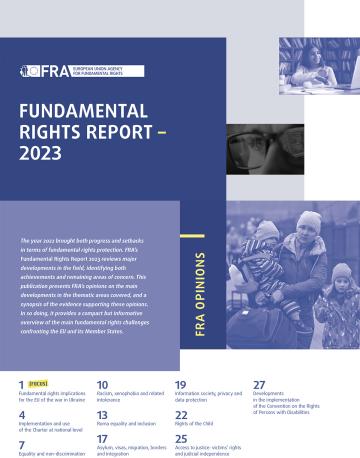
FRA’s Fundamental Rights Report 2023 reviews major developments in the field in 2022, identifying both achievements and areas of concern. It also presents FRA’s opinions on these developments, including a synopsis of the evidence supporting these opinions.
През 2022 г. отбелязахме както напредък, така и неуспехи по отношение на защитата на основните права. В Доклада на FRA относно основните права (2023 г.) е извършен преглед на важните развития в областта, като са посочени както постиженията, така и областите, които все още пораждат загриженост. В настоящата публикация са представени становищата на FRA относно основните промени в обхванатите тематични области и обзор на доказателствата в подкрепа на тези становища.
I 2022 skete der både fremskridt og tilbagegang i beskyttelsen af de grundlæggende rettigheder. FRA’s rapport om grundlæggende rettigheder 2023 gennemgår de vigtigste udviklinger på området, og fastslår både, hvad der er opnået, og hvilke områder der fortsat volder bekymring. Publikationen indeholder FRA’s udtalelser om udviklingen på de omfattede emneområder og et sammendrag af den underliggende evidens for disse udtalelser.
Το 2022 σημειώθηκε πρόοδος αλλά και οπισθοδρόμηση στην προστασία των θεμελιωδών δικαιωμάτων. Στην Έκθεση για τα Θεμελιώδη Δικαιώματα 2023 του FRA εξετάζονται οι σημαντικότερες εξελίξεις στον τομέα και προσδιορίζονται τόσο τα επιτεύγματα όσο και τα ζητήματα που εξακολουθούν να προκαλούν ανησυχία. Στην παρούσα δημοσίευση παρουσιάζονται οι γνώμες του FRA σχετικά με τις κυριότερες εξελίξεις στους εξεταζόμενους θεματικούς τομείς και συνοψίζεται η τεκμηρίωση στην οποία στηρίχθηκαν οι εν λόγω γνώμες.
The year 2022 brought both progress and setbacks in terms of fundamental rights protection. FRA’s Fundamental Rights Report 2023 reviews major developments in the field, identifying both achievements and remaining areas of concern. This publication presents FRA’s opinions on the main developments in the thematic areas covered, and a synopsis of the evidence supporting these opinions.
Vuonna 2022 perusoikeuksien suojelussa tapahtui sekä edistystä että takaiskuja. Euroopan unionin perusoikeusviraston (FRA) vuoden 2023 perusoikeusraportissa tarkastellaan perusoikeuksien tilanteen kehitystä pääpiirteissään ja tuodaan esiin sekä saavutuksia että jäljellä olevia huolenaiheita. Julkaisussa on FRA:n lausuntoja pääasiallisesta kehityksestä käsitellyillä aihealueilla sekä yleiskatsaus lausuntojen perustana olevaan näyttöön.
Tógadh céimeanna chun tosaigh agus céimeanna ar gcúl araon i ndáil le cosaint ceart bunúsach sa bhliain 2022. In Tuarascáil um Chearta Bunúsacha 2023 de chuid FRA, féachtar siar ar na mórfhorbairtí sa réimse agus sainaithnítear na héachtaí a bhí ann agus réimsí ar ábhair imní iad go fóill araon. San fhoilseachán seo, cuirtear i láthair tuairimí FRA faoi na príomhfhorbairtí sna réimsí téamacha a chumhdaítear agus déantar achoimre ar an bhfianaise a thacaíonn leis na tuairimí sin.
A 2022-es év egyaránt hozott előrelépést és visszaesést az alapvető jogok védelme terén. Az FRA 2023. évi alapjogi jelentése áttekinti a terület legfontosabb fejleményeit, valamint meghatározza az elért eredményeket és a fennmaradó aggályos területeket. Ez a kiadvány bemutatja az FRA véleményét az érintett témakörök főbb fejleményeiről, valamint a véleményeket alátámasztó bizonyítékok összefoglalóját.
Het jaar 2022 kende zowel vooruitgang als tegenslagen bij de bescherming van de grondrechten. In het Verslag over de grondrechten 2023 van FRA worden de belangrijkste ontwikkelingen op het gebied van de grondrechten geëvalueerd en wordt niet alleen ingegaan op de behaalde successen, maar ook gewezen op blijvende punten van zorg. Deze publicatie geeft een overzicht van FRA- adviezen over de belangrijkste ontwikkelingen binnen thematische gebieden en geeft in het kort de feitelijke gegevens weer waarop deze adviezen berusten.
Z hľadiska ochrany základných práv priniesol rok 2022 pokrok i určité nezdary. V publikácii agentúry FRA Správa o základných právach 2023 je uvedený prehľad hlavného vývoja v tejto oblasti, poukazuje sa na úspechy, ale aj na oblasti, ktoré ešte stále vyvolávajú obavy. V tejto publikácii sa nachádzajú stanoviská agentúry FRA k základným výsledkom vývoja v jednotlivých tematických oblastiach, ako aj súhrn dôkazov k týmto stanoviskám.
Over the span of nearly eight years, there have been developments in showing respect for the human rights of those who arrive at the EU’s borders. Russia’s war of aggression against Ukraine has shown how a large and sudden influx of people can be managed effectively and respectfully. Notwithstanding the improvements, the growing number of people crossing or attempting to enter the EU pose a wide range of fundamental rights challenges.
In this bulletin, FRA takes stock of concerns and improvements regarding the fundamental rights of migrants, asylum seekers and refugees. It highlights the EU Member States’ legal and practical responses. It identifies key trends, promising practices, long-standing and emerging patterns, and persistent concerns.
This report provides a partial update on the findings of the 2017 European Union Agency for Fundamental Rights (FRA) report Surveillance by intelligence services: Fundamental rights safeguards and remedies in the EU. It was prepared at the request of the European Parliament, which asked FRA to update its 2017 findings to support the work of its committee of inquiry to investigate the use of Pegasus and equivalent surveillance spyware (PEGA).
Το παρόν εγχειρίδιο έχει σχεδιαστεί με στόχο να συνδράμει φορείς, οργανισμούς και φυσικά πρόσωπα στην εκπαίδευση επιτρόπων ασυνόδευτων παιδιών ή στην εκπαίδευση εκπαιδευτών. Μπορεί να χρησιμοποιηθεί σε διάφορα πλαίσια κατάρτισης, όπως είναι η επαγγελματική και ακαδημαϊκή κατάρτιση, η πρακτική άσκηση και η συνεχής κατάρτιση. Το εγχειρίδιο βασίζεται στις αρχές των ανθρωπίνων και των θεμελιωδών δικαιωμάτων και στα πρότυπα δεοντολογίας, ενώ επίσης αναγνωρίζει ότι το παιδί και ο/η επίτροπος έχουν τις δικές τους προσωπικές ιστορίες, ικανότητες και δεξιότητες. Ενισχύει την αυτοπεποίθηση των επιτρόπων όσον αφορά την προώθηση των δικαιωμάτων και του συμφέροντος του παιδιού. Επιπλέον, τους/τις ενδυναμώνει προκειμένου να ενεργούν ανεξάρτητα και αμερόληπτα απέναντι σε διάφορους κρατικούς υπαλλήλους, παρόχους υπηρεσιών και μέλη της κοινότητας.
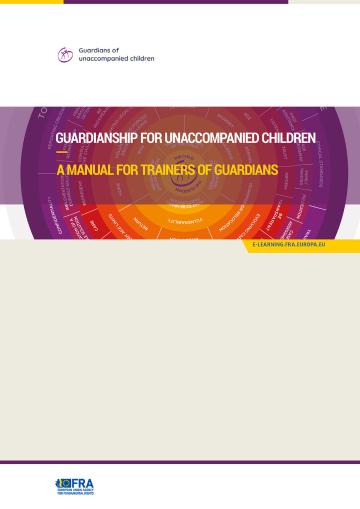
This manual is designed to help institutions, organisations and individuals to train guardians of unaccompanied children or to deliver ‘train-the-trainers’ courses. It can be used in a range of training contexts, such as professional and academic training, on-the-job training and continuing training. The manual is based on human and fundamental rights principles and ethical standards and recognises that the child and the guardian have their own personal stories, resources and capacities. It enhances guardians’ confidence to promote the child’s rights and best interests. It also enhances their confidence to act independently and impartially in relation to different state
officials, service providers and other community members.
Военната агресия на Русия срещу Украйна доведе до сцени, на които Европа не беше ставала свидетел от десетилетия. Оттогава причинява смърт, огромни разрушения и неописуеми страдания. Тя предизвика и масово движение на хора, невиждано от Втората световна война насам. За да ги защити, ЕС за първи път задейства Директивата за временна закрила. По този начин всички държави — членки на ЕС, трябва да предложат закрила на разселените лица от Украйна.
Russia’s military aggression against Ukraine triggered scenes not seen in Europe for decades. It has since caused death, immense destruction, and unspeakable suffering. It also set in motion a mass movement of people not seen since World War II. To protect them, the EU activated the Temporary Protection Directive for the first time. In doing so, all EU Member States must offer protection to those displaced from Ukraine.
Oroszország Ukrajnával szembeni katonai agressziója Európában évtizedek óta nem látott helyzeteket váltott ki. Halált, hatalmas pusztítást és elmondhatatlan szenvedést okoz. Emellett a II. világháború óta nem látott mértékű tömeges elvándorlást indított el. A lakóhelyüket elhagyni kényszerült személyek védelme érdekében az EU első alkalommal aktiválta az átmeneti védelemről szóló irányelvet. Ezzel összhangban valamennyi uniós tagállam köteles védelmet biztosítani az Ukrajnából menekülőknek.