Настоящото ръководство е предназначено за служителите по управление на границите в държавите — членки на Европейския съюз, които работят на оперативно ниво. То има за цел да подпомогне ежедневната им работа по прилагането на гаранциите за основните права, предвидени в Кодекса на шенгенските граници (Регламент (ЕС) № 2016/399), и свързаните с него законодателни актове.
Denne vejledning er til grænseforvaltningsmedarbejdere i EU’s medlemsstater, der arbejder på det operationelle plan. Den er beregnet som en hjælp i det daglige arbejde i forbindelse med at gennemføre beskyttelsen af grundlæggende rettigheder i Schengengrænsekodeksen (forordning (EU) 2016/399) og tilhørende EU-lovgivning.
Η παρούσα καθοδήγηση απευθύνεται στο προσωπικό διαχείρισης των συνόρων των κρατών μελών της Ευρωπαϊκής Ένωσης (ΕΕ) που εργάζεται στο επιχειρησιακό επίπεδο. Αποσκοπεί στο να τους βοηθήσει να εφαρμόζουν, στο πλαίσιο της καθημερινής άσκησης των καθηκόντων τους, τις εγγυήσεις των θεμελιωδών δικαιωμάτων του κώδικα συνόρων του Σένγκεν [κανονισμός (ΕΕ) αριθ. 2016/399] και του συναφούς δικαίου της ΕΕ.
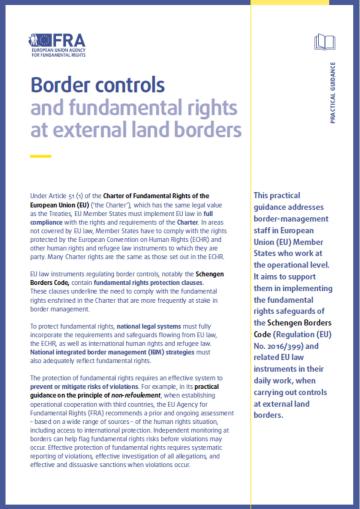
This practical guidance addresses border-management staff in European Union (EU) Member States who work at the operational level. It aims to support them in implementing the fundamental rights safeguards of the Schengen Borders Code (Regulation (EU) No. 2016/399) and related EU law instruments in their daily work, when carrying out controls at external land borders.
Nämä ohjeet on tarkoitettu EU:n jäsenvaltioiden operatiivisella tasolla työskentelevälle rajavalvontahenkilöstölle. Niiden tarkoituksena on auttaa sitä toteuttamaan päivittäisessä työssään Schengenin rajasäännöstön (asetus (EU) 2016/399) ja siihen liittyvän EU:n lainsäädännön perusoikeuksia koskevia takeita.
Ez az útmutató az EU tagállamaiban műveleti szinten határigazgatást végző személyzetnek készült. Célja, hogy segítséget nyújtson napi munkájuk során abban, hogy az alapjogoknak a Schengeni határ-ellenőrzési kódexben (2016/399/EU rendelet) és a kapcsolódó uniós jogban előírt védelmét biztosítani tudják.
Deze richtsnoeren zijn bestemd voor grensbeheerpersoneel in de lidstaten van de Europese Unie (EU) dat op operationeel niveau werkt. Ze zijn bedoeld om deze medewerkers
te helpen bij hun dagelijkse werkzaamheden om de waarborgen op het gebied van de grondrechten van de Schengengrenscode (Verordening (EU) 2016/399) en de daarmee verband houdende EU-wetgeving uit te voeren.
Toto praktické usmernenie je určené zamestnancom povereným riadením hraníc v členských štátoch Európskej únie (EÚ), ktorí pracujú na operačnej úrovni. Cieľom je podporiť ich pri implementácii záruk na ochranu základných práv zakotvených v Kódexe schengenských hraníc [nariadenie (EÚ) č. 2016/399] a súvisiacich právnych predpisov EÚ pri ich každodennej práci.
This paper presents people’s concerns and experiences relating to security. It covers worry about crime, including terrorism and online fraud; experience of online fraud; experience of cyberharassment; and concern about illegal access to data.
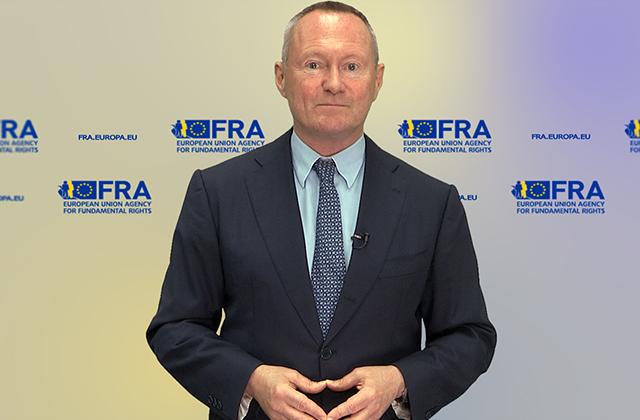
What are the next steps in the digitalisation of justice and of access to justice? This impulse video statement by FRA Director Michael O’Flaherty was recorded for the online conference “Access to Justice in the Digital Age”. The conference takes place on 16 July and is organised by the German Federal Ministry for Justice and Consumer Protection during the German Council Presidency.
The Coronavirus pandemic continues to interrupt everyday life in the EU in unprecedented ways. But the way it affects our societies is shifting. As governments gradually lift some of the measures put in place to contain the spread of COVID-19, new fundamental rights concerns arise: how to ensure that the rights to life and health are upheld as daily life transitions to a ‘new normal’. This Bulletin looks at declarations of states of emergency, or equivalent, and how they came under scrutiny. It considers
the impact on fundamental rights in important areas of daily life, and includes a thematic focus on the pandemic's impact on older people.
FRA’s Fundamental Rights Survey collected data from 35,000 people about their experiences, perceptions and opinions on a range of issues that are variously encompassed by human rights. This report presents a small selection of the survey results. It focuses on findings with respect to respondents’ opinions about human – or fundamental rights; their views and perceptions on the functioning of democratic societies – as a pillar on which human rights can flourish; and on their thoughts on and engagement with public services that have a duty to enforce human rights law and to protect people’s rights.
This document presents data from the FRA Fundamental Rights Survey. It includes data on opinions and experiences of people in the European Union (EU) linked to data protection and technology.
This focus takes a closer look at the application of the Charter of Fundamental Rights of the European Union, which has been legally binding for 10 years. At EU level, it has gained visibility and sparked a new fundamental rights culture. At national level, awareness and use of the Charter are limited. Courts increasingly use the Charter, showing the impact of this modern instrument. But its use by governments and parliaments remains low. For instance, there is little indication of anyone regularly scrutinising national legislation that transposes EU law for compatibility with the Charter.
Το 2019 υπήρξε έτος προόδου αλλά και προβλημάτων
όσον αφορά την προστασία των θεμελιωδών
δικαιωμάτων. Στην Έκθεση για τα Θεμελιώδη
Δικαιώματα 2020 του FRA εξετάζονται οι
σημαντικότερες εξελίξεις στον τομέα και
προσδιορίζονται όχι μόνο τα επιτεύγματα, αλλά και
τα ζητήματα που εξακολουθούν να προκαλούν
ανησυχία. Στην παρούσα δημοσίευση
παρουσιάζονται οι γνώμες του FRA σχετικά με τις
κυριότερες εξελίξεις στους εξεταζόμενους θεματικούς
τομείς και συνοπτική τεκμηρίωση των γνωμών
αυτών. Με αυτόν τον τρόπο, παρέχεται μια συνοπτική
και ταυτόχρονα κατατοπιστική επισκόπηση των
βασικών προκλήσεων τις οποίες αντιμετωπίζουν η ΕΕ
και τα κράτη μέλη στον τομέα των θεμελιωδών
δικαιωμάτων.
The year 2019 brought both progress and setbacks in terms of fundamental rights protection. FRA’s Fundamental Rights Report 2020 reviews major developments in the field, identifying both achievements and remaining areas of concern. This publication presents FRA’s opinions on the main developments in the thematic areas covered, and a synopsis of the evidence supporting these opinions. In so doing, it provides a compact but informative overview of the main fundamental rights challenges confronting the EU and its Member States.
Bhí idir dul chun cinn agus dul ar gcúl le tabhairt faoi
deara i ndáil le cosaint na gceart bunúsach in 2019.
Déantar athbhreithniú i dTuarascáil um Chearta
Bunúsacha 2020 FRA ar mhórfhorbairtí san earnáil,
agus tarraingítear aird ar éachtaí agus ar réimsí ar
ábhair imní iad go fóill. San fhoilseachán seo cuirtear
i láthair tuairimí FRA maidir leis na príomhfhorbairtí
sna réimsí téamacha atá curtha san áireamh, mar aon
le hachoimre ar an bhfianaise atá ag tacú leis na
tuairimí seo. Ar an gcaoi sin, soláthraítear
forbhreathnú gairid, ach faisnéiseach, ar na
príomhdhúshláin i dtaca le cearta bunúsacha atá os
comhair an AE agus a Bhallstáit.
Het jaar 2019 kende zowel vooruitgang als
teleurstellingen bij de bescherming van grondrechten.
In het Verslag over de grondrechten 2020 van het FRA
worden de belangrijkste ontwikkelingen op het gebied
van de grondrechten geëvalueerd en wordt niet alleen
ingegaan op de behaalde successen, maar ook
gewezen op blijvende punten van zorg. Deze publicatie
laat de FRA-adviezen over de belangrijkste
ontwikkelingen op de besproken thematische
gebieden de revue passeren en geeft een
samenvatting van de feitelijke gegevens waarop deze
adviezen berusten. Het resultaat is een beknopt, maar
informatief overzicht van de belangrijkste uitdagingen
op grondrechtengebied waarvoor de EU en haar
lidstaten zich nog gesteld zien.
FRA’s Fundamental Rights Report 2020 reviews major developments in the field in 2019, identifying both achievements and areas of concern. It also presents FRA’s opinions on these developments, including a synopsis of the evidence supporting these opinions. This year’s focus chapter explores how to unlock the full potential of the EU Charter of Fundamental Rights.
The Coronavirus pandemic continues to interrupt everyday life in the EU in unprecedented ways. But the way it affects our societies is shifting. As governments gradually lift some of the measures put in place to contain the spread of COVID-19, new fundamental rights concerns arise: how to ensure that the rights to life and health are upheld as daily life transitions to a ‘new normal’. This Bulletin looks at declarations of states of emergency, or equivalent, and how they came under scrutiny. It considers the impact on fundamental rights in important areas of daily life, and includes a thematic focus on the processing of users’ data to help contain COVID-19, particularly by contact-tracing apps. It covers the period 21 March – 30 April 2020.