Id-dritt Ewropew tan-nondiskriminazzjoni, kif ikkostitwit b’mod partikolari mid-direttivi tal-UE dwar in-nondiskriminazzjoni, u l-Artikolu 14 u l-Protokoll 12 tal-Konvenzjoni Ewropea dwar id-Drittijiet tal-Bniedem, jipprojbixxi d-diskriminazzjoni f’firxa ta’ kuntesti u raġunijiet. Dan il-manwal jeżamina d-dritt Ewropew tan-nondiskriminazzjoni li jirriżulta minn dawn iż-żewġ sorsi bħala sistemi
komplementari, u jużahom b’mod interkambjabbli sal-punt li jikkoinċidu, filwaqt li jenfasizza d-differenzi fejn dawn jeżistu.
A legislação europeia antidiscriminação, constituída, em particular, pelas diretivas da UE em matéria
de não discriminação, pelo artigo 14.o da Convenção Europeia dos Direitos do Homem e pelo
Protocolo n.o 12 a esta convenção, proíbe a discriminação em diversos contextos e com base em
diversos motivos. O presente manual examina a legislação europeia neste domínio, tal como
decorre dessas duas fontes, remetendo indiferenciadamente para um ou outro destes sistemas
jurídicos complementares nas situações em que os mesmos se sobrepõem, ou assinalando as
diferenças onde estas existem.
Európske antidiskriminačné právo ustanovené antidiskriminačnými smernicami EÚ, ako aj článkom
14 Európskeho dohovoru Rady Európy o ochrane ľudských práv a základných slobôd a jeho protokolu
č. 12 zakazuje diskrimináciu v celom rade súvislostí a na základe rozmanitých dôvodov. V tejto
príručke sa skúma európske antidiskriminačné právo prameniace z týchto dvoch zdrojov ako
komplementárnych systémov, pričom sa z nich striedavo vychádza v rozsahu, v akom sa prekrývajú,
a zdôrazňujú sa prípadné rozdiely.
Evropsko protidiskriminacijsko pravo, kot ga določajo zlasti protidiskriminacijske direktive Evropske
unije, člen 14 Evropske konvencije o človekovih pravicah in 12. Protokol k tej konvenciji, prepoveduje
diskriminacijo na različnih področjih in zaradi različnih razlogov. Ta priročnik pojasnjuje evropsko
protidiskriminacijsko pravo, kot izhaja iz navedenih dveh komplementarnih sistemov. Izmenjuje
navaja področja, kjer se ureditvi vsebinsko prekrivata, in izpostavlja razlike med njima.
Den europeiska icke-diskrimineringslagstiftningen, som i huvudsak består av EU:s ickediskrimineringsdirektiv och artikel 14 i och protokoll nr 12 till Europakonventionen om de mänskliga rättigheterna, förbjuder diskriminering på en rad olika grunder och i olika sammanhang. Den här handboken innehåller en genomgång av den europeiska icke-diskrimineringslagstiftning som härrör från dessa två källor. De ses som två kompletterande system som delvis överlappar varandra. I de fall de skiljer sig åt påpekas detta.
FRA’s Second European Union Minorities and Discrimination Survey surveys around 26,000 individuals from different ethnic minority and immigrant backgrounds across all 28 EU Member States. This technical report presents a detailed overview of the research methods used by FRA when collecting the survey data.
Seventeen years after adoption of EU laws that forbid discrimination, immigrants, descendants of immigrants, and minority ethnic groups continue to face widespread discrimination across the EU and in all areas of life – most often when seeking employment. For many, discrimination is a recurring experience. This is just one of the findings of FRA’s second European Union Minorities and Discrimination Survey (EU-MIDIS II), which collected information from over 25,500 respondents with different ethnic minority and immigrant backgrounds across all 28 EU Member States.
This survey involved interviews with 25,515 people with different ethnic minority and immigrant backgrounds across 28 EU countries. It explores issues concerning discrimination as well as experiences of harassment, hate-motivated violence and discriminatory profiling.
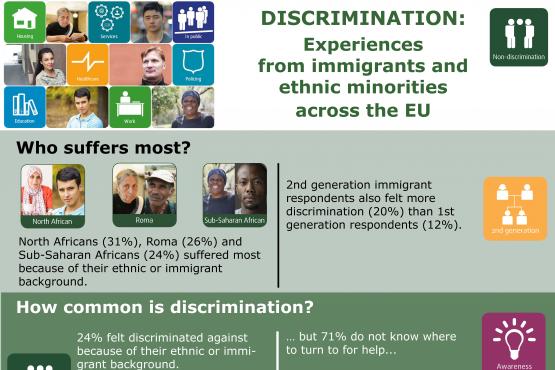
This infographic illustrates the main experiences immigrants and ethnic minorities across the EU have when it comes to discrimination. It draws from the findings from FRA's EU-MIDIS II survey.
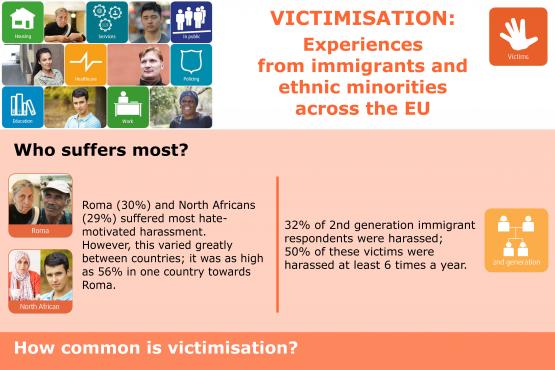
This infographic illustrates the main experiences immigrants and ethnic minorities across the EU have when it comes to victimisation. It draws from the findings from FRA's EU-MIDIS II survey.
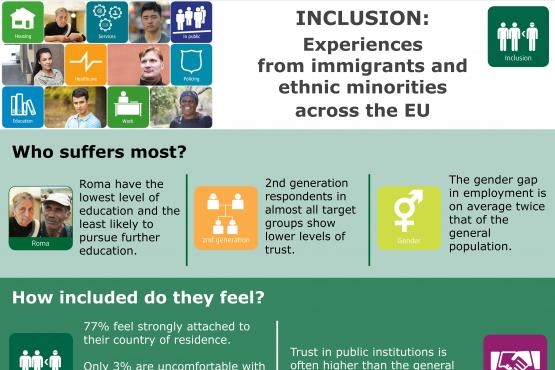
This infographic illustrates the main experiences immigrants and ethnic minorities across the EU have when it comes to inclusion. It draws from the findings from FRA's EU-MIDIS II survey.
Women and girls in the European Union (EU) experience persistent gender discrimination and gender-based violence, as evidence collected by FRA confirms. This severely limits the ability of women and girls to enjoy their rights and to participate on an equal footing in society. This FRA contribution to the third Annual Colloquium on Fundamental Rights ‘Women's rights in turbulent times’ looks at core human rights commitments. It balances these against selected evidence on gender discrimination, sexist hate speech and gender-based violence against women and girls in the EU.
Muslims living in the EU face discrimination in a broad range of settings – and particularly when looking for work, on the job, and when trying to access public or private services. The report examines how characteristics – such as an individual's first and last name, skin colour and the wearing of visible religious symbols like a headscarf, for example – may trigger discriminatory treatment and harassment.
Diverse efforts at both EU and national levels sought to bolster fundamental rights protection in 2016, while some measures threatened to undermine such protection.
80 % от респондентите роми живеят под прага на бедността за тяхната страна. Всеки трети ром живее в жилище без течаща вода. Всяко трето ромско дете живее в домакинство, в което някой си е легнал гладен поне веднъж през предходния месец. Ромските деца изостават от своите неромски връстници по всички показатели за образование. Тези — и други — констатации в настоящия доклад открояват тревожна действителност, пред която не можем да си затваряме очите: най-голямото етническо малцинство в Европейския съюз продължава да се сблъсква с дискриминация и неравен достъп до различни жизненоважни услуги.
V této zprávě se hovoří o tom, že 80 % dotazovaných Romů žije pod hranicí ohrožení chudobou platnou v dané zemi, každý třetí Rom žije v obydlí bez tekoucí vody, každé třetí romské dítě žije v domácnosti, kde nejméně jednou za poslední měsíc někdo musel jít spát hladový, a že romské děti zaostávají za svými neromskými spolužáky ve vzdělanosti; tato zpráva tak zdůrazňuje zneklidňující, nicméně nevyhnutelný fakt: nejpočetnější etnická menšina v Evropské unii nadále čelí diskriminaci a nerovnému přístupu k některým životně důležitým službám.
På baggrund af at 80 % af romaerne i undersøgelsen lever under deres lands fattigdomsrisikotærskel, at hver tredje roma bor i en bolig uden ledningsvand, at hvert tredje romabarn bor i en husstand, hvor nogen er gået sulten i seng mindst én gang i den foregående måned, og at romabørn halter bagefter ikkeromabørn inden for uddannelse, understreger denne rapport en foruroligende, men uundgåelig realitet, nemlig at Den Europæiske Unions største etniske mindretal fortsat oplever en uacceptabel forskelsbehandling og ulige adgang til livsvigtige tjenester.
Με το 80 % των Ρομά που συμμετείχαν στην έρευνα να ζουν κάτω από το όριο κινδύνου φτώχειας στη χώρα τους, έναν στους τρεις Ρομά να ζει σε νοικοκυριό χωρίς τρεχούμενο νερό, ένα στα τρία παιδιά Ρομά να ζει σε νοικοκυριό όπου κάποιος πήγε για ύπνο νηστικός τουλάχιστον μία φορά τον περασμένο μήνα και τα παιδιά Ρομά να υστερούν έναντι των μη Ρομά συνομηλίκων τους στην εκπαίδευση, η παρούσα έκθεση αναδεικνύει μια ανησυχητική πλην όμως αναπόδραστη πραγματικότητα: η μεγαλύτερη εθνοτική μειονότητα της Ευρωπαϊκής Ένωσης συνεχίζει να αντιμετωπίζει διακρίσεις και άνιση πρόσβαση σε διάφορες βασικές υπηρεσίες.